
Ground conditions rarely present themselves in perfect form for construction projects. Whether you're developing a commercial site, constructing a highway, or preparing a residential driveway, the soil beneath often requires enhancement to support the intended loads safely and economically. Ground improvement solutions have evolved significantly over recent decades, offering civil engineering professionals a comprehensive toolkit to address challenging soil conditions without resorting to complete excavation and replacement. These techniques modify existing soil properties, increase bearing capacity, reduce settlement, and mitigate risks such as liquefaction, enabling construction projects to proceed on sites that might otherwise prove unsuitable or cost-prohibitive.
Understanding Ground Improvement Fundamentals
Ground improvement solutions encompass a diverse range of engineering techniques designed to enhance the physical properties of soil. These methods target specific soil deficiencies, whether that's inadequate bearing capacity, excessive compressibility, high permeability, or susceptibility to seismic activity.
The selection of appropriate ground improvement solutions depends on several critical factors. Soil type forms the foundation of this decision, as cohesive clays respond differently to treatment than granular sands or silts. Project requirements also dictate which techniques prove most suitable, considering factors such as required bearing capacity, acceptable settlement limits, and construction timelines.
Site-Specific Considerations
Environmental constraints increasingly influence the choice of ground improvement solutions. Noise restrictions, vibration limits, and proximity to existing structures all narrow the field of viable options. Economic considerations balance initial treatment costs against long-term performance benefits and potential savings compared to alternative foundation systems.
Key factors influencing technique selection:
- Soil composition and stratigraphy
- Groundwater conditions and drainage requirements
- Load magnitude and distribution patterns
- Project timeline and construction sequencing
- Environmental and regulatory restrictions
- Budget constraints and value engineering opportunities
Understanding these parameters enables engineers to develop optimised ground improvement strategies that deliver performance whilst managing costs effectively.
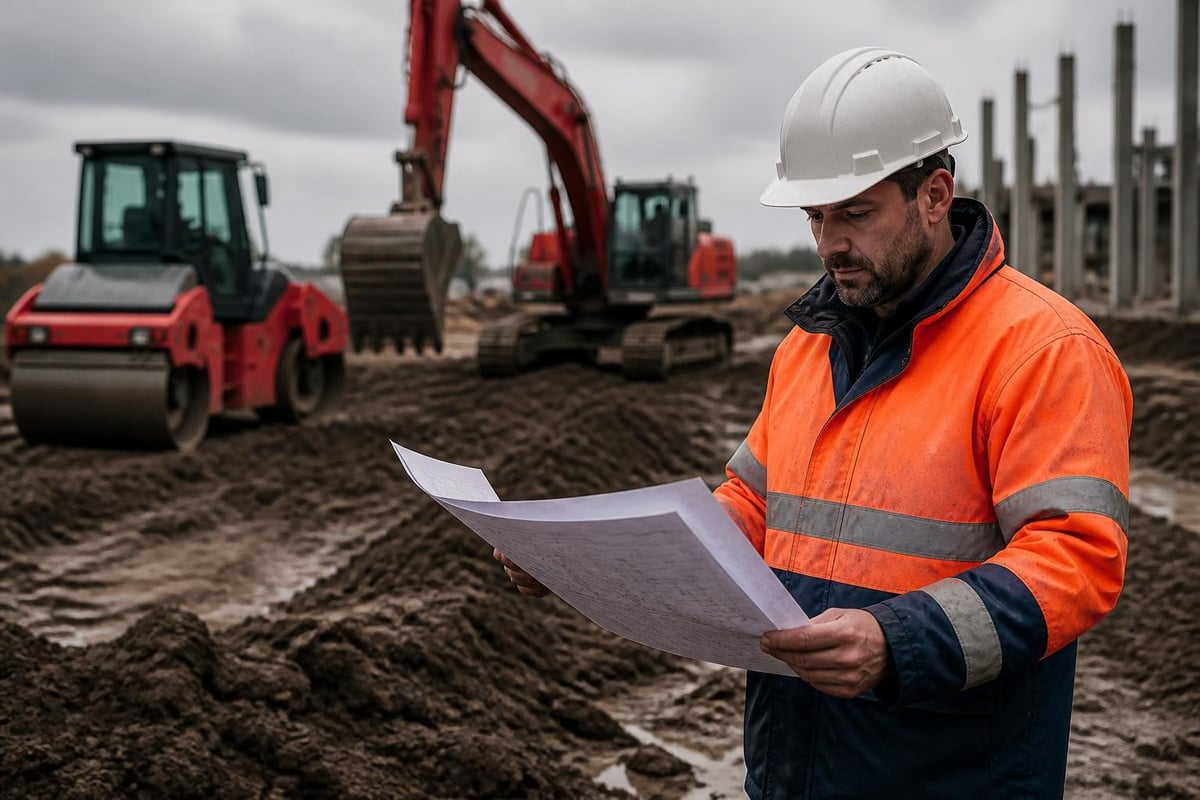
Mechanical Ground Improvement Techniques
Mechanical methods physically alter soil structure through compaction, consolidation, or reinforcement. These ground improvement solutions prove particularly effective for loose granular soils and areas requiring rapid strength gain.
Dynamic Compaction and Vibratory Methods
Dynamic compaction involves dropping heavy weights repeatedly onto the ground surface, creating shock waves that densify loose soils. This technique works exceptionally well for granular fills and some cohesive soils, penetrating depths of up to 12 metres depending on energy input and soil characteristics.
The Federal Highway Administration provides comprehensive guidance on ground improvement techniques suitable for transportation applications, including detailed specifications for dynamic compaction projects. Vibratory methods, including vibro-compaction and vibro-replacement, use specialized equipment to densify granular soils or create stone columns in weaker materials.
| Technique | Suitable Soils | Typical Depth | Primary Benefit |
|---|---|---|---|
| Dynamic Compaction | Granular fills, some clays | 3-12 metres | Rapid densification |
| Vibro-Compaction | Clean sands and gravels | 5-15 metres | Increased density |
| Vibro-Replacement | Soft clays, silts | 6-20 metres | Load transfer columns |
| Rapid Impact Compaction | Mixed fills, variable soils | 3-6 metres | Shallow improvement |
These techniques have proven invaluable for commercial services projects where ground conditions require enhancement before construction can commence.
Stone Columns and Aggregate Piers
Stone columns represent one of the most versatile ground improvement solutions for weak cohesive soils. Constructed by displacing soil and replacing it with compacted crushed stone, these vertical reinforcement elements create a composite ground system that distributes loads more effectively than untreated soil alone.
Aggregate piers function similarly but use different installation methods and aggregate gradations. Both techniques accelerate consolidation by providing drainage paths whilst simultaneously reinforcing the soil mass. Projects involving groundworks frequently benefit from these reinforcement strategies, particularly where surface loading needs distribution across weaker underlying strata.
Chemical and Grouting Solutions
Chemical ground improvement solutions alter soil properties through the introduction of binding agents, creating stronger, less permeable materials. These techniques offer precision and versatility, particularly in restricted access situations or where specific zones require targeted treatment.
Soil Mixing Technologies
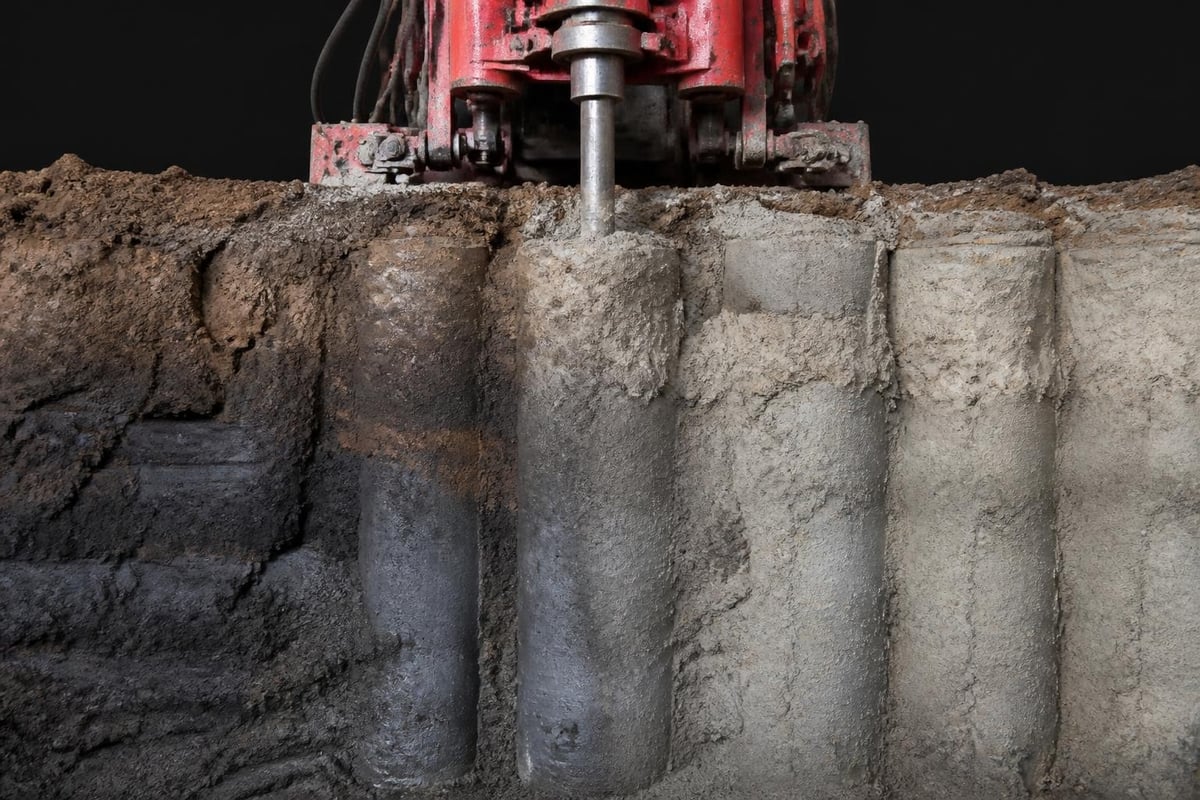
Deep soil mixing involves mechanically blending cement, lime, or other binders with in-situ soil to create stabilized columns or continuous walls. This method excels at creating barriers, supporting excavations, and improving bearing capacity simultaneously.
The technique proves particularly valuable for sites with soft clays or organic soils where mechanical methods alone prove insufficient. Menard USA outlines various approaches to soil mixing and other ground improvement solutions, demonstrating the adaptability of these technologies across diverse geological conditions.
Soil mixing applications include:
- Underpinning existing structures
- Creating excavation support systems
- Forming seismic mitigation zones
- Establishing groundwater cut-off barriers
- Supporting shallow foundations
- Stabilizing embankment slopes
The versatility of soil mixing makes it particularly relevant for urban projects where space constraints and proximity to existing structures demand precise, controlled treatment.
Grouting Techniques
Grouting introduces flowable materials into soil voids or fractures, improving strength, reducing permeability, or filling voids. Different grouting methods suit different applications, from permeation grouting for granular soils to compaction grouting for filling voids beneath structures.
Jet grouting creates columns of soil-cement by using high-pressure fluid jets to erode and mix soil with grout. This technique provides exceptional control over column geometry and proves effective in virtually any soil type. Keller North America explains how various grouting methods increase bearing capacity whilst addressing settlement concerns.
Drainage and Consolidation Methods
Many ground improvement solutions focus on accelerating natural consolidation processes or improving drainage characteristics. These techniques prove essential for cohesive soils with high water content or sites prone to settlement under sustained loading.
Vertical Drain Systems
Prefabricated vertical drains (PVDs) installed in soft clays dramatically reduce consolidation time by shortening drainage paths. Combined with preloading or surcharging, vertical drains can achieve months of consolidation in weeks, enabling construction to proceed on schedule.
The drains consist of plastic cores wrapped in geotextile filters, installed in grid patterns across the treatment area. As surcharge loads compress the soil, water escapes through the drains rather than migrating slowly through the clay matrix. This acceleration proves invaluable for highway projects and large commercial developments where construction timelines drive project economics.
Vacuum Consolidation
Vacuum consolidation applies negative pressure through drainage systems to consolidate soil without requiring heavy surcharge materials. This ground improvement solution proves particularly effective where surcharge placement proves impractical or where underlying soft layers extend to significant depths.
The technique reduces the need for imported fill materials whilst achieving similar consolidation results to conventional preloading. Projects involving foundations and piling often incorporate drainage strategies to ensure stable, settlement-resistant platforms for structural elements.
Specialist Applications and Emerging Technologies
Ground improvement solutions continue evolving, with innovations addressing specific challenges more efficiently whilst reducing environmental impacts. These advanced techniques often combine multiple principles to achieve superior results.
Controlled Modulus Columns
Controlled modulus columns (CMCs) utilize expansive concrete mixes placed in pre-drilled holes to create load-bearing elements with precisely engineered stiffness characteristics. Unlike rigid piles that transfer loads to deeper strata, CMCs work compositely with surrounding soil to distribute loads over broader areas.
Advantages of controlled modulus columns:
- Precise control over settlement characteristics
- Reduced differential settlement risk
- Lower vibration during installation
- Suitability for vibration-sensitive areas
- Flexibility in column spacing and configuration
The Deep Foundations Institute’s Ground Improvement Committee provides resources on various advanced techniques, including specifications and case studies demonstrating performance across diverse applications.
Geosynthetic Reinforcement
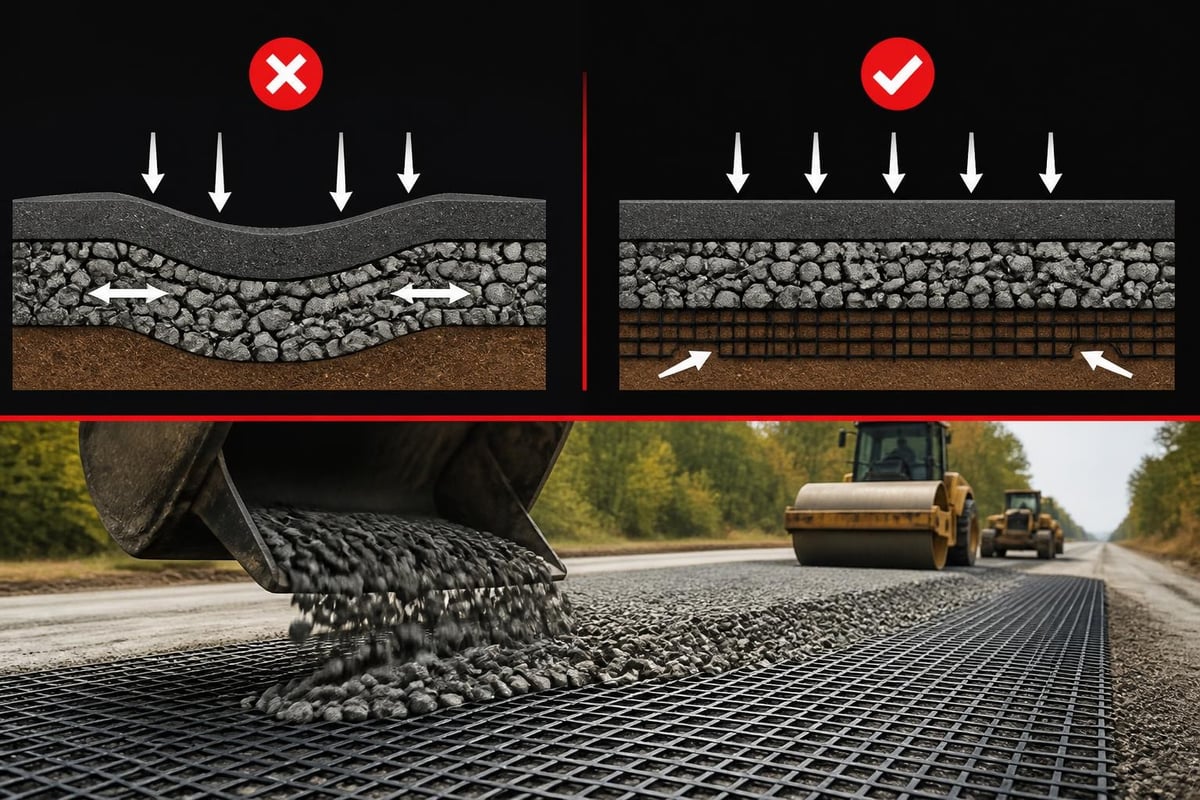
Geosynthetic materials, including geogrids and geotextiles, reinforce soil through tensile resistance and load distribution. Layering these materials within embankments or beneath foundations creates composite systems with enhanced performance characteristics compared to unreinforced soil.
For highway surfacing and driveway construction, geosynthetic reinforcement reduces required base course thickness whilst improving long-term performance. The materials prevent lateral spreading, improve bearing capacity, and extend pavement service life through better load distribution.
| Application | Primary Benefit | Typical Reduction |
|---|---|---|
| Base Reinforcement | Extended pavement life | 20-30% material savings |
| Subgrade Stabilization | Improved bearing capacity | 15-25% base thickness reduction |
| Slope Reinforcement | Enhanced stability | Steeper slopes possible |
| Separation/Filtration | Prevents intermixing | Maintains layer integrity |
These ground improvement solutions prove particularly cost-effective for projects with marginal subgrade conditions where complete removal and replacement would prove prohibitively expensive.
Selecting Appropriate Solutions for Your Project
Choosing optimal ground improvement solutions requires comprehensive site investigation and clear understanding of project objectives. The process begins with detailed geotechnical investigation to characterize soil properties, groundwater conditions, and subsurface variability.
Design criteria establish performance requirements, including bearing capacity targets, settlement tolerances, and timeline constraints. These parameters guide preliminary technique selection, often identifying multiple viable approaches worthy of detailed evaluation.
Economic Optimization
Cost-benefit analysis compares alternative ground improvement solutions, considering both direct treatment costs and indirect factors such as construction duration, equipment mobilization, and long-term performance. The lowest initial cost rarely proves most economical when lifecycle considerations enter the equation.
Value engineering identifies opportunities to optimize designs, perhaps combining techniques to address multiple objectives simultaneously. For instance, stone columns might provide both drainage acceleration and bearing capacity improvement, eliminating the need for separate treatments.
Evaluation criteria for solution selection:
- Technical feasibility and performance reliability
- Construction timeline and sequencing compatibility
- Environmental impact and sustainability considerations
- Cost-effectiveness across project lifecycle
- Risk mitigation and construction certainty
- Maintenance requirements and long-term durability
Working with experienced civil engineering contractors ensures selected ground improvement solutions align with project realities whilst delivering required performance. The expertise to evaluate options critically and recommend optimal approaches separates successful projects from those plagued by unforeseen complications.
Implementation Considerations and Quality Control
Successful ground improvement depends not only on selecting appropriate techniques but also on rigorous implementation and verification. Quality control measures ensure treated ground meets design specifications and performance criteria.
Pre-construction trials establish installation parameters and verify achievable improvement levels under actual site conditions. These trials identify potential challenges early, enabling design refinement before full-scale production begins. Testing protocols vary by technique but typically include strength testing, penetration resistance measurement, and settlement monitoring.
Performance Verification
Post-treatment testing confirms that ground improvement solutions have achieved target properties. Load tests directly assess bearing capacity improvements whilst geophysical methods provide broader coverage for assessing treatment uniformity. Ongoing monitoring during construction validates performance predictions and provides early warning of unexpected behaviour.
For projects requiring civil engineering expertise, comprehensive quality management systems ensure consistent results across treatment areas. Documentation establishes accountability and provides valuable records for future reference should conditions change or additional work prove necessary.
The sophistication of modern ground improvement solutions enables construction on sites previously considered unsuitable, transforming marginal locations into viable development opportunities. Whether supporting franchise developments like drive-through restaurants or residential projects involving driveways and patios, these techniques deliver engineered ground conditions that support intended uses safely and economically.
Environmental and Sustainability Benefits
Modern ground improvement solutions increasingly emphasize environmental responsibility alongside technical performance. Treating existing soil in place reduces the need for materials excavation and disposal, lowering project carbon footprints whilst minimizing disruption.
Techniques like soil mixing and grouting utilize materials efficiently, targeting only zones requiring treatment rather than wholesale replacement. This precision reduces waste generation and transportation requirements, contributing to more sustainable construction practices. Geopier’s ground improvement guide discusses how various methods balance performance requirements with environmental considerations.
Reducing Material Consumption
Ground improvement enables lighter foundation systems by enhancing soil properties directly beneath structures. This optimization reduces concrete and steel consumption compared to deep foundation alternatives, lowering embodied carbon whilst achieving equivalent performance.
For highway and driveway projects, improving subgrade conditions reduces required pavement thickness, conserving aggregates and bituminous materials. These savings compound across large projects, delivering substantial environmental benefits alongside economic advantages.
Sustainability advantages include:
- Reduced excavation and material disposal requirements
- Lower transportation emissions through decreased material movements
- Conservation of virgin aggregate resources
- Reduced construction timeline and associated impacts
- Enhanced long-term performance reducing maintenance needs
- Potential to reuse on-site materials after treatment
Projects prioritizing sustainability find ground improvement solutions align well with environmental objectives whilst meeting technical and economic requirements. The ability to transform existing materials into engineered ground represents resource efficiency at its most fundamental level.
Ground improvement solutions transform challenging soil conditions into stable platforms capable of supporting diverse construction projects, from commercial developments to residential driveways. These techniques balance technical performance, economic efficiency, and environmental responsibility, enabling development on sites that might otherwise remain unusable. At JRG Civils, we bring extensive experience across ground improvement, groundworks, and foundation systems to projects throughout the UK. Whether you're planning a commercial development or residential enhancement, our team delivers the expertise and attention to detail that ensures stable, durable results. Contact JRG Civils to discuss how we can support your next project with professional civil engineering solutions.