Foundation piling services form the backbone of modern construction projects, providing essential structural support for buildings, bridges, highways, and commercial developments. Whether you're planning a major infrastructure project or a commercial drive-through facility, understanding the fundamentals of piling techniques ensures your structure stands on solid ground for decades to come. From selecting appropriate pile types to managing installation processes, these services require careful planning, specialist equipment, and adherence to rigorous quality standards that protect both the structure and surrounding environment.
Understanding Foundation Piling Fundamentals
Foundation piling services involve driving or installing deep foundation elements into the ground to transfer structural loads from buildings and infrastructure to stable soil or rock layers beneath the surface. These services become essential when surface soils lack sufficient bearing capacity or when structures require support beyond traditional shallow foundations.
The primary function of piling is to distribute building loads either through friction along the pile shaft or by bearing directly onto competent strata at depth. This dual mechanism provides versatility across various ground conditions, making foundation piling services indispensable for commercial projects, residential developments, and civil engineering works.
When Piling Becomes Necessary
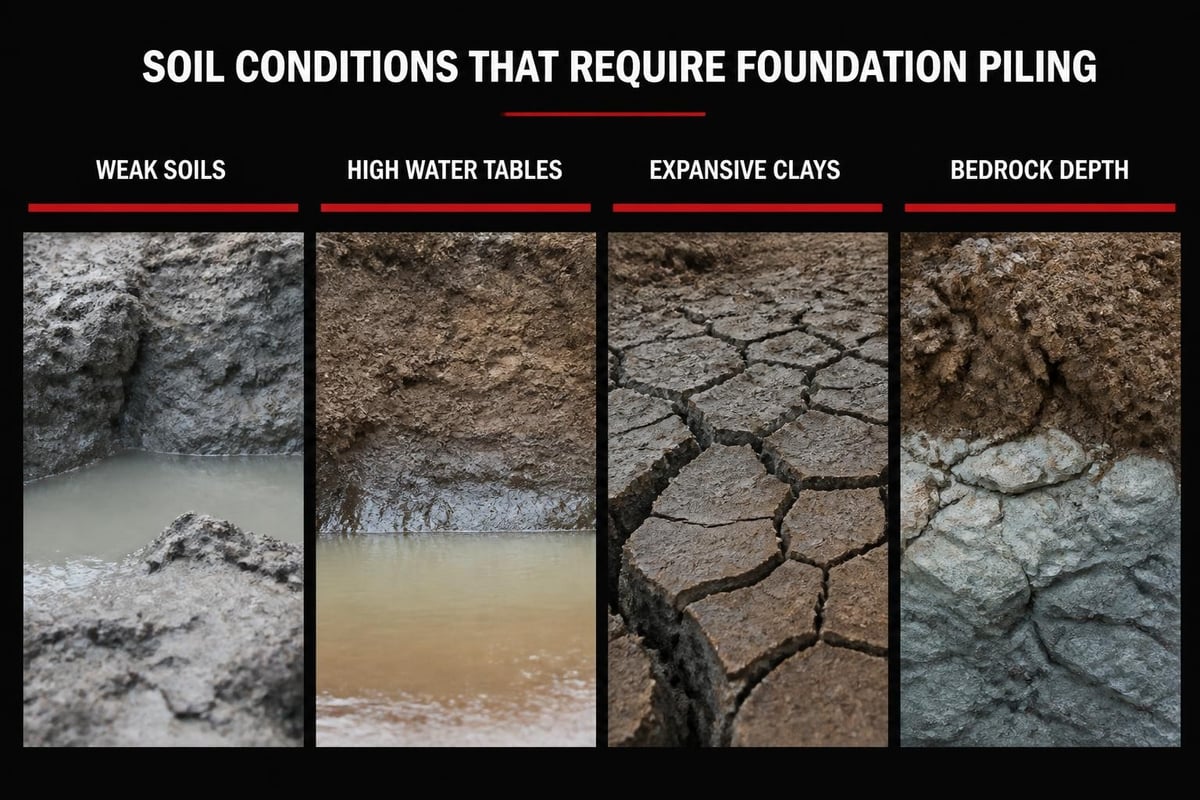
Several site conditions trigger the need for professional foundation piling services:
- Weak surface soils that cannot support conventional foundations
- High groundwater levels requiring deep load transfer
- Compressible layers prone to settlement over time
- Expansive clays that swell and shrink with moisture changes
- Structural requirements demanding minimal settlement tolerances
- Seismic zones needing enhanced foundation stability
Commercial developments such as drive-through restaurants, warehouses, and retail facilities often require piling to accommodate heavy floor loads and prevent differential settlement. The Deep Foundations Institute provides comprehensive resources for professionals navigating these complex requirements.
Types of Piling Systems and Their Applications
Foundation piling services encompass multiple installation methods, each suited to specific ground conditions and project requirements. Understanding these variations ensures optimal performance and cost-effectiveness.
| Pile Type | Installation Method | Best Applications | Key Advantages |
|---|---|---|---|
| Driven Piles | Impact hammering | Commercial buildings, bridges | High load capacity, proven reliability |
| Bored Piles | Rotary drilling | Urban areas, noise-sensitive sites | Low vibration, versatile diameters |
| Continuous Flight Auger | Auger drilling | Soft to medium soils | Speed, minimal spoil |
| Sheet Piles | Interlocking sections | Retaining walls, excavations | Water retention, temporary works |
| Micro Piles | Small diameter drilling | Restricted access, underpinning | Minimal disruption, versatile angles |
Driven piles remain popular for highway projects and commercial developments due to their exceptional load-bearing characteristics. The Michigan Department of Transportation guidelines outline detailed specifications for materials and installation procedures that ensure structural integrity.
Selecting the Right Piling Solution
Project-specific factors determine which piling methodology delivers optimal results. Ground investigation reports provide essential data about soil stratification, groundwater levels, and bearing capacity, informing the selection process.
For franchise developments like drive-through facilities, bored piles often prove advantageous due to reduced vibration and noise impact. These characteristics protect adjacent structures whilst maintaining construction schedules in commercial areas.
Steel, concrete, and timber materials each offer distinct benefits depending on load requirements, environmental conditions, and design life expectations. Modern foundation piling services typically employ either pre-cast concrete or steel sections, chosen for their durability and predictable performance characteristics.
Installation Procedures and Quality Control
Professional foundation piling services follow systematic procedures ensuring each pile achieves design specifications. The process begins with accurate pile positioning using surveying equipment, establishing precise locations according to structural drawings.
Installation proceeds with careful monitoring of key parameters:
- Verticality checks ensuring piles remain within tolerance (typically 1:75)
- Penetration depth verification against design requirements
- Installation resistance monitoring indicating soil conditions
- Pile integrity assessment through testing protocols
- Documentation of all installation data for quality records
Quality control measures protect project investments and ensure compliance with building regulations. The standardization of execution and quality control provides industry benchmarks for these critical processes.
Testing and Verification Methods
Foundation piling services incorporate various testing protocols to verify performance before structural loads are applied. These assessments provide confidence that piles will perform according to design assumptions throughout the structure's service life.
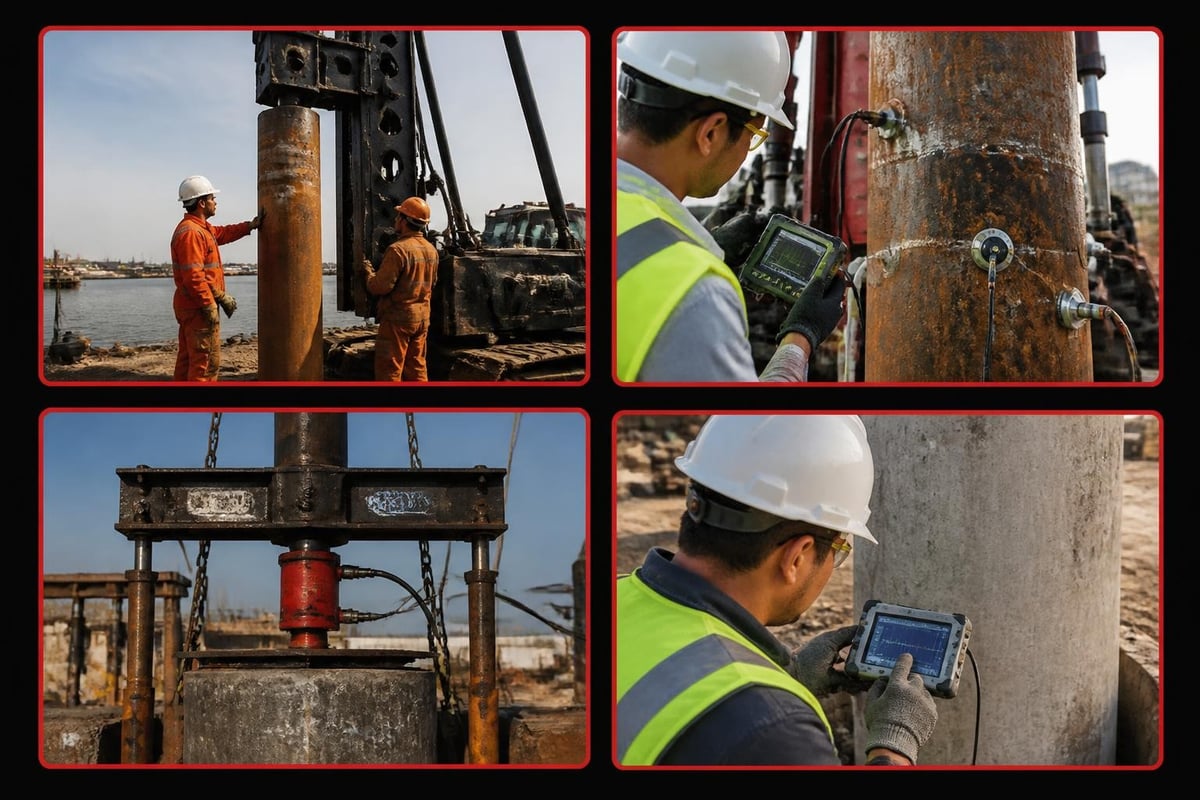
Load testing remains the definitive method for confirming pile capacity. Static load tests apply forces exceeding design loads, measuring settlement response to verify bearing capacity. Dynamic testing offers a more economical alternative, using impact measurements to estimate capacity through wave propagation analysis.
Integrity testing identifies defects such as necking, voids, or variations in cross-section that might compromise performance. Sonic echo testing and cross-hole sonic logging provide non-destructive assessment of pile condition from surface to toe.
For large-diameter open-end steel piles, the Federal Highway Administration guidelines establish protocols for determining bearing resistance and installation acceptance criteria.
Environmental and Safety Considerations
Modern foundation piling services must balance structural requirements with environmental protection and safety obligations. Ground conditions, particularly layered strata, present specific challenges requiring careful management.
The UK government guidance on piling in layered ground highlights risks to groundwater and archaeological resources. Proper assessment and mitigation strategies protect these sensitive receptors whilst allowing construction to proceed.
Managing Environmental Impacts
Several environmental factors require consideration during piling operations:
- Groundwater protection through appropriate drilling fluids and sealing methods
- Noise management using sound barriers and equipment selection
- Vibration control protecting adjacent structures and minimising disturbance
- Spoil handling ensuring proper disposal or reuse of excavated materials
- Air quality managing dust and emissions from equipment
Selecting appropriate installation methods significantly reduces environmental impact. Continuous flight auger piling produces minimal vibration compared to driven piles, making it suitable for urban environments and projects near sensitive structures.
Regulatory Framework and Standards Compliance
Foundation piling services operate within comprehensive regulatory frameworks ensuring safety, quality, and environmental protection. Multiple standards govern materials, installation procedures, and testing protocols.
Industry professionals reference various codes depending on project location and type. The PileTech-Center standards overview provides guidance on AASHTO, ACI, and ASTM requirements applicable to different piling scenarios.
| Standard | Scope | Key Requirements |
|---|---|---|
| BS EN 1536 | Bored piles | Execution, materials, quality control |
| BS EN 12699 | Displacement piles | Installation methods, testing |
| BS 8004 | Foundations | General design and construction |
| ICE Specification | Civil engineering | Workmanship, materials, testing |
Compliance ensures structural performance whilst protecting project stakeholders from liability. Documentation throughout the installation process provides evidence of adherence to specifications and regulatory requirements.
Health and Safety Protocols
Foundation piling services present inherent risks requiring robust safety management systems. The piling works industry standard provides practical guidance on health and safety in piling and foundation engineering.
Key safety considerations include:
- Equipment inspection ensuring machinery operates within safe parameters
- Personnel training verifying competence for specific tasks
- Site organisation maintaining clear working areas and access routes
- Emergency procedures establishing response protocols for incidents
- Personal protective equipment providing appropriate protection for workers
For underpinning and restricted access situations, the guidelines on safe underpinning operations offer specific protocols for these high-risk activities.
Commercial Applications and Project Integration
Foundation piling services support diverse commercial and civil engineering projects across multiple sectors. Franchise developments, including drive-through restaurants and retail facilities, frequently require piling solutions to accommodate structural loads and site constraints.
Highway infrastructure projects demand robust foundation systems capable of supporting traffic loads and resisting settlement over extended service lives. Engineering for building projects requires integration between piling specialists, structural engineers, and main contractors to achieve optimal outcomes.
Integration with Civil Engineering Works
Successful project delivery requires coordination between foundation piling services and broader civil engineering activities. This integration ensures efficient sequencing of works and minimises programme delays.
Temporary works often accompany piling operations, including access roads, working platforms, and spoil handling arrangements. For projects like the Wixam warehouses and Bourne Air Quarter, coordinating these elements with structural foundations and external works ensures smooth project progression.
Ground improvement may complement piling solutions, addressing shallow soil conditions whilst piles transfer primary loads to depth. Techniques such as vibro-compaction or stone columns enhance overall foundation performance whilst potentially reducing pile requirements.
Deep Foundation Systems for Complex Projects
Advanced foundation piling services extend beyond conventional driven or bored piles to encompass sophisticated deep foundation systems. These solutions address challenging ground conditions or exceptional structural demands.
Caissons and drilled shafts provide large-diameter options for heavy loads, particularly in bridge construction and major commercial developments. The deep foundation systems overview details characteristics and applications of various pile types.
Specialist Piling Techniques
Certain project conditions necessitate specialist approaches within foundation piling services:
Micropiles offer solutions where access restrictions prevent conventional equipment deployment. These small-diameter piles (typically 100-300mm) can be installed at various angles, making them ideal for underpinning existing structures or working in confined spaces.
Secant piling creates continuous retaining walls through overlapping bored piles, providing both structural support and water cut-off. This technique proves valuable for basement construction and deep excavations in urban environments.
Screw piles provide rapid installation with minimal excavation, offering advantages for temporary works or structures requiring future removal. Their helical bearing plates develop capacity through bearing and shaft friction.
Design Considerations and Load Calculations
Foundation piling services begin with thorough design analysis, determining pile quantities, dimensions, and installation methods to support structural loads safely. This process requires collaboration between geotechnical engineers, structural designers, and piling specialists.
Load calculations account for both vertical forces (dead and live loads) and lateral loads from wind, traffic, or seismic events. Factor of safety provisions ensure piles perform adequately despite variations in ground conditions or construction tolerances.
Geotechnical Investigation Requirements
Comprehensive ground investigation provides the foundation for effective piling design. Borehole data reveals soil stratification, strength parameters, and groundwater conditions informing pile selection and length determination.
Standard penetration tests (SPT) and cone penetration tests (CPT) quantify soil resistance, enabling calculation of bearing capacity and skin friction values. Laboratory testing of recovered samples determines consolidation characteristics, shear strength, and chemical properties affecting pile materials.
| Investigation Method | Information Provided | Typical Applications |
|---|---|---|
| Rotary boreholes | Detailed stratification, samples | Complex sites, major projects |
| Window sampling | Quick profiling, SPT values | Preliminary investigations |
| CPT | Continuous resistance profile | Soft to firm soils |
| Trial pits | Shallow conditions, services | Small sites, verification |
Inadequate investigation increases project risk through unforeseen ground conditions, necessitating design changes or additional piling works. Investment in thorough site characterisation protects project budgets and programmes.
Cost Factors and Project Planning
Foundation piling services represent significant investment within construction budgets, warranting careful planning and value engineering. Multiple factors influence overall costs, from ground conditions to access constraints and programme requirements.
Pile quantity, diameter, and length directly affect material and installation costs. However, optimising these parameters requires balancing foundation costs against overall structural economics, as fewer large-diameter piles may prove more economical than numerous smaller elements.
Programme and Logistics Planning
Effective scheduling of foundation piling services ensures efficient project delivery whilst managing dependencies with other construction activities. Lead times for specialist equipment and materials require early procurement planning.
Site logistics influence productivity significantly. Access for piling rigs, material deliveries, and spoil removal requires adequate space and load-bearing surfaces. Temporary works such as working platforms add costs but prove essential for safe, efficient operations.
Weather considerations affect productivity, particularly for driven piling operations. Winter working may require additional provisions for ground freezing or protection of fresh concrete in bored piles.
Maintenance and Long-Term Performance
Well-executed foundation piling services provide decades of reliable performance with minimal maintenance requirements. However, understanding long-term behaviour ensures structures continue meeting functional requirements throughout their design life.
Corrosion protection for steel piles in aggressive ground conditions extends service life significantly. Coatings, cathodic protection, or increased section thickness accommodate anticipated material loss over time.
Concrete piles require appropriate mix design and cover to reinforcement, protecting against sulphate attack or chloride ingress. Specifications tailored to ground chemistry ensure durability matches structural design life expectations.
Monitoring and Assessment
Periodic monitoring of pile-supported structures identifies potential issues before they compromise performance. Settlement monitoring reveals whether foundations behave according to design predictions or require remedial intervention.
For critical infrastructure, instrumentation embedded during construction provides ongoing performance data. Load cells, inclinometers, and settlement markers track foundation behaviour under service loads, validating design assumptions and informing maintenance strategies.
Foundation piling services deliver essential structural support across commercial, residential, and infrastructure projects, requiring careful selection of methods, rigorous quality control, and adherence to comprehensive standards. Whether you're developing franchise facilities, warehouse complexes, or highway infrastructure, professional execution ensures your structures stand on solid foundations. At JRG Civils, our civil engineering expertise encompasses all aspects of foundation works, from initial planning through to quality-assured completion, delivering projects across the North East and throughout the UK.