Selecting the right groundworks company represents one of the most critical decisions in any construction project. Whether planning a commercial development, residential build, or infrastructure upgrade, the groundwork phase establishes the foundation upon which everything else depends. A professional groundworks company brings specialised expertise, equipment, and experience to ensure projects start on solid ground, literally and figuratively. Understanding what these companies do, how they operate, and what distinguishes exceptional providers helps property developers, homeowners, and commercial clients make informed decisions that impact project timelines, budgets, and long-term structural integrity.
What Does a Groundworks Company Actually Do?
A groundworks company specialises in preparing construction sites and creating the essential infrastructure before buildings or surfaces can be installed. This work extends far beyond simple excavation.
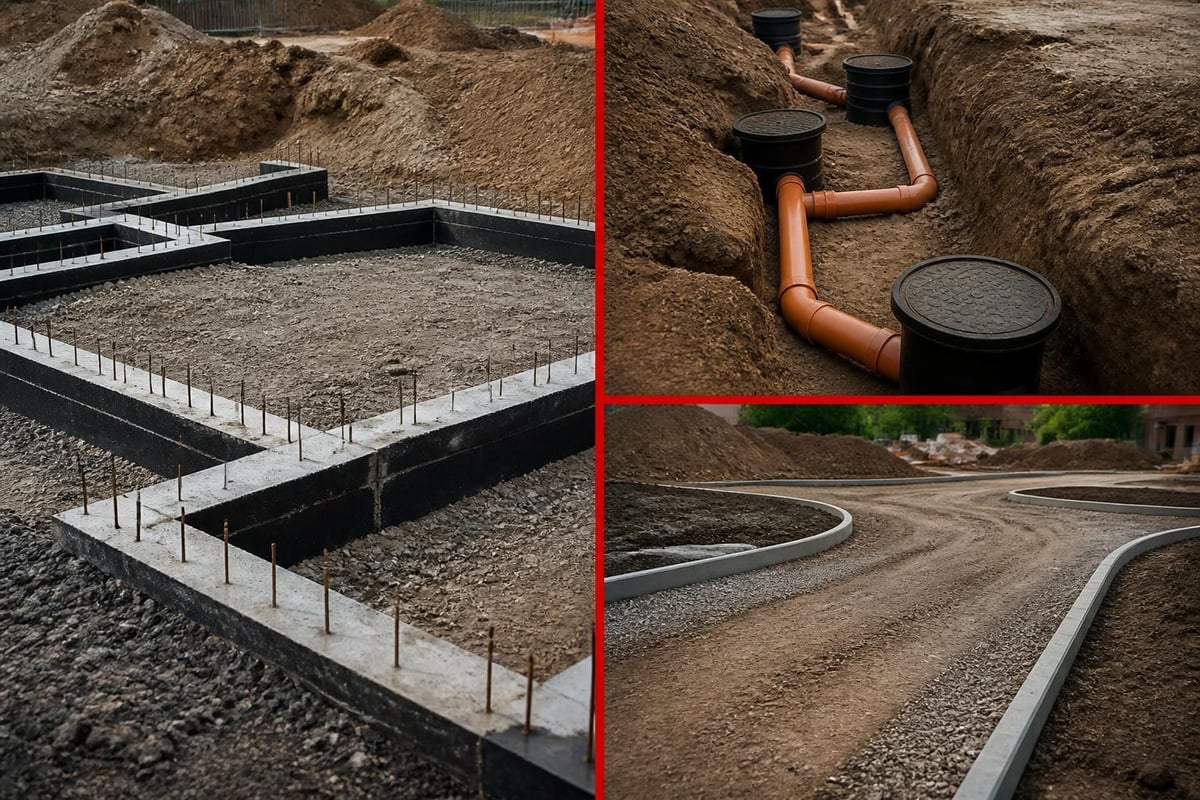
The scope encompasses multiple disciplines and technical skills. Site clearance removes vegetation, debris, and existing structures that interfere with new construction. Excavation work creates the necessary depths and contours according to engineering specifications. Foundation installation provides the structural base that supports buildings, from simple strip footings to complex piled foundations requiring specialist equipment.
Core Services Provided
Professional groundworks companies typically offer a comprehensive range of services:
- Drainage systems: Installation of surface water, foul water, and combined drainage networks
- Foundations: Construction of strip, trench fill, raft, and piled foundations
- External works: Pathways, driveways, car parks, and landscaping preparation
- Utility connections: Trenching and ducting for water, gas, electricity, and telecommunications
- Earthworks: Cut and fill operations, ground levelling, and compaction
The technical requirements vary significantly between residential and commercial projects. A groundworks company working on commercial developments must coordinate with multiple stakeholders, manage larger equipment fleets, and adhere to stricter regulatory frameworks than those handling domestic extensions or garden projects.
Modern groundworks increasingly incorporate sustainable practices. Permeable paving systems manage surface water runoff, whilst recycled aggregates reduce environmental impact. Companies investing in newer equipment achieve better fuel efficiency and lower emissions, addressing the construction industry's environmental responsibilities.
Choosing the Right Groundworks Partner
Selecting a groundworks company requires careful evaluation across multiple criteria. Project success depends on this partnership functioning effectively throughout the construction phase.
Experience and specialisation should align with your project type. A company with extensive commercial experience brings different capabilities than one focused on residential work. Review their portfolio to identify projects similar in scale and complexity to yours. The case studies from established groundworks providers demonstrate how companies tackle varying challenges and project requirements.
Essential Evaluation Criteria
When assessing potential groundworks contractors, consider these factors:
| Criteria | Why It Matters | What to Check |
|---|---|---|
| Certifications | Demonstrates professional standards | CSCS cards, ISO certifications, industry memberships |
| Insurance | Protects against project risks | Public liability (minimum £5 million), employer's liability |
| Equipment | Indicates capability and efficiency | Owned vs hired plant, equipment age and maintenance |
| Health & Safety | Legal requirement and moral obligation | Safety policies, accident records, training programmes |
| References | Validates claimed experience | Recent clients, project outcomes, problem resolution |
Health and safety records deserve particular scrutiny. The importance of adhering to trenching safety standards cannot be overstated, as violations pose serious risks to workers and can result in project delays and penalties. Companies implementing comprehensive safety management systems, such as ISO 45001 certification for construction environments, demonstrate commitment to protecting their workforce and your investment.
Financial stability matters more than many clients realise. A groundworks company facing cash flow problems may struggle to complete projects, potentially leaving sites incomplete or creating lien complications. Request evidence of financial health for larger contracts, and verify they maintain adequate bonding capacity.
Common Groundworks Projects and Applications
The versatility of groundworks companies enables them to serve diverse market sectors. Understanding typical project types helps clarify which specialist capabilities you require.
Residential Developments
New home construction demands comprehensive groundworks from initial site preparation through final landscaping. The process begins with topsoil stripping and storage for later reinstatement. Excavations create building platforms at precise levels, whilst foundation trenches follow architectural specifications exactly.
A detailed residential groundworks project example illustrates the sequential phases involved in preparing a home site, from excavation through to foundation installation and service connections.
Drainage represents a critical component. Foul water connects to mains sewerage or treatment systems, whilst surface water management prevents flooding and ground saturation. Modern sustainable drainage systems (SuDS) increasingly feature in residential developments, managing rainfall through permeable surfaces and attenuation tanks.
Commercial and Industrial Sites
Commercial projects introduce additional complexity and scale. Multi-unit developments require coordination between groundworks phases and superstructure programmes. A groundworks company on commercial sites must manage larger excavations, heavier foundation loads, and more extensive service installations.
The work JRG Civils has completed on franchise developments like Costa Coffee and Greggs drive-throughs demonstrates the specialised requirements these projects demand. Such sites need robust surfaces supporting constant vehicle traffic, carefully designed drainage handling runoff from large paved areas, and service connections positioned precisely for kitchen equipment and customer facilities.
Infrastructure and Highway Projects
Road construction and highway improvements constitute a significant sector for civil engineering firms. These projects involve bulk earthworks, structural layers of sub-base and base course materials, and precise surface finishing.
A groundworks company working on highway projects must understand:
- Pavement design: Structural calculations determining layer thicknesses and material specifications
- Traffic management: Coordinating works to minimise disruption whilst maintaining safety
- Regulatory compliance: Highways Authority specifications and adoption standards
- Material testing: Quality assurance for compaction, moisture content, and structural integrity
Professional groundworks services extend to creating new access roads, improving existing infrastructure, and constructing car parks that meet current design standards. These projects require substantial plant capacity and experienced operatives who understand the precision modern highway construction demands.
Quality Standards and Project Management
Professional groundworks companies operate within rigorous quality frameworks. These standards protect clients, ensure structural adequacy, and provide accountability throughout the construction process.
Quality Assurance Processes
Effective quality management begins with detailed planning. Method statements describe exactly how each activity will be executed, whilst risk assessments identify and mitigate potential hazards. These documents aren't mere paperwork; they guide site operations and provide reference points when issues arise.
Testing and inspection verify that works meet specifications:
- Soil testing: CBR values, particle size distribution, and moisture content analysis
- Compaction testing: Nuclear density gauges or sand replacement methods confirm adequate compaction
- Concrete testing: Slump tests and cube samples verify mix design compliance
- Drainage testing: CCTV surveys and pressure testing ensure systems function correctly
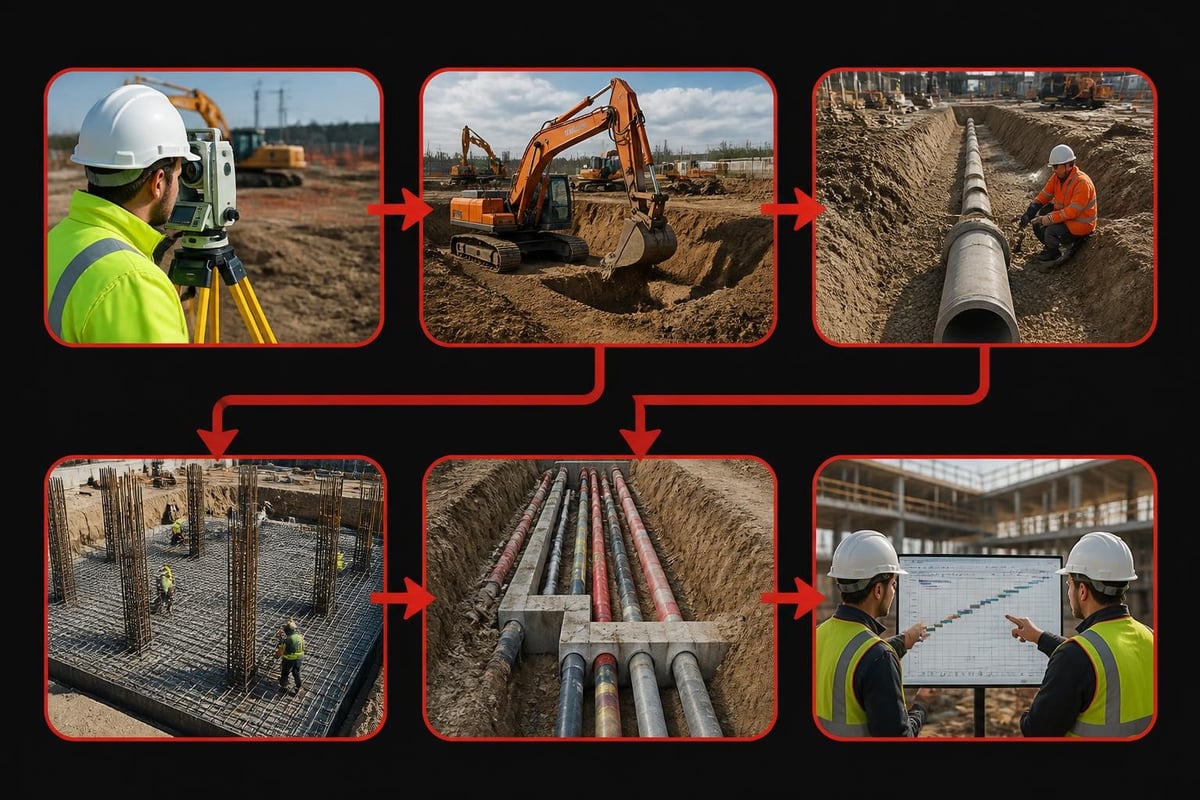
- Dimensional checks: Surveying confirms levels, positions, and alignments match drawings
Documentation creates an audit trail demonstrating compliance. Photographs, test certificates, and inspection records protect both contractor and client should disputes arise. A groundworks company maintaining comprehensive records demonstrates professionalism and provides valuable evidence for building control approval and warranty providers.
Programme Management and Coordination
Groundworks typically sit on the critical path of construction programmes. Delays at this stage cascade through subsequent trades, potentially incurring significant costs.
Experienced groundworks contractors understand programme dependencies. They coordinate with:
- Utility companies: Arranging disconnections, diversions, and new connections with appropriate lead times
- Building control: Scheduling inspections at hold points such as foundation excavations
- Subsequent trades: Ensuring service entry positions suit internal layouts
- Material suppliers: Managing deliveries to avoid storage issues or programme gaps
- Plant providers: Securing equipment availability for critical activities
Weather contingency planning acknowledges British conditions. Groundworks remains weather-dependent, with heavy rainfall preventing excavation in clay soils and frost stopping concreting operations. Professional companies build realistic contingencies into programmes rather than presenting optimistic timescales they cannot achieve.
Technology and Innovation in Groundworks
The groundworks sector increasingly adopts technology that improves accuracy, efficiency, and safety. Forward-thinking companies invest in systems that deliver better outcomes for clients.
Modern Equipment and Techniques
GPS-guided excavators enable precise earthworks without constant manual surveying. Operators work to 3D models loaded directly into machine control systems, achieving specified levels and slopes with minimal over-excavation. This technology reduces material waste, speeds operations, and improves accuracy beyond what traditional methods achieve.
Ground investigation techniques inform better design decisions. Trial pits, boreholes, and geophysical surveys identify ground conditions before major excavation begins. Understanding soil types, water tables, and underground obstructions prevents expensive surprises during construction.
| Technology | Application | Benefits |
|---|---|---|
| 3D Machine Control | Excavation and grading | Improved accuracy, reduced over-dig, faster completion |
| CCTV Drain Surveys | Drainage inspection | Identifies defects, verifies installation quality |
| Laser Scanning | Site surveys | Captures detailed topography, integrates with BIM |
| Telematics | Plant management | Monitors utilisation, schedules maintenance, reduces theft |
| Digital Documentation | Quality records | Real-time reporting, accessible archives, audit trails |
Building Information Modelling (BIM) extends to groundworks coordination. Clash detection identifies conflicts between drainage runs and foundation designs before excavators arrive on site. This digital coordination reduces abortive work and change orders that inflate project costs.
Environmental and Regulatory Considerations
Groundworks companies operate within increasingly stringent environmental frameworks. Responsible contractors view compliance not as bureaucratic burden but as professional obligation and competitive advantage.
Waste Management and Sustainability
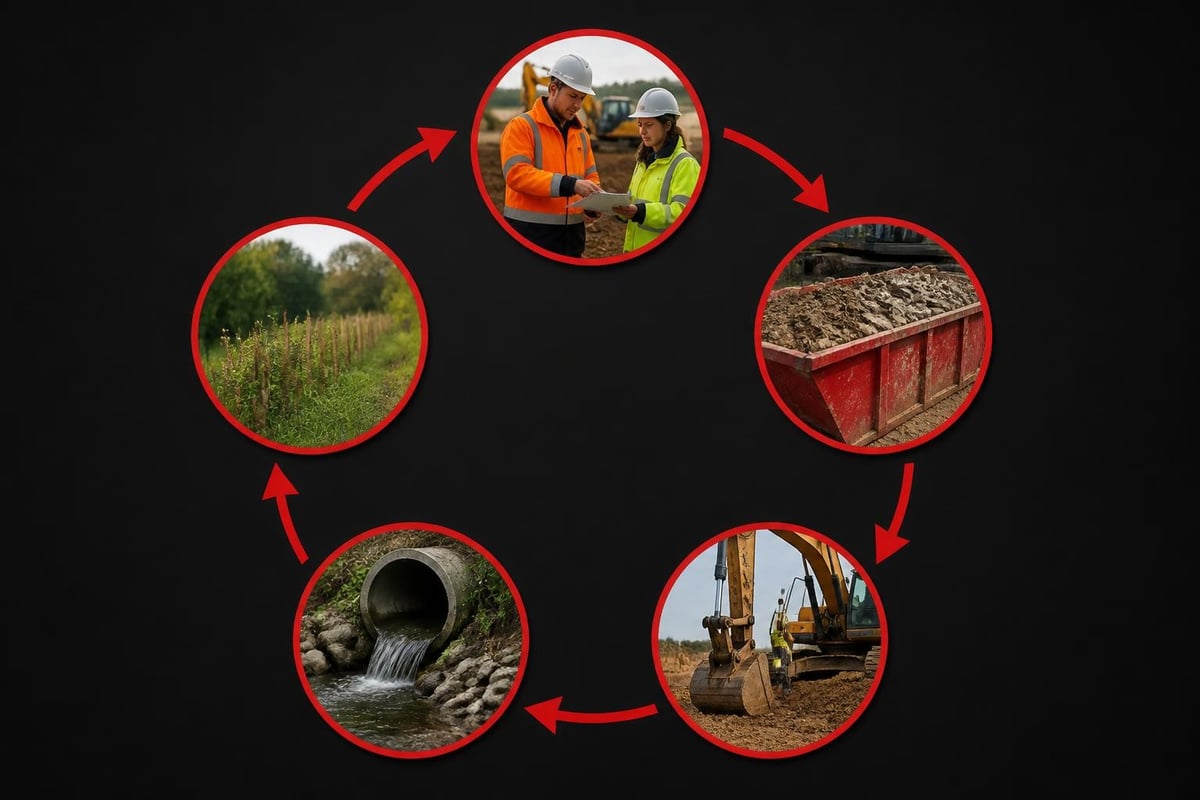
Construction and demolition waste constitutes a significant environmental challenge. Professional groundworks companies implement waste hierarchies: reduce, reuse, recycle, recover, dispose. Segregating materials on site enables higher recycling rates, reducing landfill tax and demonstrating environmental responsibility.
Contaminated land requires specialist handling. Whether dealing with asbestos-containing materials, hydrocarbon contamination, or heavy metals, proper characterisation and disposal protect human health and prevent environmental damage. Companies maintaining appropriate waste carrier licences and using licensed disposal facilities ensure legal compliance.
Material choices increasingly reflect sustainability considerations. Recycled aggregates perform adequately in many applications, reducing primary extraction impacts. Cement replacements in concrete mixes lower embodied carbon without compromising structural performance. The foundations and piling work undertaken by specialist contractors increasingly incorporates these sustainable alternatives where specifications permit.
Permits and Approvals
Multiple regulatory bodies oversee groundworks activities. Understanding which permissions apply prevents work stoppages and legal complications.
Building Regulations approval covers structural aspects of foundations and drainage. Inspections at key stages verify compliance with approved plans. Highway works require separate permits from local authorities, with specific technical approvals for connections to public sewers or highway drainage.
Environmental permits may apply for dewatering operations, particularly near watercourses or environmentally sensitive areas. Pollution prevention remains paramount, with silt control measures protecting watercourses and spill kits immediately available for fuel or oil incidents.
Cost Factors and Budget Management
Understanding groundworks pricing helps clients budget accurately and evaluate quotations fairly. Multiple variables influence costs beyond simple excavation volumes.
Pricing Structures and Variables
Groundworks companies typically price using one of several approaches:
- Lump sum: Fixed price for defined scope, transferring risk to contractor
- Schedule of rates: Agreed rates applied to measured quantities, reflecting actual works
- Cost plus: Actual costs plus agreed margin, used for uncertain scope
- Daywork: Hourly or daily rates for unquantifiable elements
Ground conditions dramatically affect pricing. Rock excavation costs substantially more than soft soil removal. High water tables necessitate dewatering systems, adding pumping costs and potential discharge permits. Existing services require careful exposure and support, slowing progress and increasing labour costs.
Site access influences efficiency and therefore price. Restricted access prevents large plant deployment, forcing reliance on smaller, less productive equipment. Urban sites with limited storage space require precise delivery coordination, potentially attracting premium charges from suppliers.
The gallery of completed projects demonstrates the variety of sites and conditions groundworks companies encounter, each presenting unique challenges that experienced contractors price appropriately.
Regional Expertise and National Capability
Whilst many groundworks companies operate regionally, project requirements sometimes demand broader geographical reach. Understanding how contractors scale operations helps clients assess capability.
Local Knowledge Benefits
Regional specialists understand local ground conditions intimately. A groundworks company familiar with North East geology knows where to expect coal mining legacy issues, how different boulder clay deposits behave, and which areas present particular drainage challenges. This knowledge informs realistic programming and pricing.
Established relationships with local suppliers, plant hirers, and subcontractors enable responsive problem-solving. When unexpected issues arise, regional connections facilitate quick solutions that keep projects moving.
Scaling for Larger Projects
Successful regional contractors can mobilise for projects beyond their immediate area when project size justifies travel. A company based in the North East but capable of working UK-wide brings local expertise to distant sites whilst maintaining quality standards and operational efficiency.
Key considerations for projects outside the home region include:
- Accommodation and subsistence: Daily travel limits necessitate overnight stays for distant projects
- Plant logistics: Transporting equipment adds costs but maintains familiar, well-maintained plant
- Local approvals: Understanding regional regulatory variations prevents compliance issues
- Supply chains: Establishing relationships with local suppliers or transporting materials from known sources
- Site supervision: Ensuring adequate management presence maintains quality despite distance
The balance between local knowledge and specialist capability varies by project. Complex works requiring particular expertise may justify engaging a contractor from further afield, whilst straightforward projects typically benefit from local contractors' efficiency and responsiveness.
Safety Culture and Worker Protection
Construction remains a high-risk industry, with groundworks presenting particular hazards. Professional companies prioritise safety not merely for compliance but as fundamental to operational excellence.
Common Groundworks Hazards
Excavations pose multiple risks. Collapse of unsupported sides can trap or kill workers within seconds. Services struck during digging cause injuries, explosions, or electrocution. Falls into excavations, particularly on sites with poor edge protection, result in serious injuries.
Plant operations require constant vigilance. Struck-by incidents involving excavators, dumpers, or delivery vehicles cause fatalities on construction sites annually. Segregating pedestrians from plant movements, implementing banksmen protocols, and maintaining equipment visibility systems all contribute to safer sites.
Confined spaces within excavations or drainage chambers present atmospheric hazards. Oxygen deficiency, toxic gases, or explosive atmospheres develop without warning in these environments. A groundworks company working in confined spaces must implement permit-to-work systems, atmospheric monitoring, and emergency rescue arrangements.
Building Positive Safety Cultures
The most effective safety management extends beyond policies and procedures to create cultures where workers actively identify and control risks. Regular toolbox talks keep safety awareness current. Near-miss reporting systems learn from incidents that could have caused harm, preventing actual injuries.
Training investment demonstrates commitment to worker development and safety. CSCS cards verify basic competence, whilst specialist training for plant operation, first aid, and confined space work equips teams for diverse challenges. Companies maintaining training matrices ensure competencies remain current through refresher courses.
Client testimonials often reflect safety performance. The feedback clients provide frequently mentions professional conduct, site tidiness, and safe working practices as distinguishing characteristics of quality contractors.
Future Trends in Groundworks
The groundworks sector continues evolving, driven by technological advancement, regulatory change, and environmental imperatives. Understanding emerging trends helps clients and contractors prepare for future developments.
Automation and Robotics
Semi-autonomous plant operation increases precision whilst reducing operator fatigue. Excavators perform repetitive tasks following programmed patterns, freeing operators to focus on complex activities requiring human judgement. This technology improves productivity without eliminating skilled employment.
Robotics for confined space inspection reduces human exposure to hazardous environments. Drones survey sites and monitor progress, whilst robotic platforms inspect drainage systems and underground structures. These tools enhance safety whilst improving data quality and inspection frequency.
Sustainable Construction Practices
Net-zero commitments drive innovation in low-carbon construction methods. Alternative binders reduce cement content in concrete, whilst electric plant eliminates diesel emissions from site operations. A groundworks company investing in electric excavators and dumpers demonstrates environmental leadership whilst benefiting from lower running costs and reduced noise pollution.
Circular economy principles influence material selection and waste management. Designing for deconstruction enables future material recovery, whilst current projects increasingly specify recycled content. The construction industry's material intensity demands these approaches to achieve meaningful environmental improvements.
Climate adaptation considerations affect drainage design particularly. More intense rainfall events require larger capacity systems and enhanced surface water management. Groundworks companies designing resilient infrastructure help clients avoid future flood damage and regulatory non-compliance.
Professional groundworks establish the essential foundation for successful construction projects, whether residential, commercial, or infrastructure developments. Selecting a groundworks company with proven expertise, comprehensive capabilities, and commitment to quality and safety ensures your project starts right and progresses smoothly. At JRG Civils, we bring civil engineering excellence to every project, from detailed planning through to final completion, serving clients across the North East and throughout the UK with the professionalism and reliability that complex groundworks demand.