
Modern civil engineering demands precision that traditional methods simply cannot achieve. The trimble earthworks excavator system represents a fundamental shift in how contractors approach excavation, grading, and earthmoving operations. Whether you're laying foundations for commercial developments, constructing highway infrastructure, or creating residential driveways, this technology transforms raw design data into millimetre-accurate reality. For civil engineering firms operating across diverse projects, from franchise developments to major roadworks, understanding how machine control systems enhance both efficiency and profitability has become essential rather than optional.
Understanding Trimble Earthworks Technology
The trimble earthworks excavator platform delivers 3D grade control directly to operators through an intuitive touchscreen interface mounted within the cab. This system connects GNSS receivers, inertial measurement units, and machine sensors to create a real-time picture of bucket position relative to design surfaces.
Unlike earlier generation systems that required extensive training periods, Trimble Earthworks emphasises operator simplicity. The touchscreen displays visual guidance showing exactly where to dig, how deep to excavate, and when target grade has been achieved. Operators see design surfaces overlaid onto their actual position, eliminating guesswork from every bucket movement.
Core System Components
The complete system comprises several integrated elements working together:
- GNSS receivers mounted on the excavator boom and chassis for position data
- Inertial measurement units tracking machine orientation and bucket angle
- Trimble TD520 touchscreen display providing operator guidance
- Design software integration supporting multiple file formats
- Wireless connectivity enabling real-time design updates from site offices
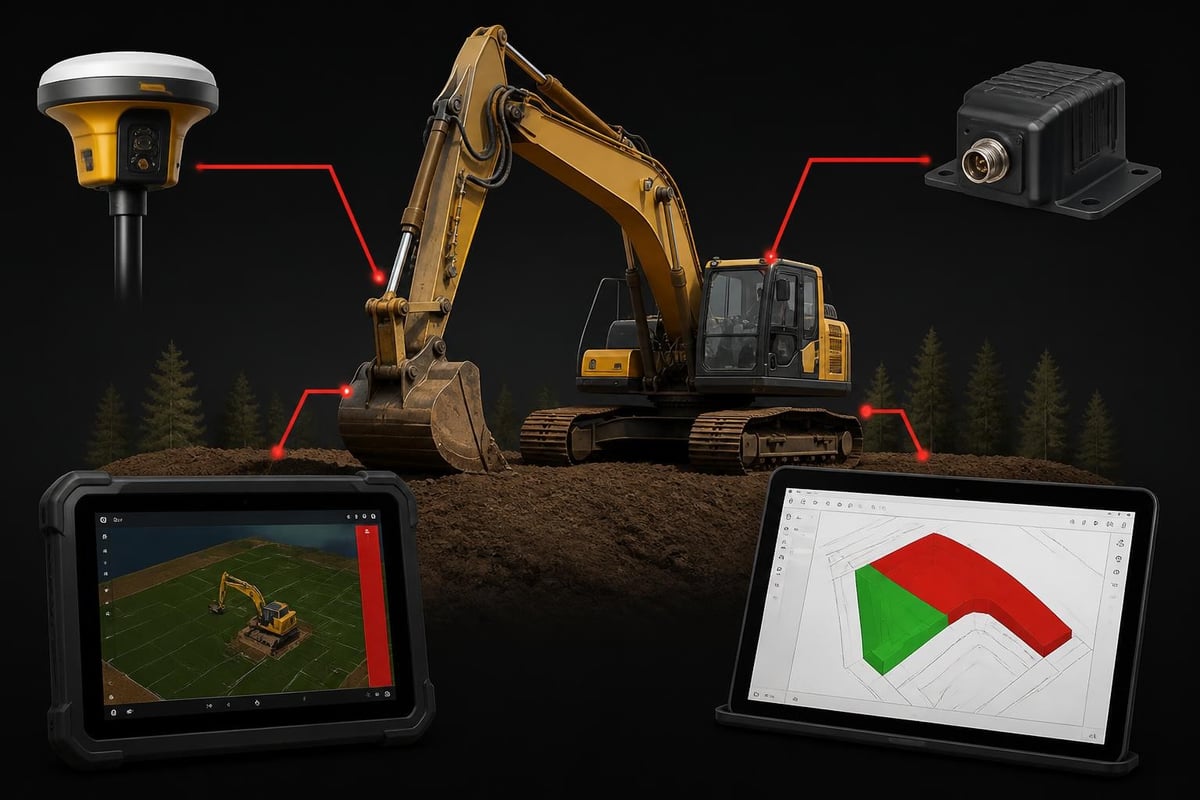
Each component feeds data to the central processing unit, which calculates cut/fill requirements thousands of times per second. This continuous feedback loop means operators always know their exact position relative to the design, whether they're excavating trenches for utilities or preparing sub-bases for surfacing projects.
Productivity Gains Across Project Types
Contractors implementing the trimble earthworks excavator consistently report substantial productivity improvements. The case study from Reuscher Tiefbau GmbH documented productivity increases up to 40%, whilst simultaneously reducing material waste and fuel consumption.
Commercial Development Applications
For commercial projects like drive-through developments, precision earthworks establishes the foundation for everything that follows. When constructing facilities requiring exact drainage gradients, carpark specifications, and accessibility compliance, the trimble earthworks excavator eliminates costly rework.
Traditional staking methods require surveyors to establish grade stakes across the site, which excavators then work towards. This process consumes significant time, and stakes frequently get destroyed during operations, requiring repeated surveys. Machine control systems eliminate this entirely.
| Traditional Method | Trimble Earthworks System |
|---|---|
| Manual stake-out required | Digital design loaded directly |
| Stakes destroyed during work | No physical stakes needed |
| Surveyor checks every phase | Continuous self-checking |
| Rework common | First-time accuracy |
| 2-3 days preliminary work | Immediate start capability |
Highway and Infrastructure Projects
Highway construction demands exacting tolerances for drainage, structural layers, and surface profiles. The trimble earthworks excavator brings survey-grade accuracy to every pass, whether excavating for kerb lines, shaping embankments, or preparing formation levels for surfacing operations.
Leading Edge Earthmoving’s implementation demonstrated daily time savings of 1-2 hours by eliminating manual level checks. Over a major infrastructure project lasting months, these savings compound dramatically, reducing programme duration and associated preliminary costs.
Return on Investment Considerations
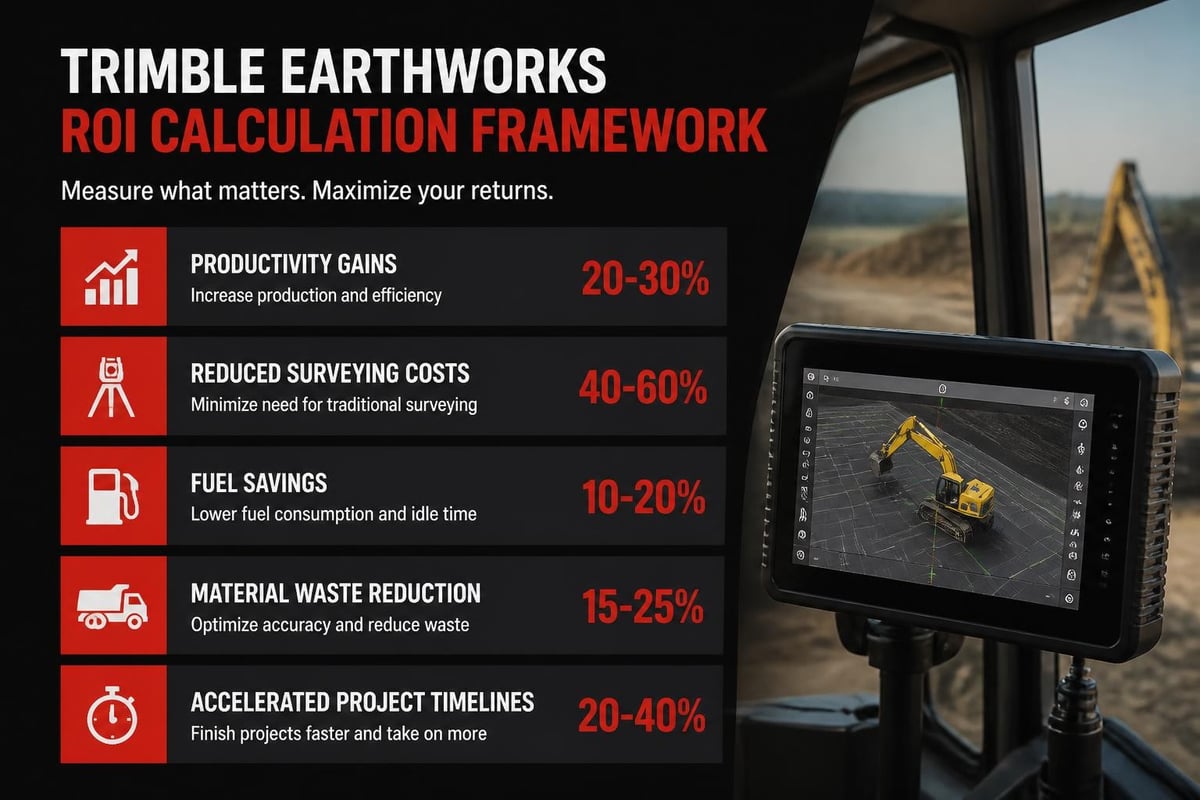
Investment in machine control technology requires careful evaluation, but the numbers consistently support adoption. Equipment costs vary depending on configuration, but contractors typically see payback periods measured in months rather than years.
Calculating Your ROI
NIX Contracting’s experience provides compelling evidence: a 60% production increase and doubled workload capacity within twelve months. For a civil engineering firm operating multiple excavators across concurrent projects, equipping even one machine creates a competitive advantage that quickly justifies expansion across the fleet.
The trimble earthworks excavator reduces operational costs through several mechanisms:
- Reduced surveying requirements cutting labour and equipment costs
- Lower fuel consumption through optimised machine movements
- Decreased material waste from accurate excavation depths
- Minimal rework eliminating duplicate efforts
- Faster project completion reducing site establishment costs
Operational Advantages for Diverse Projects
Civil engineering firms handling varied project types benefit particularly from the trimble earthworks excavator's versatility. The same system that guides major highway excavation adapts seamlessly to residential driveway construction or commercial surfacing projects.
Residential and Private Works
When constructing driveways, patios, or residential site works, precision matters just as much as on major infrastructure. Poor drainage caused by inaccurate grading leads to water pooling, surface deterioration, and ultimately expensive remedial works.
The trimble earthworks excavator ensures residential projects achieve the same precision standards as commercial works. Operators can load driveway designs created in common CAD packages, then execute the excavation knowing every bucket movement follows the engineered profile exactly.
Small Site Flexibility
Scotty’s Contracting & Stone demonstrated that equipping mini excavators with Trimble Earthworks delivered productivity improvements up to 50%. For projects in confined spaces or working around existing structures, smaller machines with full 3D control offer capabilities previously impossible.
This flexibility proves invaluable when undertaking projects like the Leicester City Football Club training facility, where precision earthworks must integrate with existing infrastructure whilst maintaining tight tolerances.
System Implementation and Training
Adopting the trimble earthworks excavator requires upfront investment in training, but modern systems reduce learning curves substantially compared to earlier technologies. Most operators become proficient within days rather than weeks.
Getting Started
- Initial system installation by certified technicians onto excavator
- Machine calibration establishing sensor relationships and dimensions
- Operator training covering interface navigation and basic operations
- Design workflow setup integrating with existing design and survey processes
- Ongoing support accessing technical assistance and software updates
The comprehensive overview of Trimble Earthworks Grade Control details the full range of capabilities and configuration options available, from basic 2D slope control through to advanced 3D modelling applications.
Training Investment
Operator training typically spans two to three days, covering system fundamentals, design loading, interface navigation, and troubleshooting common scenarios. Most suppliers offer ongoing support packages ensuring operators can access assistance when encountering unfamiliar situations.
For firms operating across the UK, from the North East to nationwide projects, having multiple trained operators ensures continuity regardless of staff allocation across concurrent sites. The intuitive interface means operators trained on one trimble earthworks excavator can transition seamlessly between different machines equipped with the system.
Design Integration and Workflow
The trimble earthworks excavator accepts designs from multiple sources, supporting industry-standard file formats including DXF, LandXML, and Trimble's proprietary formats. This flexibility means the system integrates with existing design workflows rather than forcing wholesale process changes.
From Design to Execution
Modern civil engineering projects begin with digital designs created in CAD or BIM environments. Traditionally, translating these designs to physical reality required multiple steps: printing plans, manual surveying, stake-out, and finally excavation guided by physical markers.
Machine control collapses this workflow dramatically:
| Process Stage | Traditional Approach | Trimble Earthworks Approach |
|---|---|---|
| Design creation | CAD software | CAD software (unchanged) |
| Site transfer | Printed plans | Digital file upload |
| Reference establishment | Survey stake-out | GNSS base station |
| Guidance method | Physical stakes | Real-time display |
| Verification | Manual checks | Continuous validation |
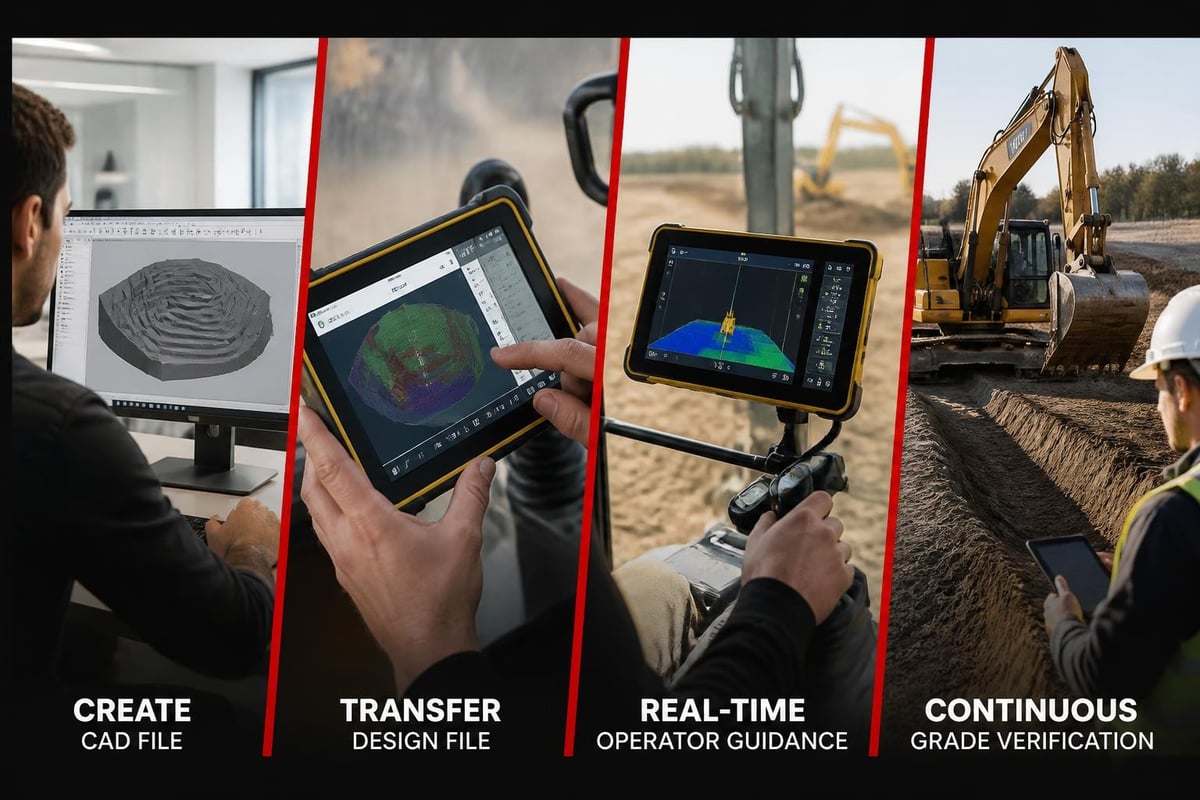
For projects like Cummins Engines Darlington, where industrial site works demand precise levels for drainage and structural requirements, this streamlined workflow eliminates communication errors between design intent and executed works.
Accuracy and Quality Control
The trimble earthworks excavator achieves positioning accuracy typically within ±20mm vertically and ±30mm horizontally under standard GNSS conditions. When augmented with RTK corrections or local base stations, these tolerances tighten further, often reaching survey-grade precision.
Quality Assurance Benefits
Continuous accuracy monitoring transforms quality control from periodic verification to constant validation. Operators see immediate feedback when deviating from design parameters, enabling instant correction before significant over-excavation or under-cutting occurs.
This real-time quality assurance proves particularly valuable on projects requiring stringent specifications, such as highway works where structural layer depths directly impact pavement longevity. The system creates digital as-built records automatically, documenting exactly what was constructed rather than relying solely on manual survey verification.
Advanced Features and Capabilities
Beyond basic grade control, the trimble earthworks excavator offers advanced functionality supporting complex project requirements. These capabilities extend the system's utility across diverse applications from earthmoving to specialised civil engineering tasks.
Compaction Integration
Some configurations integrate compaction monitoring, tracking not just position but also material density during backfilling operations. This proves invaluable when reinstating trenches or building structural fills requiring specified compaction levels.
Multi-Machine Coordination
On larger projects operating multiple excavators simultaneously, Trimble's connectivity solutions enable coordination between machines. Operators see where other equipment is working, avoiding conflicts whilst ensuring complete site coverage without gaps or overlaps.
Beaver Excavating Company’s implementation on Ohio's Portsmouth bypass achieved 20% faster excavation through such coordination, with expected ROI in less than twelve months.
Environmental and Safety Benefits
The trimble earthworks excavator contributes to sustainable construction practices through multiple mechanisms. Reduced fuel consumption from optimised machine movements decreases emissions, whilst accurate excavation minimises material waste requiring disposal.
Reduced Environmental Impact
- Fuel savings of 10-15% through efficient digging patterns
- Material waste reduction by avoiding over-excavation
- Fewer site vehicle movements eliminating repeat survey visits
- Reduced noise pollution from shortened project durations
- Lower carbon footprint across entire project lifecycle
Enhanced Site Safety
Machine control systems improve safety by reducing ground personnel requirements near active excavation. Traditional staking methods require surveyors and labourers working alongside heavy machinery, creating interaction risks. The trimble earthworks excavator eliminates most of these interactions, keeping personnel clear of the working area.
For projects like the Secret Garden at Bishop Auckland Castle, where landscaping works occur near public areas, minimising ground personnel exposure to machinery operations enhances overall site safety.
Future Developments and Technology Trends
Machine control technology continues evolving rapidly. Current research explores autonomous excavation capabilities, with recent academic work on autonomous excavator systems demonstrating potential for fully automated operation in specific scenarios.
Emerging Capabilities
The trimble earthworks excavator platform receives regular software updates adding new features and improving existing functionality. Recent additions include enhanced visualisation tools, improved battery management for electric excavators, and tighter integration with project management platforms.
Cloud connectivity enables remote monitoring, allowing project managers to track progress across multiple sites simultaneously. This visibility proves particularly valuable for firms operating nationwide projects, providing real-time insights into productivity and progress without physical site visits.
Competitive Advantages for Civil Engineering Firms
Adopting the trimble earthworks excavator creates differentiation in competitive bidding environments. Contractors demonstrating machine control capabilities signal investment in quality, efficiency, and modern methods to prospective clients.
Tender and Procurement Benefits
Many major projects now specify or preference machine control usage, recognising the quality and efficiency benefits. Having equipped excavators positions contractors favourably when bidding infrastructure projects, commercial developments, or any works where precision matters.
The Roadchef Tibshelf Services project exemplifies the type of commercial work where demonstrating advanced capabilities strengthens tender submissions, particularly when competing against firms using traditional methods.
Client Confidence
Clients increasingly understand construction technology benefits. Demonstrating trimble earthworks excavator capabilities during pre-construction meetings builds confidence that projects will deliver to specification, on schedule, and within budget. This confidence translates to repeat business and referrals, creating long-term value beyond individual project margins.
Maintenance and Long-Term Ownership
Like any precision equipment, the trimble earthworks excavator requires proper maintenance to ensure continued accuracy and reliability. Most systems prove remarkably robust, functioning reliably in harsh construction environments, but scheduled calibration and component inspection maintains optimal performance.
Ongoing Support Requirements
Annual calibration checks verify sensor accuracy and system performance. Most dealers offer service packages including calibration, software updates, and technical support. These packages typically cost a fraction of the productivity gains achieved, representing sound investments in system longevity.
Components like GNSS receivers and displays have expected lifespans measured in years rather than months, with many contractors operating systems for five years or longer before considering upgrades. As excavators themselves get replaced or refurbished, Trimble systems often transfer to new machines, protecting the initial investment.
The trimble earthworks excavator delivers measurable productivity gains, quality improvements, and competitive advantages that transform civil engineering operations from highways to driveways. Whether you're planning major infrastructure works or residential developments, precision earthmoving technology has evolved from optional enhancement to essential capability. At JRG Civils, we combine advanced construction technology with traditional civil engineering excellence, delivering projects across the North East and throughout the UK to exacting standards. From commercial developments to private residential works, our commitment to precision and quality ensures every project benefits from modern methods and meticulous attention to detail.