
Understanding the concrete kerbing price landscape has become increasingly important for property developers, commercial clients, and homeowners planning infrastructure improvements in 2026. Whether you're designing a car park for a new franchise location, creating defined boundaries for a residential driveway, or managing highway surfacing projects, accurate cost estimation forms the foundation of successful project planning. The market has evolved significantly, with material costs, installation techniques, and design options all influencing the final investment required. This comprehensive guide examines every aspect of concrete kerbing pricing, providing the insights needed to budget effectively and make informed decisions.
Understanding Concrete Kerbing Price Components
The concrete kerbing price structure comprises several distinct elements that work together to determine your total project cost. Material costs typically account for 40-50% of the overall expense, with concrete grade, aggregate quality, and any specialized additives impacting this figure substantially. Installation labour represents another significant portion, varying based on project complexity, site accessibility, and regional wage differences across the UK.
Key price components include:
- Raw material costs (concrete, aggregates, reinforcement)
- Labour and skilled installation services
- Equipment hire and machinery operation
- Site preparation and groundworks
- Finishing treatments and sealants
- Waste disposal and site clearance
According to detailed cost analyses, the average concrete kerbing price in 2026 ranges between £45 and £85 per linear metre for standard installations. However, this baseline figure can fluctuate considerably based on specification requirements and project-specific conditions.
Material Quality Impact on Pricing
Concrete grade selection fundamentally influences both upfront costs and long-term performance. Commercial-grade kerbing typically uses C32/40 concrete for high-traffic areas, whilst residential applications might specify C25/30 or C28/35 depending on anticipated loads. The strength differential translates directly into price variations, with higher-grade concrete commanding premium rates but delivering superior durability.
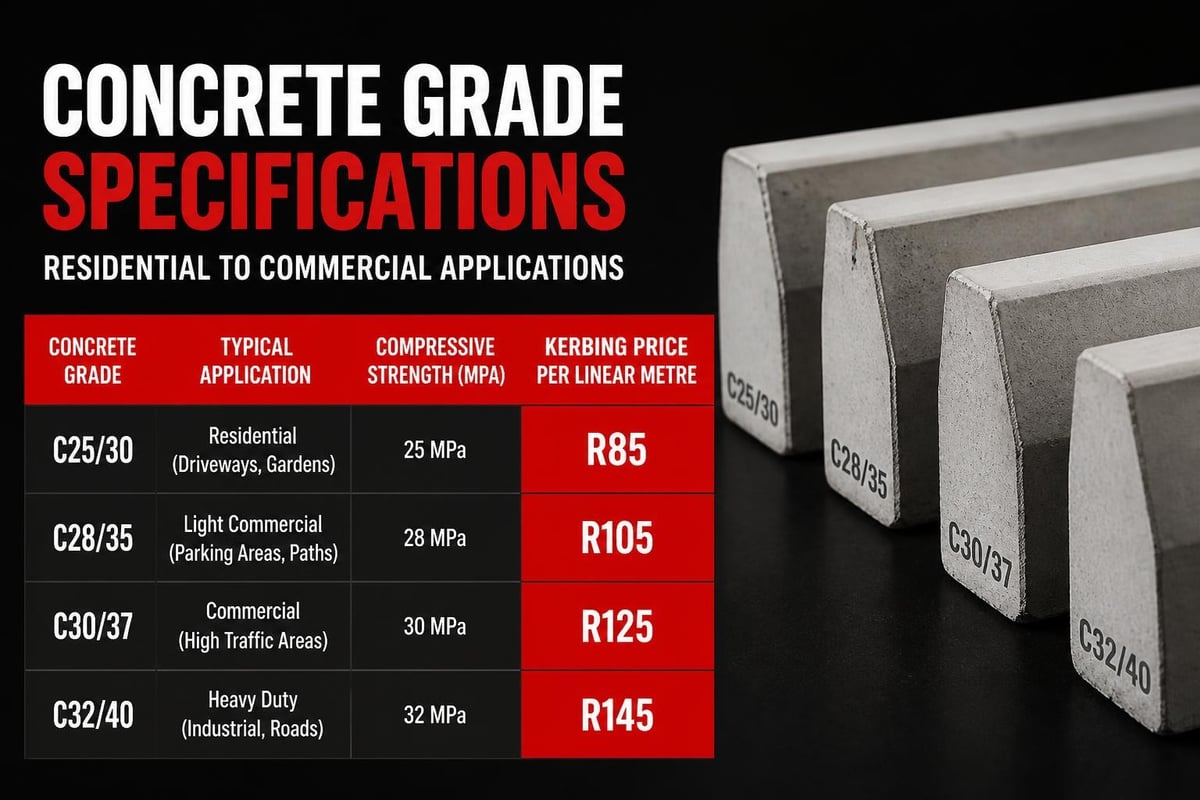
Premium aggregates, specialized fibres for crack resistance, and weather-resistant additives all contribute to enhanced performance characteristics. These enhancements typically add £8-£15 per linear metre to the base concrete kerbing price, representing worthwhile investments for projects requiring extended service life or exposure to harsh environmental conditions.
Standard vs Decorative Kerbing Costs
Standard grey concrete kerbing represents the most economical option, with straightforward installation and minimal finishing requirements. These utilitarian solutions suit commercial car parks, highway boundaries, and functional applications where aesthetics take secondary importance to durability and cost efficiency. The landscaping design considerations highlight how even basic kerbing can be integrated effectively into overall site design.
| Kerbing Type | Price Per Linear Metre | Key Features | Typical Applications |
|---|---|---|---|
| Standard Grey | £45-£60 | Plain finish, C25/30 concrete | Car parks, highways, functional boundaries |
| Coloured Concrete | £65-£85 | Integral pigmentation, various shades | Retail frontages, residential drives |
| Stamped Pattern | £85-£120 | Textured surface, decorative moulds | Feature areas, landscaping projects |
| Exposed Aggregate | £95-£135 | Decorative stone reveal, polished finish | Premium residential, commercial entrances |
Decorative options expand the aesthetic possibilities considerably. Integral colour pigments allow kerbing to complement surrounding paving or architectural features, though this addition typically increases the concrete kerbing price by £15-£25 per linear metre. Stamped and textured finishes create visual interest, particularly valuable for franchise locations like the Costa Coffee and Greggs drive-through projects where brand identity extends to exterior detailing.
Custom Profiles and Specialist Applications
Bespoke kerb profiles designed to specific dimensional requirements or unique geometric shapes command premium pricing. Manufacturing custom extrusion dies or formwork adds initial setup costs, though these distribute across larger projects more economically. When undertaking ground works, coordinating custom kerbing specifications with broader site development optimizes both cost efficiency and project timelines.
Specialist applications including drainage integration, barrier kerbs for traffic management, or reinforced sections for heavy vehicle loading require engineering input and enhanced specifications. These functional enhancements typically increase the baseline concrete kerbing price by 30-60%, reflecting the additional materials, design work, and installation precision required.
Installation Method Cost Variations
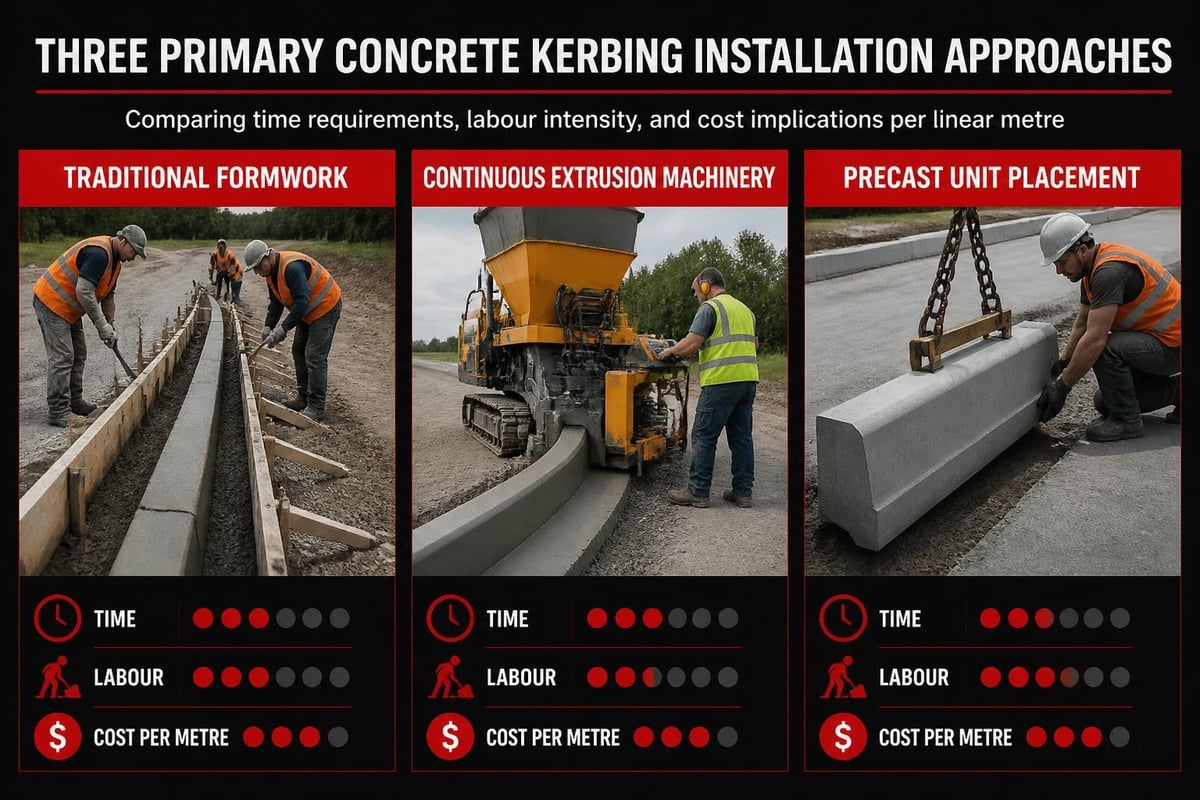
The installation approach significantly influences overall project economics. Traditional formwork installation involves constructing temporary shuttering, placing concrete, allowing curing, and then removing forms. This method suits longer runs with consistent profiles, offering excellent quality control and finish consistency. Labour requirements typically demand two skilled operatives and supporting equipment, contributing substantially to the final concrete kerbing price.
Continuous extrusion methods using specialized kerbing machines can reduce installation costs for extensive linear runs. These machines extrude concrete through shaped dies, creating consistent profiles with minimal formwork. The technique particularly suits large commercial services projects where efficiency gains offset equipment mobilization costs.
Installation cost factors:
- Site accessibility and working space constraints
- Ground conditions requiring additional preparation
- Existing services requiring careful excavation
- Complex curves or geometric configurations
- Traffic management and safety requirements
- Weather conditions affecting concrete curing
Precast concrete kerbing offers an alternative approach worth considering. The precast kerb pricing structures show competitive rates for standard units, particularly when rapid installation is prioritized. However, limitations on custom profiles and potential for visible joints make precast less suitable for certain applications.
Project Scale and Quantity Discounts
Project size directly impacts the per-metre concrete kerbing price through economy of scale effects. Small residential projects under 50 linear metres typically face higher unit costs due to minimum call-out charges, equipment mobilization, and reduced material purchasing power. Mid-sized projects between 100-500 linear metres achieve better rates as fixed costs distribute across greater quantities.
Large commercial installations exceeding 1,000 linear metres often secure preferential pricing through bulk material purchasing, efficient continuous operation, and reduced proportional mobilization costs. When planning multiple franchise locations or phased development projects, coordinating kerbing work across sites can yield significant cost advantages.
Budget Planning Across Different Project Sizes
Financial planning requires understanding how quantities affect pricing structures. For a typical 100-metre residential driveway project, expect total costs between £5,500-£8,500 including preparation, installation, and finishing. Commercial car park projects spanning 500 metres might range from £24,000-£38,000 depending on specification and complexity.
The comprehensive cost breakdown approaches demonstrate how itemized quotations provide transparency and enable informed decision-making. When evaluating proposals, ensure comparisons account for equivalent specifications, included services, and warranty provisions rather than solely focusing on headline rates.
Regional Price Variations Across the UK
Geographic location influences the concrete kerbing price through several mechanisms. Labour rates vary considerably between regions, with London and South East England commanding premiums of 15-25% compared to Northern England or Wales. Material costs fluctuate based on proximity to concrete plants and aggregate sources, with remote locations facing additional transportation charges.
Operating from the North East, projects in this region often benefit from competitive labour markets and excellent access to quality aggregates. However, when undertaking work across the UK, transportation costs for specialized equipment and potential accommodation expenses for installation teams must factor into project budgets.
Regional considerations include:
- Local labour rate variations (£18-£28 per hour for skilled operatives)
- Material transportation distances and associated costs
- Regional building regulation differences
- Seasonal weather patterns affecting working conditions
- Local market competition and contractor availability
Urban versus rural location also impacts pricing. City centre projects often incur additional costs for restricted access, limited storage, parking restrictions, and stricter working hour constraints. Conversely, rural sites might face challenges with distance from material suppliers or requirement for site access improvements.
Site Preparation and Ground Condition Impacts
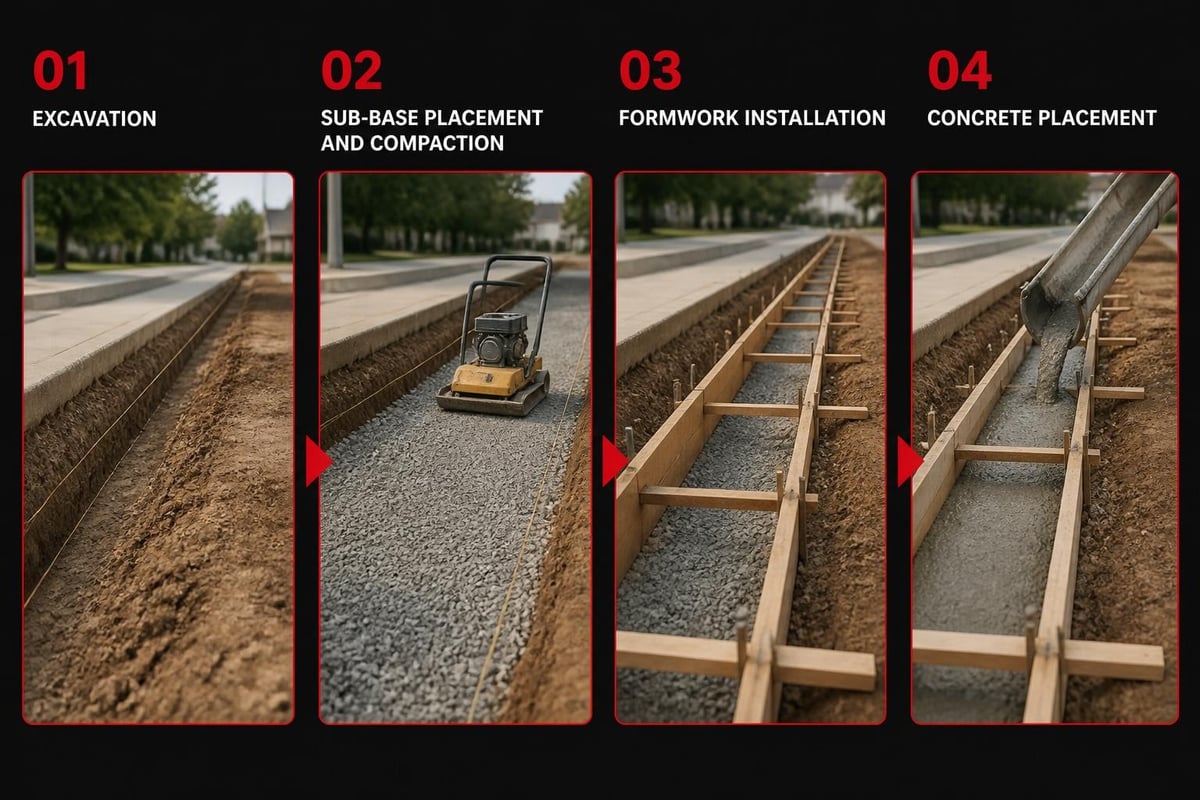
Adequate foundation preparation proves critical for kerbing longevity and performance. The concrete kerbing price quotation should account for excavation to appropriate depths, typically 150-200mm below finished kerb level. Sub-base installation using MOT Type 1 aggregate compacted to specification provides stable support, preventing settlement and subsequent failure.
Challenging ground conditions escalate preparation costs substantially. Clay soils requiring enhanced drainage, contaminated ground needing remediation, or unstable substrates demanding ground improvement treatments all increase the groundworks component. The detailed walkway curbing cost factors explore how site conditions influence overall project economics.
| Ground Condition | Preparation Requirement | Additional Cost Impact |
|---|---|---|
| Firm, well-drained soil | Standard excavation and MOT sub-base | Baseline (included) |
| Clay or poorly draining | Enhanced excavation, drainage installation | +£12-£18/linear metre |
| Existing paving removal | Breaking up and disposal of materials | +£15-£25/linear metre |
| Contaminated ground | Soil remediation or removal | +£40-£80/linear metre |
| Services relocation | Coordination with utility providers | Project-specific quotation |
When commissioning site surveys before quotation, detailed ground investigation helps avoid unexpected cost escalations during construction. Understanding subsurface conditions, existing services, and drainage requirements enables accurate concrete kerbing price estimation from the outset.
Design Complexity and Customization Costs
Straight runs of standard profile kerbing represent the most economical configuration. Each curve, radius change, or geometric complexity adds installation time and potentially requires specialized formwork or careful machine operation. Tight radius curves may necessitate hand-forming techniques, significantly increasing labour input and affecting the concrete kerbing price accordingly.
Integrating kerbing with existing structures demands precision and often additional materials. Junctions with building thresholds, transitions between different pavement levels, or connections to drainage systems require careful detailing. These interfaces, whilst essential for functional performance, increase installation complexity and associated costs.
The concrete landscape curbing cost variations illustrate how design choices cascade through project economics. Opting for simple, standardized designs where functionality permits helps control costs without compromising essential performance requirements.
Maintenance Considerations and Long-Term Value
Whilst initial concrete kerbing price naturally draws focus during planning, whole-life cost analysis provides valuable perspective. Quality installation using appropriate specifications typically delivers 25-40 years of service life with minimal maintenance requirements. This longevity compares favourably against alternative edging materials requiring more frequent replacement or ongoing upkeep.
Periodic maintenance involves crack sealing, joint repair, and cleaning to maintain appearance and prevent water ingress. These relatively minor interventions, typically costing £5-£12 per linear metre every 5-7 years, protect the initial investment and extend service life. Applying protective sealants enhances resistance to freeze-thaw damage, chemical exposure, and staining, particularly valuable for decorative finishes in high-visibility locations.
Maintenance best practices include:
- Annual inspection identifying early deterioration signs
- Prompt crack repair preventing water ingress
- Regular cleaning removing debris and potential staining agents
- Re-sealing every 3-5 years for decorative finishes
- Joint maintenance ensuring continued structural integrity
When comparing options, calculating the total cost of ownership rather than solely installation expense provides more accurate economic comparison. The durability and minimal maintenance requirements of properly specified concrete kerbing often justify slightly higher initial investment compared to alternatives requiring replacement within shorter timeframes.
Obtaining Accurate Quotations
Securing reliable concrete kerbing price quotations requires clear communication of project requirements and specifications. Detailed drawings showing kerb locations, profiles required, and any special features enable contractors to assess requirements accurately. Site photographs documenting current conditions, access constraints, and existing features supplement technical documentation effectively.
When reviewing quotations, ensure comparisons account for equivalent scope and specifications. The cheapest quote may exclude essential elements like adequate sub-base, proper drainage consideration, or finishing treatments. Evaluating proposals against a standardized specification ensures valid comparison and helps identify potentially problematic omissions.
Request itemized quotations breaking down material costs, labour, plant hire, and additional services separately. This transparency enables understanding of where value lies and facilitates discussion of potential specification adjustments to align with budget constraints. You can view examples of completed projects to understand quality standards and specification approaches.
Questions to Ask Potential Contractors
Informed selection requires understanding contractor capabilities and approach. Enquire about experience with similar project types, whether residential driveways, commercial car parks, or highway works. Request references from recent comparable projects and verification of appropriate insurance coverage and health and safety credentials.
Understanding the proposed installation methodology, anticipated timeline, and how potential challenges would be addressed provides confidence in contractor capability. Discuss warranty provisions covering both materials and workmanship, ensuring adequate protection for your investment. The continuous concrete curbing cost considerations offer insights into methodology differences and their cost implications.
Seasonal Timing and Cost Implications
Project timing influences both pricing and quality outcomes. Peak construction season during late spring and summer often sees increased demand, potentially affecting contractor availability and rates. However, optimal weather conditions during these months facilitate efficient installation and proper concrete curing, reducing risk of weather-related complications.
Winter working presents challenges including reduced daylight hours, potential frost damage during curing, and weather-related delays. Some contractors offer preferential rates during quieter winter months, though these savings must weigh against increased risk factors. Concrete kerbing requires minimum temperatures above 5°C during placement and initial curing, making winter installation viable only during suitable weather windows.
Autumn provides an often-overlooked optimal window. Contractors emerging from busy summer schedules may offer competitive rates whilst weather conditions remain generally favourable. Planning projects for September through early November can yield both cost and quality advantages, avoiding peak season premiums whilst benefiting from contractor availability and reasonable working conditions.
Value Engineering Opportunities
Strategic specification adjustments can align projects with budget constraints without compromising essential performance. Consider whether decorative finishes provide sufficient value in less-visible areas, potentially limiting premium treatments to prominent locations whilst using standard grey concrete elsewhere. This selective approach maintains visual impact where it matters most whilst controlling overall costs.
Profile selection offers another value engineering avenue. Standard profiles using readily available formwork or extrusion dies cost less than custom designs. Evaluate whether slight dimensional adjustments to utilize standard profiles affect functionality, potentially achieving significant savings without material performance compromise.
The professional cost analysis for landscaping applications explores how thoughtful design decisions optimize value whilst maintaining quality. Engaging contractors early in design development enables their practical input, identifying efficient solutions that deliver required outcomes economically.
Commercial vs Residential Project Differences
Commercial projects typically demand higher specifications reflecting greater loading, traffic volumes, and durability requirements. Car park kerbing for a franchise drive-through, for instance, requires robust construction withstanding repeated vehicle impacts, fuel spillage resistance, and extended service life. These enhanced specifications naturally increase the concrete kerbing price compared to residential applications.
Commercial work also involves different regulatory frameworks, requiring compliance with specific standards for highway construction, disabled access provisions, and traffic management during installation. These compliance requirements add design, documentation, and implementation costs that residential projects typically avoid.
Conversely, residential projects often prioritize aesthetic considerations more heavily, potentially specifying decorative finishes that commercial applications might forego. Understanding these different priorities helps align specifications with project objectives and budget parameters. If you're interested in discussing requirements for either commercial or residential projects, professional guidance ensures appropriate specification development.
Making Informed Investment Decisions
Understanding the comprehensive concrete kerbing price landscape enables confident project planning and budget allocation. Recognize that achieving value requires balancing initial costs against long-term performance, functionality, and aesthetic objectives. The cheapest option rarely delivers optimal whole-life value, whilst premium specifications may exceed actual requirements for certain applications.
Prioritize working with experienced contractors demonstrating relevant project experience, appropriate qualifications, and commitment to quality workmanship. The relationship between client and contractor significantly influences project outcomes, with clear communication, realistic expectations, and mutual understanding forming the foundation for successful delivery.
Documentation of specifications, agreed prices, and project scope protects both parties and provides reference throughout the work. Ensure contracts clearly define responsibilities, quality standards, payment terms, and procedures for addressing variations or unforeseen circumstances. This professional approach minimizes disputes and establishes framework for addressing challenges constructively.
Navigating concrete kerbing price considerations requires understanding the interplay between specifications, site conditions, project scale, and quality expectations. Whether planning commercial infrastructure, residential enhancements, or highway surfacing projects, informed decision-making balances initial investment against long-term performance and value. With expertise spanning franchise developments, road construction, and private projects across the UK, the team at JRG Civils delivers professional civil engineering solutions backed by attention to detail and commitment to excellence. Get in touch to discuss your specific requirements and receive expert guidance tailored to your project objectives.