Road safety infrastructure continues to evolve, with innovative solutions designed to protect both motorists and pedestrians. Among the most effective developments in recent years is trief kerbing, a specialized containment system that has revolutionized how highways and commercial developments approach vehicle management. Unlike traditional kerbs that can be easily mounted by vehicles, these engineered systems provide passive safety features that redirect errant vehicles back onto carriageways whilst minimizing damage and injury. For civil engineering contractors working on commercial projects, understanding the specifications, applications, and installation requirements of these systems is essential for delivering safe, compliant infrastructure.
Understanding Trief Kerbing Systems
Trief kerbing represents a significant advancement in passive road safety technology. These specialized kerbs are engineered to contain and redirect vehicles that inadvertently leave the carriageway, preventing them from mounting pavements or entering pedestrian areas. The system achieves this through a carefully designed profile that uses the vehicle's own momentum to guide it back onto the road surface safely.
The fundamental principle behind trief kerbing is vehicle containment without causing severe deceleration or vehicle damage. Traditional kerbs can cause vehicles to flip or become airborne when struck at speed, whilst these containment systems are designed to work with the vehicle's dynamics. The angled face and reinforced construction create a smooth transition that redirects rather than abruptly stops the vehicle.
Key Design Features
Several design elements distinguish trief kerbing from standard highway kerbs:
- Angled containment face that redirects vehicle wheels
- Reinforced concrete construction for structural integrity
- Specific height and width specifications tested to safety standards
- Integrated drainage channels in certain models
- High-visibility options for enhanced driver awareness
The Trief GST2A kerb system exemplifies these design principles, offering compliance with BS EN 1317 N1 standards whilst providing superior vehicle and pedestrian protection compared to conventional kerbing solutions.

Specifications and Standards Compliance
Professional installation of trief kerbing requires thorough understanding of relevant standards and specifications. These systems must meet stringent testing criteria to ensure they perform effectively in real-world scenarios. The BS EN 1317 standard governs road restraint systems, and trief kerbing products are rigorously tested to achieve certification under these frameworks.
| System Type | Standard | Application | Maximum Speed |
|---|---|---|---|
| GST1A | BS EN 1317 N1 | Urban areas | 50 km/h |
| GST2A | BS EN 1317 N1 | Commercial/Industrial | 50 km/h |
| GST2 | BS EN 1317 N1 | Restricted depth | 50 km/h |
The GST2A containment kerbs provide detailed technical specifications that civil engineering teams require for accurate project planning and integration into design processes.
Material Specifications
Trief kerbing units are manufactured from high-strength concrete, typically incorporating steel reinforcement to withstand impact forces. The concrete mix is designed to specific compression strengths, ensuring durability whilst maintaining the necessary flexibility to absorb and redirect impact energy. Surface finishes vary depending on the application, with options including natural concrete, coloured finishes, and reflective treatments for enhanced visibility.
Dimensional accuracy is critical. Each unit must conform to precise measurements to ensure proper interlocking and system performance. Tolerances are typically measured in millimeters, and quality control during manufacturing ensures consistency across production runs.
Applications in Commercial and Highway Projects
The versatility of trief kerbing makes it suitable for diverse applications across commercial developments and highway infrastructure. At JRG Civils, experience across multiple franchise projects including Costa Coffee and Greggs drive-throughs has demonstrated the value of these systems in protecting pedestrian areas whilst managing vehicle flow efficiently.
Drive-Through Facilities
Fast-food drive-throughs present unique safety challenges. Vehicles navigate tight corners, queue in confined spaces, and operate near pedestrian entrances. Trief kerbing provides essential protection by:
- Defining vehicle pathways clearly
- Protecting building facades from accidental impact
- Separating pedestrian walkways from vehicle lanes
- Managing queue formations safely
- Providing visual guidance through directional features
The Trief Chevron Kerb System offers particularly effective solutions for these environments, with high-visibility chevron patterns that provide clear directional indication to drivers navigating complex layouts.
Industrial and Distribution Sites
Warehouse facilities, distribution centers, and industrial estates benefit significantly from trief kerbing installations. Heavy goods vehicles operating in these environments pose substantial risks to infrastructure and personnel. The containment systems protect:
- Loading bay areas from vehicle encroachment
- Pedestrian walkways between buildings
- Utility infrastructure along roadways
- Car parking zones from HGV intrusion
- Building perimeters from accidental collision
Installation Considerations and Best Practices
Successful trief kerbing installation requires careful planning and execution. The foundation preparation is critical, as these systems rely on stable support to function correctly under impact. Civil engineering contractors must assess ground conditions, existing drainage infrastructure, and load-bearing requirements before commencing installation.

Foundation Requirements
The sub-base beneath trief kerbing must provide uniform support across the entire installation length. Typically, this involves:
- Excavation to appropriate depth based on ground conditions
- Compacted granular sub-base material (Type 1 MOT)
- Concrete bedding layer of specified thickness
- Haunching to provide lateral support
- Proper drainage provision to prevent water accumulation
Foundation depth varies depending on the specific trief kerbing system being installed and the anticipated loading conditions. The Trief GST2 kerb system, designed for applications with restricted depths, offers solutions where standard foundation depths cannot be achieved whilst maintaining essential safety features.
Alignment and Jointing
Precise alignment ensures the containment system functions as designed. Units must be placed with minimal gaps, typically using specially designed jointing systems or mortar beds. Horizontal and vertical alignment should be checked regularly during installation using string lines and laser levels.
Critical alignment factors include:
- Maintaining consistent face angle throughout the installation
- Ensuring tops are level to specification tolerances
- Creating smooth transitions at curves and junctions
- Matching existing levels at tie-in points
- Verifying dimensional accuracy at regular intervals
Integration with Existing Infrastructure
Trief kerbing installations rarely exist in isolation. Most projects require integration with existing highway infrastructure, drainage systems, and utilities. This integration demands careful coordination and technical expertise to ensure all elements function harmoniously whilst maintaining the safety benefits of the containment system.
Drainage Coordination
Effective drainage is essential for road safety and kerb longevity. Trief kerbing installations must accommodate surface water runoff whilst maintaining the structural integrity of the system. Options include integrated drainage channels within the kerb units themselves or carefully designed gullies positioned to work with the containment profile.
For projects requiring comprehensive civil engineering services, coordinating drainage design with kerbing installation ensures optimal performance and prevents water-related degradation of the foundation system.
| Integration Element | Consideration | Solution Approach |
|---|---|---|
| Surface water drainage | Preventing ponding behind kerbs | Channel kerbs or strategic gully placement |
| Utility crossings | Maintaining kerb line continuity | Pre-planned crossing points with proper reinstatement |
| Existing kerb tie-ins | Matching levels and profiles | Transition units or bespoke connections |
| Street furniture | Maintaining sight lines | Coordinated positioning with kerb alignment |
Transition Zones
Where trief kerbing meets standard kerbing or other road restraint systems, properly designed transition zones are essential. These zones must provide compatible safety performance whilst avoiding discontinuities that could create hazards. Transition design considers approach angles, relative heights, and structural connections to ensure smooth integration.
Performance Benefits and Safety Outcomes
The implementation of trief kerbing delivers measurable safety improvements across various metrics. Data from installations demonstrates reduced incident severity, fewer pedestrian injuries, and decreased property damage compared to locations with traditional kerbing.
Research into Trief kerbstone performance shows that these systems effectively prevent vehicle mounting in urban environments, significantly reducing the risk of pavement incursions that endanger pedestrians. The containment characteristics mean that even when struck at moderate speeds, vehicles are guided back onto the carriageway rather than continuing into pedestrian zones.
Cost-Benefit Analysis
Whilst trief kerbing systems represent a higher initial investment than standard kerbs, the long-term benefits often justify the expenditure:
- Reduced accident severity lowers insurance claims
- Decreased infrastructure damage minimizes repair costs
- Enhanced pedestrian safety reduces liability exposure
- Longer service life compared to standard kerbs
- Lower maintenance requirements due to robust construction
For commercial developments such as retail parks, drive-through restaurants, and industrial facilities, these benefits contribute directly to operational efficiency and risk management. Projects completed by civils contractors across the UK demonstrate the value of investing in quality safety infrastructure from the outset.
Technical Resources and Design Integration
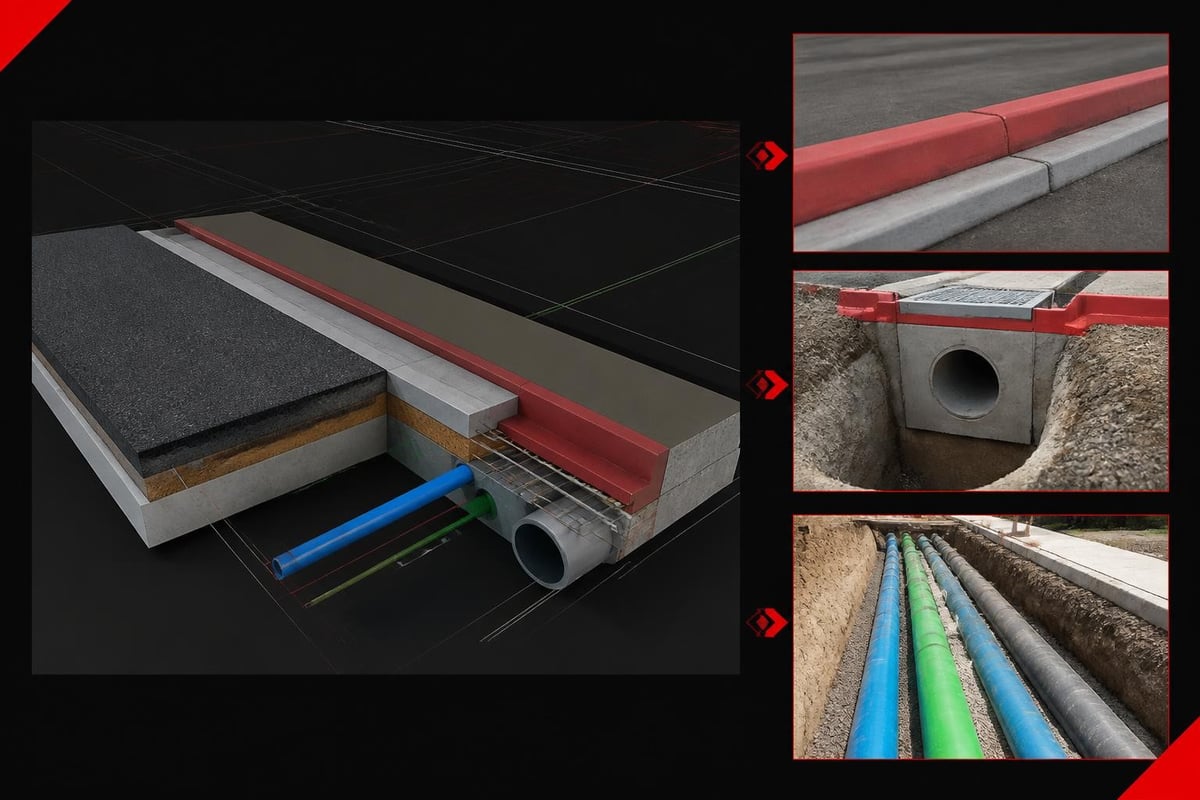
Modern construction projects increasingly rely on Building Information Modeling (BIM) and digital design processes. Trief kerbing manufacturers have responded by providing comprehensive technical resources that facilitate integration into these workflows. BIM objects for the GST2A kerb enable designers to incorporate accurate representations of these systems into project models, ensuring proper coordination with other elements and identifying potential conflicts before construction commences.
Design Software Integration
Technical specifications available through platforms like NBS Source allow architects and engineers to specify trief kerbing products accurately within project documentation. This ensures:
- Correct product selection for application requirements
- Accurate quantity surveying and cost estimation
- Compliance verification against relevant standards
- Coordination with drainage and utility designs
- Clear communication to installation teams
Access to comprehensive product ranges enables designers to select the most appropriate system for each specific application, whether that involves high-traffic commercial areas, sensitive urban environments, or challenging site conditions with restricted construction depths.
Maintenance and Long-Term Performance
Properly installed trief kerbing requires minimal maintenance compared to many road safety systems. However, regular inspection and preventative maintenance ensure optimal performance throughout the design life. Inspection protocols should assess structural integrity, alignment accuracy, and drainage functionality.
Key maintenance activities include:
- Visual inspection for cracks, chips, or displacement
- Verification of alignment and level
- Drainage channel cleaning where applicable
- Joint integrity assessment
- Surface treatment renewal for high-visibility systems
Damage from vehicle impact, whilst the system is designed to withstand such events, should be assessed and repaired promptly to maintain containment performance. Typically, individual damaged units can be replaced without affecting adjacent sections, minimizing disruption and repair costs.
Service Life Expectations
High-quality trief kerbing installations typically achieve service lives exceeding 20 years with appropriate maintenance. This longevity stems from the robust materials, engineered design, and proper installation techniques that characterize professional implementations. The reinforced concrete construction resists weathering, freeze-thaw cycles, and de-icing salt exposure more effectively than many alternative materials.
For civil engineering firms undertaking highway and commercial projects, specifying and installing durable infrastructure like trief kerbing contributes to client satisfaction through reduced whole-life costs and consistent safety performance.
Selecting the Right System
Choosing the appropriate trief kerbing system requires analysis of multiple factors specific to each project. Speed limits, traffic volumes, vehicle types, pedestrian activity, and site constraints all influence the optimal selection. Understanding the purpose and applications of Trief kerbs helps contractors and developers make informed decisions that balance safety requirements with practical and financial considerations.
Decision Matrix
| Consideration | GST1A | GST2A | Chevron System |
|---|---|---|---|
| Urban areas (≤50 km/h) | Excellent | Excellent | Good |
| Commercial sites | Good | Excellent | Excellent |
| Restricted depth | Limited | Good | Variable |
| High visibility needs | Good | Good | Excellent |
| Directional guidance | Good | Good | Excellent |
Site-specific factors such as available construction depth, existing infrastructure constraints, and aesthetic requirements further refine the selection process. Projects involving civil design services benefit from early engagement with kerbing specialists to ensure optimal system selection and integration into the overall design.
Trief kerbing represents a proven solution for enhancing road safety and protecting pedestrians across commercial and highway applications. Understanding the specifications, installation requirements, and performance characteristics of these systems enables civil engineering teams to deliver infrastructure that meets both safety standards and client expectations. At JRG Civils, our experience across diverse projects from drive-through facilities to commercial developments ensures expert implementation of containment systems that protect people and property. Whether you're planning a new commercial site or upgrading existing highway infrastructure, JRG Civils delivers the civil engineering excellence your project demands.