
Understanding the distinction between roadways and carriageways is fundamental to proper infrastructure design and construction. These terms, whilst often used interchangeably in casual conversation, represent specific components of our transportation network with distinct engineering requirements. For civil engineering projects ranging from commercial developments to residential driveways, comprehending these differences ensures compliance with design standards whilst delivering safe, durable surfaces that meet modern traffic demands.
The Technical Distinction Between Roadways and Carriageways
Roadways and carriageways serve different functions within transportation infrastructure, and recognising this difference is crucial for proper project specification. According to the legal definition of roadways, a roadway encompasses the entire surface on which vehicles travel, including highways, roads, streets, parking areas, and driveways. The carriageway, conversely, refers specifically to the portion of the roadway designated for vehicular traffic, excluding verges, footways, and central reservations.
This technical distinction matters significantly when planning civil engineering projects. A roadway represents the complete construction, incorporating drainage systems, sub-base layers, wearing courses, and associated infrastructure. The carriageway forms just one element within this broader system, though it receives the most direct traffic loading and requires the most stringent construction standards.
Design Standards for Modern Infrastructure
Contemporary roadway design adheres to strict engineering principles established through decades of research and practical application. The Arizona Department of Transportation roadway design guidelines provide comprehensive standards that inform professional practice globally, addressing everything from geometric design to drainage requirements.
When designing roadways and carriageways for commercial projects such as drive-through facilities, engineers must consider multiple variables:
- Traffic volume projections and vehicle classification distributions
- Pavement composition appropriate to expected loading patterns
- Drainage capacity sufficient for design storm events
- Geometric alignment ensuring safe vehicle manoeuvres
- Surface texture providing adequate skid resistance

| Design Element | Residential Application | Commercial Application |
|---|---|---|
| Sub-base depth | 150-200mm compacted stone | 250-350mm engineered aggregate |
| Wearing course | 40-60mm asphalt or block paving | 60-100mm heavy-duty asphalt |
| Drainage gradient | 1:60 minimum fall | 1:80 to 1:40 depending on area |
| Design life | 15-20 years | 20-30 years |
These specifications demonstrate why professional civil engineering expertise proves essential for projects of any scale. Whilst a residential driveway and a commercial car park both constitute roadways, their engineering requirements differ substantially based on anticipated traffic patterns and loading conditions.
Construction Methodologies for Durable Surfaces
The construction of roadways and carriageways follows a systematic process that builds performance from the foundation upwards. Each layer serves specific structural and functional purposes, and proper execution at every stage determines the long-term durability of the finished surface.
Foundation preparation represents the critical first stage. Existing ground conditions must be assessed and improved where necessary, with unsuitable materials excavated and replaced with properly compacted fill. This prevents differential settlement that would eventually manifest as surface cracking or deformation.
The sub-base layer provides the primary load-spreading function. Typically constructed from well-graded granular material compacted in layers not exceeding 150mm thickness, this element distributes vehicle loads across the underlying subgrade. For commercial applications experiencing heavy goods vehicle traffic, enhanced sub-base specifications with cement-bound materials may be specified.
Surfacing Options and Performance Characteristics
Contemporary roadways and carriageways can be finished with various surfacing materials, each offering distinct advantages. The selection depends on aesthetic preferences, functional requirements, budget constraints, and anticipated maintenance needs.
Asphalt surfacing remains the predominant choice for both commercial and residential applications due to its versatility and cost-effectiveness:
- Hot rolled asphalt provides exceptional durability for high-traffic applications
- Dense bitumen macadam offers good performance across varied conditions
- Stone mastic asphalt delivers superior resistance to deformation under heavy loading
- Porous asphalt facilitates surface water drainage in sustainable drainage schemes
Block paving presents an alternative particularly suited to specific applications. Individual concrete or clay blocks create a flexible pavement that can accommodate ground movement without cracking, making it ideal for areas with challenging subgrade conditions. The permeable variants support sustainable drainage objectives whilst maintaining structural integrity.
Recent research into roadway design impacts on safety demonstrates how surface characteristics influence accident rates, with texture, colour contrast, and geometric design all playing measurable roles in driver response and behaviour patterns.
Integration of Drainage Systems
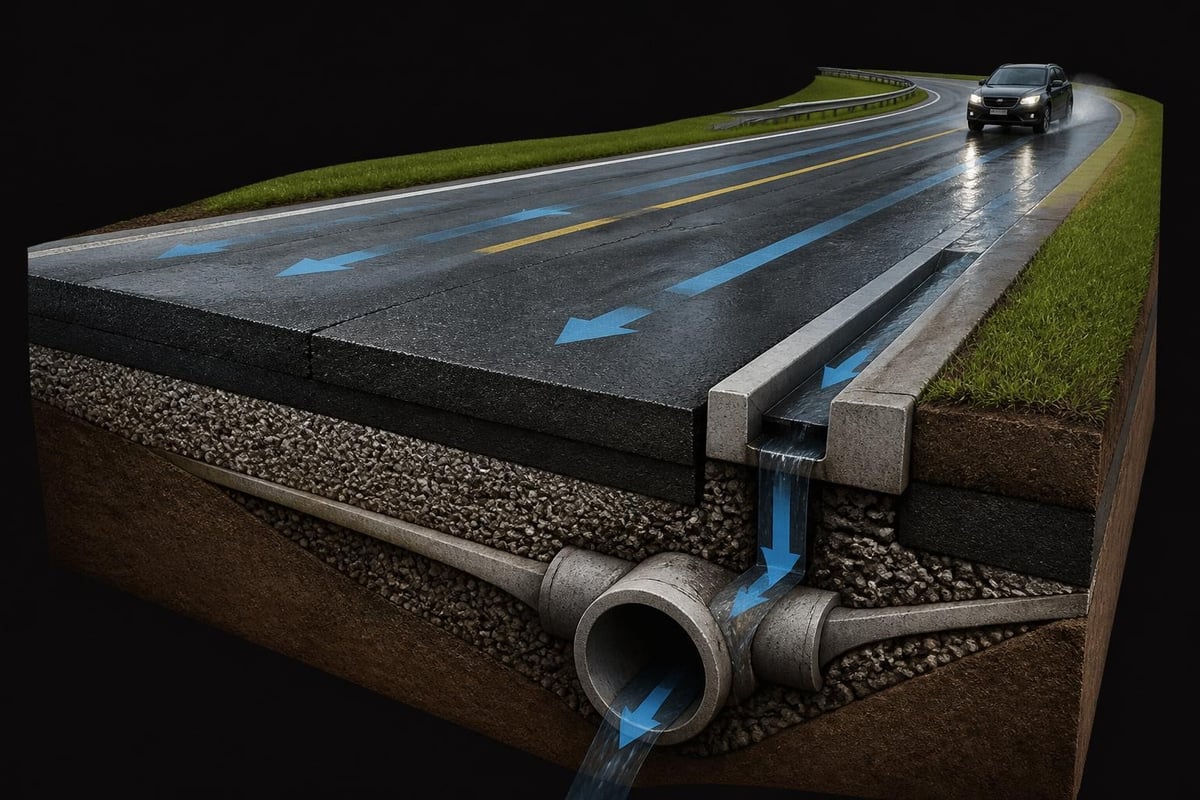
Effective water management separates successful roadways and carriageways from projects plagued by premature deterioration. Water represents the primary enemy of pavement structures, weakening sub-base materials, reducing bearing capacity, and accelerating surface degradation through freeze-thaw cycling and erosion processes.
Surface water drainage requires careful design to prevent ponding whilst directing runoff towards appropriate collection and disposal systems. The Montana Department of Transportation roadway design manuals emphasise the critical relationship between geometric design and drainage performance, with longitudinal and transverse gradients working together to achieve effective water removal.
Sustainable Drainage Considerations
Modern approaches to roadways and carriageways increasingly incorporate sustainable drainage systems (SuDS) that manage surface water through infiltration rather than rapid conveyance to watercourses. These systems provide multiple benefits:
- Reduced peak flow rates alleviating downstream flooding risk
- Natural filtration improving water quality before environmental discharge
- Groundwater recharge supporting ecological balance
- Temperature moderation through evaporative cooling
- Aesthetic enhancement through integrated landscaping
Permeable paving represents one SuDS technique particularly applicable to roadway construction. The surface structure allows water to infiltrate through voids between aggregate particles, either infiltrating to the ground below or being collected in sub-surface storage for controlled release. This approach proves especially valuable in urban regeneration projects where existing drainage infrastructure operates at capacity.
Quality Control and Testing Protocols
Maintaining strict quality standards throughout construction ensures roadways and carriageways perform as designed throughout their intended service life. Professional civil engineering contractors implement comprehensive testing protocols addressing every construction stage.
Material testing begins before construction commences, with aggregate gradings, binder properties, and mix designs verified against specification requirements. During construction, regular sampling ensures consistency and compliance. Core samples extracted from completed carriageways provide definitive evidence of achieved thickness and density.
Compaction testing utilises various methodologies depending on the material and application. Nuclear density gauges provide rapid, non-destructive assessment of achieved compaction levels, whilst plate bearing tests measure the structural capacity of completed layers. These tests verify that materials have been compacted to specification, ensuring adequate load-bearing performance.
| Test Method | Purpose | Typical Frequency |
|---|---|---|
| Aggregate grading | Verify material specification | Per delivery batch |
| Nuclear density gauge | Confirm compaction levels | Every 100-200m² |
| Core sampling | Verify thickness and composition | Every 500-1000m² |
| Deflectograph testing | Assess structural capacity | Post-completion survey |
The systematic application of quality control procedures differentiates professional civil engineering contractors from less rigorous operators. Documentation of test results provides clients with confidence whilst establishing baseline data for future maintenance planning.
Maintenance Strategies for Extended Service Life
Even well-constructed roadways and carriageways require periodic maintenance to address the inevitable deterioration resulting from traffic loading, environmental exposure, and material ageing. Proactive maintenance programmes significantly extend service life whilst minimising whole-life costs compared to reactive approaches that allow defects to propagate unchecked.
Surface dressing represents an effective preventative maintenance technique for asphalt carriageways. A bitumen binder is sprayed onto the existing surface before being covered with aggregate chippings that are rolled into the binder. This treatment seals minor cracks, restores surface texture, and protects the underlying pavement structure from water ingress and UV degradation.
Crack sealing addresses isolated defects before they develop into more serious problems. Cracks allow water to penetrate the pavement structure, accelerating deterioration through several mechanisms. Timely sealing prevents this progression, substantially reducing future maintenance requirements.
For roadways and carriageways showing more extensive deterioration, rehabilitation techniques include:
- Surface course replacement – removing and replacing the wearing course whilst retaining serviceable lower layers
- Plane and overlay – milling the existing surface to a specified depth before applying new material
- Full-depth reconstruction – complete removal and replacement where structural capacity has been compromised
- Crack and seat – deliberately fracturing concrete pavements before overlaying with asphalt to prevent reflection cracking
Advanced assessment tools like FARSA automated roadway safety assessment employ deep learning to evaluate road condition from imagery, enabling data-driven maintenance prioritisation.

Commercial Applications and Project Considerations
Commercial developments present unique challenges for roadways and carriageways design due to concentrated traffic movements, diverse vehicle types, and intensive usage patterns. Drive-through facilities, retail parks, and industrial estates all demand robust infrastructure capable of withstanding continuous heavy loading.
Geometric design for commercial applications requires careful attention to vehicle swept paths, ensuring that delivery vehicles can manoeuvre safely without overrunning kerbs or encroaching on adjacent lanes. This proves particularly critical for drive-through facilities where queue management and operational efficiency depend on appropriate lane widths and turning radii.
Pavement thickness design must account for the cumulative effect of heavy goods vehicle movements. Standard analytical methods such as the design charts published in pavement design standards translate anticipated traffic into required structural capacity. Commercial applications typically require enhanced specifications compared to residential developments experiencing only light vehicle traffic.
The materials specified for commercial roadways and carriageways reflect these demanding conditions. Heavy-duty asphalt mixes incorporating modified binders resist the rutting and deformation that would occur with standard residential-grade materials. Enhanced aggregate specifications with harder stone types provide the necessary resistance to polishing under concentrated traffic.
Residential Driveway Specifications
Whilst residential driveways constitute roadways under technical definitions, their design and construction requirements differ substantially from public highway standards. Nevertheless, professional engineering principles remain applicable, ensuring attractive, durable surfaces that enhance property values whilst providing practical functionality.
Design considerations for residential driveways encompass both aesthetic and functional aspects. The surface must complement the property's architectural character whilst providing adequate drainage, vehicle maneuvering space, and parking capacity. Planning regulations in many areas control driveway construction, particularly regarding permeability and runoff management.
Material selection for residential roadways and carriageways balances durability, aesthetics, and budget. Block paving offers extensive design flexibility with various colours, patterns, and textures available. Resin-bound surfacing provides a contemporary appearance with good permeability characteristics. Traditional asphalt delivers reliable performance at competitive cost, though aesthetic options are more limited.
Research examining highway design exceptions and their safety impacts reminds us that even minor deviations from established standards can have consequences, a principle equally applicable to residential work where proper falls, adequate sub-base depth, and appropriate edge restraints all contribute to long-term performance.
Safety Enhancements Through Thoughtful Design
Safety considerations permeate every aspect of roadways and carriageways design, from geometric layout through to surface characteristics and roadside features. Professional civil engineers employ evidence-based approaches that prioritise user safety without compromising functionality or aesthetic quality.
Visibility represents a fundamental safety requirement. Sightlines at junctions, visibility splays at access points, and adequate lighting all contribute to safe operation. For commercial developments, the interaction between vehicles and pedestrians requires particular attention, with clearly defined routes, appropriate surfacing differentiation, and physical separation where necessary.
Surface characteristics directly influence vehicle control and stopping distances. Adequate skid resistance must be maintained throughout the surface's service life, with materials selected and maintained accordingly. Studies investigating urban roadway design impacts on cyclist safety demonstrate how design choices affect vulnerable road user behaviour and safety outcomes, lessons applicable across diverse project types.
The incorporation of traffic calming measures in appropriate locations reduces vehicle speeds and enhances safety for all users. Speed humps, raised tables, and chicanes can be integrated into roadway design where speed reduction objectives warrant their implementation, though careful design ensures they don't create hazards themselves or generate unacceptable noise and vibration impacts.
Understanding the engineering principles behind roadways and carriageways enables property owners and developers to make informed decisions about their infrastructure projects whilst appreciating the value that professional expertise delivers. Whether you're planning a commercial development requiring robust pavement structures or a residential driveway that combines aesthetics with durability, working with experienced civil engineering contractors ensures your project meets technical standards whilst achieving your practical and visual objectives. JRG Civils brings the expertise and attention to detail necessary for successful roadway projects across the North East and throughout the UK, delivering excellence from initial design through to final completion.