
Granite curb stones represent a cornerstone of quality civil engineering projects, offering unmatched durability and aesthetic appeal for highways, commercial developments, and residential properties. Whether you're planning a drive-through facility, car park construction, or driveway enhancement, understanding the benefits and specifications of granite kerbing ensures your project stands the test of time. These natural stone elements provide essential edge definition whilst withstanding the harshest British weather conditions and heavy traffic loads, making them the preferred choice for contractors who take pride in delivering exceptional standards.
Why Granite Curb Stones Outperform Alternative Materials
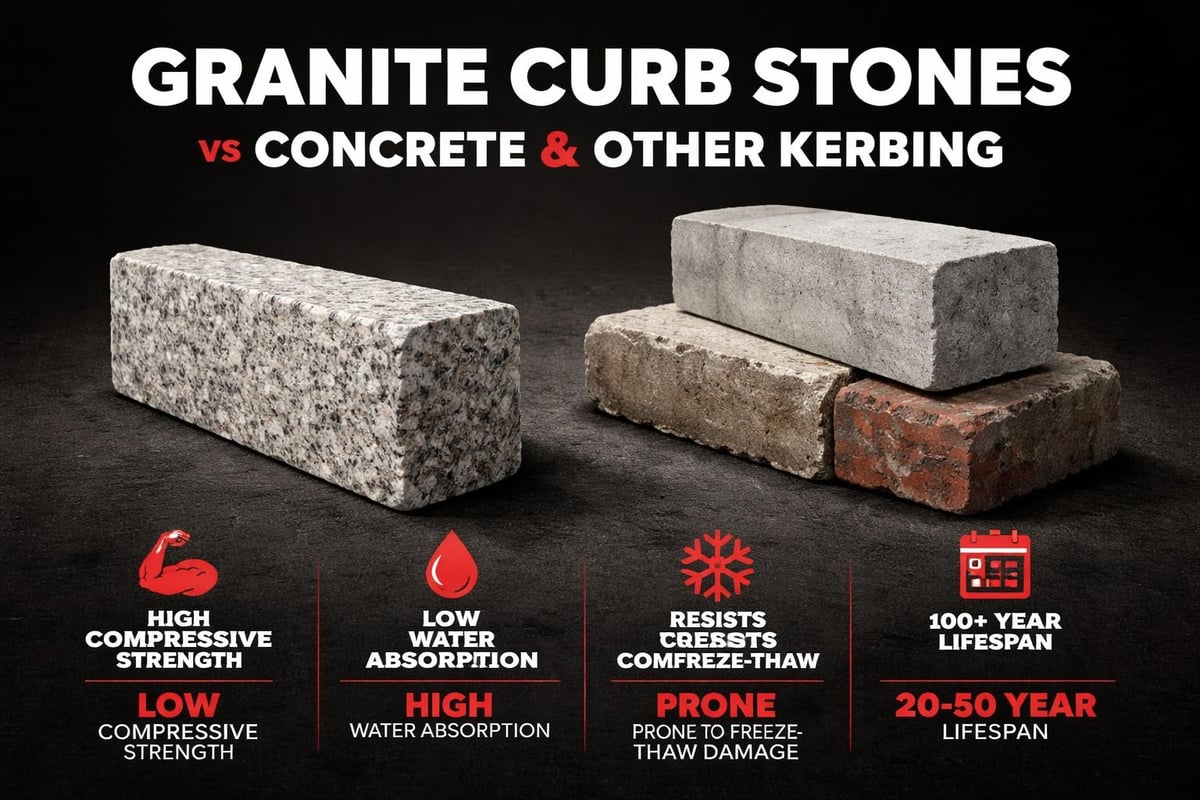
The superiority of granite curb stones becomes evident when examining material longevity and maintenance requirements over decades of service. Granite's inherent strength derives from its igneous formation, creating an extremely dense crystalline structure that resists wear, weathering, and chemical degradation.
Key Performance Advantages:
- Compressive strength exceeding 19,000 psi, far surpassing concrete alternatives
- Freeze-thaw resistance essential for British climate conditions
- Minimal water absorption typically below 0.4%, preventing cracking and spalling
- Colour stability maintaining appearance without fading or discolouration
- Impact resistance crucial for loading bays and high-traffic areas
Commercial projects such as drive-through restaurants and retail car parks demand materials that maintain professional appearance whilst handling constant vehicle movements. Granite kerbing meets these requirements whilst reducing lifecycle costs through minimal maintenance needs.
Material Specifications and Standards
Professional installation begins with selecting appropriate granite curb stones that meet rigorous industry standards. The material specifications cover dimensions, finishes, and quality benchmarks that ensure consistency across projects.
| Specification Category | Standard Requirement | Typical Range |
|---|---|---|
| Compressive Strength | Minimum 19,000 psi | 19,000-30,000 psi |
| Water Absorption | Maximum 0.4% | 0.2-0.4% |
| Flexural Strength | Minimum 1,500 psi | 1,500-2,500 psi |
| Density | Minimum 160 lb/ft³ | 160-180 lb/ft³ |
Polycor’s technical guide provides comprehensive material specifications that align with Department of Transportation requirements, ensuring compliance across various jurisdictions. Understanding these benchmarks helps contractors specify materials confidently for both public highway projects and private developments.
Finish options significantly impact both aesthetics and functionality. Rock-faced finishes provide traditional character suitable for heritage areas, whilst thermal finishes offer slip resistance for pedestrian zones. Polished faces deliver contemporary aesthetics ideal for commercial frontages and prestige developments.
Installation Techniques for Long-Term Performance
Proper installation techniques determine whether granite curb stones deliver their full service life potential or require premature replacement. The foundation preparation, setting methods, and jointing procedures each contribute to overall system performance.
Foundation and Base Preparation
Adequate foundation design prevents the settlement and movement that causes kerb failure. The base requirements vary depending on anticipated loading conditions and existing ground conditions.
Foundation Depth Guidelines:
- Light-duty applications (residential driveways): minimum 150mm compacted granular base
- Medium-duty areas (car parks): 200-250mm engineered base with geotextile separation
- Heavy-duty highways: 300mm minimum with appropriate sub-base specification
- Loading areas (delivery zones): reinforced concrete haunching with 400mm depth
Excavation width should accommodate the kerb dimension plus a minimum 150mm working space on the rear face for proper haunching. This additional width ensures adequate concrete support that prevents forward rotation under vehicle impact.
Ground conditions assessment identifies weak spots requiring additional stabilisation. Clay soils benefit from lime stabilisation, whilst waterlogged areas need drainage solutions before kerb installation commences. Best practices in stone installation emphasise the importance of addressing these foundational issues before material placement.
Setting and Alignment Procedures
Precise alignment and level control separate professional installations from amateur attempts. String lines establish both horizontal and vertical control, ensuring smooth curves and consistent reveal heights.
Granite curb stones require setting in a mortar bed that provides immediate stability whilst allowing minor adjustments. A 3:1 sand-cement mix offers adequate strength without premature stiffening that prevents repositioning.
The haunching concrete provides structural support that prevents kerb movement under lateral forces. Standard practice involves placing concrete to two-thirds of the kerb height on the rear face, sloping away to promote drainage. This haunching should cure for minimum 24 hours before backfilling or trafficking.
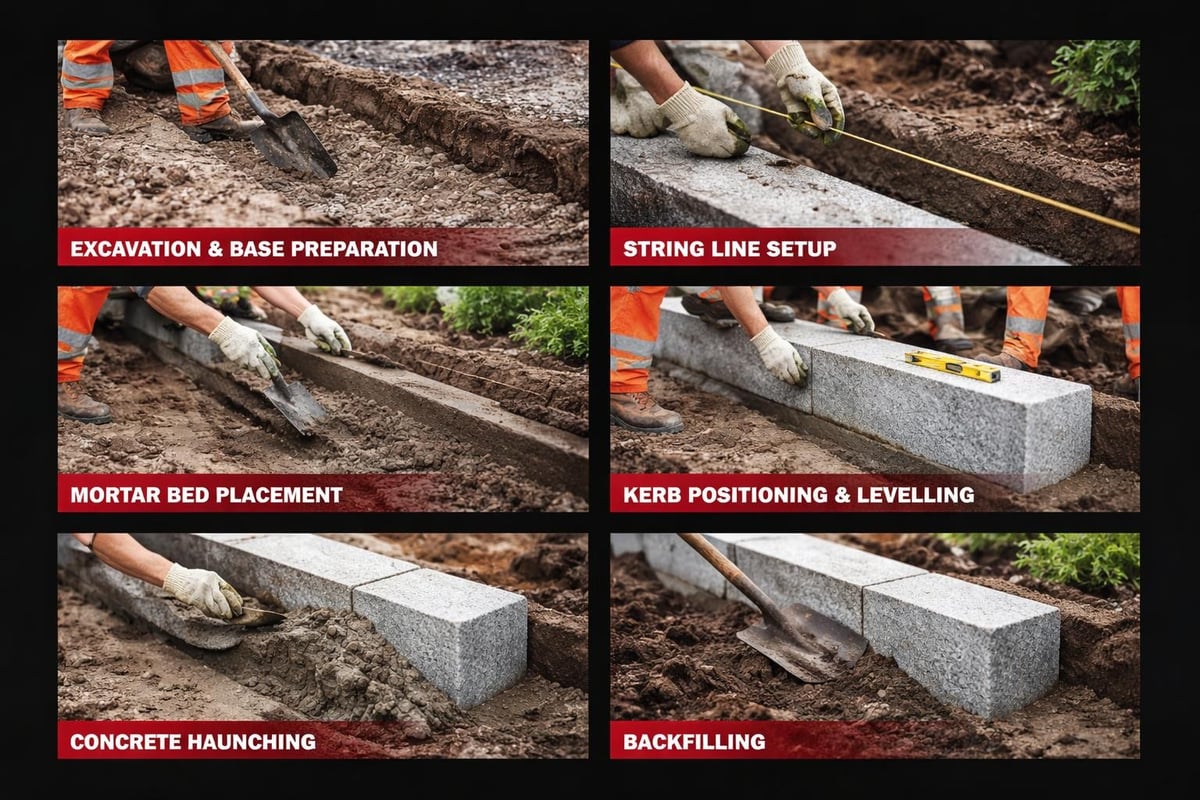
| Installation Stage | Critical Control Points | Common Errors to Avoid |
|---|---|---|
| Base Preparation | Compaction, drainage, level tolerance | Inadequate depth, poor compaction |
| String Line Setup | Accurate curves, consistent reveal | Sagging lines, incorrect height |
| Mortar Bedding | Consistent thickness, workable mix | Excessive water, insufficient coverage |
| Kerb Placement | Tight joints, precise alignment | Gaps exceeding 3mm, misalignment |
| Haunching | Adequate coverage, proper slope | Insufficient height, voids behind kerb |
Application-Specific Considerations
Different project types demand tailored approaches to granite curb stone specification and installation. Understanding these nuances ensures optimal performance across diverse civil engineering contexts.
Highway and Road Projects
Public highway applications require compliance with local authority specifications and Department of Transportation standards that govern dimensions, materials, and installation methods. Standard highway kerbs typically measure 125mm width by 255mm depth, though variations exist for specific applications.
Visibility requirements in highway contexts favour lighter granite colours that provide clear delineation, particularly important at junctions and pedestrian crossing points. Reflective properties help drivers identify carriageway edges during low-light conditions, contributing to road safety objectives.
Drainage integration represents a critical design consideration. Kerbs work in conjunction with gullies and channels to manage surface water, preventing ponding that creates hazards and accelerates pavement deterioration. Urban design guidelines demonstrate how granite kerbing integrates with comprehensive stormwater management systems.
Commercial Development Applications
Drive-through facilities, retail car parks, and service areas subject granite curb stones to intensive use patterns that test material durability. Vehicle overrun, particularly by delivery lorries and commercial vehicles, generates impact forces exceeding residential applications.
Commercial Project Requirements:
- Increased haunching dimensions for enhanced stability
- Radius kerbs for smooth traffic flow through tight turns
- Integration with wheel stops and bollards for parking control
- Coordination with surface water drainage and interceptors
- Compliance with accessibility standards for pedestrian movements
The projects completed by specialist contractors demonstrate how granite kerbing contributes to professional finish quality that reflects brand standards. Premium materials signal quality to customers whilst reducing maintenance interventions that disrupt business operations.
Residential Driveways and Private Developments
Domestic applications offer greater design flexibility, allowing homeowners to select granite curb stones that complement architectural character and landscape design. The kerb style can range from substantial traditional profiles to sleek contemporary lines that suit modern properties.
Colour selection impacts overall aesthetic harmony. Silver-grey granites coordinate with most house styles, whilst pink and red tones provide warmth that suits period properties. Black granites deliver contemporary sophistication ideal for minimalist design schemes.
Radius work enables curved driveways and borders that soften hard landscaping. Smaller dimension stones facilitate tighter curves, though skilled installation can achieve impressive radii with standard units through careful joint management.
Maintenance and Long-Term Care
Although granite curb stones require minimal maintenance compared to alternative materials, periodic care preserves appearance and extends service life. Understanding proper maintenance protocols prevents damage from inappropriate cleaning methods or neglect.
Routine Cleaning Procedures
Regular cleaning removes accumulated dirt, algae, and organic matter that can stain granite surfaces over time. Simple maintenance schedules prevent the build-up that necessitates aggressive intervention.
Recommended Cleaning Frequency:
- Monthly: Brush down with water to remove loose debris
- Quarterly: Wash with pH-neutral detergent solution
- Annually: Deep clean with appropriate stone cleaner
- As needed: Spot treat stains or biological growth
Pressure washing offers effective cleaning but requires care to avoid joint mortar erosion. Maintain equipment at moderate pressure settings (maximum 1,500 psi) and avoid directing the jet into joints at close range. Professional stone maintenance guidance emphasises gentle techniques that clean effectively without causing damage.
Avoid acidic cleaners that can etch granite surfaces and weaken mortar joints. Vinegar, lemon juice, and harsh chemical cleaners all risk permanent damage to both stone and pointing materials.

Repair and Restoration Techniques
Despite granite's exceptional durability, occasional repairs address damage from impacts, settlement, or installation defects. Early intervention prevents minor issues escalating into costly replacements.
Joint repointing represents the most common maintenance requirement. Mortar deterioration occurs gradually through weathering and traffic vibration. Rake out failed joints to minimum 20mm depth before repointing with matching mortar that maintains consistency across the installation.
Individual stone replacement becomes necessary when units suffer significant damage. Careful extraction prevents disturbing adjacent stones, achieved through cutting haunching and mortar joints before lifting the damaged unit. New stones require matching existing material for colour and finish consistency.
Settlement correction addresses individual stones that have dropped below design level. Lifting and re-setting on fresh mortar beds restores proper alignment, though investigating underlying causes prevents recurrence. Durability insights for stone installations highlight the importance of addressing root causes rather than merely treating symptoms.
Specification and Procurement Considerations
Successful projects begin with comprehensive specifications that communicate requirements clearly to suppliers and installers. Detailed documentation prevents misunderstandings whilst establishing quality benchmarks.
Creating Effective Specifications
Granite curb stone specifications should address multiple aspects that influence project outcomes. Material properties, dimensional tolerances, finish requirements, and installation standards all warrant explicit definition.
| Specification Element | Details Required | Purpose |
|---|---|---|
| Material Source | Granite type, quarry location | Ensures consistency, verifies availability |
| Physical Properties | Strength, absorption, density | Confirms performance characteristics |
| Dimensions | Length, width, depth, tolerances | Enables accurate quantity calculations |
| Finish | Face treatment, edge details | Defines aesthetic outcome |
| Installation Method | Base, bedding, haunching requirements | Ensures proper structural support |
Detailed granite specifications demonstrate the level of detail that eliminates ambiguity whilst providing contractors with clear execution guidance. Comprehensive documents reduce variations and disputes during project delivery.
Tolerances merit particular attention, as excessive variation complicates installation and compromises finished appearance. Dimensional tolerances typically permit ±3mm on length and ±2mm on cross-sectional dimensions for standard production.
Quality Assurance and Testing
Material testing verifies compliance with specified properties before installation commences. Independent laboratory testing provides objective verification that granite curb stones meet performance requirements.
Standard test protocols include compressive strength determination, water absorption measurement, and freeze-thaw cycling. Reputable suppliers provide certification documenting test results from accredited laboratories.
Visual inspection identifies surface defects, colour variations, and dimensional discrepancies. Reject stones showing cracks, excessive veining that compromises strength, or finishes that deviate from specification. Quality control at receipt prevents substandard materials entering the works.
Cost-Benefit Analysis for Project Planning
Investment decisions benefit from comprehensive cost analysis that examines initial expenditure alongside lifecycle considerations. Granite curb stones command premium pricing compared to concrete alternatives, yet deliver superior long-term value.
Initial Cost Factors
Material costs vary significantly based on granite colour, finish complexity, and order quantity. Standard grey granite with rock-faced finish represents the most economical option, whilst exotic colours and polished finishes command higher prices.
Cost Influencing Variables:
- Granite colour and rarity (common grey versus premium colours)
- Finish complexity (rock-faced versus polished or thermal)
- Order volume (bulk purchases achieve better unit rates)
- Delivery distance and access constraints
- Installation complexity (straight runs versus radius work)
- Site conditions requiring additional preparation
Installation labour represents a significant cost component. Skilled craftsmen command appropriate rates reflecting the precision required for quality kerb work. Rushing installation through inexperienced labour proves false economy when failures necessitate remedial works.
Lifecycle Value Proposition
The true economic advantage of granite curb stones emerges over decades of service life. Minimal maintenance requirements, exceptional durability, and sustained appearance deliver return on investment that surpasses initial cost differentials.
Concrete kerbs require periodic replacement after 15-25 years depending on conditions and traffic loading. Granite installations routinely exceed 50 years with minimal intervention, often outlasting the pavements they border. This longevity translates to reduced whole-life costs and avoided disruption from replacement projects.
Maintenance cost savings accumulate annually through reduced cleaning, repair, and replacement requirements. Property values benefit from premium materials that signal quality and maintain kerb appeal throughout ownership periods.
Design Integration and Aesthetic Considerations
Granite curb stones contribute significantly to project aesthetics beyond their functional role. Thoughtful design integration enhances visual appeal whilst maintaining practical performance.
Colour and Texture Selection
The natural variation within granite provides rich palette options that suit diverse design visions. Regional granite sources offer characteristic colours that create sense of place and connection to local geology.
Silver-grey granites deliver versatility that coordinates with most architectural styles and paving materials. These neutral tones provide timeless appeal that ages gracefully without appearing dated as design trends evolve.
Warmer tones including pink, red, and brown granites suit traditional settings and heritage contexts. These colours complement brick architecture and natural stone buildings whilst providing contrast against darker asphalt surfaces.
Texture selection influences both aesthetics and functionality. Polished finishes showcase granite's crystalline structure whilst providing formal character suited to prestige developments. Thermal finishes offer contemporary aesthetics with improved slip resistance. Rock-faced profiles deliver traditional charm with pronounced texture that suits conservation areas.
Radius and Custom Profiles
Curved layouts require careful planning to achieve smooth radii without excessive joint gaps. Standard straight units can form curves through joint fanning, though tighter radii benefit from purpose-made radius stones manufactured to specific curves.
Transition pieces manage changes in height, direction, or profile that occur throughout developments. Step units, dropped kerbs for accessibility, and junction details require coordination during specification to ensure seamless integration.
Custom profiles accommodate unique project requirements ranging from drainage channels to decorative features. Many suppliers offer bespoke manufacturing services that deliver stones matching specific design requirements, though custom work commands premium pricing and extended lead times.
Granite curb stones deliver unmatched durability, aesthetic appeal, and lifecycle value for highways, commercial developments, and residential projects throughout the UK. From foundation preparation through installation and maintenance, attention to detail at every stage ensures these premium materials perform to their full potential. Whether you're planning a major highway scheme, commercial car park, or residential driveway enhancement, JRG Civils brings the expertise and commitment to quality that transforms civil engineering projects into lasting assets. Our experience across diverse applications ensures your granite kerbing installation meets the highest standards from start to finish.