
Earthwork in road construction forms the foundational stage of any successful infrastructure project, establishing the stable base upon which durable roads, highways, and driveways are built. This critical phase involves the systematic excavation, transportation, placement, and compaction of soil materials to create a properly graded surface that meets engineering specifications. Whether constructing commercial access roads for drive-through facilities or residential driveways, understanding the complexities of earthwork processes ensures project longevity, cost efficiency, and structural integrity throughout the lifespan of the road surface.
Understanding Earthwork Fundamentals
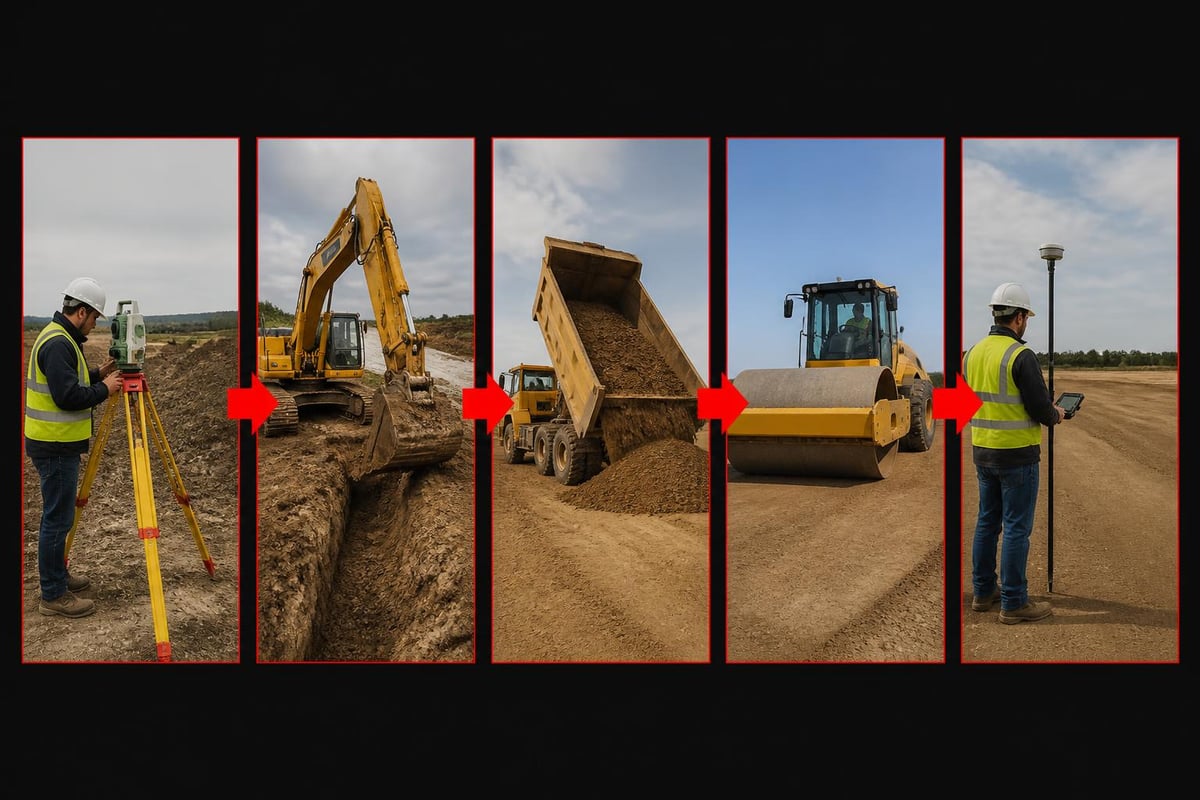
Earth work in road construction encompasses all operations involved in manipulating earth materials to achieve the desired road profile and structural stability. The process begins with detailed surveying and site assessment, progressing through excavation of unsuitable materials, followed by the strategic placement of engineered fill materials. According to Procore’s comprehensive guide to earthwork construction, this foundational work directly impacts the performance and durability of the final road surface.
The primary objectives include creating a stable subgrade, establishing proper drainage gradients, and ensuring adequate load-bearing capacity for the anticipated traffic volumes. Each cubic metre of soil moved represents a calculated decision based on geotechnical analysis, moisture content evaluation, and compaction requirements.
Key Components of Earthwork Operations
Successful earthwork execution relies on several interconnected elements working in harmony:
- Site preparation and clearing to remove vegetation, topsoil, and obstructions
- Excavation and cut operations to achieve design elevations
- Fill placement and compaction to build up low areas
- Grading and shaping to establish proper drainage slopes
- Quality control testing to verify compaction and material specifications
The balance between cut and fill volumes significantly affects project economics. Efficient earthwork in road construction minimizes the need to import or export materials, reducing haulage costs and environmental impact whilst maintaining schedule adherence.
Excavation Methods and Best Practices
Excavation represents the removal of earth materials from their natural position, creating space for road formation or removing unsuitable soils. The Michigan Department of Transportation’s roadway earthwork guidelines detail specific equipment requirements and procedural standards that ensure safe and efficient excavation operations.
Classification of Excavation Types
Different soil conditions and project requirements demand varied excavation approaches:
| Excavation Type | Application | Typical Equipment |
|---|---|---|
| Common Excavation | Routine soil removal | Excavators, dozers, scrapers |
| Rock Excavation | Hard material removal | Rippers, breakers, explosives |
| Unsuitable Material Removal | Contaminated or weak soil | Specialized excavators |
| Drainage Excavation | Trenches and culverts | Backhoes, trenchers |
Mass excavation for major highway projects differs substantially from precision excavation required for residential driveways. In commercial applications such as drive-through facilities, excavation depths must accommodate substantial base courses whilst maintaining tight tolerances for drainage systems and utility installations.
The selection of excavation methodology depends on soil type, moisture conditions, working space constraints, and proximity to existing structures. Modern GPS-guided equipment has revolutionized excavation accuracy, enabling operators to achieve design grades within millimetres whilst maximizing productivity.
Grading and Slope Management
Proper grading establishes the foundation for effective drainage and structural stability throughout the road's service life. Earth work in road construction demands meticulous attention to longitudinal and cross-sectional gradients to prevent water accumulation and premature pavement failure.
Cross-fall gradients typically range from 2% to 4% on straight sections, ensuring surface water runs efficiently to drainage channels. Longitudinal grades must balance driver safety, drainage requirements, and earthwork volumes. The NZ Forest Road Engineering Manual emphasizes drainage control as paramount during construction phases.
Achieving Precise Grade Control
Modern road construction projects employ multiple verification methods:
- Initial survey establishment using total stations and GPS networks
- Continuous grade checking during excavation and fill operations
- String line verification for critical sections requiring high precision
- Laser-guided grading for final surface preparation
- Post-compaction surveys to confirm design compliance
Minor grade discrepancies can cause significant drainage problems, leading to water infiltration beneath the pavement structure and accelerated deterioration. For projects ranging from small residential driveways to expansive commercial parking areas, grade precision directly correlates with long-term performance.
Compaction Standards and Testing
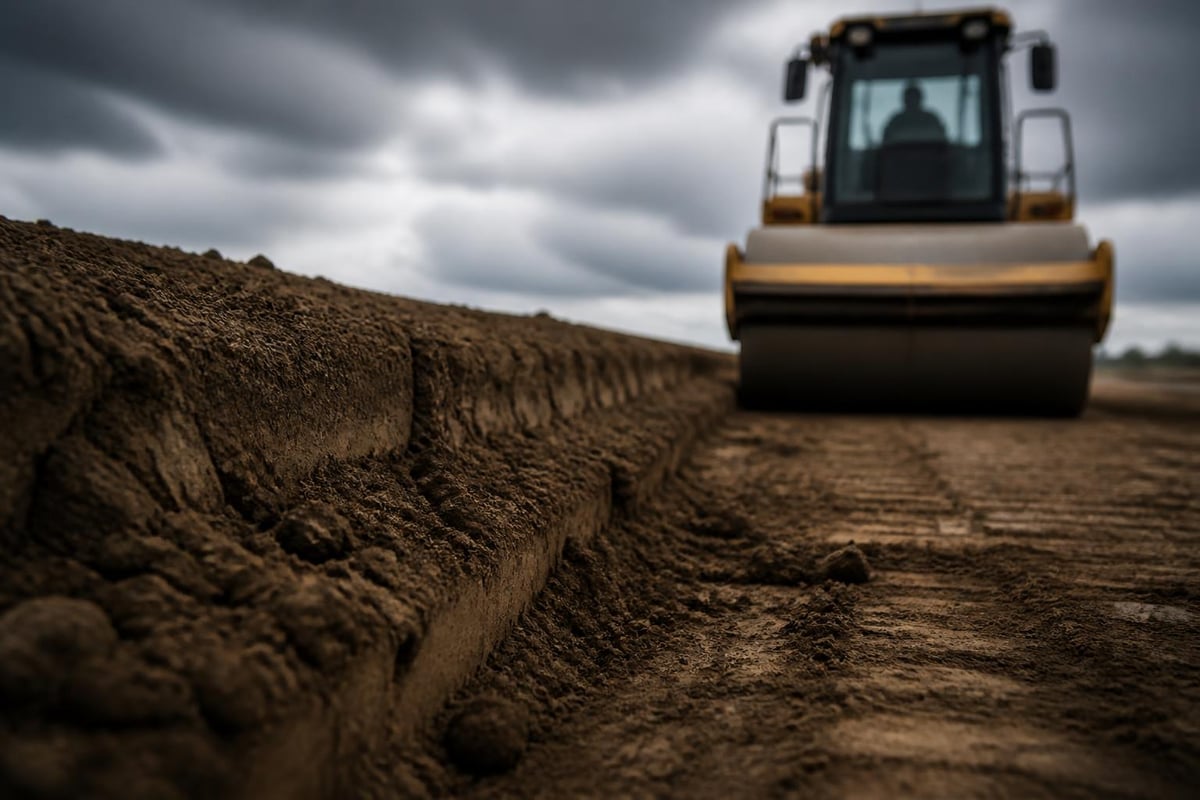
Compaction increases soil density, improving load-bearing capacity and reducing settlement potential. This critical aspect of earth work in road construction transforms loose fill materials into a stable foundation capable of supporting traffic loads without excessive deformation.
The degree of compaction is typically specified as a percentage of maximum dry density determined through laboratory testing such as the Modified Proctor test. Highway specifications commonly require 95% to 100% compaction in the upper subgrade layers, with slightly lower requirements in deeper fill sections.
Compaction Equipment Selection
Different soil types and layer thicknesses require specific compaction equipment:
- Vibratory rollers for granular materials and thin lifts
- Sheepsfoot rollers for cohesive clay soils
- Pneumatic-tyred rollers for final sealing and finishing
- Plate compactors for confined spaces and utility trenches
- Rammers for highly confined areas and spot repairs
Moisture content during compaction proves crucial for achieving specified densities. Soil too dry resists compaction, whilst overly wet material develops excess pore pressures and achieves inadequate density. The Caltrans earthwork construction manual provides detailed moisture conditioning procedures for various soil classifications.
Field density testing using nuclear gauges or sand cone methods verifies compliance at regular intervals. Projects completed by experienced contractors incorporate continuous quality monitoring, preventing costly remediation after subsequent construction layers have been placed.
Cut and Fill Balance Optimization
Efficient earth work in road construction seeks to balance cut volumes with fill requirements, minimizing material haulage distances and associated costs. The research on unified vertical alignment and earthwork models demonstrates how optimization techniques can significantly reduce project expenses whilst improving environmental outcomes.
Mass Haul Diagram Applications
Civil engineers utilize mass haul diagrams to visualize earthwork movement and identify optimal haulage strategies:
| Parameter | Impact on Cost | Design Consideration |
|---|---|---|
| Average Haul Distance | Direct cost driver | Minimize through alignment adjustment |
| Free Haul Limit | Contract threshold | Typically 300-500 metres |
| Borrow vs. Waste | Material sourcing | Balance import/export costs |
| Shrinkage/Swell Factors | Volume calculations | Soil-specific adjustments |
For commercial projects such as drive-through facilities, site constraints often limit earthwork balancing opportunities, necessitating import of engineered fill materials or export of excess excavation. Residential driveway projects typically work within existing site elevations, requiring careful material selection to achieve compaction requirements with available soils.
Strategic sequencing of earthwork operations can create temporary haul roads from initial excavation materials, improving site access whilst reducing disturbance to surrounding areas. This approach proves particularly valuable on constrained urban sites where public road usage for hauling generates disruption and additional costs.
Drainage Integration During Earthwork
Effective drainage systems must be integrated throughout earth work in road construction phases, not merely added as afterthoughts. The Missouri Department of Transportation’s drainage excavation guidelines emphasize coordination between earthwork operations and drainage installation to ensure long-term pavement performance.
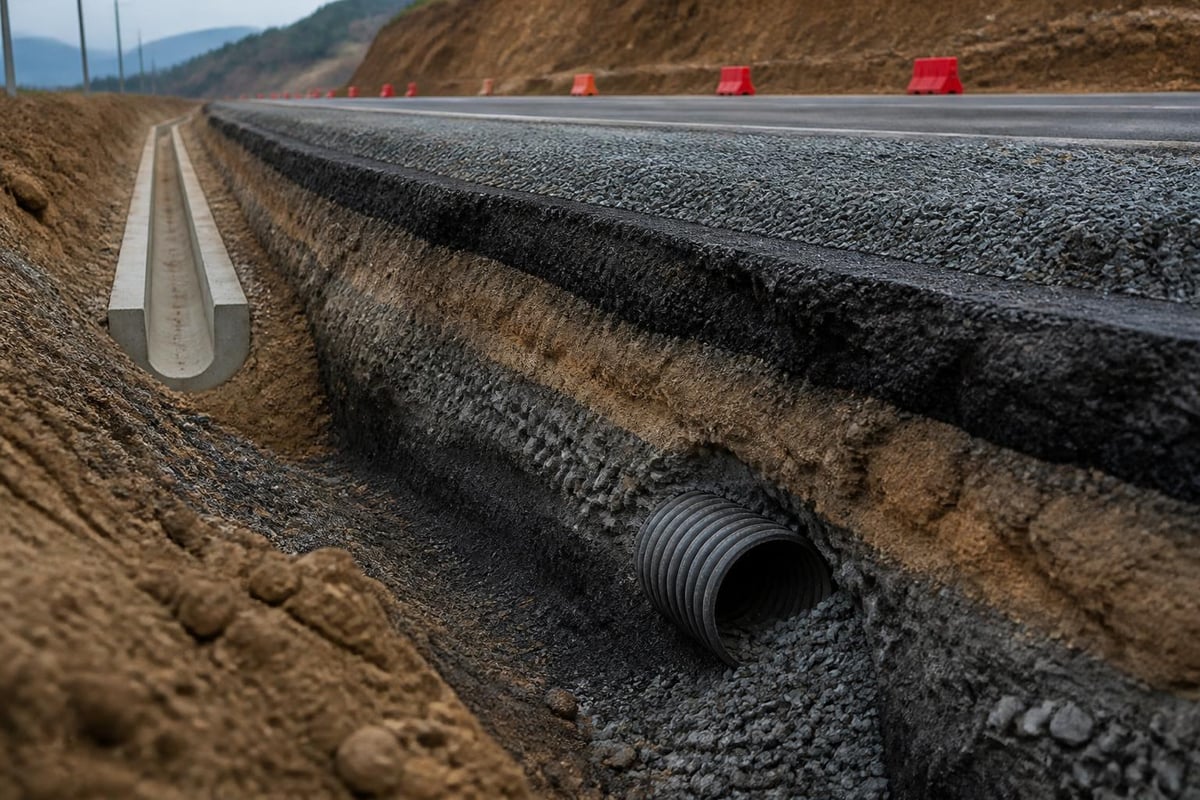
Subsurface drainage prevents water accumulation within the pavement structure, whilst surface drainage rapidly removes precipitation from the travelled way. Both systems require precise grading and installation during earthwork phases.
Critical Drainage Elements
Installation sequencing follows a logical progression:
- Underdrains and French drains placed in excavated trenches before fill placement
- Geotextile fabrics installed to prevent soil migration and maintain drainage capacity
- Cross drains and culverts positioned at natural water courses
- Longitudinal drains constructed adjacent to the road alignment
- Surface water collection through grading to designed drainage channels
Temporary drainage provisions during construction prevent erosion of exposed earthwork and maintain working conditions during wet weather. Failure to protect newly placed fills can result in saturation, loss of compaction, and project delays extending weeks or months.
For projects across the UK, where precipitation occurs throughout the year, robust temporary drainage proves essential. Experienced contractors incorporate phased construction schedules that minimize exposed earthwork duration whilst maintaining adequate protection measures.
Material Selection and Classification
Soil materials exhibit vastly different engineering properties based on particle size distribution, plasticity characteristics, and moisture sensitivity. Proper classification guides material placement decisions within earth work in road construction projects.
The Unified Soil Classification System (USCS) and AASHTO classification systems provide standardized methods for categorizing soils. Well-graded granular materials with limited fines content typically perform excellently as subgrade and subbase materials, whilst highly plastic clays require stabilization or replacement.
Suitability Criteria for Road Construction
| Soil Type | Subgrade Suitability | Treatment Options |
|---|---|---|
| Well-graded gravel (GW) | Excellent | Use as placed |
| Poorly-graded sand (SP) | Fair to good | Moisture control |
| Low-plasticity clay (CL) | Poor to fair | Lime/cement stabilization |
| High-plasticity clay (CH) | Very poor | Replacement recommended |
| Organic soils (OL, OH) | Unsuitable | Complete removal required |
On-site soils frequently require improvement to meet specifications. Stabilization using lime, cement, or proprietary additives transforms marginal materials into acceptable construction materials, reducing import costs whilst utilizing existing resources. The National Academies’ sustainable highway construction guidelines discuss environmental benefits of maximizing on-site material utilization.
For commercial developments requiring substantial earthwork volumes, preliminary geotechnical investigation identifies material sources and potential problem areas before construction commences. This proactive approach prevents unexpected conditions that could compromise schedules and budgets.
Embankment Construction Techniques
Embankment construction involves placing and compacting fill materials to raise the road elevation above existing ground levels. This aspect of earth work in road construction demands systematic layer placement, moisture conditioning, and quality verification to achieve stable, long-lasting structures.
Fill materials are placed in horizontal lifts, typically 150mm to 300mm thick before compaction, depending on equipment capability and material characteristics. Each lift receives uniform compaction before the subsequent layer is placed, preventing differential settlement and ensuring consistent density throughout the embankment height.
Foundation Preparation Requirements
Before embankment placement begins, foundation preparation ensures adequate support:
- Vegetation and topsoil stripping to expose competent bearing material
- Proof rolling to identify weak zones requiring treatment
- Benching into slopes when constructing fills on inclined ground
- Subgrade stabilization where soft materials cannot be economically removed
- Geogrid installation to reinforce weak foundation conditions
The NZ Forest Road Engineering Manual’s guidance on cut and bench fill construction details methods for building roads in challenging terrain where hillside construction demands specialized techniques.
High embankments require careful monitoring during and after construction to detect settlement or lateral movement. Inclinometers, settlement plates, and survey monitoring provide early warning of instability, enabling corrective measures before serious problems develop.
Quality Control and Documentation
Comprehensive quality control programs distinguish successful earth work in road construction projects from those plagued by performance problems and disputes. Systematic testing, inspection, and documentation create an evidence trail demonstrating specification compliance whilst identifying deficiencies requiring correction.
Testing frequencies are specified in project documents, typically requiring density verification at regular intervals and whenever conditions change. Nuclear density gauges provide rapid results, enabling real-time decisions about compaction adequacy.
Essential Documentation Elements
Professional contractors maintain detailed records including:
- Daily earthwork quantities by station and material type
- Compaction test results with locations and depths
- Moisture content measurements and conditioning activities
- Weather conditions affecting earthwork operations
- Material source documentation and approval records
Photographic documentation proves invaluable for resolving disputes and demonstrating proper construction procedures. Time-stamped images showing layer thicknesses, compaction equipment, and testing locations supplement formal test reports.
For commercial clients requiring design-build services, integrated quality systems ensure earthwork meets both immediate construction needs and long-term performance expectations. Projects delivered by JRG Civils incorporate rigorous quality protocols from initial excavation through final grading verification.
Environmental Considerations and Sustainability
Modern earth work in road construction increasingly incorporates sustainable practices minimizing environmental impact whilst maintaining engineering performance. Erosion control, dust suppression, and noise management protect surrounding areas during construction phases.
Sediment control measures prevent soil-laden runoff from entering watercourses, utilizing silt fences, sediment traps, and stabilized construction entrances. These provisions prove especially critical during winter months when precipitation levels peak across the UK.
Sustainable Earthwork Strategies
Progressive contractors implement multiple sustainability measures:
- Maximizing on-site material reuse to reduce haulage emissions
- Scheduling to minimize wet-weather working and associated environmental impacts
- Utilizing recycled materials for non-critical applications
- Implementing progressive stabilization of completed earthwork areas
- Employing modern equipment with improved fuel efficiency and emissions control
Material recycling extends beyond basic reuse of excavated soils. Crushed concrete from demolished structures, recycled asphalt planings, and processed industrial by-products increasingly serve as engineered fill materials when properly tested and approved.
Climate considerations influence both design and construction methods. Increased precipitation intensity and frequency necessitate enhanced drainage capacity, whilst extended dry periods may complicate moisture conditioning during compaction operations.
Equipment Selection and Productivity
Earth work in road construction productivity depends heavily on appropriate equipment selection matched to project scale, site conditions, and material characteristics. Modern machinery incorporates GPS guidance, automated grade control, and telemetry systems that enhance accuracy whilst improving operator efficiency.
Excavators dominate material handling on most projects, available in sizes from compact units suitable for confined residential work to large machines moving substantial volumes on highway projects. Track-mounted machines excel in soft ground conditions, whilst wheeled excavators offer superior mobility on firm surfaces.
Matching Equipment to Applications
| Project Scale | Primary Equipment | Productivity Range |
|---|---|---|
| Residential driveways | Mini excavator, small roller | 50-150 m³/day |
| Commercial parking areas | Standard excavator, vibratory roller | 200-500 m³/day |
| Highway projects | Large excavators, scrapers, dozers | 1,000-5,000 m³/day |
Haul equipment selection balances capacity, site access, and economics. Articulated dump trucks handle rough terrain and steep gradients effectively, whilst rigid trucks offer higher capacity on well-maintained haul roads. For shorter distances, excavator-loader combinations may prove more economical than dedicated hauling equipment.
Rental versus ownership decisions depend on utilization rates and project duration. Specialized equipment required intermittently typically makes more economic sense to hire, whilst core machinery seeing continuous use justifies capital investment.
Project Planning and Coordination
Successful earth work in road construction requires meticulous planning coordinating multiple activities across compressed timeframes. Sequencing earthwork with drainage installation, utility placement, and pavement construction demands careful scheduling that accounts for weather windows, material delivery, and inspection requirements.
Critical path analysis identifies activities controlling project duration, enabling resource allocation that prevents delays. Earthwork often resides on the critical path early in construction schedules, making productivity and weather management paramount.
Pre-Construction Planning Essentials
Thorough planning addresses numerous considerations:
- Geotechnical investigation review to understand material characteristics
- Environmental permit compliance ensuring regulatory approvals
- Utility location verification preventing conflicts and service disruptions
- Haul route planning minimizing public impact and optimizing efficiency
- Material source identification securing adequate quantities at competitive pricing
Weather contingency planning proves essential for UK projects where precipitation can halt operations for extended periods. Alternative work areas, covered storage for materials, and flexible scheduling accommodate inevitable weather delays without catastrophic schedule impacts.
Communication protocols ensure all stakeholders receive timely information about progress, problems, and schedule adjustments. Weekly coordination meetings, digital progress tracking, and collaborative planning tools maintain alignment between owners, designers, contractors, and regulatory authorities.
Successful road construction fundamentally depends on expertly executed earthwork that establishes stable foundations through proper excavation, grading, compaction, and drainage integration. These principles apply equally whether constructing major highways, commercial access roads, or residential driveways, with attention to detail and specification compliance separating enduring infrastructure from premature failures. At JRG Civils, we bring comprehensive civil engineering expertise to every earthwork project, from initial site assessment through final grade verification, ensuring your road construction investment delivers decades of reliable performance. Contact JRG Civils today to discuss how our earthwork capabilities can support your next infrastructure project across the North East or throughout the UK.