
Civil earthworks form the fundamental backbone of virtually every construction project, from motorway developments to residential driveways. This essential phase of civil engineering involves the systematic manipulation, movement, and placement of earth materials to create stable foundations and achieve desired ground levels. Whether you're planning a commercial development or a domestic driveway installation, understanding the principles and practices of earthworks ensures project success and long-term structural integrity.
Understanding Civil Earthworks Fundamentals
Civil earthworks encompass a wide range of ground preparation activities that transform raw land into construction-ready sites. At its core, this discipline involves the careful management of soil, rock, and other earth materials to establish proper grades, drainage patterns, and load-bearing surfaces.
The primary objective is to create a stable platform that can support the intended structure, whether that's a major highway, a commercial facility, or a residential enhancement. Earthworks in civil engineering require precise planning and execution to avoid costly remediation work later in the construction timeline.
Key Components of Earthworks Operations
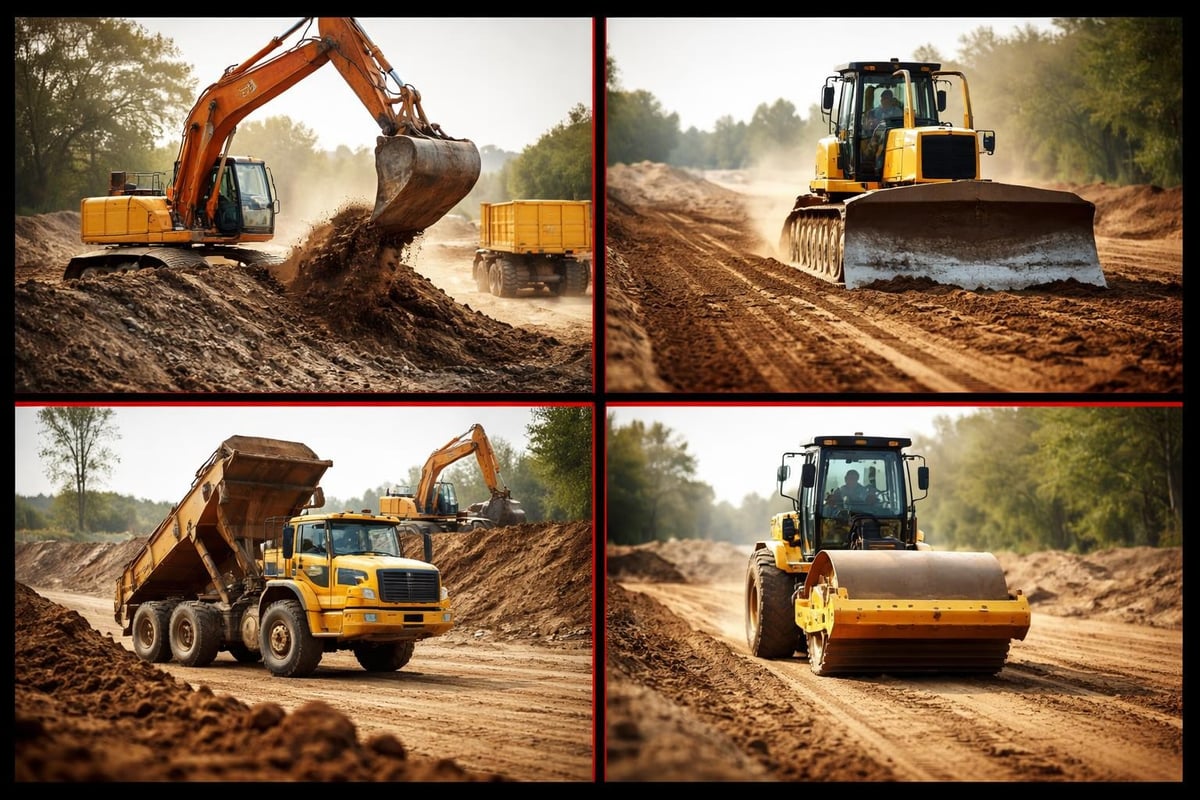
Excavation represents the initial phase where existing ground materials are removed to achieve design depths. This process demands careful consideration of soil types, water table levels, and the presence of utilities or archaeological features. Modern excavation techniques balance speed with precision, employing GPS-guided machinery to achieve exact specifications.
Grading and shaping follows excavation, establishing the contours and slopes necessary for proper drainage and structural support. Engineers calculate optimal gradients to prevent water accumulation whilst maintaining stability under expected loads.
Compaction ensures the placed materials achieve the required density and bearing capacity. This critical step prevents future settlement that could compromise structures built upon the earthworks foundation.
Essential Earthworks Processes and Techniques
The success of any civil earthworks project depends on following established processes that have been refined through decades of engineering practice. These methodologies ensure consistency, safety, and compliance with regulatory standards.
Cutting and Filling Operations
Cutting involves removing earth from elevated areas, whilst filling builds up lower sections to achieve the desired final grade. The balance between these two activities significantly impacts project economics and environmental considerations.
| Operation Type | Purpose | Key Considerations |
|---|---|---|
| Cutting | Remove excess material | Disposal methods, contamination checks |
| Filling | Build up low areas | Material quality, compaction standards |
| Benching | Create level platforms | Slope stability, drainage integration |
Effective cutting and filling techniques minimize the need to import or export materials, reducing both costs and environmental impact. Site engineers carefully calculate these volumes during the design phase to optimize material movement.
Material Selection and Management
Not all earth materials provide equal performance in civil earthworks applications. Cohesive clays, granular sands, and crushed aggregates each offer distinct advantages depending on the specific application and loading requirements.
Granular materials excel in drainage applications and as base courses beneath paved surfaces. These free-draining materials prevent water accumulation that could weaken structures or cause frost damage in colder months.
Cohesive soils provide excellent stability when properly compacted but require careful moisture management during placement. Too wet or too dry, and these materials won't achieve the necessary density.
Engineered fills combine selected materials to meet precise specifications, often used in critical applications where natural soils prove inadequate. These might include cement-stabilized materials or geogrid-reinforced systems for enhanced performance.
Site Investigation and Planning Requirements
Before any civil earthworks commence, thorough site investigation provides the essential data that informs design decisions and construction methodologies. This preparatory work identifies potential challenges and opportunities that affect project delivery.
Ground Condition Assessment
Geotechnical investigations reveal subsurface conditions through trial pits, boreholes, and laboratory testing. Understanding soil classifications, bearing capacities, and groundwater levels allows engineers to design appropriate earthworks strategies.
Professional site surveys establish existing levels and identify features requiring protection or removal. This baseline information enables accurate volume calculations and helps identify the most efficient construction sequences.
- Soil classification testing determines particle size distribution and plasticity characteristics
- California Bearing Ratio (CBR) tests measure material strength for pavement design
- Moisture content analysis guides compaction procedures and material handling
- Contamination screening protects workers and ensures regulatory compliance
- Existing utility mapping prevents costly service strikes during excavation
Design Considerations for Drainage
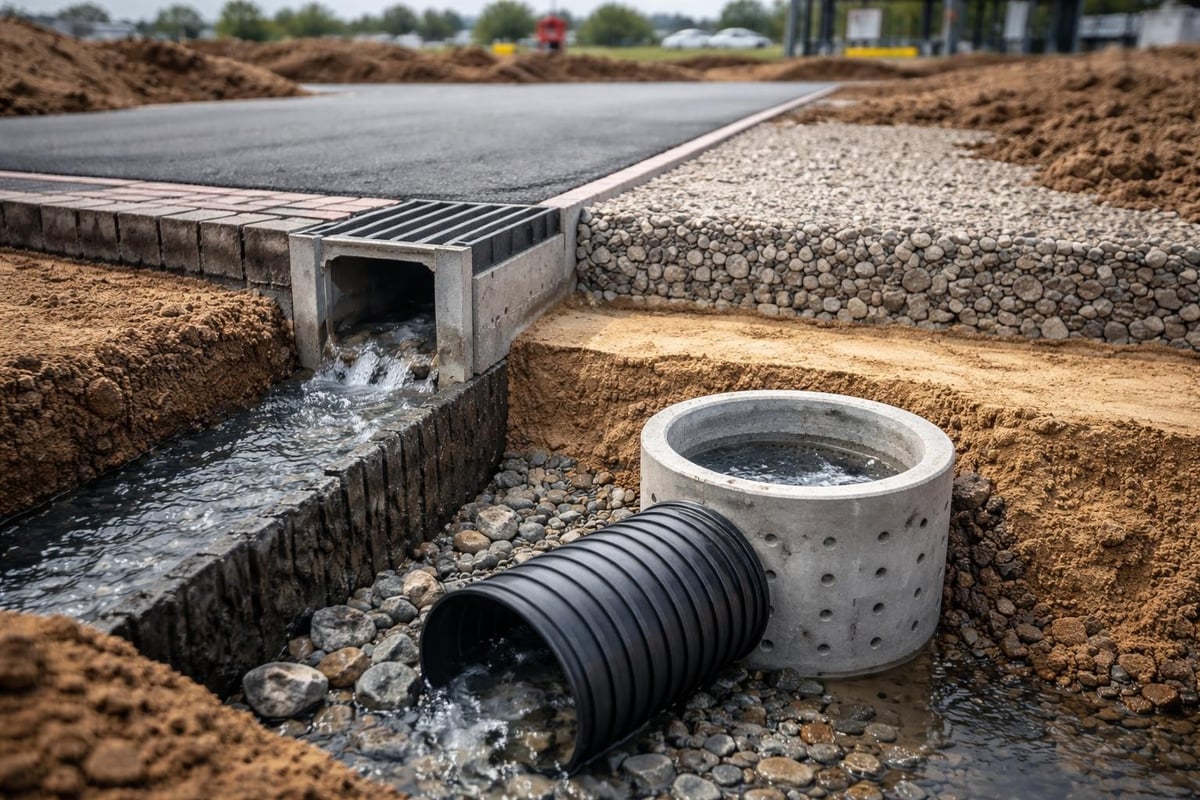
Proper drainage integration within civil earthworks prevents water-related failures that account for a significant proportion of infrastructure problems. Surface water must be directed away from structures, whilst groundwater requires management to prevent undermining foundations.
Designers incorporate falls, crossfalls, and drainage channels to control water movement. French drains, land drains, and attenuation systems work together to manage both normal rainfall and exceptional weather events that are becoming increasingly common.
Equipment and Technology in Modern Earthworks
The machinery employed in civil earthworks has evolved dramatically, with modern equipment offering unprecedented precision and efficiency. GPS-guided systems enable operators to achieve design levels within millimetres, reducing the need for manual checking and rework.
Primary Earthmoving Plant
Excavators range from compact mini-diggers suitable for restricted domestic sites to massive tracked machines capable of moving hundreds of tonnes per hour. Quick-hitch systems allow rapid attachment changes, adapting machines for excavation, grading, or compaction duties.
Dump trucks and articulated haulers transport materials across sites, with modern telematics systems tracking productivity and fuel consumption. Payload monitoring prevents overloading whilst maximizing efficiency.
Dozers excel at spreading and grading bulk materials, creating the level platforms essential for subsequent construction phases. Laser-guided blades maintain precise grades across large areas.
| Equipment Type | Primary Function | Typical Applications |
|---|---|---|
| 360° Excavator | Digging, loading | Trenches, foundations, drainage |
| Bulldozer | Spreading, grading | Large area leveling, pushing material |
| Grader | Fine grading | Road formation, precise levels |
| Roller | Compaction | Achieving specified density |
| Dumper | Material transport | Moving soil, aggregate, waste |
Compaction Equipment Selection
Achieving proper compaction is perhaps the most critical aspect of civil earthworks, yet it's often underestimated. Different soil types require specific compaction methods to achieve optimal density and stability.
Vibratory rollers work effectively on granular materials, using dynamic force to rearrange particles into dense configurations. Smooth drum rollers suit cohesive materials, applying static weight to compress layers.
Plate compactors and rammer compactors handle confined areas where larger equipment cannot operate, essential for trenches and areas adjacent to existing structures. These tools ensure consistent quality throughout the works.
Quality Control and Testing Standards
Civil earthworks must meet stringent quality standards to ensure long-term performance. Internationally recognized standards provide benchmarks for material specification, placement procedures, and verification testing.
On-Site Testing Protocols
Nuclear density gauges provide rapid moisture and density measurements, allowing real-time adjustment of compaction procedures. These instruments help maintain consistent quality across large areas whilst minimizing delays.
Proof rolling involves driving a loaded vehicle across compacted areas to identify weak spots that deflect under load. This simple yet effective test reveals inadequate compaction or unsuitable materials before subsequent construction phases commence.
Field CBR testing verifies that materials meet design assumptions for bearing capacity. Results inform decisions about layer thicknesses and the need for additional treatment or replacement of unsuitable materials.
Documentation and Compliance
Maintaining comprehensive records throughout civil earthworks operations provides essential evidence of quality and compliance. These documents prove invaluable should questions arise during or after construction completion.
- Material test certificates confirm imported aggregates meet specifications
- Compaction test results demonstrate achieved densities
- As-built surveys record actual levels versus design intent
- Photographic records document conditions and progress
- Non-conformance reports and remedial action records
Applications Across Project Types
Civil earthworks principles apply across an enormous range of construction projects, though the scale and complexity vary considerably. Understanding how these fundamentals adapt to different contexts helps clients appreciate the skill and planning involved.
Commercial and Industrial Developments
Large-scale commercial projects often involve significant earthworks to create level platforms from sloping sites. Drive-through facilities, retail parks, and industrial estates require extensive ground preparation to accommodate buildings, car parks, and service yards.
These projects demand careful coordination between earthworks contractors and subsequent trades. Levels must accommodate surface water drainage, utility connections, and future maintenance access whilst supporting heavy loading from vehicles and equipment.
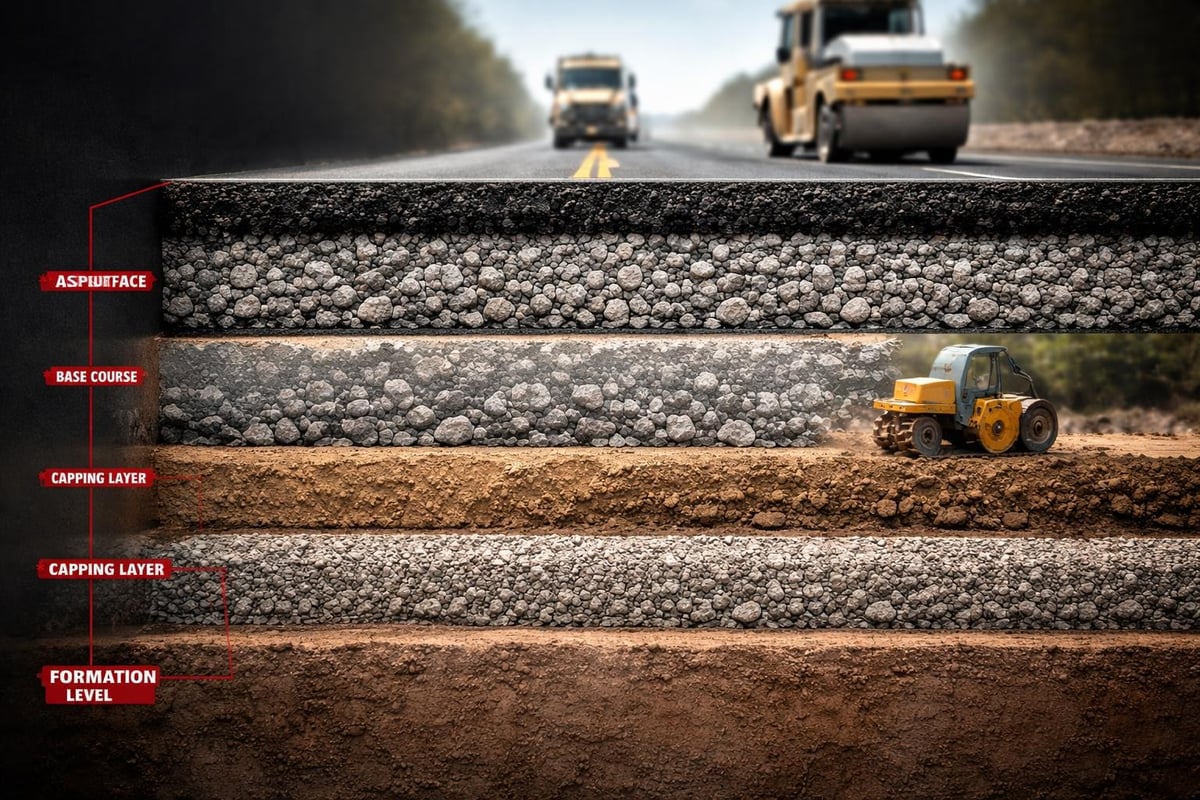
Pavement construction for commercial facilities requires robust foundations capable of withstanding constant heavy vehicle traffic. Multiple layers of specified materials, each properly compacted and tested, build up to create durable surfaces that minimize maintenance requirements.
Highway and Infrastructure Projects
Roads, railways, and similar infrastructure represent perhaps the most demanding applications of civil earthworks expertise. These linear projects traverse varied terrain, requiring extensive cutting and filling to achieve acceptable gradients.
Embankments and cuttings must remain stable for decades under traffic loading and environmental exposure. Engineers specify reinforcement systems, drainage measures, and erosion protection to ensure long-term performance.
The formation layer beneath road pavements receives particular attention, as inadequate preparation here will inevitably lead to premature failure of expensive surfacing materials. Proper specification and construction of this foundation saves significant costs over a road's lifetime.
Residential Earthworks Projects
Domestic driveways, patios, and garden landscaping involve the same fundamental principles as major infrastructure, albeit at a smaller scale. Proper ground preparation ensures these features remain level, well-drained, and capable of supporting intended uses without settlement or failure.
Driveway construction requires careful consideration of existing ground conditions, drainage patterns, and vehicle loading. A properly constructed driveway begins with adequate excavation, a well-compacted sub-base, and appropriate surfacing materials selected for the specific application.
Patio installations demand precise levels to ensure water drains away from buildings whilst creating comfortable outdoor spaces. Sub-base preparation follows the same principles as larger projects, scaled to suit domestic requirements and budgets.
Environmental and Sustainability Considerations
Modern civil earthworks incorporate environmental responsibility alongside technical performance. Sustainable practices reduce project impacts whilst often delivering cost savings through efficient resource use.
Waste Minimization Strategies
Balancing cut and fill volumes keeps materials on-site, eliminating transport costs and reducing carbon emissions associated with haulage. Advanced design software helps engineers optimize alignments to achieve this balance.
Reusing excavated materials where suitable reduces demand for virgin aggregates, conserving natural resources and reducing environmental impact. Even materials initially deemed unsuitable might be treated or used in less critical applications.
- Soil stripping and storage for landscape restoration
- Crushing oversized materials for use as fill or sub-base
- Treating weak soils with lime or cement stabilization
- Segregating topsoil for reuse in final landscaping
- Implementing erosion control during construction
Managing Water and Sediment
Construction sites must prevent sediment-laden runoff from entering watercourses or drainage systems. Silt fences, settlement ponds, and wheel washing facilities protect the surrounding environment whilst maintaining compliance with environmental permits.
Dewatering systems manage groundwater during deep excavations, with treated water discharged in accordance with regulatory requirements. These temporary works require careful design to prevent ground movement that could affect adjacent properties.
Common Challenges and Solutions
Even well-planned civil earthworks encounter unexpected conditions requiring adaptive solutions. Experience and technical knowledge enable contractors to address these challenges efficiently whilst maintaining quality standards.
Dealing with Poor Ground Conditions
Weak or contaminated soils sometimes necessitate removal and replacement with suitable materials. Alternatively, ground improvement techniques like dynamic compaction, stone columns, or soil mixing can enhance bearing capacity without complete excavation.
High water tables complicate earthworks operations, requiring dewatering or the use of free-draining materials that remain stable in saturated conditions. Design modifications might include deeper drainage systems or the incorporation of geotextile separators.
Weather-Related Impacts
British weather presents particular challenges for civil earthworks, with frequent rainfall affecting soil moisture content and site accessibility. Cohesive materials become unworkable when wet, whilst even granular materials suffer reduced compaction efficiency in saturated conditions.
Experienced contractors schedule weather-sensitive operations during favorable periods and implement contingency measures such as temporary covers or accelerated drainage. Building flexibility into programmes accommodates inevitable weather delays without compromising overall project delivery.
Professional Standards and Training
The civil earthworks sector maintains high professional standards through industry qualifications and continuous professional development. Operators, supervisors, and engineers each require specific competencies to ensure safe, efficient, and compliant operations.
Operator Certification Requirements
Construction plant operators undertake nationally recognized training courses that combine theoretical knowledge with practical assessment. Understanding earthwork processes ensures operators contribute to quality outcomes rather than simply moving materials.
Modern machinery complexity demands ongoing training as technology advances. GPS-guided equipment requires different skills compared to traditional methods, whilst safety systems and efficiency features need proper understanding for optimal utilization.
Site Management Competencies
Site engineers and supervisors must understand soil mechanics, compaction theory, and quality control procedures. This technical knowledge combines with practical experience to make informed decisions that keep projects on programme whilst maintaining standards.
Recognizing when specialist input is required prevents problems from escalating. Early consultation with geotechnical engineers or materials specialists can resolve emerging issues before they impact critical path activities or incur significant additional costs.
Planning Your Earthworks Project
Whether planning a commercial development or residential enhancement, thorough preparation maximizes the likelihood of successful civil earthworks delivery. Understanding project requirements and communicating them clearly to contractors ensures alignment of expectations.
Defining Project Scope and Specifications
Clear specifications remove ambiguity about material quality, compaction standards, and testing requirements. These documents should reference recognized standards whilst accommodating site-specific conditions and constraints.
Site access, working hours, and environmental considerations need early clarification. Restricted access might necessitate smaller equipment or alternative construction sequences, affecting programme duration and costs.
Budget planning should account for contingencies that address unforeseen ground conditions or weather delays. Realistic cost estimates include testing, quality control, and proper disposal of unsuitable materials rather than simply earthmoving rates.
Selecting Experienced Contractors
Contractor selection should consider track record, equipment capabilities, and technical expertise alongside competitive pricing. References from similar projects provide insight into working practices and quality standards.
Established contractors bring valuable experience that prevents common pitfalls and optimizes construction sequences. Their relationships with suppliers, testing laboratories, and specialist subcontractors facilitate smooth project delivery even when challenges arise.
Successful civil earthworks combine technical expertise, appropriate equipment, and meticulous attention to detail throughout every phase from initial excavation through final compaction. Whether you're planning a major commercial development or a residential driveway, these fundamental principles remain constant. At JRG Civils, we bring extensive experience across commercial and residential projects throughout the UK, delivering the civil engineering excellence that ensures your development starts on the strongest possible foundation. Contact JRG Civils today to discuss how our professional team can deliver your earthworks project to the highest standards.