
Earth movers excavation represents the cornerstone of modern civil engineering and construction projects, encompassing everything from residential driveways to large-scale commercial developments. Understanding the complexities of excavation operations, equipment capabilities, and safety protocols ensures project success whilst minimising risks and delays. Whether you're planning a modest driveway installation or a comprehensive infrastructure project, mastering the fundamentals of earth movers excavation establishes the foundation for quality outcomes that stand the test of time.
Understanding Earth Movers Excavation Equipment
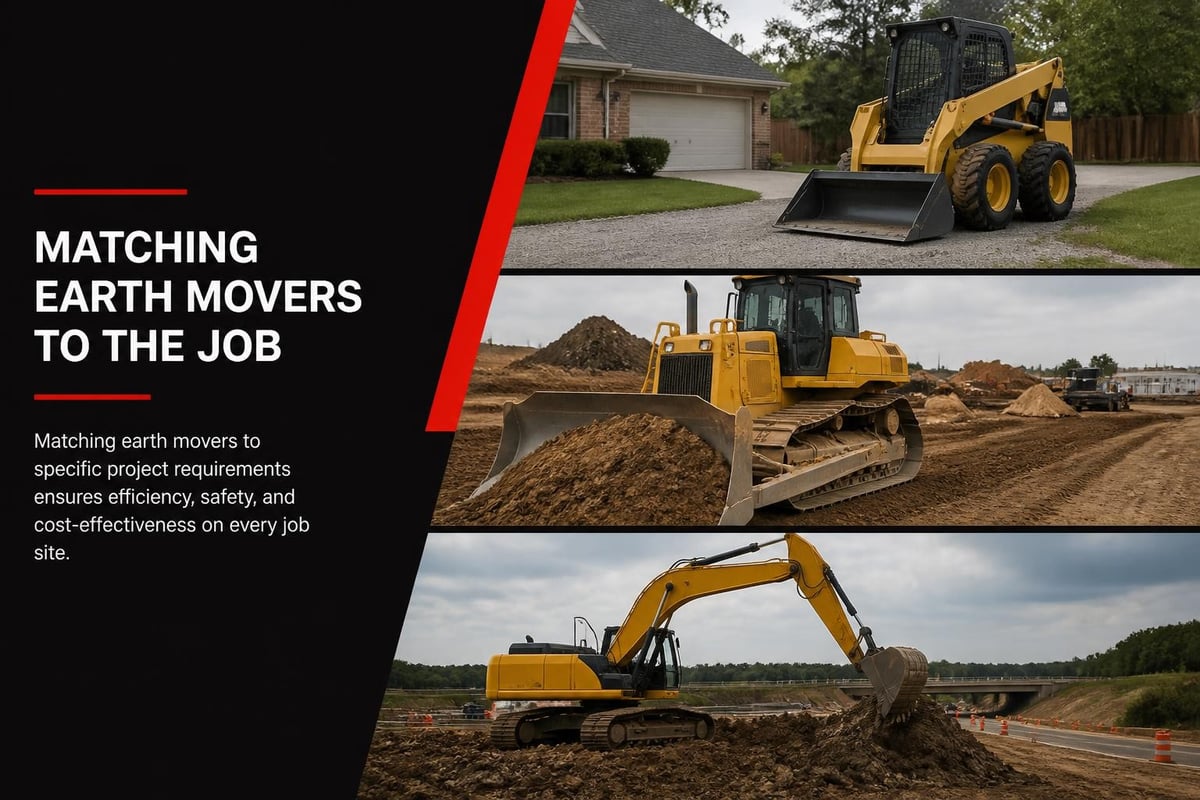
The selection of appropriate equipment determines project efficiency and cost-effectiveness in any earth movers excavation operation. Modern machinery has evolved significantly, offering enhanced precision, fuel efficiency, and operator safety features that transform how civil engineering contractors approach site preparation.
Primary Excavation Machinery Categories
Excavators remain the workhorses of most earth movers excavation projects, available in various sizes to suit different applications. Mini excavators, weighing under 10 tonnes, excel in confined spaces and residential projects where access limitations restrict larger equipment deployment. Standard excavators, ranging from 10 to 45 tonnes, handle the majority of commercial excavation tasks, whilst heavy-duty models exceeding 45 tonnes tackle substantial earthmoving requirements on major infrastructure developments.
Key equipment types include:
- Hydraulic excavators for precision digging and material handling
- Bulldozers for large-scale earth pushing and site levelling
- Backhoe loaders combining digging and loading capabilities
- Wheel loaders for material transport and stockpile management
- Trenchers for utility installation and drainage systems
Technological advancements in automation of earthmoving machinery continue reshaping industry standards, with GPS-guided systems and load monitoring enhancing productivity across all equipment categories.
Site Assessment and Planning Procedures
Thorough site evaluation precedes every successful earth movers excavation project, identifying underground utilities, soil composition, drainage patterns, and access constraints that influence operational approaches. Detailed planning prevents costly delays and safety incidents whilst establishing realistic timelines and budget parameters.
Pre-Excavation Investigation Steps
Professional contractors conduct comprehensive site surveys incorporating topographical mapping, geotechnical testing, and utility location services. Ground-penetrating radar and electromagnetic detection equipment reveal hidden obstacles, whilst soil samples determine load-bearing capacity and excavation difficulty levels.
- Commission detailed utility surveys identifying gas, electric, water, and telecommunication infrastructure
- Conduct soil testing to assess composition, moisture content, and compaction characteristics
- Evaluate site access routes for equipment delivery and material removal
- Identify environmental considerations including protected species and contamination risks
- Develop comprehensive risk assessments addressing all identified hazards
| Assessment Element | Information Required | Impact on Project |
|---|---|---|
| Soil Classification | Clay, sand, rock composition | Equipment selection, timeline |
| Groundwater Levels | Seasonal variations, depth | Dewatering requirements |
| Utility Infrastructure | Locations, depths, materials | Excavation methods, safety zones |
| Site Access | Width, gradient, surface condition | Equipment mobilisation costs |
| Environmental Factors | Protected areas, contamination | Permit requirements, remediation |
This systematic approach aligns with standard earth moving procedures that prioritise safety and efficiency throughout project execution.
Safety Protocols in Earth Movers Excavation
Safety considerations dominate every aspect of earth movers excavation operations, with regulatory compliance and risk mitigation protecting both personnel and project stakeholders. The construction industry maintains stringent standards addressing excavation-specific hazards that require constant vigilance and proactive management.
Critical Safety Requirements
Cave-ins represent the most serious threat in excavation work, with OSHA regulations requiring protective systems for trenches exceeding 1.5 metres depth. Sloping, shoring, or shielding systems prevent soil collapse, whilst competent person inspections verify protective measure adequacy before personnel entry.
Essential safety measures include:
- Daily excavation inspections by qualified personnel before work commences
- Proper spoil pile placement at least 0.6 metres from excavation edges
- Secure barriers preventing unauthorised access to open excavations
- Atmospheric testing in confined excavations detecting hazardous gases
- Emergency response procedures with rescue equipment readily accessible
Equipment operators require comprehensive training covering machine-specific controls, visibility limitations, and ground condition recognition. Modern earth movers excavation projects integrate technology solutions including proximity warning systems, rear-view cameras, and automatic shut-off features that enhance operational safety beyond traditional methods.
Commercial Applications and Project Diversity
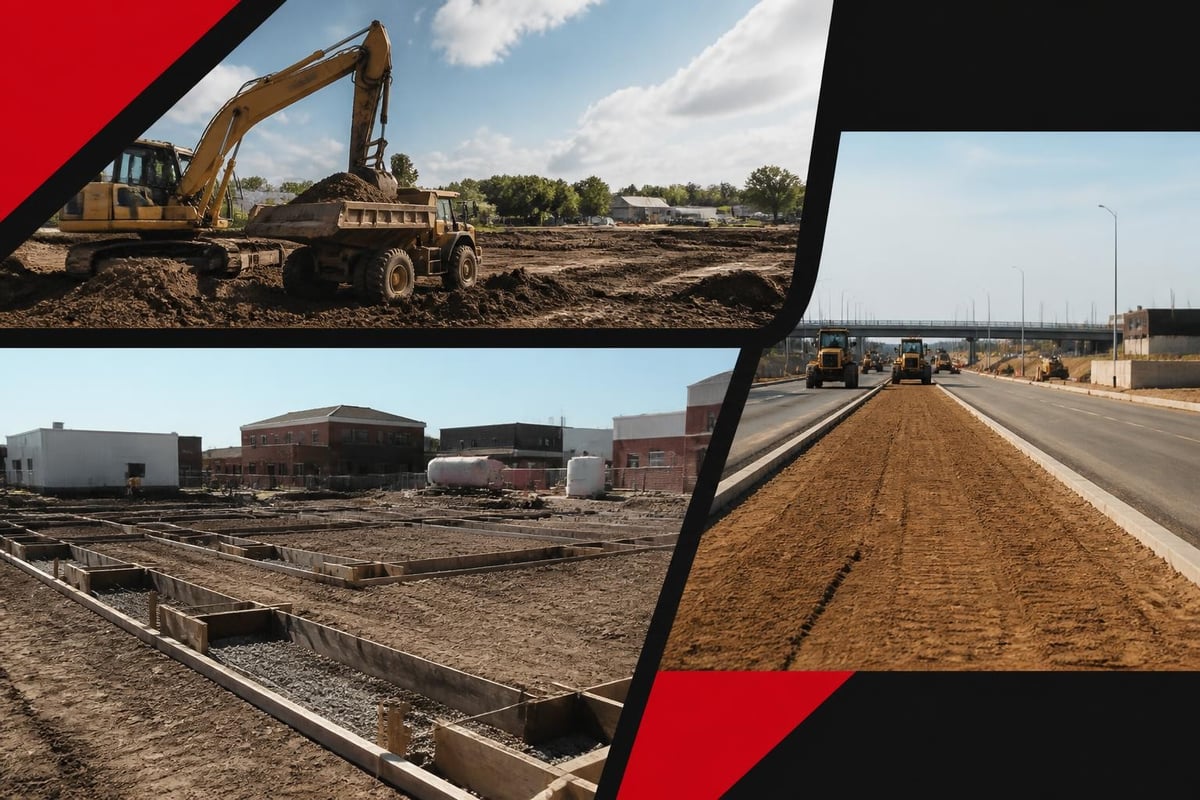
Earth movers excavation services support diverse commercial ventures requiring precise execution and coordinated logistics. From franchise development to highway construction, contractors must adapt methodologies addressing unique project specifications whilst maintaining consistent quality standards.
Highway and Infrastructure Projects
Major roadway developments demand extensive earth movers excavation capabilities coordinating multiple equipment types across extended work zones. Projects involve substantial cut-and-fill operations balancing excavated material volumes with embankment requirements, minimising haulage costs whilst achieving specified gradients and drainage configurations.
Successful highway projects integrate comprehensive drainage services addressing surface water management and subsurface infrastructure installation. Excavation depths vary considerably, from shallow topsoil stripping across wide areas to deep cuttings through challenging geological formations requiring specialist techniques and equipment specifications.
Franchise and Retail Development
Drive-through facilities and retail establishments present unique earth movers excavation challenges combining tight site constraints with demanding construction schedules. Foundations, utilities, car parking areas, and drainage systems require precise excavation maintaining accurate levels and dimensions throughout project execution.
Typical excavation scope includes:
- Foundation trenches for building structures and canopy supports
- Service trenches accommodating utilities, drainage, and communications infrastructure
- Car park formation removing unsuitable material and establishing proper gradients
- Soakaway and attenuation tank installations managing surface water discharge
- Access road construction connecting developments to existing highway networks
These projects benefit from contractors experienced in coordinating multiple trades, managing material logistics in confined spaces, and maintaining operational flexibility accommodating design modifications during construction phases.
Residential Earth Movers Excavation Services
Residential applications represent significant market segments for earth movers excavation specialists, encompassing driveways, patios, landscaping features, and foundation works. Homeowners increasingly recognise quality excavation's importance in ensuring durable, visually appealing outdoor improvements that enhance property value and functionality.
Driveway Installation Requirements
Professional driveway construction begins with proper earth movers excavation establishing stable foundations supporting vehicle loads whilst facilitating drainage. Excavation depths typically range from 200-400mm depending on soil conditions, expected traffic volumes, and selected surfacing materials.
| Driveway Type | Excavation Depth | Sub-base Requirement | Drainage Considerations |
|---|---|---|---|
| Block Paving | 250-300mm | Type 1 MOT aggregate | Linear drainage channels |
| Tarmac/Asphalt | 200-250mm | Compacted hardcore | Crossfall gradient minimum 1:40 |
| Resin Bound | 150-200mm | Porous sub-base | Soakaway connections |
| Concrete | 200-300mm | Reinforced sub-base | Edge drainage details |
Accurate excavation prevents future settlement issues, with proper compaction of sub-base materials crucial for long-term performance. Experienced contractors understand local ground conditions, adjusting specifications based on site-specific characteristics ensuring optimal outcomes.
Foundation and Groundworks Projects
Residential extensions and new builds require precise earth movers excavation for foundation trenches meeting structural engineering specifications. Trench dimensions, depths, and profile accuracy directly impact structural integrity, with variations potentially causing differential settlement or structural defects.
Strip foundations typically require excavation to firm, undisturbed ground, often extending 1-1.5 metres below ground level depending on soil conditions and building loads. Trench widths accommodate wall thickness plus working space for bricklayers and waterproofing applications, with excess material requiring proper disposal or strategic site redeployment.
Material Management and Environmental Considerations
Efficient material handling distinguishes professional earth movers excavation contractors, with strategic planning minimising waste whilst maximising opportunities for excavated material reuse. Modern projects increasingly emphasise environmental responsibility, reducing landfill dependency and associated disposal costs through intelligent resource management.
Soil Classification and Reuse Strategies
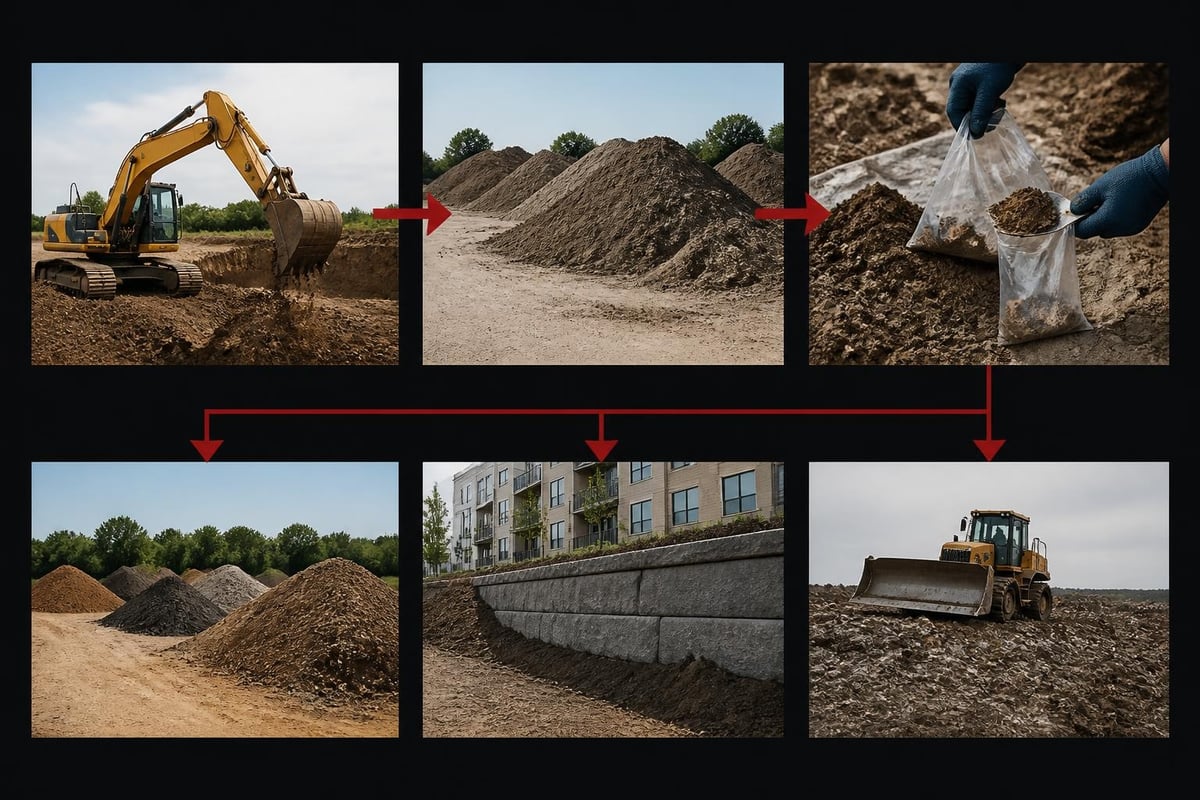
Excavated materials fall into distinct categories determining reuse potential and disposal requirements. Topsoil, the valuable upper layer containing organic matter, requires careful stripping and stockpiling for landscaping applications. Subsoil, underlying the topsoil layer, often provides suitable fill material following proper compaction testing and specification compliance verification.
Material categorisation framework:
- Topsoil: Preserved for final landscaping, grading, and vegetation establishment
- Clean subsoil: Reusable as general fill material after compaction testing
- Contaminated soil: Requires specialist disposal following environmental assessment
- Rock and hardcore: Processable as aggregate for sub-base applications
- Unsuitable material: Designated for approved disposal facilities
Research into excavation force estimation contributes to optimising equipment performance whilst understanding soil cutting principles enhances operational efficiency across varying ground conditions.
Environmental Protection Measures
Contemporary earth movers excavation projects implement robust environmental controls preventing pollution and ecological damage. Sediment control measures including silt fences, settlement ponds, and wheel-washing facilities contain contaminated runoff protecting watercourses and neighbouring properties from construction impacts.
Dust suppression through water spraying or chemical stabilisation maintains air quality, particularly important in urban environments or during extended dry periods. Noise monitoring and restricted working hours address community concerns, whilst vibration monitoring protects adjacent structures from excavation-induced damage.
Equipment Maintenance and Operational Excellence
Reliable equipment performance underpins successful earth movers excavation operations, with preventative maintenance programmes reducing breakdowns and extending machinery service life. Professional contractors invest substantially in fleet management systems tracking service intervals, component wear, and performance metrics optimising availability and operational efficiency.
Preventative Maintenance Schedules
Daily inspections identify fluid leaks, worn components, and developing faults before catastrophic failures interrupt project progress. Operators check hydraulic systems, track or tyre condition, cutting edges, and safety features ensuring equipment operates within manufacturer specifications throughout demanding work cycles.
Critical maintenance activities include:
- Engine oil and filter changes at manufacturer-specified intervals
- Hydraulic system inspections checking hoses, cylinders, and fluid contamination
- Undercarriage component assessment monitoring wear rates and alignment
- Structural integrity checks identifying cracks or fatigue in frames and booms
- Control system calibration ensuring accurate operation and safety feature functionality
Advanced diagnostic systems monitor engine performance, fuel consumption, and operating parameters, alerting maintenance teams to developing issues requiring attention. Comprehensive service records demonstrate equipment reliability, supporting resale values whilst providing evidence of professional operational standards.
Operator Training and Competency Development
Skilled operators maximise earth movers excavation productivity whilst minimising fuel consumption and component wear. Modern training programmes combine classroom instruction covering machine systems and safety protocols with practical assessments developing operational proficiency across various equipment types and site conditions.
Continuous professional development keeps operators current with technological advancements including GPS-guided systems, automated functions, and enhanced safety features. Competency certification demonstrates operator capability, satisfying client requirements and insurance obligations whilst fostering pride in professional standards.
Cost Estimation and Project Budgeting
Accurate cost forecasting enables informed decision-making throughout earth movers excavation project planning and execution phases. Multiple variables influence final costs, requiring detailed analysis balancing equipment selection, operational efficiency, material management, and risk mitigation strategies.
Primary Cost Components
Equipment deployment represents substantial expense in earth movers excavation budgets, encompassing machine hire or ownership costs, fuel consumption, operator wages, and maintenance provisions. Larger equipment delivers higher productivity but incurs increased hourly rates, whilst smaller machines suit confined spaces despite extended operational durations.
| Cost Element | Percentage of Total | Key Variables |
|---|---|---|
| Equipment and Operation | 35-45% | Machine selection, productivity rates |
| Labour and Supervision | 25-35% | Skill levels, project complexity |
| Material Disposal/Import | 15-25% | Volumes, haulage distances, tipping fees |
| Safety and Compliance | 5-10% | Protective systems, inspections, permits |
| Contingency and Risk | 10-15% | Ground conditions, weather, unforeseen obstacles |
Transportation costs fluctuate based on site accessibility and distance from equipment depots, whilst material disposal expenses depend on classification and approved facility locations. Contaminated ground requires specialist handling substantially increasing project costs compared to clean excavations.
Value Engineering Opportunities
Strategic planning identifies cost-saving opportunities without compromising quality or safety standards. Balancing cut-and-fill volumes minimises material haulage, whilst scheduling efficiency reduces equipment idle time and associated costs.
Experienced contractors explore innovative approaches including on-site material processing converting oversized rock into usable aggregate, or phased excavation programmes accommodating client budget constraints. Technology adoption, from GPS machine control to automated excavation systems, enhances productivity reducing overall project durations and associated costs.
Quality Assurance and Project Documentation
Comprehensive quality management systems ensure earth movers excavation projects meet specified standards through systematic monitoring, testing, and verification procedures. Documentation provides evidence of compliance, facilitates progress payments, and establishes accountability throughout project lifecycles.
Inspection and Testing Protocols
Regular inspections verify excavation dimensions, gradients, and depths against design specifications before subsequent construction phases commence. Surveying equipment including laser levels and GPS systems confirms accuracy, whilst visual assessments identify unsuitable material requiring removal or special treatment.
Compaction testing validates sub-base preparation meets load-bearing requirements supporting proposed structures or surfacing installations. Nuclear density gauges or plate bearing tests demonstrate compliance with engineering specifications, with results documented in quality records forming permanent project archives.
Essential documentation includes:
- Pre-construction photographs establishing baseline site conditions
- Daily excavation logs recording depths, observations, and progress rates
- Material test certificates confirming imported aggregate specifications
- Compaction test results demonstrating sub-base adequacy
- As-built drawings showing final excavation profiles and utility installations
- Inspection records documenting safety checks and protective system verification
Projects featured in our portfolio demonstrate commitment to quality assurance maintaining comprehensive records supporting client confidence and project success.
Seasonal Considerations and Weather Impact
Weather conditions significantly influence earth movers excavation operations, with seasonal variations affecting ground conditions, equipment performance, and operational safety. Professional contractors adapt methodologies addressing environmental challenges whilst maintaining project momentum through adverse conditions.
Winter Operations Challenges
Frozen ground substantially increases excavation difficulty, with rock-hard surfaces resisting bucket penetration and reducing productivity. Equipment modifications including reinforced cutting edges and increased hydraulic pressure partially mitigate performance reduction, whilst heated shelters maintain operator comfort during extended cold exposure.
Reduced daylight hours limit productive time, whilst snow and ice create additional hazards requiring enhanced safety measures. Material stockpiles freeze solid preventing reuse, whilst concrete operations face curing challenges necessitating thermal protection or schedule adjustments.
Summer Conditions and Dust Management
Extended dry periods transform soil characteristics, with clay soils hardening substantially whilst sandy materials become dusty creating visibility and environmental concerns. Water application softens hard ground facilitating excavation whilst suppressing airborne particles protecting neighbouring properties and maintaining community relations.
High temperatures stress equipment cooling systems and operators, requiring additional hydration breaks and potentially limiting continuous operation durations. Regular maintenance checks monitor coolant levels and hydraulic oil temperatures preventing overheating-related breakdowns during peak demand periods.
Understanding earth movers excavation fundamentals ensures successful project outcomes whether you're planning commercial developments, highway infrastructure, or residential improvements. Professional execution combining appropriate equipment selection, rigorous safety protocols, and comprehensive quality management delivers lasting results that exceed expectations. If you're considering an excavation project requiring experienced civil engineering specialists committed to excellence from initial planning through final completion, JRG Civils brings the expertise and dedication necessary to transform your vision into reality.