
Curved kerbing represents a sophisticated approach to landscape and highway design that combines aesthetic appeal with practical functionality. Whether defining the boundaries of a commercial car park, creating elegant sweeping driveways, or establishing garden pathways, curved kerbing transforms ordinary spaces into visually dynamic environments. This comprehensive guide explores the technical aspects, installation methodologies, and design considerations that make curved kerbing an essential element in modern civil engineering projects.
Understanding the Fundamentals of Curved Kerbing
Curved kerbing serves multiple purposes within civil engineering and landscaping projects. At its core, this technique involves creating continuous, flowing boundaries that guide traffic flow, define spatial zones, and enhance visual interest across various applications.
The primary distinction between curved and straight kerbing lies in the geometric complexity and installation precision required. Standard kerbing follows linear paths with straightforward alignment, whilst curved kerbing demands careful planning, accurate setting out, and specialised techniques to achieve smooth, consistent radii. This complexity translates into both challenges and opportunities for creating distinctive spaces.
Design Principles and Geometric Considerations
Successfully implementing curved kerbing begins with understanding the mathematical relationships governing curve formation. Designers must consider radius measurements, arc lengths, and tangent points to ensure curves flow naturally within the surrounding landscape.
Key geometric factors include:
- Minimum radius requirements based on kerb unit dimensions
- Transition points where curves meet straight sections
- Compound curves involving multiple radii
- Superelevation considerations for drainage purposes
Installing curved kerbs for garden pathways requires careful attention to these geometric principles, particularly when working within confined residential spaces where aesthetic appeal must balance with practical functionality.
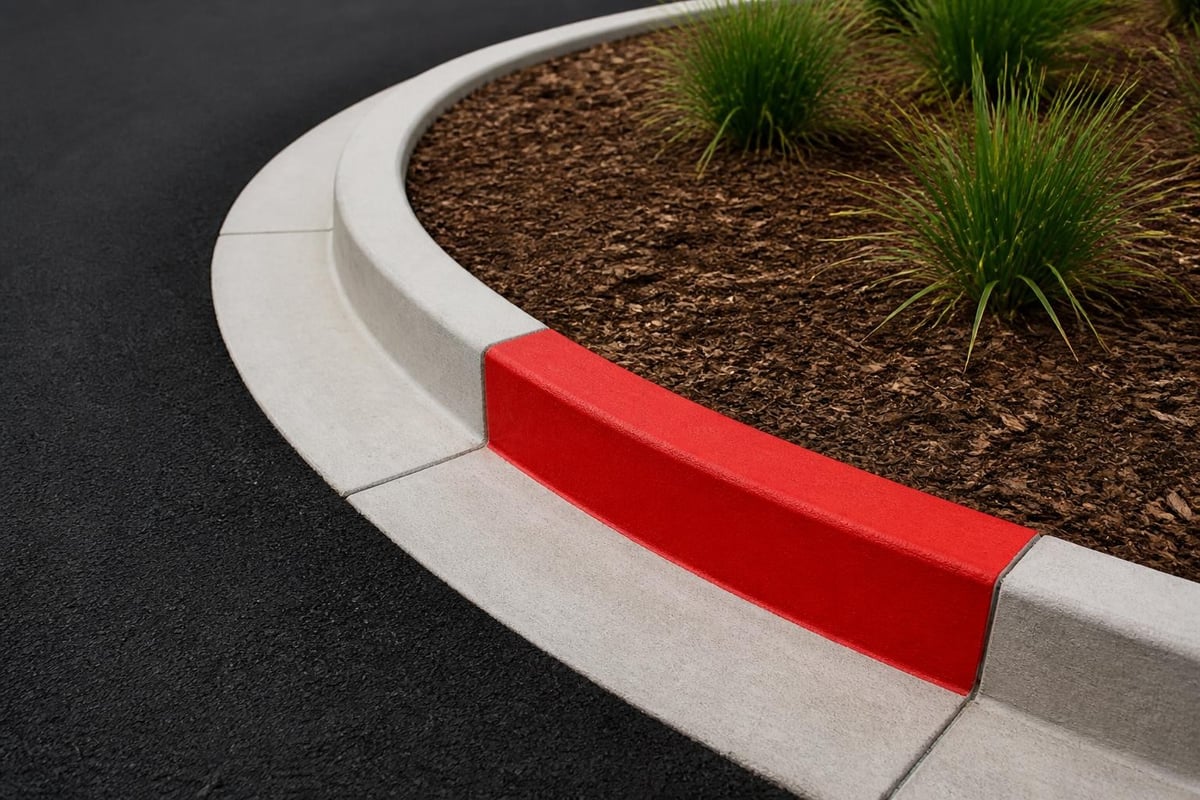
Material Selection for Curved Kerbing Projects
Choosing appropriate materials fundamentally impacts both the installation process and long-term performance of curved kerbing. Different materials offer varying degrees of flexibility, durability, and aesthetic qualities suited to specific project requirements.
Traditional and Modern Material Options
| Material Type | Flexibility | Durability | Typical Applications |
|---|---|---|---|
| Precast Concrete Sections | Moderate | High | Commercial car parks, highways |
| Natural Stone | Limited | Very High | Heritage projects, high-end residential |
| Flexible Plastic Systems | High | Moderate | Garden edging, temporary boundaries |
| In-situ Concrete | Maximum | High | Custom curves, complex geometries |
Natural stone kerbs, governed by European standards for external paving, provide exceptional longevity and visual appeal. These materials particularly suit conservation areas and premium residential developments where authenticity matters.
Precast concrete sections dominate commercial applications due to their consistent quality, structural integrity, and cost-effectiveness. Manufacturing advances now produce wedge-shaped units specifically designed for curved applications, reducing on-site cutting requirements and installation time.
For projects requiring tight radii or complex serpentine patterns, understanding materials suitable for curved concrete forms becomes essential. Flexible formwork systems enable contractors to achieve precise curves whilst maintaining structural integrity throughout the concrete curing process.
Planning and Setting Out Techniques
Accurate setting out distinguishes professional curved kerbing installations from amateur attempts. This critical phase establishes the foundation for achieving smooth, visually pleasing curves that function correctly throughout their service life.
Traditional Setting Out Methods
Historical approaches to setting out curved walls and kerbing remain relevant today, particularly for projects involving heritage restoration or traditional construction techniques. These methods employ simple tools yet deliver remarkable precision through careful application.
Essential setting out tools include:
- Pegs and string lines for establishing baseline geometry
- Trammel bars for scribing consistent radii
- Templates fabricated from flexible materials
- Optical instruments for large-radius curves
- Digital survey equipment for complex geometries
Modern projects increasingly incorporate digital survey technology, enabling contractors to establish precise curve coordinates directly from design software. This integration between design and construction reduces setting out time whilst improving accuracy across civil engineering projects.
Creating Templates for Complex Curves
For curved kerbing involving multiple radii or irregular patterns, physical templates prove invaluable. Contractors fabricate these guides from flexible plywood, hardboard, or specialized composite materials that bend smoothly without kinking.
Template creation involves plotting key points along the desired curve, connecting these coordinates with flexible materials, then transferring the resulting shape to rigid backing boards. This tangible reference ensures consistency throughout the installation process, particularly when multiple operatives work simultaneously on extended sections.
Installation Methods and Best Practices
Successful curved kerbing installation combines technical knowledge with practical craftsmanship. The methodology varies depending on materials selected, site conditions, and project specifications, yet fundamental principles remain consistent across applications.
Foundation Preparation Requirements
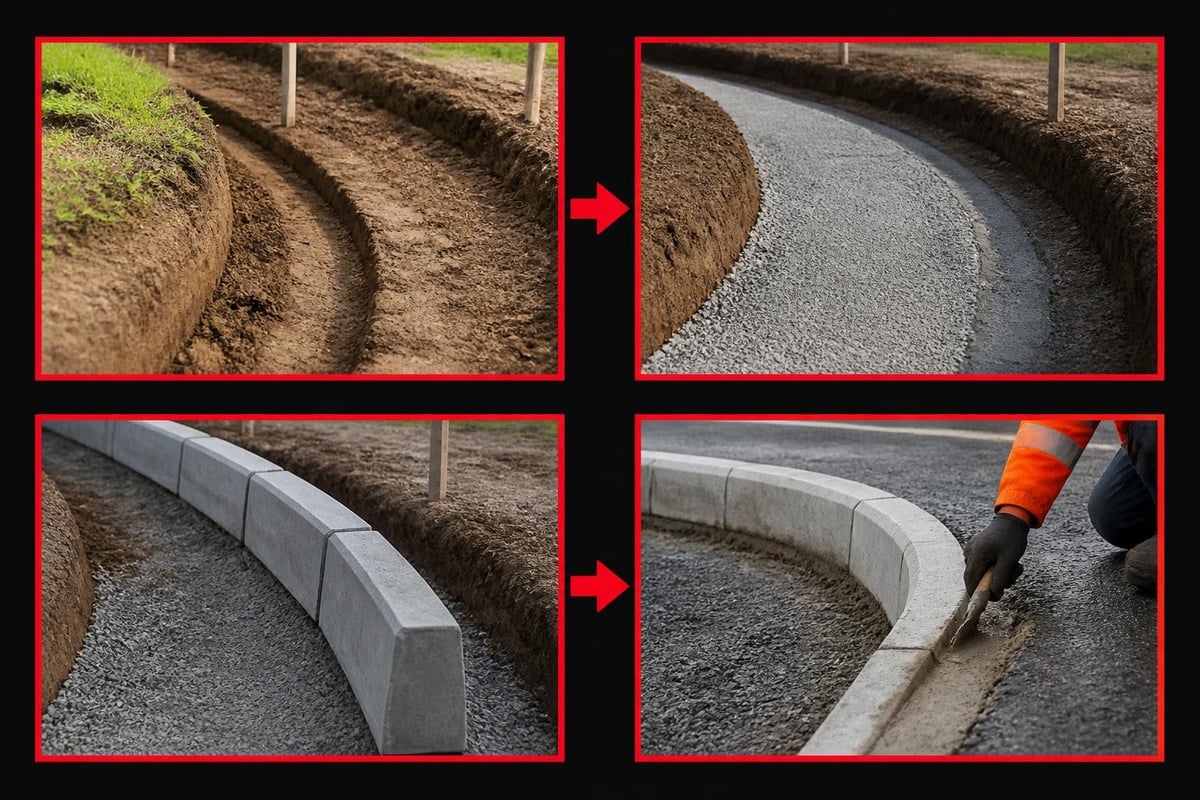
Adequate foundation preparation underpins long-term curved kerbing performance. The base must provide uniform support along the entire curve whilst accommodating the additional stresses generated at points of maximum curvature.
Typical foundation specifications for curved kerbing include:
- Excavation to consistent depth following curve alignment
- Compacted granular sub-base minimum 150mm depth
- Concrete haunch providing lateral support
- Adequate thickness to resist movement and settlement
Commercial foundations for curved kerbing in high-traffic areas require enhanced specifications, often incorporating reinforcement mesh and increased concrete volumes to accommodate vehicle loading patterns.
Unit Placement and Alignment Techniques
Positioning individual kerb units along curved alignments demands constant attention to line, level, and spacing. Small deviations accumulate rapidly, resulting in unsightly kinks or irregular gaps that compromise both appearance and functionality.
Professional installers employ systematic approaches to maintain alignment:
- Establish primary control points at intervals matching equipment accuracy
- Work progressively from fixed points toward free ends
- Check alignment constantly using string lines or laser references
- Adjust units whilst concrete remains workable to correct minor deviations
- Verify levels cross-fall to ensure proper drainage characteristics
For tight radius curves, specialized wedge-shaped units minimize joint gaps whilst maintaining consistent face alignment. Building curves without cutting reduces waste, accelerates installation, and produces superior aesthetic results compared to cutting standard units.
Applications Across Commercial and Residential Projects
Curved kerbing finds application across diverse project types, each presenting unique requirements and opportunities. Understanding these contexts enables designers and contractors to optimize solutions for specific circumstances.
Commercial Highway and Car Park Applications
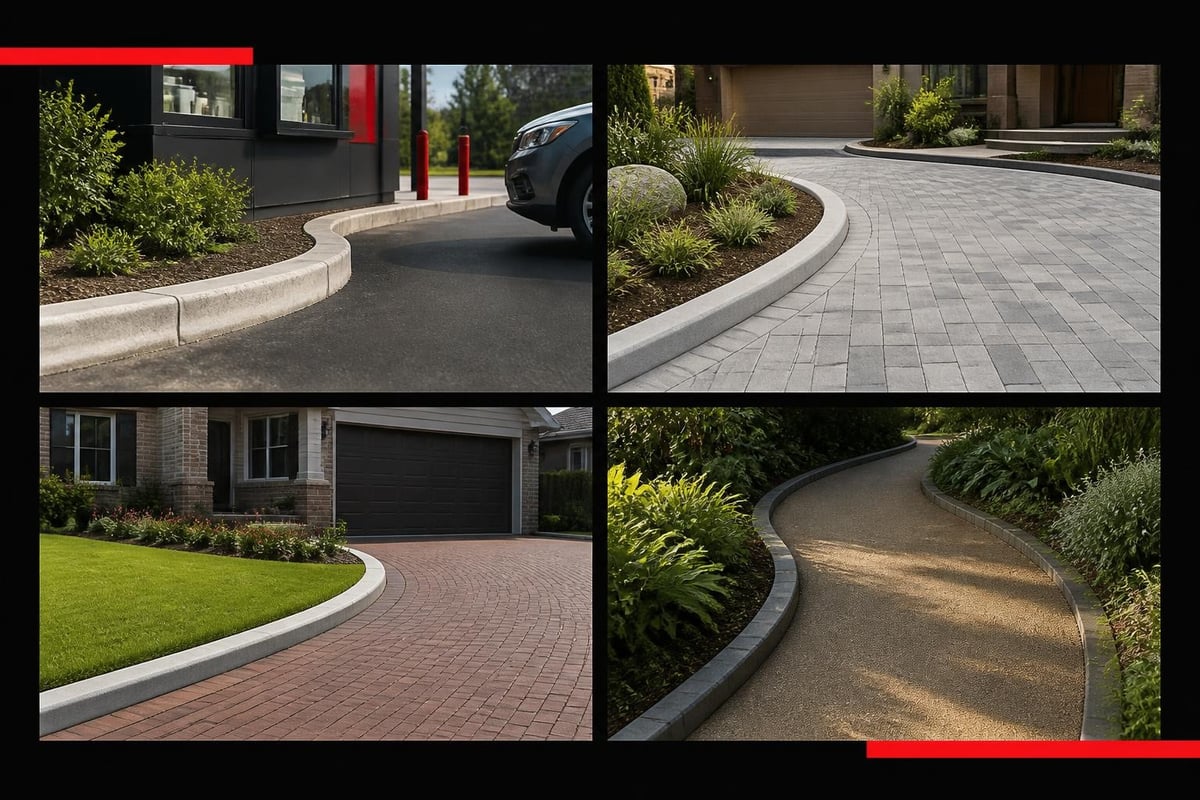
Within commercial developments, curved kerbing guides traffic flow whilst defining parking bays, pedestrian zones, and landscaped areas. The flowing geometry encourages appropriate vehicle speeds whilst creating visually interesting environments that enhance property appeal.
Large-scale projects such as drive-through facilities require robust curved kerbing capable of withstanding frequent heavy vehicle movements. Projects completed for major franchises demonstrate how properly specified and installed curved kerbing maintains integrity under demanding conditions whilst contributing to brand identity through consistent, professional presentation.
Drainage services integrate seamlessly with curved kerbing installations, with channel positioning following curve geometry to collect surface water efficiently. This integration requires careful coordination during design and installation phases.
Residential Driveways and Garden Features
Residential applications emphasize aesthetic considerations whilst maintaining practical functionality. Curved kerbing transforms standard driveways into distinctive features that enhance property appeal and value.
| Application | Typical Radius | Material Preference | Key Considerations |
|---|---|---|---|
| Driveway Edges | 2-10 metres | Concrete or Natural Stone | Vehicle clearance, drainage |
| Garden Pathways | 1-5 metres | Natural Stone or Flexible Systems | Pedestrian comfort, planting integration |
| Patio Boundaries | 1.5-8 metres | Natural Stone | Visual harmony with paving |
| Water Features | 0.5-3 metres | Specialized Flexible Materials | Waterproofing, settlement resistance |
Small radius curves present particular challenges in residential contexts where space constraints limit working room. Achieving smooth curves within confined areas requires skilled operatives and, often, specialized materials that accommodate tight bending without structural compromise.
Technical Challenges and Problem-Solving Strategies
Every curved kerbing project presents unique challenges requiring creative problem-solving approaches. Experienced contractors anticipate common issues and implement preventative measures that ensure successful outcomes.
Managing Joint Spacing and Alignment
Joints between individual kerb units create potential weak points where alignment may falter. In curved installations, joint angles deviate from perpendicular relationships, potentially creating wedge-shaped gaps that compromise aesthetics and structural integrity.
Effective joint management strategies include:
- Calculating unit spacing to distribute joints evenly around curves
- Adjusting joint widths progressively to accommodate radius changes
- Using pointing materials with appropriate flexibility characteristics
- Installing longer units where feasible to reduce joint frequency
Advanced mathematical approaches, including research into modeling curved structures, inform modern design software that optimizes unit placement and joint distribution automatically.
Drainage Integration Along Curved Alignments
Water management becomes more complex where curved kerbing defines boundaries between different surface treatments. Cross-fall directions must direct water appropriately whilst maintaining safe pedestrian and vehicle surfaces.
Successful drainage integration requires:
- Establishing primary fall directions during initial design
- Coordinating kerb levels with surface gradients
- Positioning gullies and channels to intercept concentrated flows
- Ensuring adequate capacity for anticipated runoff volumes
- Maintaining accessibility standards across level transitions
Material Wastage and Cutting Requirements
Despite advances in specialized curved kerbing units, many projects still require cutting standard sections to achieve desired geometries. Minimizing wastage whilst maintaining quality demands careful planning and skilled execution.
Contractors reduce cutting requirements by:
- Selecting unit dimensions that divide evenly into curve circumferences
- Sequencing installation to position full units at prominent locations
- Reserving cut sections for less visible areas
- Maintaining sharp cutting equipment for clean, precise edges
Quality Control and Long-Term Performance
Ensuring curved kerbing performs satisfactorily throughout its design life requires rigorous quality control during installation and appropriate maintenance thereafter. Professional contractors implement systematic inspection protocols that verify compliance with specifications.
Installation Verification Procedures
Quality assurance processes should verify multiple parameters affecting curved kerbing performance:
| Verification Parameter | Acceptable Tolerance | Testing Method |
|---|---|---|
| Horizontal Alignment | ±10mm from designed curve | String line or laser measurement |
| Vertical Level | ±5mm over 3-metre straight edge | Spirit level and datum checks |
| Joint Width | 3-10mm (depending on specification) | Gap measurement gauge |
| Concrete Strength | Minimum 25 N/mm² (typical) | Cube testing or non-destructive methods |
Documentation of verification results provides valuable records demonstrating compliance with specifications. These records prove particularly important for commercial projects where client acceptance depends upon meeting defined quality standards.
Maintenance Considerations
Well-installed curved kerbing requires minimal maintenance beyond routine inspection and occasional joint repair. However, certain conditions accelerate deterioration and demand proactive intervention.
Common maintenance requirements include:
- Joint re-pointing where weathering causes material loss
- Relevelling individual units affected by settlement or ground movement
- Cleaning to remove vegetation growth or staining
- Replacement of damaged sections following impact or extreme weather
Regular inspection programmes identify emerging issues before they escalate into costly repairs. The visual prominence of curved kerbing makes deterioration particularly noticeable, emphasizing the importance of maintaining high standards throughout the project lifecycle.
Innovative Approaches and Future Developments
The field of curved kerbing continues evolving as new materials, techniques, and design philosophies emerge. Forward-thinking contractors and designers explore innovative approaches that enhance both installation efficiency and finished quality.
Digital Design and Manufacturing Integration
Modern manufacturing techniques enable production of bespoke curved kerbing units precisely matching project-specific geometries. Computer-controlled cutting and forming equipment translates digital designs directly into physical components, eliminating traditional templating stages.
This integration between design and manufacturing offers several advantages:
- Reduced installation time through pre-formed units
- Improved geometric accuracy matching design intent
- Minimized on-site cutting and associated waste
- Enhanced consistency across repeated curve sections
Research into innovative curved structure techniques provides inspiration for novel approaches to creating flowing, organic forms that challenge traditional rectilinear conventions.
Sustainable Materials and Practices
Environmental consciousness increasingly influences material selection and installation methodologies. Sustainable curved kerbing approaches prioritize:
- Locally sourced materials reducing transportation environmental impact
- Recycled content in concrete and composite products
- Permeable systems allowing water infiltration rather than shedding
- Long-life solutions minimizing replacement frequency
- Low-carbon manufacturing processes and material choices
These considerations align with broader industry movements toward responsible construction practices that minimize environmental footprints whilst delivering exceptional quality and performance.
Specifications and Compliance Requirements
Professional curved kerbing installations comply with relevant standards, regulations, and specifications governing civil engineering works. Understanding these requirements ensures projects meet legal obligations and client expectations.
Relevant Standards and Guidelines
Multiple regulatory frameworks influence curved kerbing design and installation across different project types. Highway applications must conform to stringent specifications governing materials, dimensions, and installation tolerances. Residential work, whilst less rigidly controlled, still requires compliance with building regulations regarding drainage, accessibility, and structural adequacy.
Contractors working on diverse project portfolios must maintain current knowledge across multiple specification systems. This expertise enables appropriate material selection, methodology development, and quality assurance procedures tailored to specific project contexts. For detailed examples of compliant commercial installations, reviewing commercial work portfolios demonstrates the range of applications requiring specification adherence.
Documentation and Record-Keeping
Comprehensive documentation supports project delivery and provides valuable records for future reference. Essential documentation includes:
- Design drawings showing curve geometry, dimensions, and materials
- Setting out calculations and survey records
- Material certification and test results
- Installation photographs recording progress
- Quality verification records demonstrating compliance
- As-built drawings reflecting actual installed conditions
These records prove particularly valuable when future works require coordination with existing installations or when maintenance activities necessitate understanding original construction details.
Curved kerbing represents far more than simply aesthetic enhancement; it delivers practical functionality whilst creating visually engaging environments that distinguish exceptional projects from ordinary developments. The techniques, materials, and methodologies discussed throughout this guide provide the foundation for successful implementations across both commercial and residential applications. Whether you're planning a new commercial development, upgrading existing highways infrastructure, or creating distinctive residential features, professional expertise ensures curved kerbing installations deliver lasting value and performance. At JRG Civils, we bring extensive experience across diverse project types, from major franchise developments to bespoke residential enhancements, delivering the precision, quality, and attention to detail that transforms vision into reality.