Modern civil engineering projects demand materials that combine durability, precision, and efficiency. Steel kerbing has emerged as a transformative solution for contractors, developers, and property owners seeking superior edge retention systems for driveways, car parks, and commercial developments. Whether you're managing a franchise drive-through or enhancing residential properties, understanding the advantages of steel edging systems can significantly impact project outcomes and long-term performance.
Why Steel Kerbing Outperforms Traditional Materials
The construction industry has witnessed a marked shift towards steel-based solutions in recent years, and for compelling reasons. Traditional concrete kerbs, whilst familiar, present numerous challenges that modern steel alternatives effectively address.
Durability stands as the primary advantage. Steel kerbing resists cracking, chipping, and deterioration that commonly affects concrete installations. This resilience proves particularly valuable in commercial settings where vehicle traffic, weather extremes, and operational demands create significant stress on boundary systems.
Performance Advantages in Real-World Applications
Steel systems deliver consistent performance across diverse applications. Commercial projects, such as drive-through facilities for major brands, require materials that maintain structural integrity whilst accommodating heavy vehicle movements and frequent turning manoeuvres.
Consider these key performance characteristics:
- Impact resistance: Steel withstands vehicle contact without fracturing or displacement
- Thermal stability: Maintains dimensional accuracy across temperature fluctuations
- Load distribution: Evenly disperses forces without settlement or failure
- Weather resistance: Protective coatings prevent corrosion in challenging environments
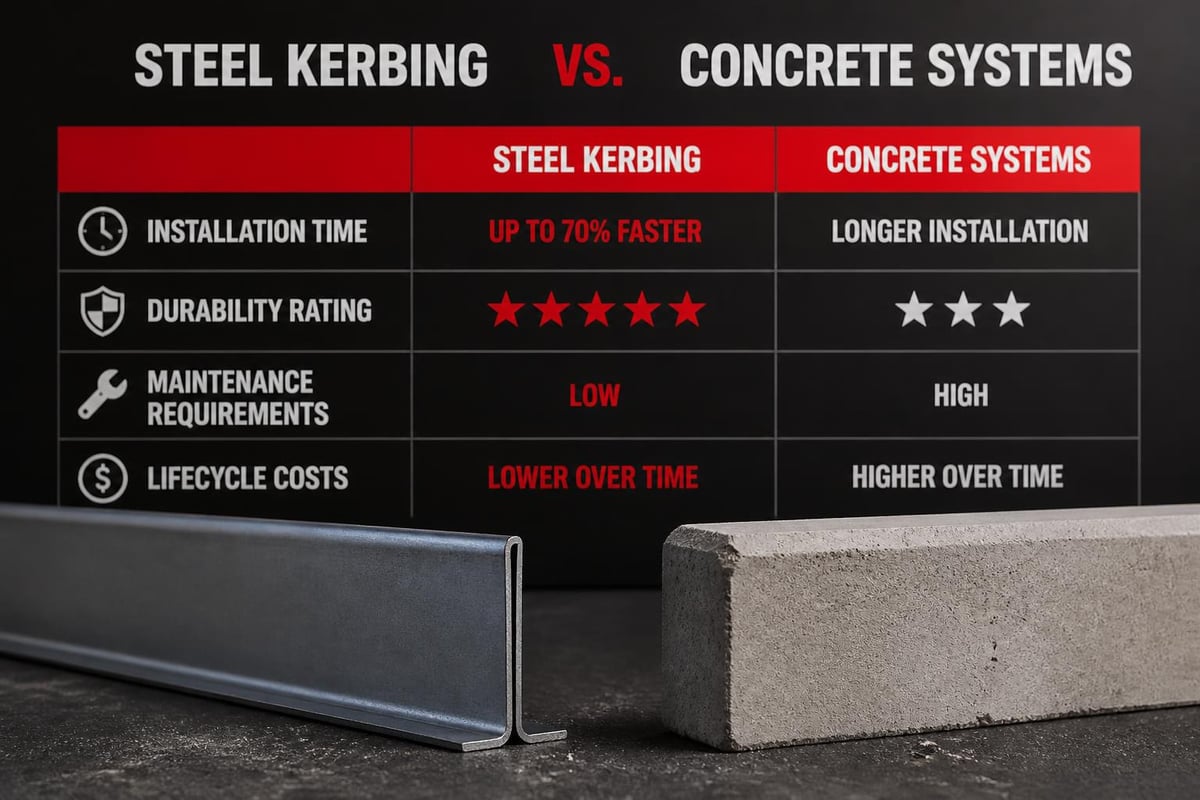
The advantages of steel kerbing over traditional concrete extend beyond mere structural performance. Installation efficiency, aesthetic flexibility, and lifecycle costs all favour modern steel systems, making them increasingly popular for both commercial and residential projects.
Installation Efficiency and Project Timelines
Time represents money in civil engineering, and steel kerbing delivers substantial time savings compared to conventional alternatives. The installation process requires fewer personnel, less equipment, and significantly reduced curing time.
Rapid Deployment Benefits
Steel systems arrive on-site ready for immediate installation. Unlike concrete, which demands formwork, pouring, and extended curing periods, steel kerbing can be positioned, secured, and operational within hours rather than days.
| Installation Aspect | Steel Kerbing | Traditional Concrete |
|---|---|---|
| Site preparation | Minimal excavation | Extensive groundwork |
| Installation time | 4-6 hours typical | 2-3 days minimum |
| Curing period | None required | 7-14 days |
| Traffic readiness | Same day | 14-28 days |
This efficiency proves invaluable for projects with tight deadlines. Civil engineering projects often operate within constrained timeframes, particularly when coordinating multiple trades or minimising disruption to operational businesses.
The stainless steel kerb system available in continuous lengths up to 18 metres eliminates joints and reduces installation complexity. Continuous lengths create seamless boundaries that enhance both appearance and structural performance whilst dramatically reducing labour requirements.
Design Flexibility and Aesthetic Integration
Modern developments demand materials that satisfy both functional and aesthetic requirements. Steel kerbing excels in this dual capacity, offering design professionals considerable creative freedom.
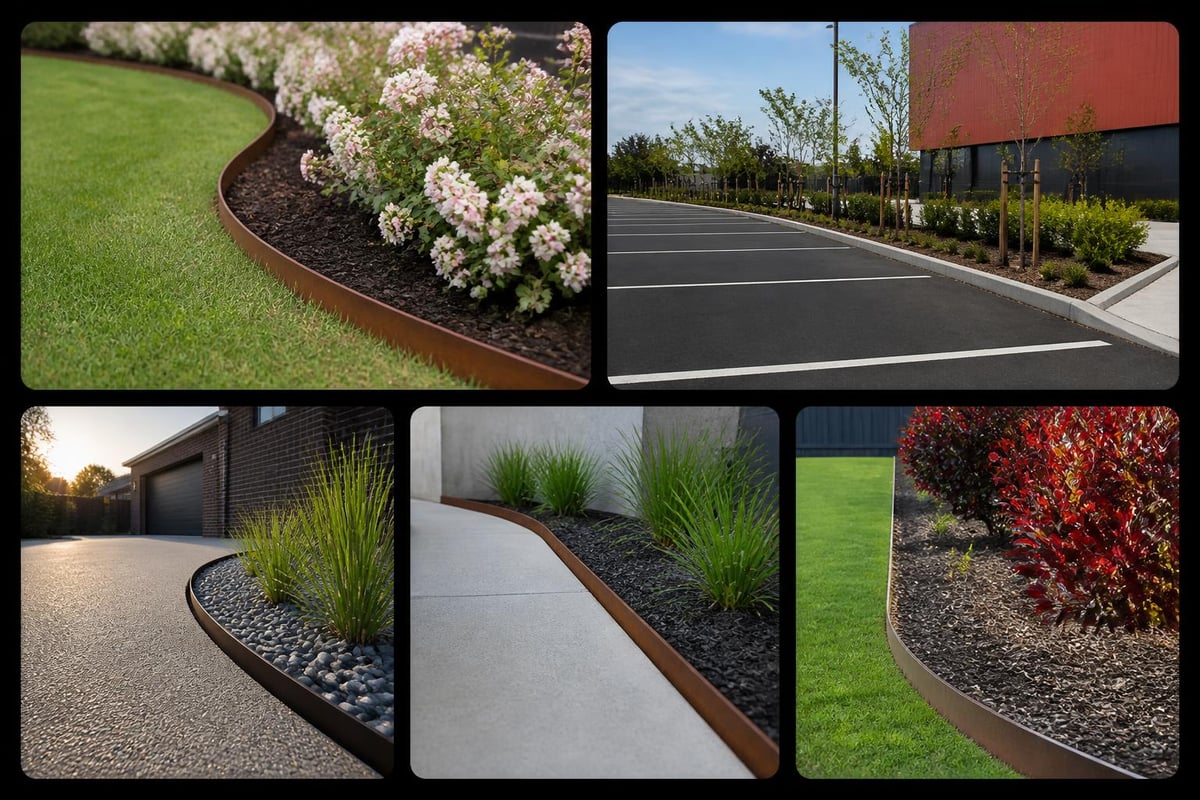
Curved installations become straightforward with steel systems. The material's inherent flexibility allows precise radius work without custom fabrication or complex forming techniques. This capability proves essential for contemporary landscape designs and vehicle circulation areas.
Applications Across Project Types
Steel edging adapts to diverse project requirements:
- Commercial car parks: Define parking bays with precision and durability
- Drive-through facilities: Create robust vehicle guidance systems
- Residential driveways: Establish clean boundaries with minimal maintenance
- Landscaping features: Separate surface materials with elegant transitions
- Pedestrian areas: Protect planted zones from vehicle encroachment
The benefits of using steel edging in modern landscape designs extend to both minimalist contemporary projects and traditional settings. Powder-coated finishes provide colour options, whilst various heights and profiles accommodate specific functional requirements.
Specification Considerations for Civil Projects
Selecting appropriate steel kerbing requires understanding project-specific demands. Material grade, finish specification, and installation methodology all influence long-term performance.
Material Selection Criteria
Grade specification determines corrosion resistance and structural capacity. Standard mild steel with protective coatings suits most applications, whilst stainless steel systems serve environments demanding superior hygiene or extreme weather resistance.
Projects completed by civil engineering specialists demonstrate how proper specification ensures optimal outcomes. Understanding load requirements, drainage integration, and surface transitions proves essential for successful installations.
Key specification elements include:
- Profile height: Typically ranging from 75mm to 200mm depending on application
- Material thickness: Generally 3mm to 6mm based on loading conditions
- Coating system: Galvanised, powder-coated, or stainless options
- Fixing method: Stake frequency and type according to ground conditions
- Joint treatment: Overlap specifications and sealing requirements
Cost Analysis and Project Value
Initial material costs for steel kerbing typically exceed traditional concrete alternatives. However, comprehensive project analysis reveals significant value advantages when considering total lifecycle costs.
Whole-Life Cost Comparison
| Cost Element | Steel Kerbing | Concrete Kerbing |
|---|---|---|
| Material cost | Higher initial | Lower initial |
| Installation labour | Reduced hours | Extended timeframe |
| Equipment requirement | Minimal | Substantial |
| Maintenance frequency | Minimal | Regular repairs |
| Replacement cycle | 25+ years | 10-15 years |
| Project disruption | Single installation | Multiple interventions |
Installation efficiency reduces labour costs substantially. A typical car park project might require three days with concrete systems but complete within one day using steel, delivering immediate savings that offset material premiums.
Maintenance considerations further enhance steel kerbing's value proposition. Concrete systems frequently require joint repairs, crack remediation, and section replacement. Steel installations, properly specified and installed, deliver decades of maintenance-free service.
The steel edging solutions designed to outperform traditional materials prove particularly cost-effective in high-traffic commercial environments where replacement disruption creates significant operational costs beyond direct material expenses.
Specialist Applications and Industry-Specific Requirements
Certain industries demand kerbing systems that satisfy stringent regulatory or operational standards. Steel solutions excel in these demanding environments.
Hygiene-Critical Environments
Food processing, pharmaceutical manufacturing, and healthcare facilities require materials that support rigorous cleaning protocols. Stainless steel kerbs in maintaining high hygiene standards provide smooth, non-porous surfaces that resist bacterial colonisation and withstand aggressive cleaning agents.
These environments benefit from:
- Seamless construction eliminating dirt traps and contamination risks
- Chemical resistance maintaining integrity despite frequent sanitisation
- Easy cleaning with smooth surfaces requiring minimal maintenance effort
- Durability resisting damage from cleaning equipment and procedures

Installation Best Practices and Technical Considerations
Successful steel kerbing installations require attention to ground preparation, fixing methodology, and interface detailing. Proper execution ensures systems deliver their full performance potential.
Ground Preparation Requirements
Unlike concrete systems that incorporate substantial foundations, steel kerbing demands precise sub-base preparation. The supporting material must provide stable, level bedding whilst accommodating drainage requirements.
Base course specification typically includes:
- Excavation to appropriate depth based on kerb height and loading
- Compacted granular sub-base providing stable foundation
- Adjustment layer allowing precise level and line control
- Adequate drainage provision preventing water accumulation
- Proper compaction ensuring long-term stability
Fixing and Securing Methods
Steel systems utilise driven stakes or mechanical fixings to maintain position. Stake frequency depends on ground conditions, loading expectations, and profile characteristics. Typical installations employ stakes at 1000mm to 1500mm centres, with reduced spacing in challenging conditions.
The robust steel kerbing system designed for rapid installation demonstrates how engineered fixing systems ensure reliable long-term performance. Proper stake selection, driving technique, and backfill compaction prove critical to installation success.
Integration with Surfacing and Drainage Systems
Steel kerbing functions as part of broader pavement systems. Successful projects coordinate kerb installation with surfacing operations and drainage infrastructure.
Surfacing Interface Details
The junction between steel edging and adjacent surfaces requires careful specification. Asphalt installations typically overlap kerb edges slightly, creating weather-tight seals whilst allowing thermal movement. Block paving installations require precise height coordination ensuring proper interlock without vertical displacement.
Drainage coordination ensures water management systems function effectively:
- Position kerbs to direct surface water towards collection points
- Incorporate drainage outlets at appropriate intervals
- Ensure kerb height maintains positive drainage gradients
- Coordinate with below-ground drainage infrastructure
- Allow for surface water flow patterns and volume calculations
Projects involving civils design expertise integrate these elements seamlessly, ensuring kerbing enhances rather than compromises overall site performance. Proper coordination during design phases prevents costly modifications during construction.
Project Case Studies and Performance Evidence
Real-world applications demonstrate steel kerbing's capabilities across diverse project types. Commercial developments, in particular, showcase how these systems deliver under demanding conditions.
Commercial Drive-Through Facilities
Drive-through restaurants present challenging requirements. Vehicles navigate tight radii, queue in designated areas, and generate concentrated loading along boundary systems. Traditional concrete kerbs frequently fail in these applications, developing cracks and displacement within months of installation.
Steel systems address these challenges effectively. The material's flexibility accommodates curved layouts without custom fabrication. Impact resistance prevents damage from occasional vehicle contact. Installation speed minimises disruption during site development.
Performance metrics from completed installations demonstrate steel's advantages:
| Performance Measure | Steel System Results | Typical Concrete Results |
|---|---|---|
| Displacement incidents | Zero after 2 years | Multiple within 6 months |
| Crack development | None observed | Widespread within 1 year |
| Maintenance interventions | None required | Quarterly repairs typical |
| Service life projection | 25+ years | 8-12 years average |
Residential and Private Development Applications
Domestic driveways and residential developments benefit equally from steel kerbing technology. Homeowners appreciate the clean aesthetic, whilst developers value installation efficiency and long-term performance.
Private projects demonstrate versatility across design styles. Contemporary properties pair steel edging with resin-bound surfaces or porcelain paving. Traditional homes integrate steel systems with block paving or natural stone, proving the material's aesthetic adaptability.
Environmental Considerations and Sustainability
Sustainability increasingly influences material selection in civil engineering. Steel kerbing presents compelling environmental credentials that align with modern construction values.
Material Lifecycle and Recyclability
Steel ranks among the world's most recycled materials. End-of-life steel kerbing retains substantial value and readily enters recycling streams. This circular economy characteristic contrasts sharply with concrete, which typically ends in landfill or low-value aggregate applications.
Carbon footprint analysis reveals nuanced sustainability profiles:
- Manufacturing steel involves significant energy input and emissions
- Extended service life distributes embodied carbon across decades
- Reduced transportation requirements (lighter weight) lower installation emissions
- Elimination of repeated replacements prevents accumulated environmental impact
- Complete recyclability recovers embodied energy and material value
Projects pursuing environmental certifications find steel systems support sustainability objectives. Civil engineering opportunities focusing on sustainable infrastructure increasingly specify materials demonstrating robust lifecycle credentials.
Maintenance and Long-Term Performance
Steel kerbing's low maintenance requirements deliver ongoing operational benefits throughout its service life. Understanding care requirements ensures systems achieve their full performance potential.
Routine Inspection and Care
Annual visual inspections identify potential issues before they escalate. Check points include:
- Stake stability: Ensure fixing points remain secure and properly embedded
- Coating condition: Monitor protective finishes for damage or deterioration
- Joint integrity: Verify overlap sections maintain proper connection
- Alignment: Confirm kerbs maintain designed position and level
- Drainage function: Ensure water management systems operate effectively
Minor maintenance interventions prevent significant problems. Touch-up painting addresses coating damage. Stake adjustment corrects minor displacement. These simple actions extend service life and maintain appearance.
Performance Expectations
Properly installed steel kerbing systems deliver decades of reliable service. The material's inherent durability, combined with protective coatings and appropriate specification, creates edge retention systems that outlast multiple generations of adjacent surfacing.
Expected service life varies by application and environment:
- Standard commercial applications: 20-30 years minimum
- Residential installations: 30+ years typical
- Harsh environments with proper specification: 15-25 years
- Hygiene-critical stainless systems: 30-50 years achievable
These timeframes assume proper installation, appropriate specification, and routine inspection. Systems experiencing exceptional loading or environmental challenges may require earlier intervention, though performance typically exceeds concrete alternatives substantially.
Specification Resources and Technical Support
Successful steel kerbing projects begin with proper specification. Manufacturers provide comprehensive technical resources supporting design professionals and contractors.
Available Product Systems
Multiple manufacturers offer steel kerbing solutions with varying characteristics. MKERB’s stainless steel kerbing system highlights unique continuous length design suited to applications requiring hygienic processes. Alternative systems emphasise rapid installation, aesthetic flexibility, or specific loading capacities.
Product selection considers:
- Loading requirements: Vehicle types, traffic volumes, turning forces
- Environmental exposure: Weather conditions, chemical exposure, cleaning protocols
- Aesthetic objectives: Colour preferences, profile visibility, design integration
- Installation constraints: Access limitations, timeline pressures, coordination requirements
- Budget parameters: Initial costs, lifecycle value, maintenance provisions
Technical support from manufacturers and experienced contractors ensures appropriate system selection. Consultation during design phases prevents specification errors that compromise performance or inflate costs.
Steel kerbing represents a proven, versatile solution for modern civil engineering projects, delivering superior durability, installation efficiency, and long-term value across commercial and residential applications. Whether you're planning a major commercial development or enhancing residential properties, selecting the right materials and partners ensures project success. At JRG Civils, we bring extensive experience in civil engineering and construction, delivering excellence from initial design through to final completion across the North East and throughout the UK. Contact our team to discuss how we can support your next project with professional, reliable service and attention to detail that ensures outstanding results.