
When planning any development that impacts public highways, understanding the legal framework governing highway alterations becomes essential. A section 278 application represents the formal process through which developers seek permission to modify or improve existing highway infrastructure under the Highways Act 1980. Whether constructing a new commercial access point, adding junction improvements, or implementing traffic calming measures, this statutory requirement ensures that all highway works meet safety standards and integrate seamlessly with existing road networks. For civil engineering contractors and property developers alike, navigating this process efficiently can determine project timelines and overall budgetary success.
Understanding Section 278 Agreements
Section 278 of the Highways Act 1980 grants highway authorities the power to enter into agreements with developers who wish to undertake works on the public highway. This legislation covers a broad spectrum of modifications, from creating new vehicular accesses to reconstructing entire junctions that facilitate development projects.
The agreement serves multiple purposes beyond mere legal compliance. It establishes clear responsibilities between the developer and the highway authority, outlines technical standards that must be met, and provides financial safeguards through commuted sums and performance bonds. Most importantly, it ensures that any modifications enhance or maintain highway safety standards rather than compromise them.
Types of Works Covered
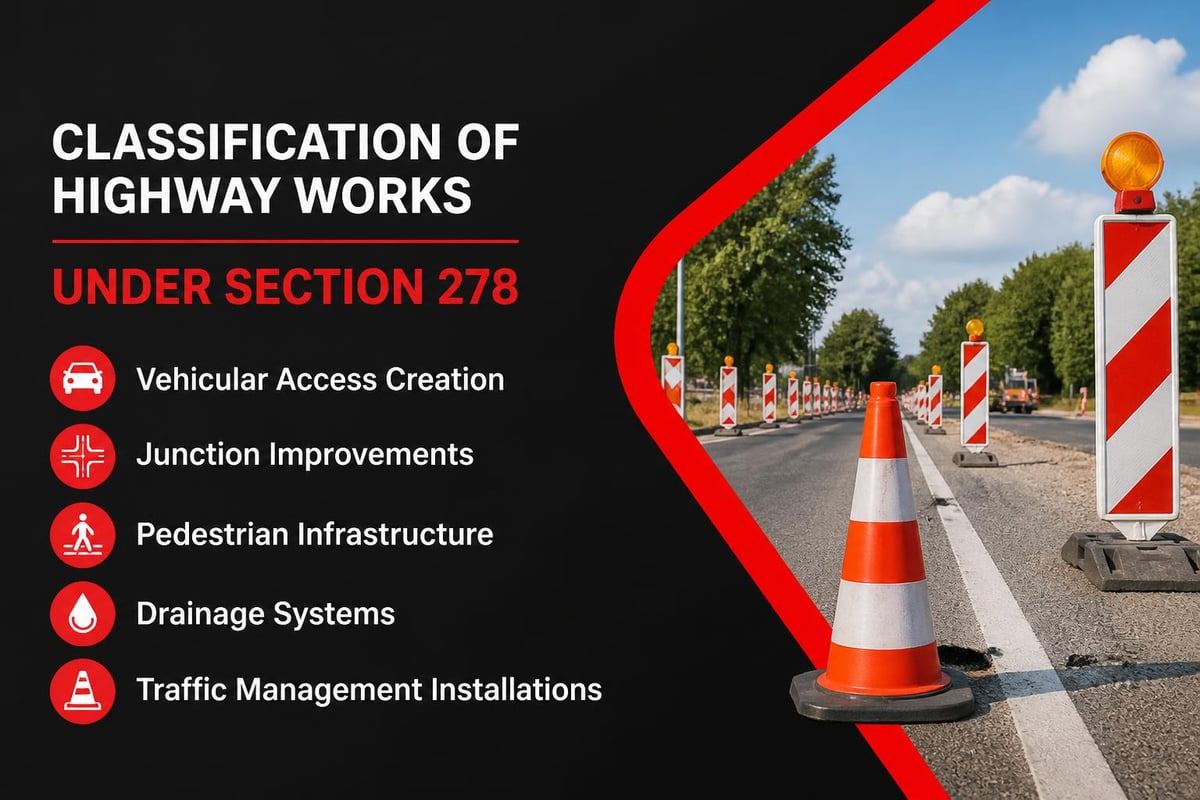
A section 278 application typically encompasses several categories of highway improvement:
- New vehicular access points for residential, commercial, or industrial developments
- Junction modifications including roundabouts, traffic signals, and turning lanes
- Footway construction or widening to accommodate increased pedestrian traffic
- Street lighting installations and upgrades
- Traffic calming measures such as speed humps or chicanes
- Drainage improvements necessitated by development impact
Commercial developments like drive-through restaurants or retail parks frequently require substantial highway modifications. The comprehensive scope of Section 278 agreements demonstrates how varied these projects can be, from minor dropped kerbs to major junction reconfigurations.
The Application Process Explained
Submitting a section 278 application requires careful preparation and attention to procedural requirements. Highway authorities maintain specific protocols, though the fundamental structure remains consistent across jurisdictions.
Initial engagement with the highway authority should occur during early planning stages. Pre-application discussions help identify potential issues, clarify technical requirements, and establish realistic timelines. Many authorities offer formal pre-application services that provide written feedback on proposed schemes.
Required Documentation
The application package must demonstrate comprehensive planning and technical competence:
- Completed application form with developer and site details
- Location plans clearly showing the extent of proposed works
- Detailed engineering drawings prepared to highway authority standards
- Traffic impact assessments demonstrating safety implications
- Construction methodology statements outlining work sequencing
- Programme of works with realistic completion timescales
Each highway authority maintains specific documentation standards. The Section 278 application process in Shropshire provides an excellent example of typical requirements, including submission formats and technical specifications.
Design Approval Stages
Highway authorities implement staged approval processes to ensure works meet required standards. Technical approval typically progresses through preliminary design review, detailed design scrutiny, and final approval before construction commences. This phased approach allows for iterative refinement and prevents costly modifications during construction.
Professional highway design consultants often prove invaluable during this phase. Their expertise in Section 278 highway design ensures compliance with technical standards whilst managing the approval process efficiently from initial concept through to construction sign-off.
Financial Considerations and Fees
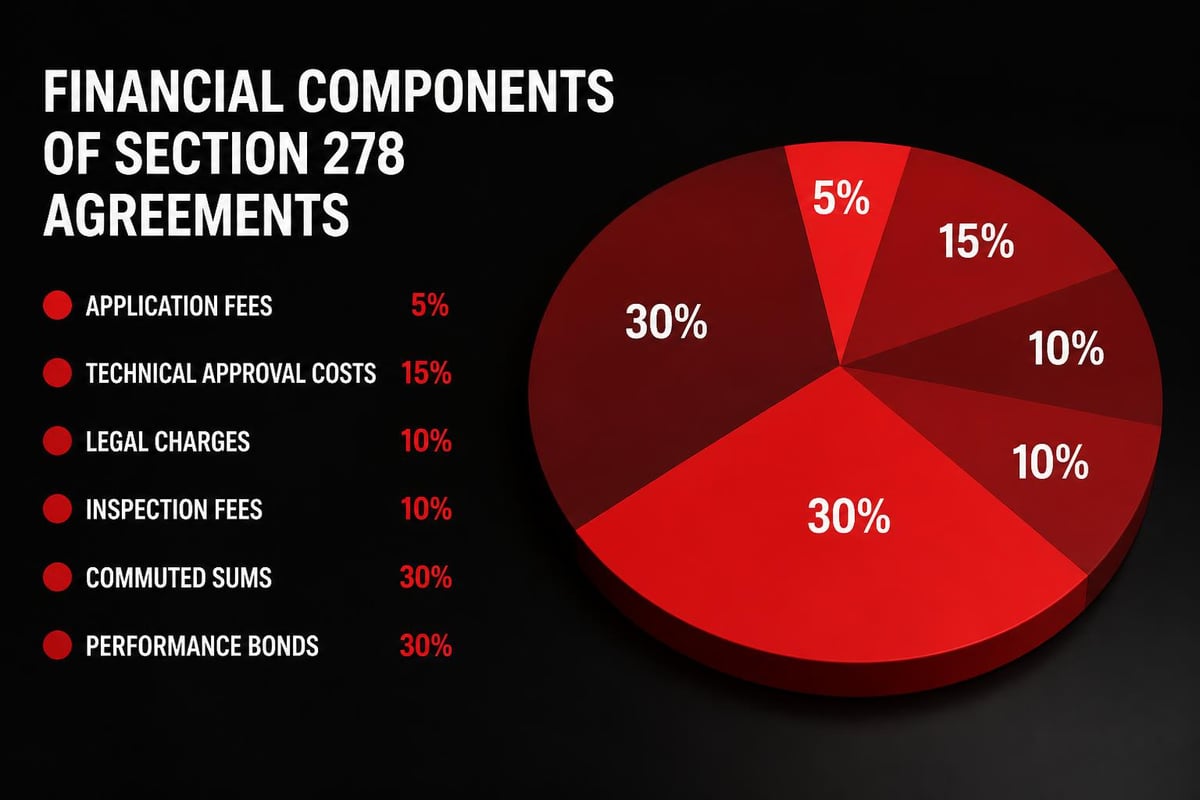
Understanding the financial obligations associated with a section 278 application enables accurate project budgeting and prevents unwelcome surprises during development.
| Cost Component | Typical Range | Purpose |
|---|---|---|
| Application Fee | £500-£2,000 | Administrative processing |
| Technical Approval | £1,500-£5,000 | Design review and approval |
| Legal Agreement | £2,000-£8,000 | Solicitor fees and documentation |
| Inspection Fees | £3,000-£15,000 | Construction supervision |
| Commuted Sum | Variable | Future maintenance costs |
Application and processing fees cover the administrative burden of reviewing submissions and coordinating internal consultations. These fees vary significantly between authorities based on scheme complexity and required resources.
Commuted sums represent perhaps the most substantial financial consideration. These one-off payments compensate highway authorities for the future maintenance burden of new or modified infrastructure. Calculations typically consider asset lifespan, anticipated maintenance frequency, and replacement costs over a predetermined period, often 25 or 30 years.
Performance bonds provide financial security that works will be completed to specification. Highway authorities typically require bonds equivalent to 150% of estimated construction costs, returnable upon satisfactory completion and an initial defects period.
The Barnsley Section 278 agreement process illustrates how local authorities structure their fee schedules, providing transparency for developers during budget preparation.
Construction Phase Requirements
Once all approvals are secured and legal agreements executed, construction can commence. However, the section 278 application obligations continue throughout the build phase.
Site Supervision and Inspection
Highway authorities maintain rigorous oversight during construction. Appointed inspectors conduct regular site visits to verify compliance with approved drawings, specifications, and safety protocols. Developers must provide adequate notice before commencing works, reaching critical hold points, or covering elements requiring inspection.
Quality assurance documentation forms a critical component of construction phase requirements:
- Material test certificates for aggregates, asphalt, and concrete
- Compaction test results demonstrating adequate foundation preparation
- As-built drawings recording actual construction details
- Photographic records documenting construction progression
- Daily site records noting weather, activities, and personnel
Failing inspections can result in remedial works at the developer's expense and programme delays. Maintaining open communication with inspecting officers and addressing concerns promptly helps prevent such complications.
Traffic Management Considerations
Highway works inevitably affect normal traffic flow. Developers must prepare comprehensive traffic management plans that minimise disruption whilst maintaining safety for road users and site operatives. These plans require separate approval under the New Roads and Street Works Act 1991.
Coordination with the highway authority's street works team ensures that proposed closures, diversions, or temporary traffic signals align with other planned works and minimise cumulative impact on the network.
Common Challenges and Solutions
Even experienced developers encounter obstacles during the section 278 application journey. Recognising potential issues and implementing proactive strategies significantly improves outcomes.
Design rejection or modification requests frequently arise when initial submissions don't fully align with highway authority standards or safety requirements. Engaging experienced civil engineering contractors like JRG Civils during design development helps ensure submissions meet technical expectations from the outset.
Extended approval timescales can derail development programmes. Highway authorities face resource constraints and must balance Section 278 work with their statutory obligations. Building realistic timescales into development programmes, typically 12-16 weeks for straightforward schemes and longer for complex proposals, prevents disappointment.
Utility diversions present unexpected complications in many projects. Early engagement with utility companies through the highway authority's coordination processes identifies conflicts before construction commences, allowing adequate programming and budgeting for diversion works.
Technical Standards and Specifications
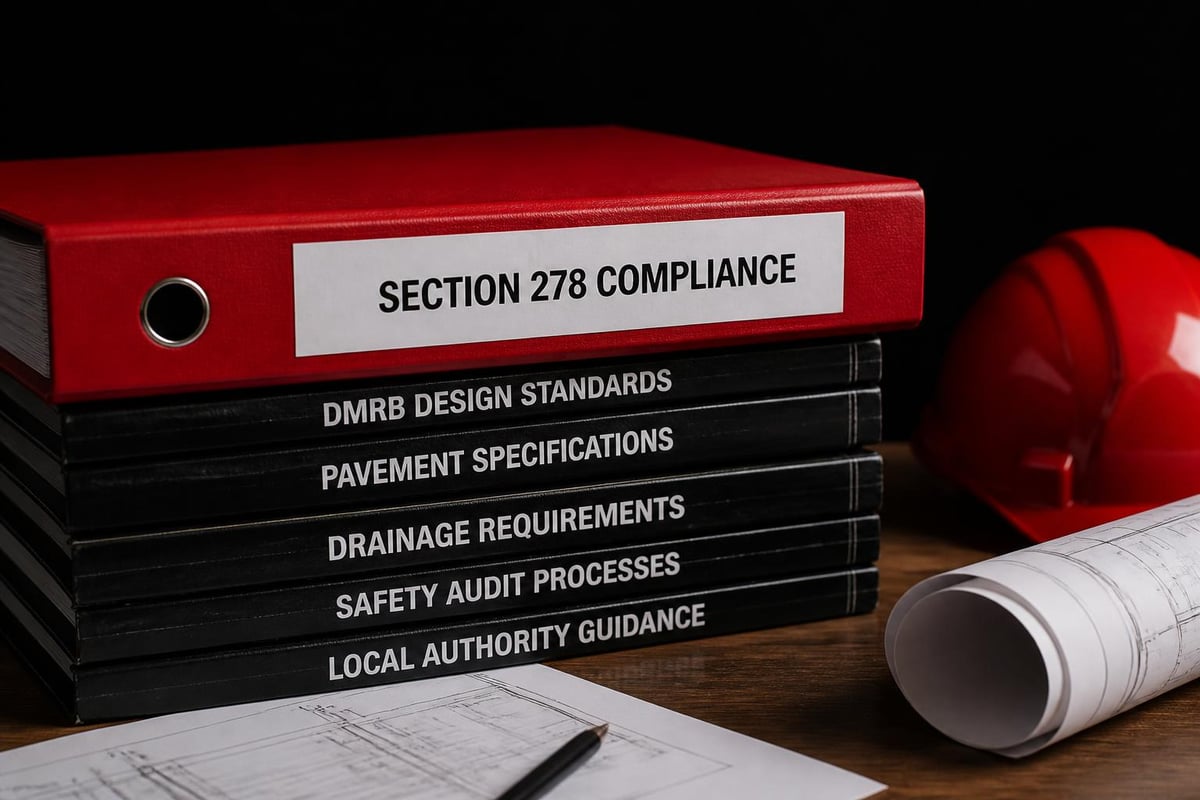
Highway works must comply with rigorous technical standards that ensure longevity, safety, and compatibility with existing infrastructure. The Design Manual for Roads and Bridges (DMRB) provides the foundational guidance for highway design in the UK, though local authorities may supplement these with specific requirements.
Pavement Construction Standards
Road construction specifications typically reference:
- Foundation design appropriate to traffic loading and ground conditions
- Aggregate materials meeting specified grading and strength requirements
- Asphalt composition and laying temperatures for optimal compaction
- Surface regularity tolerances ensuring driver comfort and safety
Construction quality directly impacts long-term performance and maintenance requirements. Superior workmanship during the initial construction phase reduces whole-life costs and prevents premature deterioration that reflects poorly on both the developer and the civil engineering contractor.
Access to standard documents for Section 278 agreements helps contractors understand technical expectations and prepare compliant submissions.
Drainage Design Requirements
Effective drainage design prevents water accumulation that compromises pavement integrity and creates safety hazards. Section 278 works must incorporate:
- Adequate longitudinal gradients for surface water runoff
- Gully spacing calculated for anticipated rainfall intensity
- Connection to existing drainage systems without overloading capacity
- Sustainable drainage solutions where conventional systems prove inadequate
Climate change considerations now influence drainage design, with authorities requiring capacity for increased rainfall intensity and more frequent extreme weather events.
Working with Highway Authorities
Successful navigation of the section 278 application process depends significantly on establishing productive working relationships with highway authority personnel. Different authorities maintain varying approaches, but fundamental principles remain consistent.
Proactive communication prevents misunderstandings and delays. Regular dialogue with case officers, design reviewers, and inspectors ensures that concerns are addressed promptly and expectations remain aligned. Treating highway authority staff as partners rather than obstacles transforms the process from adversarial to collaborative.
Understanding local preferences accelerates approvals. Whilst national standards provide the framework, individual authorities often have preferences regarding specific details, materials, or construction techniques based on local experience and maintenance capabilities. Researching these preferences through local authority guidance and pre-application discussions prevents unnecessary revision cycles.
Respecting timescales demonstrates professionalism. Highway authorities work within structured processes and resource constraints. Providing complete, well-prepared submissions reduces review time, whilst unrealistic deadline expectations create friction and may prove counterproductive.
Post-Completion Procedures
The section 278 application obligations don't conclude when construction finishes. Several post-completion requirements must be satisfied before the agreement is formally discharged.
A defects period, typically 12 months, follows practical completion. During this time, the developer remains responsible for rectifying any defects arising from workmanship or materials. Highway authorities conduct final inspections at the defects period's conclusion, identifying any remedial works required before issuing a completion certificate.
Final as-built drawings must accurately reflect the constructed works. These drawings become part of the highway authority's permanent records, informing future maintenance and modification projects. Discrepancies between approved designs and as-built conditions can delay completion certification and bond release.
The commuted sum payment typically occurs following satisfactory completion and defects period expiry. Some authorities collect this payment earlier in the process, whilst others defer until final certification. Understanding the specific authority's requirements prevents financial planning complications.
Integration with Planning Conditions
Section 278 works frequently arise from planning conditions attached to development consents. Coordination between planning requirements and highway authority processes requires careful attention to ensure compliance with both regimes.
Planning conditions often specify that particular highway works must be completed before development occupation or use commences. Failure to satisfy these conditions can result in enforcement action, halting development despite substantial investment. Early identification of such conditions allows realistic programming that sequences section 278 works appropriately within the broader construction programme.
Some developments trigger both Section 278 agreements for works on existing highways and Section 38 agreements for new roads that will be adopted. Understanding the distinction and managing both processes simultaneously requires considerable expertise but ensures comprehensive highway infrastructure delivery.
Best Practices for Developers
Successful section 278 application processes result from diligent preparation, professional execution, and collaborative attitudes. Several best practices emerge from examining successful projects across diverse contexts.
Early engagement cannot be overemphasised. Involving highway authorities during conceptual design stages identifies constraints and opportunities that influence site layouts and access strategies. This early dialogue often reveals solutions that satisfy both development objectives and highway safety requirements more elegantly than later compromise.
Professional expertise delivers value throughout the process. Whilst developers may possess considerable construction knowledge, highway design and approval processes involve specialised considerations. Experienced civil engineering contractors bring valuable insights that streamline applications and prevent costly errors.
Comprehensive budgeting must account for all elements:
- Professional fees for design and supervision
- Highway authority fees and charges
- Construction costs including preliminaries and traffic management
- Commuted sums and performance bonds
- Contingency allowances for unforeseen complications
Programme realism acknowledges that section 278 application processes require time. Schemes cannot be rushed through approvals without compromising quality or creating friction with highway authorities. Adequate programming prevents the temptation to commence works prematurely, which can result in enforcement action and relationship damage.
Regional Variations and Local Requirements
Whilst the statutory framework remains consistent across England and Wales, individual highway authorities implement the section 278 application process according to local priorities and resources. Understanding these regional variations prevents misapplied assumptions based on experience in different jurisdictions.
| Authority Type | Typical Approach | Key Characteristics |
|---|---|---|
| County Councils | Structured processes | Detailed guidance, standard forms |
| Unitary Authorities | Variable procedures | Flexibility based on team size |
| Metropolitan Districts | High volume experience | Streamlined for common schemes |
| London Boroughs | Urban-focused standards | Emphasis on pedestrian/cycle provision |
Some authorities maintain dedicated development teams specifically handling Section 278 and Section 38 agreements, whilst others integrate this function within broader highway engineering departments. Team structure influences response times, communication protocols, and process formality.
Technical requirements also vary regionally. Authorities in areas with specific challenges, such as mining subsidence risk or poor ground conditions, may impose additional investigation or design requirements. Understanding these local factors during initial feasibility assessments prevents surprises during detailed design development.
Quality Assurance and Compliance
Maintaining rigorous quality standards throughout design and construction phases ensures that completed works satisfy highway authority requirements and provide long-term performance.
Quality management systems should encompass both design development and construction execution. For design, this includes independent checking procedures that verify calculations, assess constructability, and confirm compliance with relevant standards before submission. During construction, systematic inspection and testing protocols ensure that materials and workmanship meet specifications.
Documentation management deserves particular attention. Complete, organised records demonstrate compliance and facilitate efficient inspections. Modern project management systems enable digital record-keeping that improves accessibility and prevents loss of critical information.
Non-compliance carries serious consequences. Beyond immediate remedial costs and programme delays, poor-quality work damages professional reputations and may prejudice future applications with the same authority. The investment in proper quality assurance delivers returns far exceeding its cost.
Successfully managing a section 278 application requires technical expertise, procedural knowledge, and collaborative working with highway authorities throughout design, approval, and construction phases. Whether you're planning a commercial development requiring new highway access or improvements to existing infrastructure, the process demands careful attention to regulatory requirements, technical standards, and financial obligations. JRG Civils brings extensive experience in civil engineering and highway works across the UK, delivering projects from initial design through to successful completion and adoption, ensuring your development proceeds smoothly whilst meeting all statutory requirements.