
The foundation of any successful construction project lies beneath the surface, where civil and earthworks operations create the stable platforms upon which roads, buildings, and infrastructure are built. Whether you're planning a commercial development, a highway extension, or a residential driveway, understanding the principles and practices of earthworks engineering is essential for project success. This comprehensive guide explores the key aspects of civil and earthworks, from initial site assessment through to final compaction and quality assurance.
Understanding Civil and Earthworks Fundamentals
Civil and earthworks encompass all activities related to moving, shaping, and compacting earth materials to create stable foundations and landforms. These operations form the critical first phase of most construction projects, determining the long-term stability and performance of everything built above them.
The scope of earthworks extends far beyond simple excavation. Professional contractors must assess soil conditions, manage drainage patterns, ensure proper compaction levels, and create precise grades according to engineering specifications. Each project presents unique challenges based on soil composition, existing topography, weather conditions, and the intended final use of the land.
Key Components of Earthworks Projects
Successful civil and earthworks projects require careful coordination of multiple elements working together as an integrated system:
- Site investigation and soil analysis to determine bearing capacity and drainage characteristics
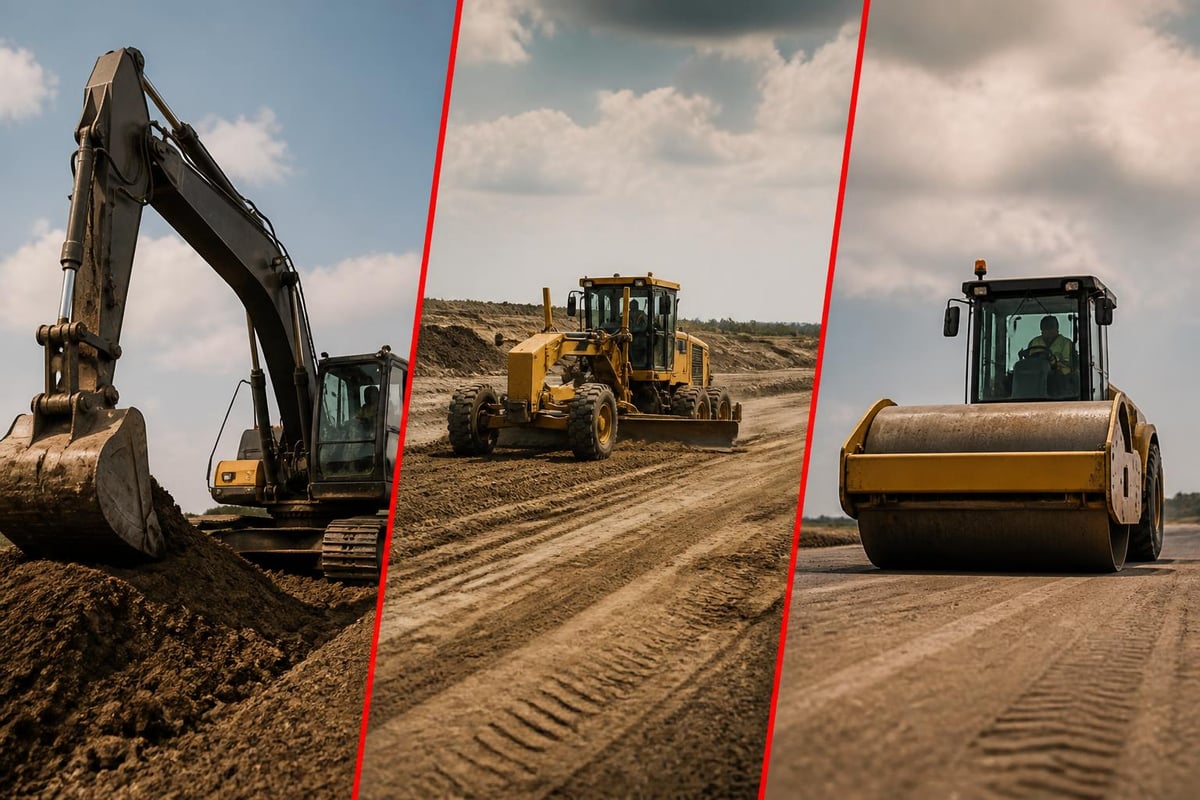
- Excavation and bulk earthmoving using appropriate plant and machinery
- Grade preparation to achieve specified levels and slopes
- Drainage installation including pipes, channels, and retention systems
- Fill placement and compaction in controlled layers to engineering standards
- Surface finishing ready for subsequent construction phases
Project planning must account for material movement across the site. Cut and fill operations aim to balance excavated material with fill requirements, minimising the need to import or export soil and thereby reducing project costs and environmental impact.
Site Assessment and Ground Investigation
Before any earthmoving equipment arrives on site, thorough ground infrastructure evaluation establishes the foundation for successful civil and earthworks execution. Ground investigation reveals subsurface conditions that directly impact design decisions, construction methods, and project viability.
Geotechnical surveys typically include trial pits, borehole drilling, and laboratory testing of soil samples. These investigations identify soil types, stratification patterns, groundwater levels, and potential contamination. For highway projects and commercial developments, understanding load-bearing capacity prevents future settlement issues that could compromise structural integrity.
| Investigation Method | Information Provided | Typical Depth |
|---|---|---|
| Trial Pits | Visual soil profiling, sampling | 3-5 metres |
| Cable Percussion Boreholes | Deep soil layers, groundwater | 10-30 metres |
| Dynamic Probing | Soil density, layering | 5-15 metres |
| In-situ Testing | Bearing capacity, strength | Variable |
The data collected during site investigation directly informs earthworks design specifications. Engineers use this information to calculate required excavation depths, specify compaction requirements, design drainage systems, and determine whether soil stabilisation measures are necessary.
Excavation and Earth Movement Techniques
Efficient excavation forms the cornerstone of productive civil and earthworks operations. Modern contractors deploy a range of plant and machinery matched to specific project requirements, soil conditions, and site constraints.
Equipment Selection and Deployment
Choosing appropriate excavation equipment significantly impacts project efficiency and cost-effectiveness. Large-scale highway projects may utilise scrapers and bulldozers for bulk earthmoving, whilst tighter commercial sites benefit from 360-degree excavators offering greater precision and manoeuvrability.
Key factors influencing equipment selection include:
- Volume of material to be moved determines machine size and capacity
- Haul distances influence whether scrapers, dump trucks, or conveyors prove most economical
- Site access and working space availability constrain machine dimensions
- Soil conditions affect traction, digging resistance, and cycle times
- Environmental considerations such as noise, vibration, and emission restrictions
Experienced domestic and commercial contractors maintain diverse plant fleets, enabling them to match equipment to specific project phases. This flexibility proves particularly valuable when working on varied projects, from large franchise developments to residential driveways.
Compaction and Ground Stabilisation
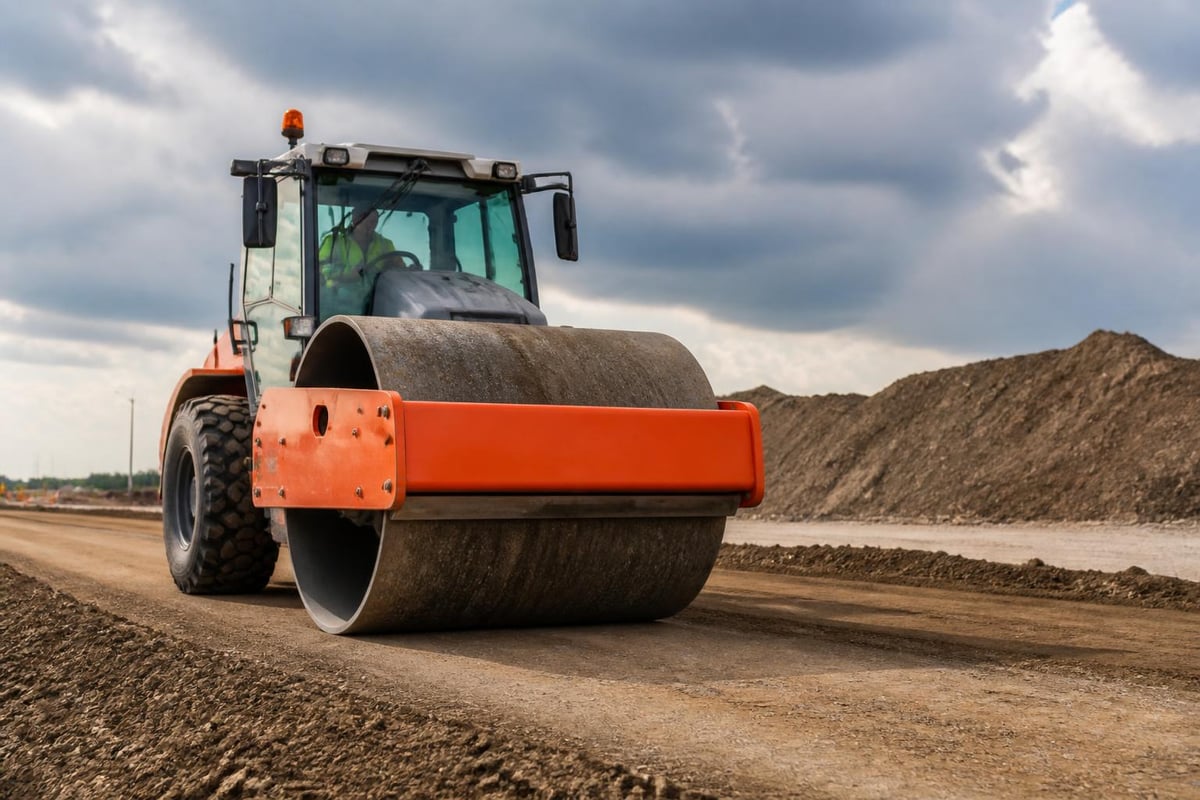
Proper compaction transforms loose fill material into stable, load-bearing foundations capable of supporting roads, buildings, and other structures. Civil and earthworks specifications typically mandate specific compaction levels expressed as percentages of maximum dry density, determined through laboratory testing.
Achieving specified compaction requires careful attention to multiple variables. Material moisture content must fall within narrow tolerance ranges-too dry and particles won't bind effectively, too wet and excess water prevents proper densification. Layer thickness also proves critical, with most specifications requiring compaction in lifts no thicker than 150-300mm depending on soil type and compaction equipment.
Testing and Quality Assurance
Quality control procedures verify that civil and earthworks meet design specifications before subsequent construction phases commence. Field testing typically includes:
- Nuclear density gauge testing for rapid in-situ density and moisture measurements
- Plate bearing tests to assess load-bearing capacity
- California Bearing Ratio (CBR) testing for road subgrade assessment
- Proof rolling to identify soft spots or inconsistent compaction
Documentation of test results provides essential quality assurance records, demonstrating compliance with project specifications and relevant engineering standards. This documentation protects both contractors and clients, establishing clear accountability for earthworks performance.
Drainage and Water Management
Effective water management represents one of the most critical aspects of civil and earthworks design and execution. Water infiltration undermines soil stability, reduces bearing capacity, and accelerates deterioration of constructed surfaces. Comprehensive drainage systems protect earthworks investments by controlling surface water runoff and managing groundwater.
Highway projects and commercial developments typically incorporate multiple drainage elements working together as integrated systems. Surface water drainage channels and gullies collect rainfall and direct it away from paved areas. Subsurface drainage layers and pipes prevent water accumulation within pavement structures, whilst cut-off drains intercept groundwater before it reaches critical areas.
| Drainage Component | Primary Function | Typical Application |
|---|---|---|
| French Drains | Subsurface water collection | Building perimeters, retaining walls |
| Swales | Surface water conveyance | Site boundaries, landscape areas |
| Permeable Sub-base | Water infiltration and storage | Car parks, driveways |
| Attenuation Systems | Flow rate control | Commercial developments |
The increasing focus on sustainable drainage systems (SuDS) has transformed civil and earthworks design approaches. Rather than rapidly conveying water off-site, modern projects often incorporate retention ponds, permeable paving, and infiltration basins that manage water naturally whilst providing environmental benefits.
Commercial and Highway Applications
Civil and earthworks operations for commercial developments and highway projects demand precision, coordination, and strict adherence to specifications. These large-scale projects often involve complex phasing, multiple contractors, and stringent quality requirements that challenge even experienced teams.
Franchise and Commercial Site Development
Drive-through restaurants, retail parks, and commercial centres present unique civil and earthworks challenges. These projects require careful grading to achieve precise falls for drainage whilst creating level building platforms and car parking areas. Service trenches for utilities must be coordinated with structural foundations, and surface finishes must meet both functional and aesthetic requirements.
Successful commercial projects balance multiple competing demands. Construction programmes often impose tight deadlines, requiring efficient earthworks execution without compromising quality. Site constraints may limit working areas and material storage locations, demanding careful logistics planning. Meanwhile, maintaining access for adjacent businesses during construction adds further complexity to project management.
Modern commercial projects increasingly incorporate advanced construction methods. Soil stabilisation using cement or lime can transform weak subgrades into stable platforms, reducing excavation depths and imported material requirements. Ground improvement techniques such as dynamic compaction or stone columns enable development on sites previously considered unsuitable.
Residential Earthworks and Driveways
Whilst large-scale highway projects capture attention, civil and earthworks for residential applications require equal expertise and attention to detail. Driveways, patios, and garden landscaping projects may involve smaller volumes of earth movement, but the principles of proper excavation, drainage, and compaction remain identical.
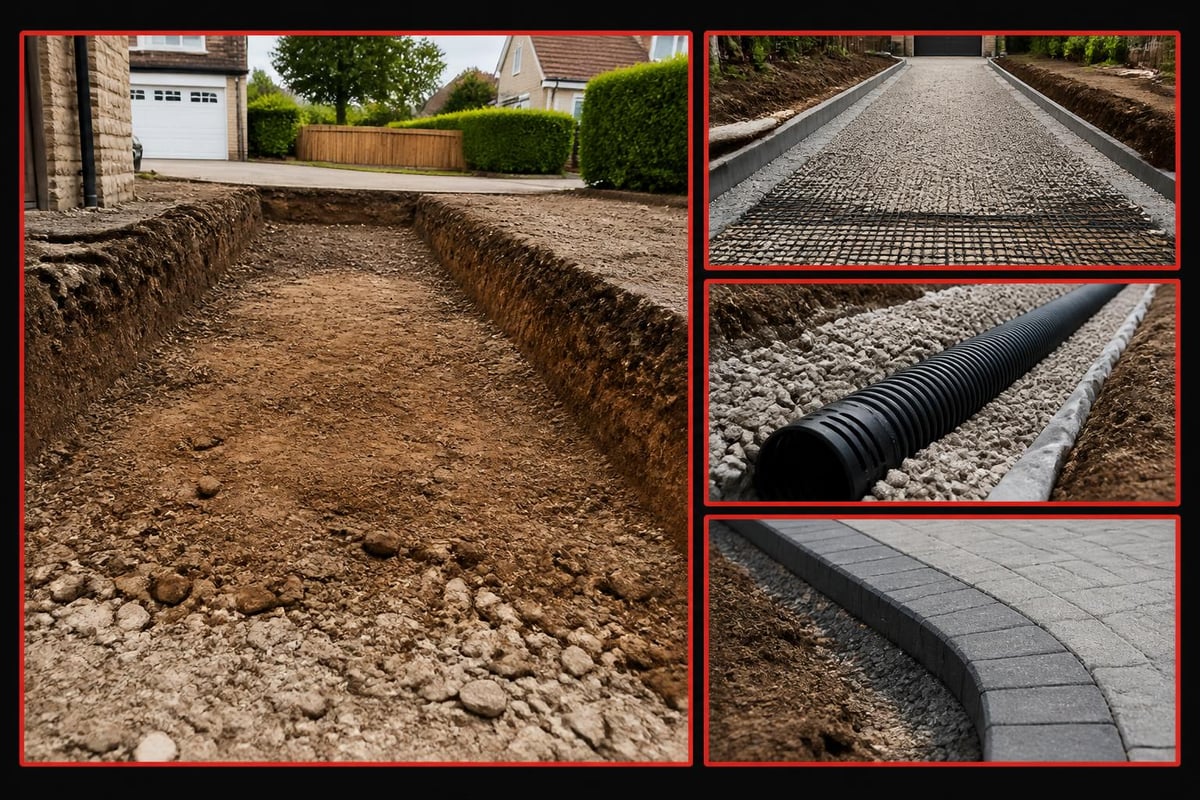
Residential civil and earthworks projects benefit from careful planning and realistic expectations. Homeowners often underestimate the complexity involved in creating durable, long-lasting surfaces. A properly constructed driveway requires excavation to adequate depth, installation of drainage where necessary, placement of appropriate sub-base materials in compacted layers, and installation of edge restraints to prevent lateral movement.
Common Residential Earthworks Challenges
Several issues frequently arise during residential projects, often due to inadequate initial earthworks:
- Insufficient excavation depth leading to sub-base thickness below design requirements
- Poor drainage provision causing water accumulation and surface deterioration
- Inadequate compaction resulting in settlement and surface cracking
- Unsuitable fill materials compromising long-term stability
- Lack of edge restraint allowing lateral spreading and edge failure
Professional contractors delivering domestic services recognise that proper earthworks form the foundation of customer satisfaction. Taking time to execute groundworks correctly prevents callbacks, warranty claims, and reputation damage whilst ensuring clients enjoy durable, trouble-free surfaces for decades.
Modern Technology and Civil Earthworks
Technological advancement continues transforming civil and earthworks practices, improving efficiency, accuracy, and environmental performance. Unmanned aerial vehicles now provide rapid site surveys and progress monitoring, generating detailed topographical data that once required weeks of manual surveying.
GPS-guided machine control systems enable excavator and grader operators to work to digital designs with centimetre-level accuracy. These systems eliminate traditional grade stakes and manual checking, accelerating earthworks whilst reducing errors and rework. Operators receive real-time feedback on cut and fill depths, ensuring precise achievement of design levels.
Digital Design and Planning Tools
Building Information Modelling (BIM) and digital twin technologies are reshaping how civil and earthworks projects are planned and executed. Three-dimensional design models enable engineers to optimise cut-fill balance, identify potential drainage issues, and coordinate underground utilities before construction commences.
These digital tools facilitate better communication between designers, contractors, and clients. Stakeholders can visualise the finished project, understand construction sequencing, and identify potential issues during the planning phase when changes remain relatively inexpensive. The result is smoother project delivery with fewer surprises and variations during construction.
Advanced analytical methods, including physics-based machine learning, are enhancing civil engineering capabilities. These techniques enable more accurate prediction of soil behaviour under various loading conditions, optimisation of compaction processes, and assessment of long-term performance characteristics.
Quality Standards and Compliance
Professional civil and earthworks contractors operate within frameworks of technical standards, regulations, and best practice guidance. These standards ensure consistent quality, protect public safety, and provide clear benchmarks for project specifications.
Key standards governing earthworks in the United Kingdom include:
- Specification for Highway Works (SHW) setting requirements for road construction
- British Standards covering materials, testing methods, and construction practices
- Building Regulations governing drainage, foundations, and ground preparation
- Environmental regulations controlling dust, noise, and contamination
Compliance requires systematic quality management procedures throughout project delivery. Material testing verifies that imported soils, aggregates, and other materials meet specification requirements before incorporation into the works. Process control ensures proper execution of excavation, placement, and compaction operations. Final verification testing demonstrates achievement of specified performance parameters.
| Standard | Application Area | Key Requirements |
|---|---|---|
| SHW Series 600 | Earthworks | Material classification, compaction levels |
| BS 6031 | Earthworks | Execution methods, testing procedures |
| BS 7533 | Pavements | Sub-base specification, construction |
| Building Regs Part H | Drainage | Pipe installation, bedding, testing |
Documentation and record-keeping prove essential for demonstrating compliance. Test certificates, compaction records, as-built drawings, and photographic evidence create an audit trail establishing that earthworks were executed according to specifications and applicable standards.
Environmental Considerations
Modern civil and earthworks projects must address environmental impacts alongside technical and commercial objectives. Sustainable practices minimise ecological disturbance, reduce carbon emissions, and protect natural resources whilst delivering quality infrastructure.
Soil management represents a primary environmental concern. Topsoil preservation maintains valuable growing medium for landscaping, whilst careful handling of excavated materials prevents unnecessary waste disposal. On-site reuse of excavated material reduces lorry movements, lowering carbon emissions and minimising disruption to local communities.
Pollution Prevention and Control
Construction sites generate multiple potential pollution pathways requiring active management:
- Sediment runoff from exposed soils reaching watercourses
- Fuel and oil spills from plant and machinery
- Dust generation affecting air quality and neighbouring properties
- Noise and vibration impacting residential areas
- Contaminated land requiring assessment and remediation
Effective pollution prevention relies on proactive planning and diligent site management. Sediment control measures such as silt fencing, settlement ponds, and wheel washing facilities prevent soil particles reaching drainage systems. Fuel storage and machinery maintenance protocols minimise spill risks, whilst dust suppression through water spraying or misting systems maintains air quality during dry periods.
Project Planning and Execution
Successful civil and earthworks delivery requires meticulous planning coordinating multiple elements into coherent programmes. Project managers must sequence operations logically, allocate resources efficiently, and manage interfaces between different work packages and contractors.
Pre-construction planning establishes clear scope, identifies constraints and risks, and develops strategies for managing variables such as adverse weather. Site establishment activities include installing temporary works, establishing safe access routes, implementing environmental controls, and setting up quality assurance systems.
Construction phase management focuses on executing planned activities whilst maintaining flexibility to respond to unforeseen conditions. Ground conditions may differ from expectations revealed during site investigation, requiring design modifications or construction method adjustments. Weather disruption may necessitate programme revisions and resource reallocation.
Communication proves critical throughout project delivery. Regular progress meetings ensure all stakeholders remain aligned on programme, quality expectations, and emerging issues. Clear documentation of variations, additional works, and design changes protects all parties and provides the information necessary for efficient project completion.
Understanding the principles and practices of civil and earthworks enables better project planning, realistic expectations, and appreciation of the expertise required for successful delivery. Whether you're developing a commercial site, constructing highway infrastructure, or installing a residential driveway, these foundational operations determine long-term performance and durability. At JRG Civils Ltd, we combine technical expertise with meticulous attention to detail, ensuring every project achieves the highest standards from initial excavation through final finishing. Discover how our civil engineering excellence can support your next project by visiting JRG Civils today.