
An earthworks project represents one of the most critical foundational stages in any construction or civil engineering endeavour. Whether you're developing a commercial property, constructing a new driveway, or preparing land for highways surfacing, understanding the complexities of earthworks can mean the difference between a successful build and costly delays. These projects involve the strategic movement, removal, and manipulation of earth materials to create the precise ground conditions required for subsequent construction phases. From initial site surveys through to final compaction, every stage demands technical expertise, proper equipment, and rigorous safety standards.
Understanding Earthworks Projects and Their Scope
The term "earthworks project" encompasses a broad spectrum of ground engineering activities that transform raw land into construction-ready sites. These undertakings involve excavation, grading, trenching, embankment creation, and soil stabilisation. The scale can range from modest residential driveways to extensive highway infrastructure developments.
At its core, an earthworks project manipulates the earth's surface to achieve specific elevations, gradients, and load-bearing characteristics. This groundwork establishes the foundation upon which all subsequent construction depends. Poor earthworks execution can compromise structural integrity, leading to settlement issues, drainage problems, and premature failure of surfacing materials.
Primary Components of Earthworks
Every earthworks project consists of several fundamental operations that work together to achieve the desired outcome:
- Site clearance removing vegetation, debris, and existing structures
- Excavation cutting into existing ground to reach design levels
- Material placement filling areas with imported or relocated earth
-
- Compaction densifying soil layers to specified standards
- Grading creating precise slopes and surface profiles
- Drainage integration establishing water management systems
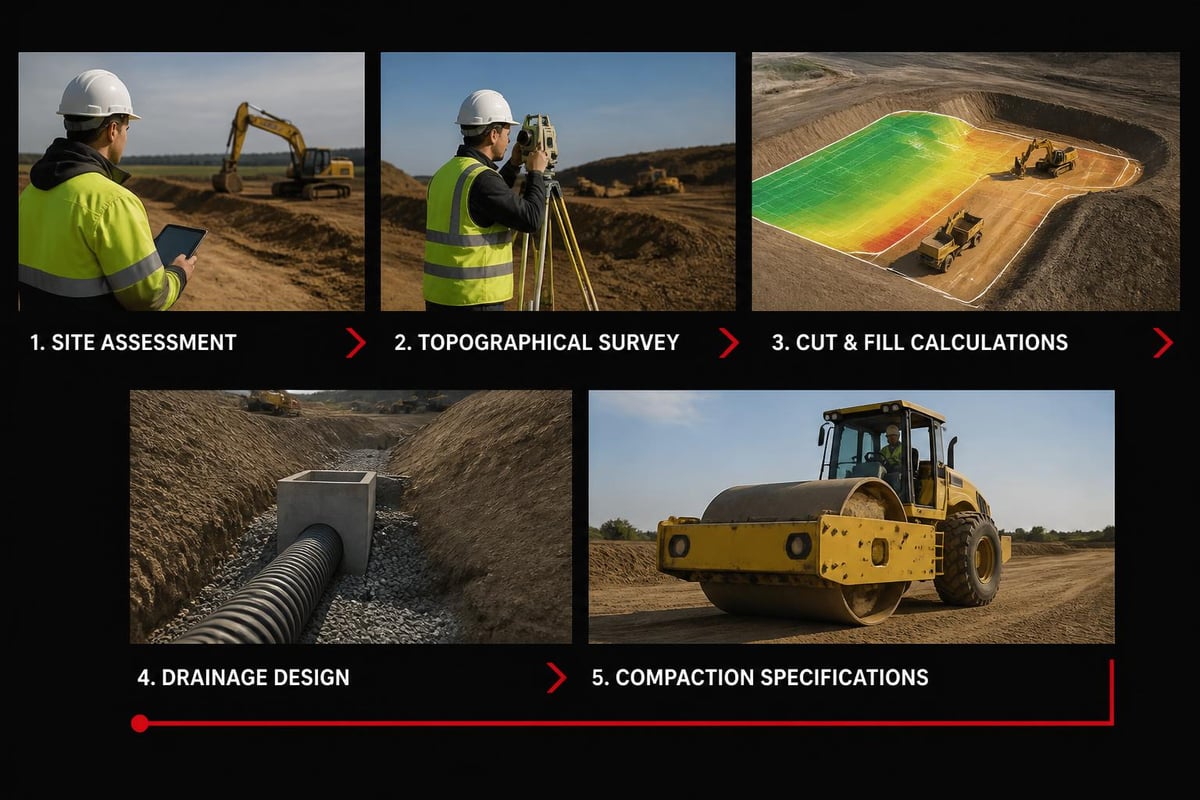
The sequencing of these operations requires careful planning. Engineers must calculate cut-and-fill volumes to balance material movement efficiently, minimising the need for off-site disposal or importation. This balance directly impacts project costs and environmental footprint.
Pre-Construction Planning and Site Assessment
Success in any earthworks project begins long before machinery arrives on site. Comprehensive planning identifies potential obstacles, determines material requirements, and establishes realistic timelines. The pre-construction phase typically consumes 15-20% of the total project duration but prevents 80% of potential complications.
Geotechnical Investigation Requirements
Understanding subsurface conditions forms the bedrock of effective earthworks planning. Geotechnical surveys reveal soil composition, bearing capacity, groundwater levels, and contamination risks. These investigations employ various techniques:
| Investigation Method | Purpose | Typical Depth | Application |
|---|---|---|---|
| Trial pits | Visual soil assessment | 3-5 metres | Shallow works, driveways |
| Borehole sampling | Deep soil profiling | 10-30 metres | Major infrastructure |
| Cone penetration testing | Soil strength analysis | Variable | Bearing capacity assessment |
| Laboratory analysis | Material classification | N/A | All project types |
Armed with geotechnical data, engineers can specify appropriate foundation designs, predict settlement patterns, and select suitable construction methodologies. This information proves particularly valuable when planning an earthworks project in areas with challenging ground conditions, such as expansive clays or high water tables.
The investigation phase also identifies archaeological sensitivities, protected habitats, and utility corridors. Early discovery of these constraints allows design adjustments before mobilisation, avoiding expensive delays during construction.
Regulatory Compliance and Permissions
Modern earthworks projects operate within a complex regulatory framework. Planning permissions, environmental permits, and highway authority consents often require months to secure. The civil engineering and building contract work sector demands strict adherence to these requirements.
Key regulatory considerations include:
- Planning permission for material changes to land use
- Environmental permits for waste management and discharge
- Highways Act agreements for works affecting public roads
- Building control approval for structural earthworks
- Ecological surveys and mitigation strategies
Documentation requirements extend beyond initial approvals. Most earthworks projects require method statements, risk assessments, and quality plans before commencement. These documents demonstrate due diligence and provide frameworks for consistent execution throughout the project lifecycle.
Equipment Selection and Site Operations
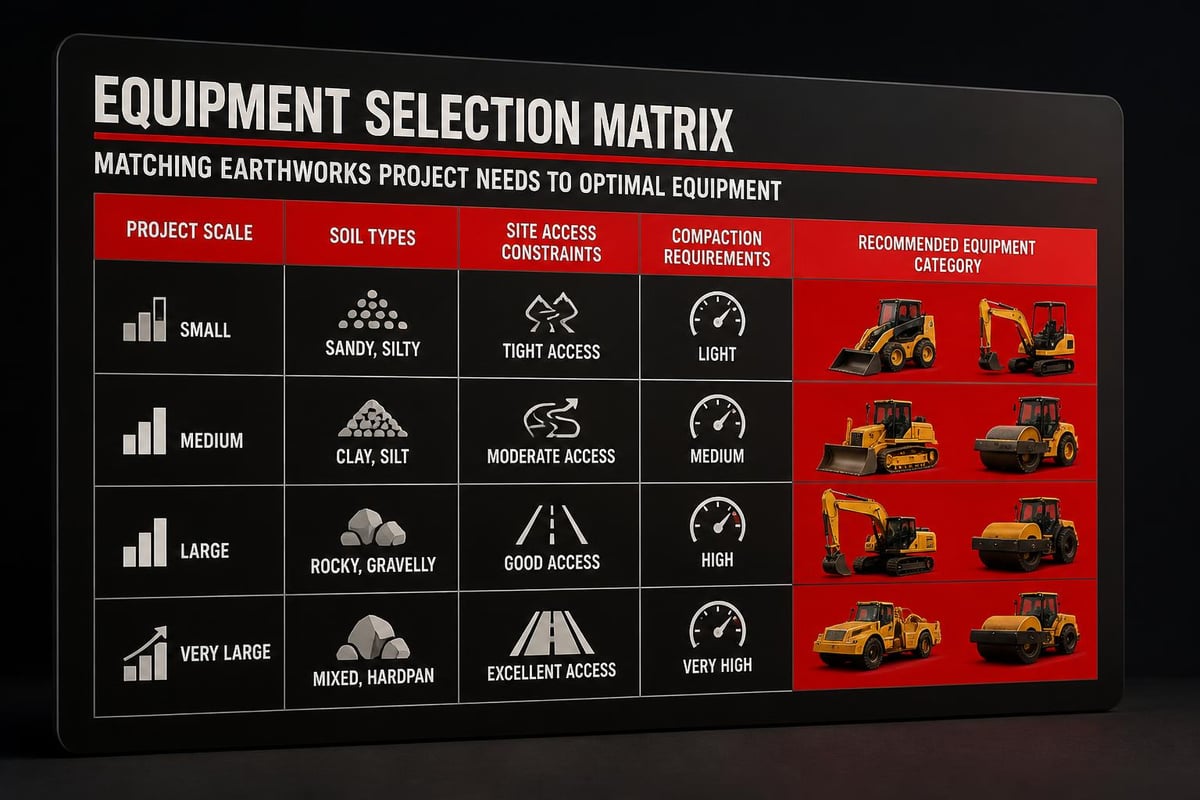
The machinery deployed on an earthworks project fundamentally determines productivity rates, finish quality, and operational safety. Equipment selection must align with site conditions, material characteristics, and specified tolerances. Oversized machinery can damage substrates, whilst undersized plant extends timelines and increases costs.
Essential Machinery for Different Earthworks Scales
For residential projects such as driveways and patios, compact equipment offers manoeuvrability within confined spaces. Mini excavators, plate compactors, and small dumpers handle material volumes efficiently without causing excessive ground disturbance in surrounding areas.
Commercial and highway projects demand higher-capacity machinery. Tracked excavators ranging from 20 to 40 tonnes provide the power needed for bulk excavation whilst maintaining stability on variable ground. Articulated dump trucks move materials across site efficiently, and motor graders achieve the precise surface profiles required for pavement construction.
Compaction equipment varies by material type and lift thickness:
- Vibrating plates for granular materials in thin layers
- Pedestrian rollers for pathways and restricted areas
- Self-propelled rollers for large-scale compaction
- Sheepsfoot rollers for cohesive clay soils
- Proof rolling with loaded lorries for final verification
The sequencing of equipment deployment requires coordination to prevent bottlenecks. An earthworks project operates most efficiently when excavation, haulage, placement, and compaction proceed in continuous cycles. Site managers must balance production rates across these operations to maintain workflow.
Material Management and Quality Control
Earthworks quality depends heavily on material selection, handling, and placement procedures. Different soil types exhibit varying engineering properties that affect compaction behaviour, drainage characteristics, and long-term stability. Specifying appropriate materials for each application within an earthworks project prevents future failures.
Soil Classification and Suitability
Engineers classify soils according to particle size distribution, plasticity, and organic content. These classifications guide material usage decisions:
| Soil Type | Characteristics | Best Applications | Limitations |
|---|---|---|---|
| Granular (Type 1) | Free-draining, stable | Sub-base, capping layers | Requires containment on slopes |
| Cohesive clay | Water-retentive, plastic | Embankment fill | Difficult compaction, poor drainage |
| Sandy gravel | Good bearing, permeable | General fill, drainage layers | Can segregate during handling |
| Silty materials | Variable properties | Limited structural use | Frost-susceptible, poor bearing |
Material testing occurs throughout an earthworks project to verify compliance with specifications. Moisture content testing ensures soils remain within optimal compaction ranges. Density measurements confirm adequate compaction has been achieved. Particle size analysis validates material gradings match design assumptions.
Compaction Standards and Verification
Achieving specified density ratios forms a critical quality control requirement. Most infrastructure projects demand compaction to 95% of maximum dry density, whilst highway works often require 98% or higher. These targets ensure adequate load-bearing capacity and minimise future settlement.
Testing frequency depends on project criticality and material consistency. Typical protocols require density tests every 500 square metres per layer, with increased frequency in critical areas such as beneath pavement foundations. Nuclear density gauges provide rapid in-situ measurements, whilst sand replacement methods offer verification without radioactive sources.
Moisture conditioning presents ongoing challenges during earthworks operations. Materials too dry resist compaction and remain loose. Excessive moisture creates a spongy matrix that rebounds after compaction. Weather monitoring and material protection become essential management activities, particularly during autumn and winter construction periods.
Drainage Integration and Water Management
Water represents both an essential tool and a persistent challenge within earthworks projects. Proper drainage design prevents hydroplaning on finished surfaces, protects structural layers from saturation damage, and maintains slope stability. Conversely, inadequate water management undermines earthworks integrity and compromises long-term performance.
Surface Water Control Systems
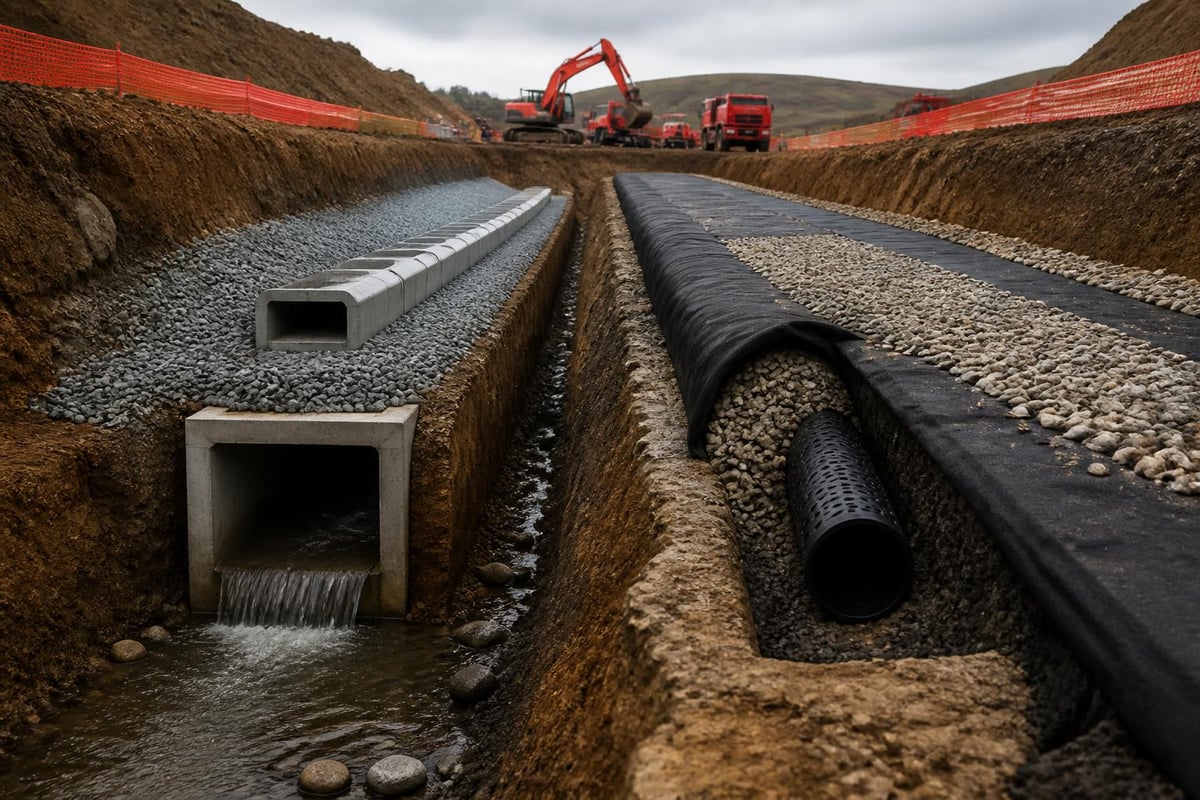
An earthworks project must incorporate drainage from the earliest stages. Temporary measures prevent construction areas becoming waterlogged, whilst permanent systems manage runoff throughout the asset's operational life. Surface water systems typically include:
- Longitudinal channels collecting flow along slope edges
- Cross-drainage conveying water beneath roads and platforms
- Outfall connections discharging to watercourses or sewers
- Attenuation features controlling discharge rates
- Filter drains removing water from structural layers
The gradient achieved during grading operations determines surface water flow patterns. Even slight deviations from design levels can create ponding areas that accelerate pavement deterioration. Laser-guided grading equipment maintains tolerances within 10-15mm, ensuring positive drainage across the entire surface.
Subsurface drainage prevents groundwater from saturating pavement foundations. French drains, filter trenches, and geocomposite systems intercept rising water before it reaches critical structural layers. These installations prove particularly important when an earthworks project encounters high water tables or artesian conditions.
Safety Management and Environmental Protection
Modern earthworks projects operate under stringent health, safety, and environmental regulations. The Construction (Design and Management) Regulations 2015 place legal duties on all parties involved in construction work. Principal contractors must establish management systems that identify hazards, implement controls, and monitor compliance throughout project execution.
Principal Hazards in Earthworks Operations
Excavation work presents multiple life-threatening risks. Trench collapse remains one of the leading causes of construction fatalities. Any excavation exceeding 1.2 metres depth requires edge protection, safe access provisions, and competent person inspections. Deeper excavations demand engineered support systems designed by qualified engineers.
Mobile plant operations create interaction risks between machinery and site personnel. Segregation measures, including barrier systems and designated pedestrian routes, prevent struck-by incidents. Reversing aids, 360-degree cameras, and trained banksmen reduce blind-spot risks inherent in large earthmoving equipment.
Critical safety considerations include:
- Utility strikes during excavation operations
- Instability of excavation sides and stockpiles
- Machinery rollover on sloping ground
- Dust suppression and respiratory protection
- Noise exposure from compaction equipment
- Manual handling during material sampling
Environmental Responsibilities
Earthworks projects generate significant environmental impacts that require active management. Dust suppression through water spraying or chemical binders prevents particulate emissions affecting neighbouring properties. Wheel-washing facilities prevent mud being deposited on public highways, which creates hazardous driving conditions and drainage blockages.
Soil handling procedures aim to preserve topsoil for reuse in landscaping. Stripping and stockpiling this valuable resource separately from subsoil enables restoration of planted areas after construction completes. Contaminated materials require specialist assessment and disposal through licensed waste carriers to authorised facilities.
Ecology protection extends beyond designated nature reserves. Ground-nesting birds, protected species, and seasonal breeding patterns influence construction timing. Civil engineering projects increasingly incorporate biodiversity enhancement measures, creating habitats that deliver net ecological gain compared to pre-construction conditions.
Commercial and Residential Applications
The principles governing earthworks projects apply across diverse construction sectors, though scale and complexity vary significantly. Understanding sector-specific requirements ensures appropriate methodologies, materials, and quality standards are applied to each project type.
Highway and Infrastructure Earthworks
Major road schemes represent the most demanding earthworks applications. These projects move millions of cubic metres of material, create embankments exceeding 20 metres height, and establish pavement foundations that must perform for decades under heavy traffic loading. Specification compliance becomes paramount, with materials testing, compaction verification, and geometric accuracy measured against exacting tolerances.
Highway earthworks typically follow the Specification for Highway Works, which defines material classifications, construction methods, and acceptance criteria. This standardisation ensures consistent performance across the strategic road network whilst providing clarity for contractors executing the works.
Capping layers form the interface between natural ground and pavement construction. These engineered fills protect the pavement from weak subgrade intrusion whilst providing a stable working platform for subsequent operations. Material selection for capping depends on subgrade strength, with weaker foundations requiring higher-specification capping materials.
Residential and Commercial Development
Property development earthworks scale down material volumes whilst maintaining quality imperatives. A residential driveway project requires the same fundamental processes as highway construction: excavation to formation level, installation of drainage, placement and compaction of sub-base, and surface finishing. The primary differences lie in equipment scale and production rates rather than technical principles.
Commercial developments such as drive-through restaurants demand careful coordination between earthworks and building construction programmes. Ground floor levels must align precisely with finished external levels to ensure accessible thresholds and effective drainage. An earthworks project for commercial applications often includes service trenching for utilities, foundation excavations, and external hardstanding areas, requiring integrated planning across multiple trades.
Platform creation for building foundations involves removing unsuitable materials and replacing them with engineered fill compacted to specified densities. Bearing capacity requirements depend on structural loadings, with heavier buildings demanding deeper excavations and higher-quality fill materials. Ground improvement techniques such as vibro-compaction or soil mixing enhance poor ground conditions where complete excavation proves uneconomical.
Cost Estimation and Programme Planning
Accurate cost forecasting for an earthworks project requires detailed quantity measurement, current material pricing, plant hire rates, and realistic productivity assumptions. Earthworks constitute 15-30% of total construction costs for infrastructure projects, making accurate estimation critical to project viability.
Quantity Surveying and Volume Calculations
Modern earthworks projects utilise digital terrain models created from topographical surveys and design information. These 3D models calculate cut and fill volumes with precision, identifying areas requiring excavation and zones needing imported material. Volume calculations account for bulking factors (excavated material expands by 15-25%) and compaction factors (placed material reduces by 10-15%).
Mass haul diagrams illustrate the most economical material movement strategy, balancing haulage distances against the cost of importation or disposal. An efficient earthworks project minimises double handling, routes materials from cut areas directly to nearby fill zones, and stockpiles excess material strategically for later use.
Cost elements within earthworks budgets include:
- Site clearance and topsoil stripping
- Excavation to formation levels
- Material importation or disposal charges
- Compaction and testing operations
- Temporary works and traffic management
- Drainage installation and connections
Programme Development and Critical Paths
Weather sensitivity makes earthworks scheduling particularly challenging. Clay soils become unworkable during wet periods, extending programmes significantly. Winter working often requires covered stockpiles, temporary drainage, and enhanced moisture conditioning. Many projects schedule bulk earthworks for summer months, accepting higher plant hire costs to mitigate weather risks.
Production rates vary enormously based on material characteristics, haul distances, and compaction requirements. A typical earthworks project might achieve 200-400 cubic metres per day with a single excavator and supporting plant in favourable conditions. Poor ground, restricted access, or stringent compaction requirements can reduce outputs by 50% or more.
Critical path analysis identifies activities that constrain overall programme duration. Earthworks frequently appear on the critical path during early construction stages, particularly when ground conditions prove worse than anticipated. Float periods built into programmes provide contingency for unforeseen delays without affecting completion dates.
Quality Assurance and Acceptance Testing
Demonstrating compliance with specifications requires systematic quality assurance throughout an earthworks project. Quality plans establish inspection frequencies, testing protocols, and acceptance criteria before work commences. These documents define responsibilities between contractors, engineers, and clients, ensuring everyone understands quality expectations.
Inspection and Testing Regimes
Layer thickness verification ensures materials are placed in lifts thin enough to achieve thorough compaction. Thicker layers resist effective densification, leaving voids that reduce bearing capacity and allow future settlement. Depth checks occur before compaction begins, with non-compliant areas being reduced to specified thickness.
Compaction testing employs various methods depending on project requirements and available equipment:
| Test Method | Accuracy | Speed | Applications |
|---|---|---|---|
| Nuclear density gauge | High | Fast | General earthworks |
| Sand replacement | High | Slow | Verification testing |
| Plate bearing | Direct load measurement | Moderate | Foundation acceptance |
| Proof rolling | Qualitative | Fast | Finished platform validation |
Non-compliance triggers immediate corrective action. Under-compacted areas require additional rolling passes and retesting. Materials outside specification tolerances must be removed and replaced with conforming products. This rigorous approach ensures an earthworks project delivers the performance characteristics assumed in structural designs.
Record Keeping and As-Built Documentation
Comprehensive records provide evidence of specification compliance and create valuable information for future maintenance planning. Daily site records document materials used, testing locations and results, weather conditions, and any deviations from standard procedures. These contemporaneous notes prove invaluable should disputes arise regarding quality or programme delays.
Photographic records supplement written documentation, capturing construction stages that become invisible once subsequent layers are placed. Georeferenced images linked to specific locations enable precise identification of test positions and material boundaries years after construction completes.
As-built drawings incorporate design changes made during construction, showing actual drainage routes, material boundaries, and finished levels. These documents form essential references for future works, enabling targeted investigations and preventing damage to buried services during maintenance activities.
Successful earthworks projects demand technical expertise, appropriate equipment, rigorous quality control, and comprehensive safety management throughout every construction phase. Whether you're planning highway infrastructure, commercial development platforms, or residential driveways, the fundamental principles remain consistent: thorough ground investigation, careful material selection, controlled placement and compaction, and integrated drainage design. When you need civil engineering excellence delivered with pride in workmanship from initial excavation through to final finishing touches, JRG Civils brings proven expertise across projects of all scales throughout the UK.