
Rammed earth sculpture represents a fascinating convergence between ancient building techniques and contemporary artistic expression. This innovative art form employs the same principles used in constructing durable walls and buildings for millennia, transforming compressed soil into three-dimensional works that celebrate both structural integrity and aesthetic beauty. As civil engineering projects increasingly embrace sustainable practices, understanding how traditional materials can serve artistic purposes provides valuable insights into material versatility and environmental responsibility. The sculptural application of rammed earth construction methods demonstrates that engineering excellence and creative vision need not exist separately.
Understanding Rammed Earth as Sculptural Material
Rammed earth sculpture utilises compressed layers of moistened earth, gravel, sand, and clay to create solid, monolithic forms. The technique mirrors the construction process used in building walls, where successive layers are compacted within temporary formwork until the desired height or shape is achieved.
The material composition requires precise attention to ratios and consistency. Soil mixtures typically contain 70% aggregates and 30% clay, though these proportions vary depending on local soil characteristics and intended structural requirements. Moisture content proves critical, as too much water weakens the structure whilst insufficient moisture prevents proper compaction.
Material Properties and Structural Considerations
The compressive strength of rammed earth sculpture depends on several factors:
- Soil composition and particle distribution
- Moisture content during construction
- Compaction intensity and consistency
- Curing time and environmental conditions
- Formwork design and construction precision
Unlike traditional sculpture materials such as bronze or marble, rammed earth develops strength gradually through drying rather than instantaneous setting. This characteristic influences both construction timeline and design possibilities. The material exhibits excellent thermal mass properties, making it particularly suitable for outdoor installations that experience temperature fluctuations.
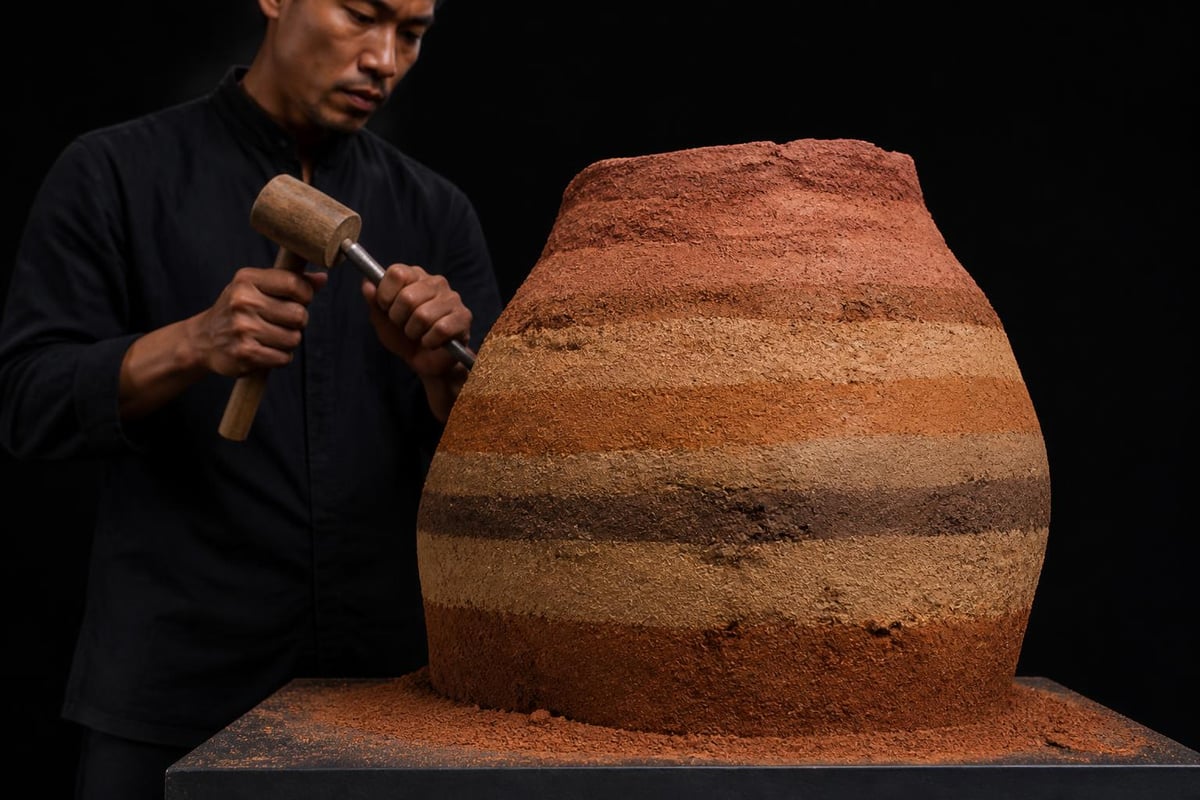
| Property | Rammed Earth | Concrete | Natural Stone |
|---|---|---|---|
| Compressive Strength | 2-4 MPa | 20-40 MPa | 50-200 MPa |
| Environmental Impact | Very Low | High | Medium |
| Local Sourcing | Excellent | Limited | Variable |
| Aesthetic Variety | High | Medium | High |
| Construction Time | Extended | Short | N/A |
Design Principles for Rammed Earth Sculpture
Creating effective rammed earth sculpture requires understanding both artistic vision and engineering constraints. The formwork dictates the final shape, making preliminary planning essential. Unlike clay sculpture where forms emerge through addition and subtraction, rammed earth sculpture develops through systematic layering within predetermined boundaries.
Designers must consider structural stability throughout the creation process. Tall or overhanging elements require careful engineering to prevent collapse during construction or after formwork removal. The artistic applications demonstrated by installations like Asaase show how ambitious forms can succeed through proper structural planning.
Formwork Engineering
Temporary formwork represents the most critical technical component. The structure must withstand significant compaction forces whilst maintaining dimensional accuracy. Plywood panels reinforced with steel or timber framing typically serve residential-scale projects, whilst larger installations demand more robust engineering solutions.
Formwork design influences the final aesthetic considerably. Sharp corners, curves, and complex geometries all require specialised approaches. Many sculptors embrace the horizontal layering inherent to the technique, allowing natural stratification to become a visual feature rather than concealing it.
The connection between formwork engineering and final appearance parallels considerations in commercial infrastructure projects, where precision in temporary works directly impacts permanent outcomes.
Construction Methodology and Techniques
The physical construction of rammed earth sculpture follows a methodical sequence. Preparation begins with soil testing and formwork fabrication, followed by layer-by-layer compaction until completion. Each stage demands attention to detail and consistency.
Step-by-Step Construction Process
- Site preparation and soil testing – Analyse local soil composition and modify as necessary to achieve optimal binding characteristics
- Formwork installation – Construct temporary moulds with adequate bracing and dimensional accuracy
- Layer placement – Deposit 100-150mm soil lifts within formwork, ensuring even distribution
- Systematic compaction – Apply pneumatic or manual tamping to compress each layer to approximately 50% original thickness
- Progressive building – Repeat layering and compaction until reaching desired height or completing planned geometry
- Curing period – Allow adequate drying time before formwork removal, typically 24-48 hours minimum
- Formwork stripping – Carefully remove temporary structures to reveal finished sculpture
- Surface treatment – Apply sealants or protective coatings if required for longevity
The compaction stage proves most labour-intensive. Pneumatic rammers provide consistent results for larger works, whilst hand tamping suits smaller or more delicate sections. The pressure applied during ramming significantly affects final density and strength.

Aesthetic Possibilities and Colour Variation
One distinctive characteristic of rammed earth sculpture lies in its natural colour palette. Unlike painted surfaces or uniform manufactured materials, rammed earth displays inherent variation derived from soil composition. These natural hues range from warm ochres and terracottas to cool greys and subtle pinks.
Sculptors can intentionally manipulate colour through several approaches. Blending different soil types creates horizontal banding that emphasises the layered construction method. Adding natural pigments such as iron oxide extends the colour range without compromising structural properties. Some artists incorporate recycled aggregates or local materials that reference specific geographical locations.
Textural Treatments
Surface finish options vary considerably:
- As-rammed texture – Retains the slightly rough, matte surface created by formwork contact
- Carved details – Allows post-construction refinement through careful removal of material
- Sealed surfaces – Application of natural oils or modern sealants for weather protection
- Exposed aggregate – Strategic washing to reveal internal composition
The contemporary residential applications demonstrate how surface treatments can range from rustic to refined, proving the material's aesthetic versatility.
Scale Considerations and Installation Context
Rammed earth sculpture exists across a remarkable range of scales, from intimate gallery pieces to monumental public installations. Scale decisions influence both construction methodology and viewer experience significantly.
Small-scale works allow detailed experimentation with composition, colour blending, and formal complexity. These pieces typically employ manual compaction techniques and simplified formwork. Gallery installations benefit from controlled environmental conditions that protect the material from weathering.
Large-scale public sculptures present different challenges. They require engineered foundations, substantial formwork infrastructure, and often mechanical compaction equipment. However, their presence in public spaces creates opportunities for community engagement and education about sustainable materials.
| Scale Category | Typical Dimensions | Construction Approach | Primary Considerations |
|---|---|---|---|
| Intimate | Under 0.5m | Manual compaction | Detail and precision |
| Human-scale | 0.5m – 2.5m | Mixed methods | Proportional balance |
| Monumental | Over 2.5m | Mechanical systems | Structural engineering |
| Architectural | Integrated elements | Professional installation | Building codes compliance |
Environmental and Sustainability Aspects
The environmental credentials of rammed earth sculpture align with growing interest in sustainable artistic practices. The material typically sources locally, minimising transportation impacts whilst celebrating regional geological characteristics. Production requires minimal processing energy compared to fired ceramics, cast metals, or manufactured composites.
Carbon sequestration represents an additional environmental benefit. Unlike concrete production, which releases significant CO2, rammed earth construction generates negligible emissions. Some researchers suggest the material may actually absorb atmospheric carbon during its lifetime, though this remains an area of ongoing study.
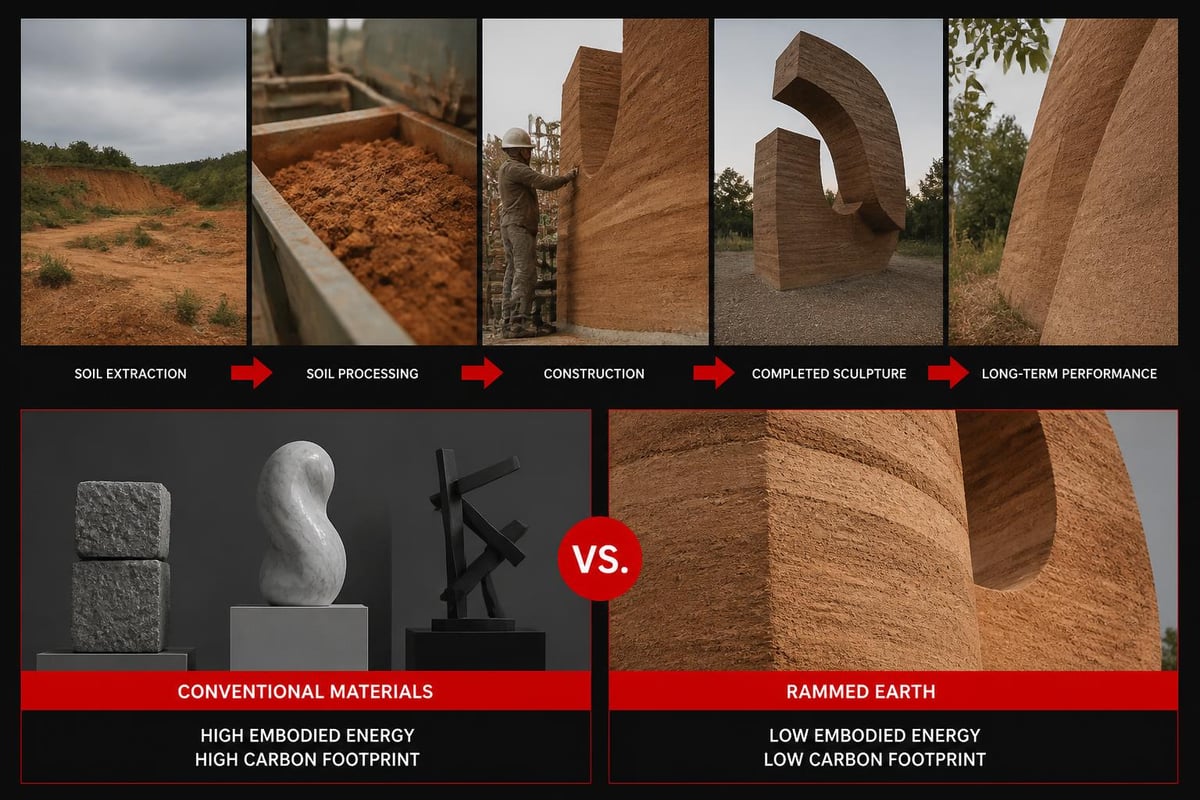
Water usage during construction remains modest, requiring only enough moisture to activate clay binding properties. This contrasts favourably with concrete curing or the substantial water demands of traditional masonry construction. The principles of efficient resource utilisation that guide civil engineering projects apply equally to sculptural applications.
Longevity and Maintenance Requirements
Properly constructed rammed earth sculpture demonstrates remarkable durability. Historical rammed earth structures survive for centuries when protected from direct water exposure. Modern installations benefit from foundation design, roof overhangs, or sacrificial base courses that prevent water wicking from ground contact.
Maintenance demands remain minimal. Unlike painted surfaces requiring periodic refinishing or metals developing problematic patina, rammed earth ages gracefully. Natural weathering creates surface character rather than degradation. Occasional reapplication of sealants may prove necessary in harsh climates, though many installations perform adequately without intervention.
Contemporary Artists and Notable Installations
The artistic potential of rammed earth sculpture has attracted international attention. Artists working in this medium often bring backgrounds in architecture, landscape design, or environmental art, creating works that blur disciplinary boundaries.
David Adjaye's collaboration on monumental rammed earth installations demonstrates how the technique scales to architectural proportions. These works reference traditional West African building methods whilst engaging contemporary formal vocabularies. The results transcend mere material demonstration, creating spaces for contemplation and cultural dialogue.
Karen McCoy's geometric explorations show different possibilities. Her works emphasise pure form and proportional relationships, using the material's inherent stratification to reinforce compositional decisions. This approach treats rammed earth as a medium for investigating fundamental sculptural concerns rather than primarily showcasing sustainable credentials.
Technical Innovations and Hybrid Approaches
Recent developments expand rammed earth sculpture beyond traditional parameters. Some practitioners integrate reinforcement systems, embedding steel or timber elements that enable cantilevers or spans impossible with unreinforced earth. These hybrid techniques maintain environmental benefits whilst expanding formal possibilities.
Digital fabrication tools increasingly influence formwork design. Computer-controlled cutting creates complex moulds that would prove impractical through traditional carpentry. This technological integration mirrors broader construction industry trends where precision engineering combines with established materials.
Stabilisation additives represent another innovation area. Small percentages of cement or lime improve weather resistance and compressive strength, though purists debate whether such modifications compromise the material's sustainable character. The optimal balance depends on specific project requirements and environmental exposure.
Cross-Disciplinary Applications
The techniques developed for rammed earth sculpture inform broader construction practices. Residential projects incorporating rammed earth elements benefit from artistic experimentation that tests material limits and aesthetic potential. Conversely, engineering knowledge from infrastructure construction enhances sculptural ambitions.
This reciprocal relationship strengthens both fields. Sculptors gain structural understanding that enables more ambitious works, whilst builders appreciate aesthetic possibilities beyond purely functional applications. The material's versatility suits both creative expression and practical construction.
Educational and Community Engagement Opportunities
Rammed earth sculpture offers exceptional educational potential. The construction process remains accessible to participants without specialised training, making it ideal for community workshops and educational programmes. The tangible connection between raw materials and finished artwork provides learning experiences difficult to replicate with industrial materials.
Workshop participants typically begin with small test pieces, learning soil preparation, formwork construction, and compaction techniques. Progression to collaborative larger works builds confidence whilst demonstrating collective capability. These experiences often spark interest in sustainable building practices generally.
Schools and educational institutions incorporate rammed earth sculpture into curricula spanning art, technology, environmental studies, and cultural history. The interdisciplinary nature encourages holistic thinking about materials, sustainability, and creative problem-solving. Students appreciate working with natural materials that connect them to historical building traditions.
Preservation and Documentation Challenges
Unlike bronze or stone sculptures with extensive conservation literature, rammed earth works lack comprehensive preservation protocols. This gap creates challenges for institutions acquiring such pieces or artists planning long-term installations. Developing appropriate conservation approaches requires collaboration between sculptors, conservators, and materials scientists.
Documentation methodologies must capture both physical characteristics and construction processes. Traditional photography and dimensional records prove insufficient for fully understanding how to maintain or repair rammed earth sculpture. Video documentation of construction sequences and detailed material specifications become essential archival components.
Climate change presents additional preservation concerns. Increased precipitation intensity or altered freeze-thaw cycles may challenge outdoor installations designed for historical climate patterns. Adaptive strategies might include enhanced drainage, modified formulations, or protective structures that shield vulnerable elements without compromising aesthetic intent.
Rammed earth sculpture demonstrates how traditional construction techniques can evolve into sophisticated artistic practices whilst maintaining environmental responsibility and material authenticity. The discipline offers valuable lessons in resourcefulness, sustainability, and the expressive potential of modest materials. Whether you're planning commercial infrastructure or residential enhancements, the principles of quality craftsmanship and attention to detail that guide sculptural excellence apply equally to all construction work. JRG Civils brings the same commitment to precision and professional standards across every project, from highways and carriageways to private driveways and patios throughout the North East and beyond.