
When undertaking development projects that require changes to public highways, developers must navigate a complex legal framework. A 278 agreement represents a critical contractual arrangement between developers and local highway authorities, enabling necessary modifications to roads, junctions, footways, and associated infrastructure. Understanding this process proves essential for commercial developments, retail expansions, residential estates, and infrastructure projects that interface with the existing highway network. Whether you're planning a drive-through facility, commercial premises with new access points, or large-scale residential development, grasping the fundamentals of Section 278 agreements ensures compliance, prevents costly delays, and establishes clear responsibilities from inception through completion.
What Is a Section 278 Agreement
A 278 agreement derives its name from Section 278 of the Highways Act 1980, which empowers highway authorities to enter into agreements with developers for highway improvement works. This legal mechanism allows developers to carry out works on the public highway, which would otherwise be prohibited without proper authorization.
The agreement establishes a binding contract specifying the nature of works, technical standards, timing, costs, and ongoing maintenance responsibilities. Highway authorities retain ultimate control over public roads, making this formal arrangement necessary whenever development impacts existing infrastructure.
Legal Framework and Authority
Section 278 agreements operate under strict statutory provisions. Highway authorities possess exclusive rights to modify public highways, and any unauthorized works constitute an offence. The agreement framework provides developers with legal permission whilst safeguarding public interest through rigorous oversight.
Key legal aspects include:
- Formal contractual obligations between developer and authority
- Technical approval requirements for all design elements
- Financial bonds securing work completion
- Inspection protocols throughout construction phases
- Defect liability periods following practical completion
The detailed guidance from St Helens Council illustrates how local authorities implement these statutory requirements, ensuring consistent application across different jurisdictions whilst accommodating local circumstances.
Types of Works Covered
Section 278 agreements encompass a diverse range of highway improvements and modifications. Understanding which works require formal agreement helps developers plan effectively and budget accurately for the entire project lifecycle.
| Work Category | Typical Examples | Key Considerations |
|---|---|---|
| Access Creation | New vehicular entrances, modified junctions, bellmouth formations | Visibility splays, safety audits, traffic impact |
| Traffic Management | Signal installations, roundabout construction, priority changes | Coordination with existing systems, phasing requirements |
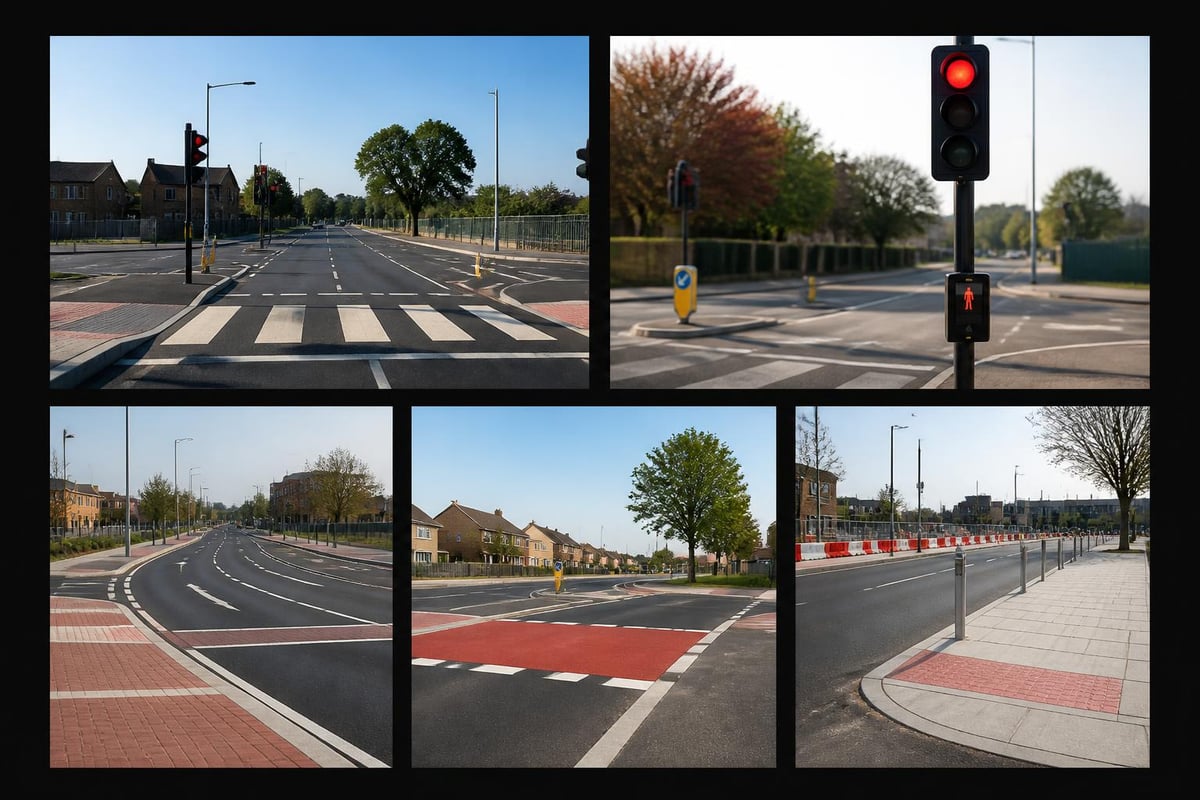
| Pedestrian Facilities | Crossing points, footway widening, tactile paving | Accessibility standards, connectivity to existing networks |
| Drainage Systems | Highway gullies, attenuation features, connection points | Adoption agreements, maintenance responsibilities |
| Street Furniture | Lighting columns, signage, safety barriers | Design standards, ongoing electrical maintenance |
Commercial Development Applications
For businesses undertaking franchise developments, drive-through facilities, or retail expansions, highway works frequently prove necessary. A Costa Coffee or Greggs drive-through typically requires modified access arrangements, queue management systems, and enhanced pedestrian facilities. These projects demonstrate how Section 278 programmes facilitate commercial growth whilst maintaining highway safety.
Drive-through developments particularly benefit from early engagement with highway authorities. Queue lengths, stacking capacity, and exit strategies all require careful design to prevent disruption to the public highway. Technical approval processes examine these elements rigorously, ensuring commercial operations don't compromise traffic flow or pedestrian safety.
The Agreement Process
Navigating the 278 agreement process demands careful planning, technical expertise, and sustained dialogue with highway authorities. The journey from initial concept through to practical completion follows structured stages, each with distinct requirements and potential challenges.
Pre-Application Stage
Successful projects begin with pre-application discussions. Developers should engage highway authorities early, ideally before submitting planning applications. This preliminary dialogue identifies potential constraints, establishes design principles, and clarifies technical expectations.
Pre-application benefits include:
- Early identification of highway capacity issues
- Clarity on technical standards and design requirements
- Understanding of timescales and procedural steps
- Indicative cost estimates for agreement fees and bonds
- Alignment between planning and highway consents
Highway authorities often provide pre-application advice services, offering formal feedback on proposals. This investment typically saves substantial time and expense during subsequent formal stages.
Formal Application and Technical Approval
Once planning permission is secured or anticipated, developers submit formal Section 278 applications. The technical approval process outlined by Northumberland County Council demonstrates the rigorous checks highway authorities perform.
Applications require comprehensive documentation:
- Detailed design drawings showing all proposed highway modifications
- Safety audit reports examining collision risks and mitigation measures
- Traffic impact assessments demonstrating acceptable network performance
- Construction methodology outlining phasing, traffic management, and timescales
- Drainage calculations proving adequate surface water management
Highway authorities review submissions against established design standards, local policies, and statutory requirements. This technical checking phase often generates queries requiring design refinement before approval.
Agreement Execution and Bonds
Following technical approval, parties execute the formal legal agreement. This binding contract specifies all obligations, payment mechanisms, inspection protocols, and defect liability arrangements.

Financial securities protect highway authorities against non-completion or substandard works. Section 278 agreement costs typically include several components presented in a structured format:
| Cost Element | Purpose | Typical Range |
|---|---|---|
| Application Fee | Initial assessment and technical review | £2,000 – £10,000 |
| Inspection Fee | Highway authority supervision costs | 10-15% of works value |
| Works Bond | Security for completion | 125% of estimated construction cost |
| Commuted Sum | Future maintenance liability | 10-25 years maintenance calculation |
Bonds remain in place throughout construction and defect liability periods, typically extending 12 months beyond practical completion. Only after satisfactory performance can developers reclaim these securities.
Design Standards and Technical Requirements
Highway works must conform to rigorous design standards ensuring safety, durability, and consistency across the network. Understanding these requirements early prevents costly redesigns and programme delays.
Geometric Design Standards
Road geometry follows established principles balancing safety, capacity, and user experience. Junction design particularly demands careful attention, with visibility splays, turning radii, and gradient calculations all subject to minimum standards.
The Design Manual for Roads and Bridges (DMRB) provides authoritative guidance for major schemes, whilst local authorities often supplement these with area-specific requirements. Smaller developments may reference Manual for Streets, offering proportionate standards for lower-speed environments.
Critical geometric elements include:
- Forward visibility distances appropriate to speed limits
- Junction spacing preventing conflicting movements
- Pedestrian crossing sight lines
- Cycle facility integration
- Emergency vehicle access requirements
Construction Specifications
Materials and construction methods must deliver long-term performance with minimal maintenance. Highway authorities specify approved materials, laying techniques, and quality control procedures ensuring consistency with existing infrastructure.
Surfacing works prove particularly critical for commercial developments. Professional highways and surfacing contractors understand the importance of proper foundation preparation, appropriate material selection, and meticulous finishing to achieve durable, safe running surfaces that withstand intensive use from commercial traffic.
Structural design of pavements considers anticipated traffic loading, subgrade conditions, and design life expectations. Construction layer thicknesses, material specifications, and compaction requirements all flow from these fundamental design parameters.
Common Challenges and Solutions
Even well-planned projects encounter obstacles during the 278 agreement journey. Recognizing common challenges enables proactive mitigation, maintaining programme certainty and controlling costs.
Design Approval Delays
Technical approval processes sometimes extend beyond anticipated timescales. Multiple review iterations, requests for additional information, or changing highway authority priorities can impact programme delivery.
Mitigation strategies include:
- Comprehensive initial submissions addressing predictable queries
- Early pre-application engagement establishing design principles
- Experienced design teams familiar with local authority expectations
- Regular communication maintaining momentum through approval stages
- Realistic programme allowances accommodating review periods
Construction Phase Coordination
Highway works often occur alongside broader development construction, creating coordination challenges. Traffic management, material deliveries, and inspection scheduling all require careful orchestration.
Appointing contractors with proven highway experience proves invaluable. Understanding traffic management regulations, possession procedures, and authority inspection requirements prevents disruption and ensures compliant delivery.
Adoption and Handover
Achieving practical completion and subsequent highway adoption demands meticulous attention to finishing details. As-built records, material certifications, maintenance manuals, and commuted sum calculations all require compilation and submission.
Barnsley Council’s Section 278 guidance emphasizes the importance of proper documentation supporting adoption processes. Highway authorities won't accept substandard works or incomplete records, potentially extending defect liability periods and delaying bond release.
Commercial Development Case Studies
Real-world applications illustrate how 278 agreements facilitate commercial growth whilst maintaining highway safety and network efficiency.
Drive-Through Facilities
Drive-through restaurants present unique highway challenges. Queue management, stacking arrangements, and safe egress all require careful design validated through traffic modelling and safety audits.
A typical drive-through development involves:
- Modified junction geometry accommodating turning movements
- Queue detection and management systems
- Enhanced pedestrian crossing facilities
- Street lighting improvements ensuring visibility
- Signage and road marking schemes guiding customers
Highway authorities scrutinize these elements rigorously, ensuring commercial operations don't compromise public highway function. Successful schemes demonstrate how thoughtful design reconciles commercial objectives with highway safety imperatives.
Retail Park Access Improvements
Larger commercial developments often trigger significant highway enhancements. New roundabouts, signal-controlled junctions, or dedicated turning lanes may prove necessary to accommodate generated traffic whilst maintaining acceptable network performance.
These substantial interventions involve extended design development, comprehensive traffic modelling, and significant construction programmes. Developers benefit from early highway authority engagement, establishing the scope of necessary improvements before committing to land acquisitions or planning submissions.

Residential Development Considerations
Whilst commercial schemes often dominate 278 agreement discussions, residential developments equally rely on this legal framework. Estate access roads, pedestrian links, and modified junctions all frequently require Section 278 agreements before adoption as public highway.
Estate Road Adoption
Residential estate roads built to adoptable standards eventually transfer to highway authority maintenance responsibility. This transfer requires Section 38 agreements (for new roads) or Section 278 agreements (for modifications to existing highways providing estate access).
The adoption process ensures:
- Roads meet technical construction standards
- Drainage systems function effectively
- Street lighting complies with current regulations
- Road markings and signage provide clear guidance
- Commuted maintenance sums reflect true lifecycle costs
Developers must balance construction costs against long-term maintenance liabilities. Higher initial construction standards reduce future maintenance burdens, making roads more attractive for highway authority adoption.
Pedestrian Connectivity
Modern residential developments emphasize sustainable transport, requiring safe pedestrian and cycle connections to local facilities, schools, and public transport. Section 278 agreements enable developers to enhance existing footway networks, create new crossing points, and improve accessibility.
These improvements benefit both new residents and existing communities, demonstrating how development can deliver genuine public realm enhancements beyond basic access requirements.
Working with Professional Contractors
Selecting appropriate contractors for highway works critically influences project success. Highway construction demands specialized skills, equipment, and understanding of authority inspection regimes.
Professional civil engineering contractors bring essential capabilities:
- Technical expertise in highway construction methodologies
- Quality assurance systems meeting authority inspection requirements
- Traffic management competence maintaining safety during construction
- Programme discipline coordinating with authority possession windows
- Documentation practices supporting adoption processes
Companies experienced in diverse project types, from commercial franchise developments to residential enhancements, understand how different schemes present unique challenges. This breadth of experience enables efficient delivery regardless of project scale or complexity.
Financial Planning and Budgeting
Accurate cost forecasting for Section 278 works prevents unwelcome surprises during project delivery. Multiple cost elements extend beyond basic construction values, requiring comprehensive budgeting.
Cost Components Breakdown
| Cost Category | Description | Budgeting Approach |
|---|---|---|
| Design Fees | Technical design, safety audits, traffic assessments | 8-12% of construction value |
| Authority Fees | Application processing, technical approval, inspections | Fixed fees plus percentage of works |
| Construction | Physical highway works execution | Detailed quantity surveying with contingency |
| Traffic Management | Temporary arrangements during construction | Method-dependent, often 10-20% of construction |
| Bonds and Securities | Financial guarantees and commuted sums | 125% works value plus maintenance calculation |
Early engagement with highway authorities provides indicative fee structures, enabling realistic budget development. Comprehensive agreement checklists help ensure all cost elements receive appropriate consideration during financial planning stages.
Value Engineering Opportunities
Design refinement can sometimes reduce costs whilst maintaining functionality and safety. Alternative junction layouts, modified drainage strategies, or phased implementation approaches all merit exploration during design development.
However, value engineering must never compromise safety or long-term performance. Highway authorities reject proposals failing to meet established standards, regardless of cost pressures. Experienced design teams balance economy with compliance, identifying genuine savings without regulatory risk.
Timeline Expectations
Understanding typical timescales helps developers programme projects realistically and coordinate highway works with broader construction activities.
Indicative timeline from application to completion:
- Pre-application discussions: 4-8 weeks for initial feedback
- Formal application submission: Prepare comprehensive documentation package
- Technical approval: 8-16 weeks depending on scheme complexity
- Agreement drafting and execution: 4-8 weeks legal processes
- Construction: Project-specific duration
- Defect liability: Typically 12 months post-practical completion
- Final adoption: Following successful defect period
Total timescales from initial engagement through to final adoption commonly extend 18-30 months for moderately complex schemes. Larger interventions involving substantial highway remodelling may require extended periods.
Regional Variations and Local Requirements
Whilst Section 278 legislation applies uniformly across England and Wales, individual highway authorities implement processes differently. Local design guides, fee structures, and procedural requirements create regional variations demanding careful navigation.
Understanding Local Authority Expectations
Developers working across multiple local authority areas must adapt to varying requirements. Some authorities provide detailed technical guidance documents, whilst others rely on national standards with minimal local supplementation. Fee structures, bond calculation methodologies, and commuted sum approaches all vary between authorities.
Early dialogue establishes specific local expectations, preventing assumptions based on experience elsewhere. What proves acceptable in one authority area may require modification for another, even for seemingly identical works.
Multi-Authority Schemes
Complex developments sometimes interface with multiple highway authority boundaries. A single development site might require agreements with county councils, unitary authorities, and potentially Highways England for strategic road network interfaces.
These multi-authority scenarios demand careful coordination, ensuring design consistency across boundaries whilst satisfying each authority's specific requirements. Programme management becomes particularly critical, as different approval timescales can impact overall delivery schedules.
Understanding Section 278 agreements proves essential for any development impacting public highways, from commercial expansions to residential estates. The structured legal framework balances development needs with public highway safety, requiring careful planning, technical expertise, and sustained collaboration with highway authorities throughout the project lifecycle. Whether you're planning drive-through facilities, retail developments, or residential schemes requiring highway modifications, JRG Civils delivers the civil engineering excellence and professional reliability necessary for successful Section 278 project delivery across the UK. Our proven experience with commercial and residential developments ensures your highway works meet exacting standards whilst supporting your broader project objectives.