
Earthworks civil and construction forms the foundational cornerstone of virtually every infrastructure project, from motorways and commercial developments to residential driveways and patios. This critical phase involves the systematic movement, shaping, and compaction of earth materials to create stable platforms for construction. Understanding the complexities of earthworks processes, standards, and best practices ensures projects are delivered safely, efficiently, and within budget whilst maintaining the highest quality standards throughout.
Understanding Earthworks Civil and Construction Fundamentals
The scope of earthworks civil and construction encompasses far more than simple excavation and backfilling. It represents a sophisticated engineering discipline requiring detailed knowledge of soil mechanics, drainage principles, material behaviour, and environmental considerations.
Modern earthworks projects demand comprehensive planning that accounts for ground conditions, water management, material reuse, and long-term stability. Civil engineering earthworks standards provide essential frameworks that ensure safety and efficiency throughout construction activities.
Key Components of Earthworks Projects
Every earthworks operation involves multiple interconnected activities:
- Site investigation and ground assessment to determine soil types, bearing capacity, and contamination
- Cut and fill calculations to balance earth movement and minimise waste disposal
- Excavation works including bulk earthworks, trenching, and formation preparation
- Material processing such as screening, crushing, and blending to achieve specifications
- Compaction operations ensuring adequate density and load-bearing characteristics
- Drainage installation to manage surface and groundwater effectively
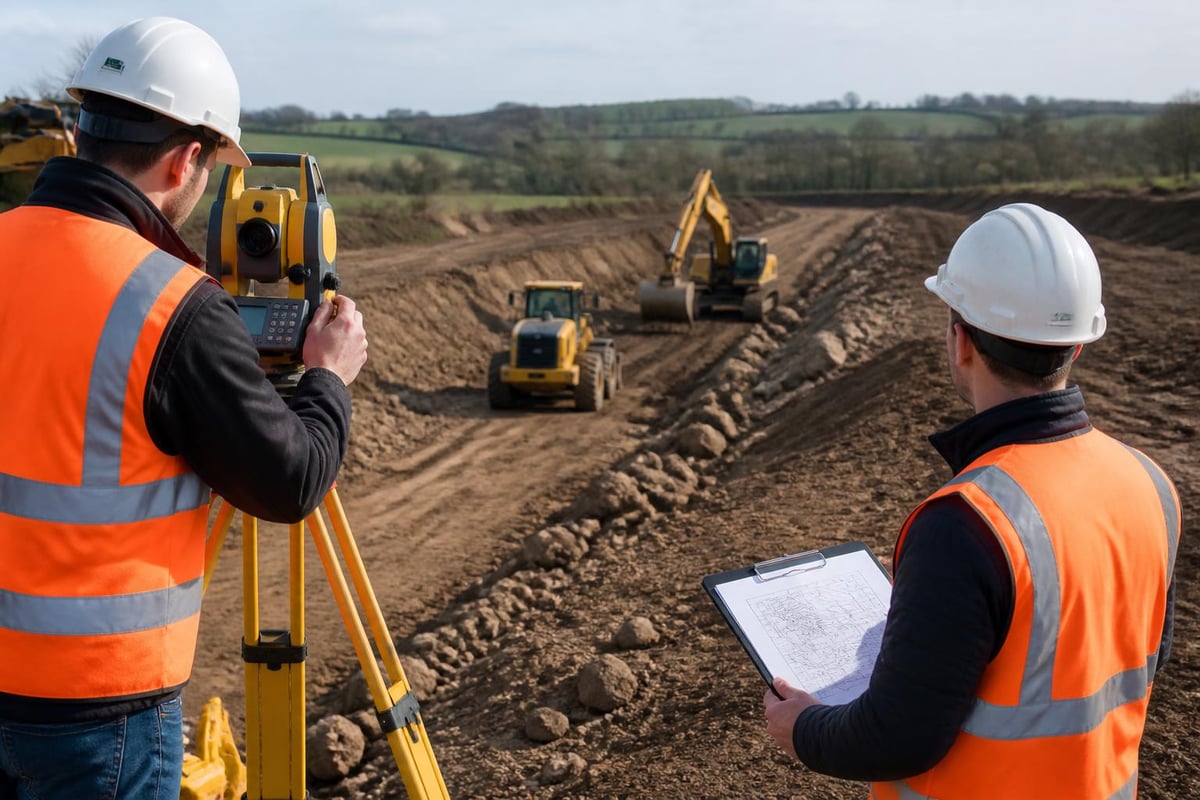
The complexity of these elements requires experienced contractors who understand the interplay between different phases. Companies specialising in civil engineering work coordinate these activities to deliver cohesive results that meet structural and performance requirements.
Planning and Design Considerations for Earthworks
Successful earthworks civil and construction projects begin long before machinery arrives on site. The planning phase determines project feasibility, cost effectiveness, and ultimate success.
Site Assessment and Investigation
Comprehensive ground investigation provides crucial data that informs every subsequent decision. Geotechnical surveys reveal soil stratification, groundwater levels, bearing capacity, and potential hazards such as contamination or unstable ground.
This information directly influences design choices, equipment selection, and methodology. Understanding site conditions prevents costly surprises during construction and enables accurate programme development.
| Investigation Method | Purpose | Typical Depth |
|---|---|---|
| Trial pits | Visual soil classification, sampling | 3-5 metres |
| Boreholes | Deep soil profiling, water table identification | 10-30 metres |
| Plate bearing tests | Bearing capacity verification | Formation level |
| Laboratory testing | Moisture content, plasticity, compaction | As required |
Design Standards and Specifications
Adhering to recognised standards ensures earthworks meet required performance criteria. BS 6031:2009 offers comprehensive best practice guidance on geotechnical aspects and working practices for earthworks.
European standards such as BS EN 16907-1:2018 provide common frameworks for planning, designing, and specifying earthworks across different project types. These documents establish consistent approaches to material classification, compaction requirements, and quality control procedures.
Material Management Strategies
Efficient earthworks civil and construction depends heavily on intelligent material management. The objective is to maximise reuse of excavated materials whilst meeting engineering specifications.
Material classification systems categorise soils based on particle size distribution, plasticity, and engineering properties. This classification determines suitability for different applications:
- Class 1 materials – granular soils ideal for general fill and drainage layers
- Class 2 materials – cohesive soils requiring moisture control and careful placement
- Class 3 materials – heavy clays with limited reuse potential
- Class 4 materials – organic or contaminated soils requiring disposal or treatment
Balancing cut and fill across the site minimises haulage costs and environmental impact. Effective earthworks management requires understanding material behaviour and appropriate specification to prevent construction problems.
Execution and Construction Procedures
The construction phase transforms planning into physical reality. Earthworks civil and construction execution demands skilled operators, appropriate equipment, and rigorous quality control.
Excavation Techniques and Methods
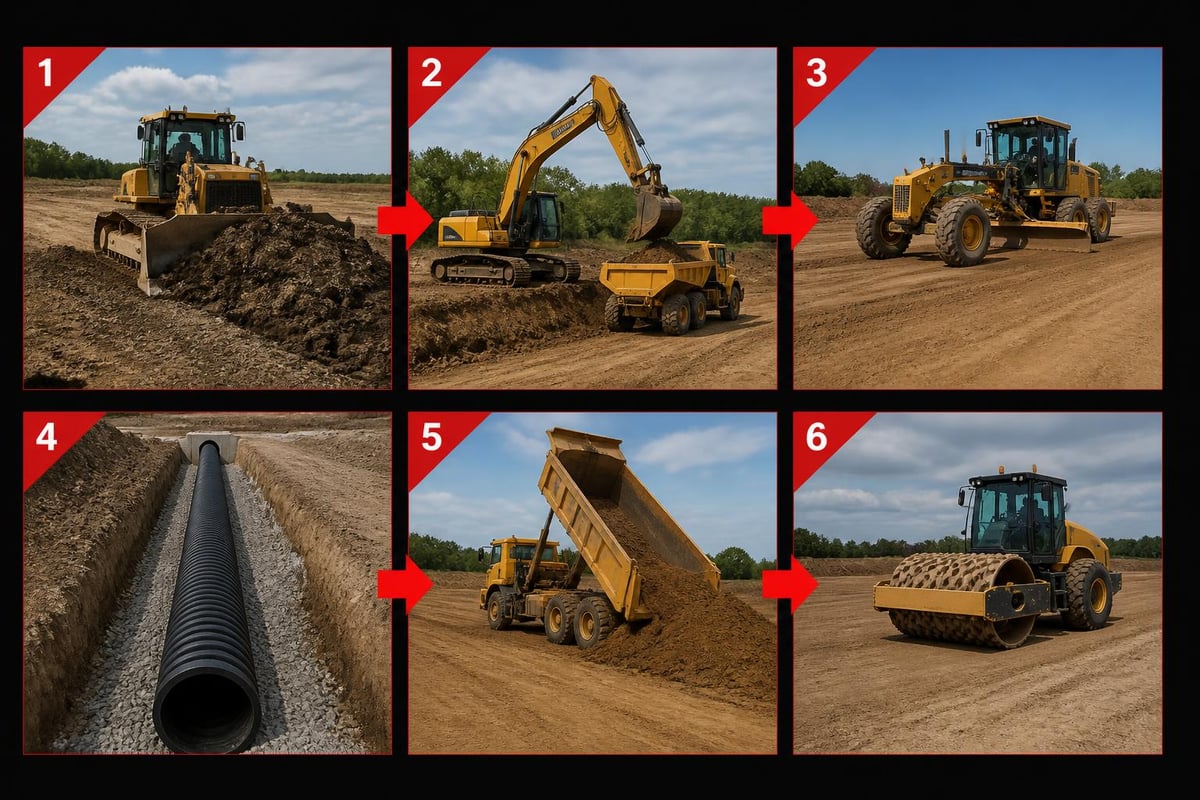
Different site conditions and project requirements necessitate varied excavation approaches. Bulk earthworks for large-scale grading operations employ scrapers, dozers, and articulated dump trucks to move substantial volumes efficiently.
Precision excavation for foundations, drainage, and utilities requires smaller machines with enhanced accuracy. Modern GPS-guided equipment enables operators to achieve design levels within millimetres, reducing over-excavation and improving material yields.
BS EN 16907-3:2018 details execution procedures for excavating, transporting, and placing soils and rocks, providing technical guidance on construction methods.
Compaction and Quality Control
Adequate compaction ensures earthworks achieve specified density and bearing capacity. Under-compacted fill settles over time, causing structural damage and surface deformation.
Compaction requirements vary based on material type and final use:
- Road sub-formation: typically 95% maximum dry density
- General fill areas: 90-95% maximum dry density depending on proximity to structures
- Structural backfill: 95-100% maximum dry density with strict moisture control
- Landscape areas: 85-90% maximum dry density with less stringent control
Testing confirms compliance through field density measurements, plate bearing tests, and California Bearing Ratio (CBR) assessments. Documentation provides auditable evidence that specifications have been met.
Drainage Integration
Water management represents a critical aspect of earthworks civil and construction. Inadequate drainage causes softening of formation, slope instability, and premature failure of pavement structures.
Surface water systems collect and convey rainfall away from vulnerable areas. Subsurface drainage intercepts groundwater before it reaches formation level. Drainage services require careful coordination with earthworks to ensure systems function as designed.
Common Challenges and Risk Mitigation
Even well-planned projects encounter difficulties during earthworks civil and construction. Recognising potential issues enables proactive management strategies.
Weather-Related Complications
British weather presents ongoing challenges for earthworks operations. Excessive rainfall saturates soils, reducing trafficability and preventing effective compaction. Clay soils become unworkable when moisture content exceeds optimum levels.
Mitigation strategies include:
- Stockpiling materials during dry periods for use when weather deteriorates
- Installing temporary drainage systems to remove surface water quickly
- Using lime or cement stabilisation to improve wet soils
- Programming weather-sensitive activities during favourable seasons
- Maintaining flexible schedules that accommodate weather delays
Unexpected Ground Conditions
Despite thorough investigation, unforeseen conditions occasionally emerge during excavation. Archaeological finds, buried services, contaminated ground, or variable geology can significantly impact programmes and costs.
Common mistakes in large-scale earthworks include inadequate site investigation and failure to plan for contingencies. Building contingency allowances into programmes and budgets provides flexibility to address unexpected discoveries.
| Risk Factor | Potential Impact | Mitigation Approach |
|---|---|---|
| Contaminated ground | Health hazards, disposal costs | Phase 1 desk study, intrusive sampling |
| Buried services | Damage, delays, safety risks | Utility searches, trial holes, safe digging |
| High groundwater | Excavation flooding, instability | Dewatering systems, sumps, drainage |
| Variable geology | Design changes, cost increases | Comprehensive investigation, adaptable designs |
Material Shortages and Quality Issues
Earthworks civil and construction relies on consistent material quality and availability. On-site materials may prove unsuitable for reuse, necessitating importation of compliant fill. Supply chain disruptions or quarry closures can delay projects significantly.
Early material testing and identification of alternative sources provides security. Developing relationships with multiple suppliers ensures continuity even when primary sources become unavailable.
Cost Estimation and Budget Management
Accurate earthworks civil and construction cost estimation prevents financial overruns and enables informed decision-making. Estimating earthworks costs requires consideration of multiple factors influencing final expenditure.
Quantity Calculations
Precise volume calculations form the foundation of cost estimates. Modern software generates accurate cut and fill quantities from digital terrain models, accounting for bulking factors during excavation and shrinkage during compaction.
Key considerations include:
- Topsoil stripping and stockpiling volumes
- Unsuitable material excavation and disposal quantities
- Imported fill requirements and haulage distances
- Rock excavation necessitating specialist equipment or breaking
- Temporary works such as haul roads, stockpile areas, and dewatering
Equipment and Labour Costs
Plant hire rates, operator wages, and fuel consumption significantly influence project costs. Equipment selection balances productivity against mobilisation expenses and operating costs.
Large scrapers move vast volumes efficiently on open sites with long haul distances. Excavators and dump trucks provide flexibility for confined areas or variable conditions. Achieving optimal productivity requires matching equipment capacity to project scale.
Project-Specific Factors
Each earthworks civil and construction project presents unique cost drivers:
- Site accessibility affecting delivery routes and equipment mobilisation
- Environmental restrictions limiting working hours or requiring dust suppression
- Traffic management for highway projects adding logistical complexity
- Disposal costs for contaminated or unsuitable materials
- Seasonal variations influencing productivity and working conditions
Section 278 works involving highway improvements incorporate additional complexity through statutory processes and authority requirements.
Applications Across Different Project Types
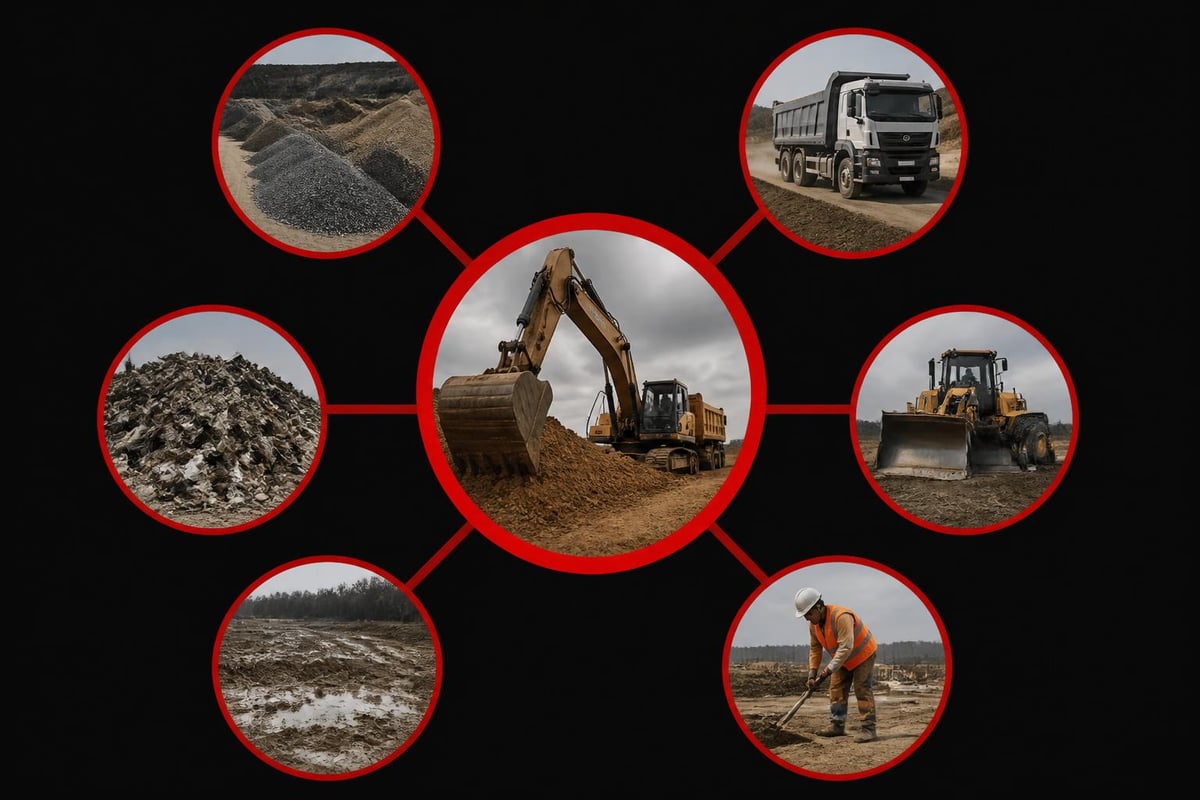
Earthworks civil and construction techniques adapt to diverse project requirements, from major infrastructure schemes to residential developments.
Commercial and Industrial Developments
Large-scale commercial projects such as retail parks, distribution centres, and industrial estates require extensive platform creation. These developments often involve substantial cut and fill operations to achieve level building pads across sloping sites.
Drive-through restaurant facilities demand precisely graded forecourts, vehicle circulation areas, and service yards. Coordinating earthworks with drainage, utilities, and pavement construction ensures cohesive site development.
Highway and Transportation Projects
Road construction represents perhaps the most demanding application of earthworks civil and construction principles. Highways require consistent gradients, proper crossfall for drainage, and stable sub-formations to support pavement structures.
Embankments and cuttings must achieve long-term stability whilst minimising land take. Modern road design incorporates optimisation techniques to balance earthworks quantities and reduce environmental impact.
Residential and Domestic Projects
Earthworks principles scale effectively to smaller residential applications. Domestic work including driveways, patios, and garden landscaping requires the same attention to preparation, drainage, and compaction as larger projects.
Proper formation preparation prevents settlement and surface cracking. Adequate sub-base thickness and quality ensures driveways withstand vehicle trafficking without deterioration. These fundamentals remain constant regardless of project scale.
Quality Assurance and Documentation
Comprehensive quality management ensures earthworks civil and construction meets specified standards. Systematic testing, inspection, and documentation provides evidence of compliance.
Testing Protocols
Regular testing at defined intervals verifies material properties and placement quality:
- Moisture content testing ensures fill materials achieve optimum compaction conditions
- Density testing confirms adequate compaction levels throughout fill depths
- CBR testing validates bearing capacity for pavement design assumptions
- Grading analysis verifies imported materials meet specification requirements
Results inform ongoing construction decisions and identify areas requiring remedial work before subsequent layers are placed.
Record Keeping Requirements
Detailed records document earthworks activities, test results, and as-built conditions. These records serve multiple purposes including demonstrating compliance, supporting warranty claims, and informing future maintenance.
Essential documentation comprises:
- Daily worksheets recording activities, plant deployment, and weather conditions
- Test certificates with locations, results, and pass/fail determinations
- As-built drawings showing final levels, drainage positions, and service locations
- Photographic records illustrating construction progress and key details
- Material delivery tickets confirming sources and quantities
Inspection and Verification
Independent inspection provides objective verification that works meet requirements. Client representatives, consulting engineers, or local authority inspectors review construction quality at critical hold points.
This oversight identifies deficiencies early when remediation costs remain minimal. Collaborative working between contractors and inspectors achieves superior outcomes through shared understanding of project objectives.
Environmental Considerations and Sustainability
Modern earthworks civil and construction incorporates environmental responsibility alongside technical and commercial objectives. Sustainable practices reduce ecological impact whilst often delivering cost benefits.
Soil Resource Management
Topsoil represents a valuable finite resource requiring careful management. Stripping topsoil before construction preserves this material for landscape restoration. Segregated stockpiling prevents contamination with subsoil or construction debris.
Protecting stockpiles from erosion and weed colonisation maintains soil quality during storage. Progressive restoration returns topsoil to landscape areas as construction advances, minimising double-handling and storage duration.
Minimising Waste and Maximising Reuse
Achieving balanced earthworks eliminates or reduces the need for material import and export. This approach delivers multiple benefits:
- Reduced haulage costs and programme duration
- Lower carbon emissions from minimised vehicle movements
- Decreased disposal fees and landfill tax liability
- Conservation of virgin aggregate resources
Ground improvement techniques such as stabilisation can render marginal materials suitable for reuse, further enhancing sustainability credentials.
Erosion Control and Water Quality
Earthworks expose soils to erosion from rainfall and runoff. Sediment-laden water pollutes watercourses and drainage systems if preventative measures are not implemented.
Control measures include temporary seeding, silt fences, settlement lagoons, and wheel washing facilities. These interventions protect environmental quality whilst demonstrating corporate responsibility and regulatory compliance.
Understanding earthworks civil and construction fundamentals enables informed decisions throughout project lifecycles, from initial feasibility through to final completion and beyond. Whether you're planning commercial developments, highway improvements, or residential enhancements, partnering with experienced professionals ensures your earthworks deliver the stable, durable foundations essential for long-term success. JRG Civils brings proven expertise across diverse projects throughout the UK, combining technical excellence with meticulous attention to detail that transforms earthworks challenges into accomplished results.