
Selecting the right curb stones for sale requires careful consideration of material quality, dimensional specifications, and intended application. Whether you're managing a large-scale commercial development or enhancing a residential driveway, understanding the technical requirements and aesthetic possibilities of curb stones ensures both functional performance and visual appeal. The market offers diverse options, from traditional concrete kerbs to premium granite edging, each suited to specific project demands and budgetary constraints. Making an informed purchasing decision begins with understanding what differentiates quality suppliers from basic stockists and recognising how proper specification can extend the lifespan of your installation.
Understanding Curb Stone Types and Materials
Curb stones serve multiple critical functions beyond simple visual demarcation. They prevent surface water from eroding road edges, protect pedestrians, and provide structural support to pavement systems. When evaluating curb stones for sale, the material composition directly impacts durability, maintenance requirements, and overall project costs.
Concrete Curb Stones
Concrete remains the most widely specified material for commercial and highway applications. These precast units offer exceptional strength, consistent dimensions, and cost-effectiveness at scale. Modern manufacturing processes incorporate reinforcement bars or fibres that enhance crack resistance, particularly important in areas experiencing freeze-thaw cycles.
Standard concrete curbs typically measure 150mm in height with varying base widths depending on loading requirements. Their uniform grey appearance suits most functional applications, though pigmented options provide aesthetic flexibility for residential schemes.
Natural Stone Options
Granite curb stones represent the premium end of the market, offering unmatched longevity and visual distinction. Their natural variation in colour and texture creates character impossible to replicate in manufactured products. Sandstone and limestone alternatives provide softer aesthetics at intermediate price points, though they require more careful consideration regarding durability in high-traffic environments.
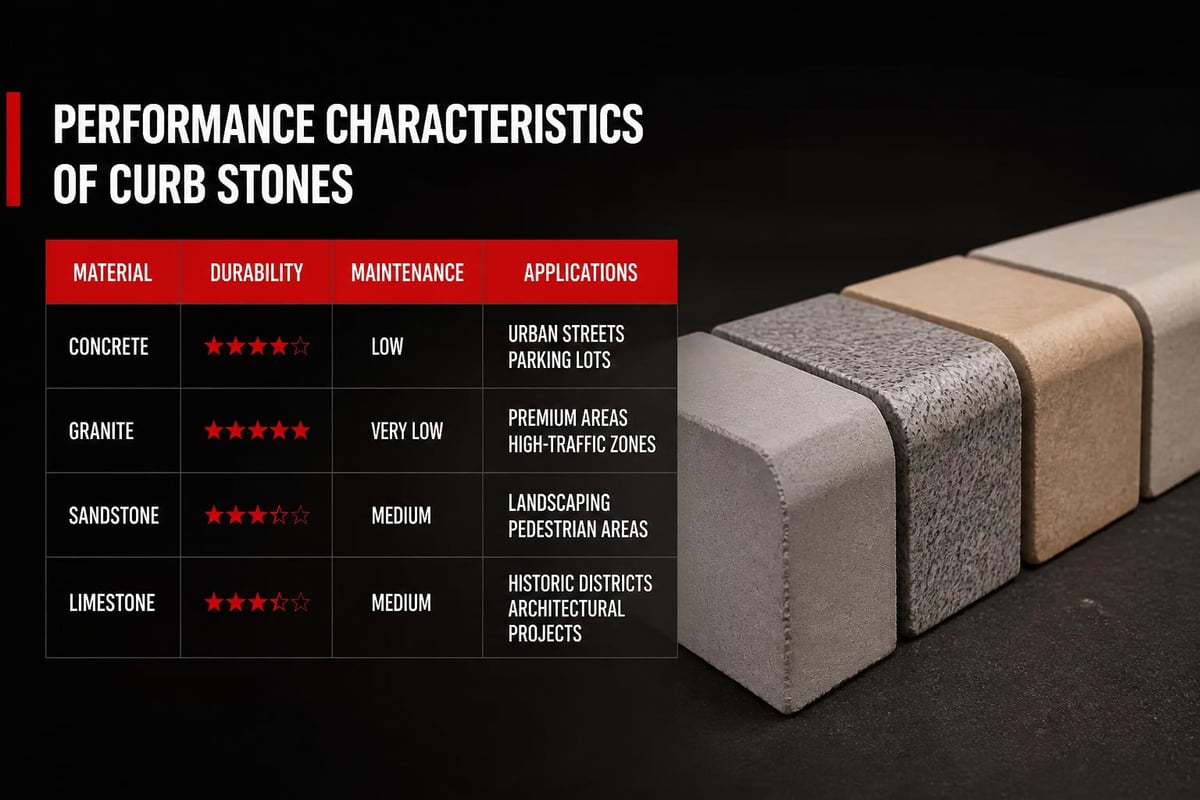
When sourcing natural stone curbs, verify that dimensions comply with established construction standards to ensure compatibility with typical installation methods and equipment.
Specification Considerations for Different Applications
Highway and Commercial Projects
Large-scale infrastructure demands curb stones that withstand heavy loading, frequent vehicle impact, and decades of service with minimal maintenance. For projects similar to the drive-through facilities completed by specialists in civil engineering work, specification typically focuses on:
- Load-bearing capacity: Minimum compressive strength of 40 MPa for concrete units
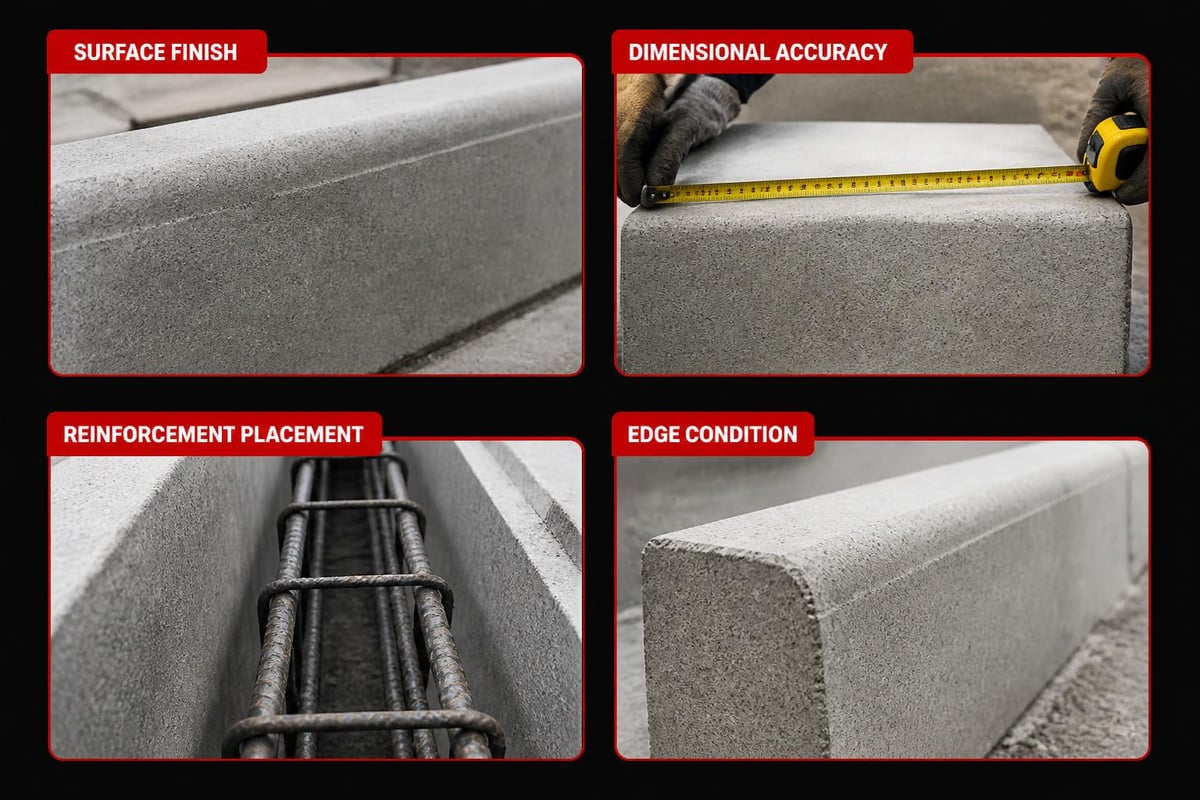
- Dimensional tolerance: Variations not exceeding ±3mm to ensure consistent installation
- Surface finish: Textured faces for improved visibility and skid resistance
- Joint compatibility: Profiles that accommodate proper expansion gaps
Suppliers offering curb stones for sale should provide comprehensive technical datasheets confirming compliance with relevant British Standards and performance characteristics verified through independent testing.
Residential Driveways and Pathways
Domestic applications permit greater flexibility in material selection and aesthetic expression. Homeowners increasingly favour curb stones that complement existing paving materials whilst providing practical edge retention. The installation of kerbs for residential projects requires attention to proportionality, ensuring edging doesn't overwhelm smaller-scale surfaces.
Popular residential specifications include:
- Radius kerbs for curved driveway entrances
- Dropped kerbs facilitating vehicle access
- Decorative profiles with chamfered or bullnose edges
- Colour-matched units coordinating with paving schemes
| Application Type | Recommended Height | Typical Material | Installation Complexity |
|---|---|---|---|
| Highway kerbing | 200-250mm | Reinforced concrete | High |
| Commercial car parks | 150-200mm | Standard concrete | Medium |
| Residential driveways | 100-150mm | Concrete or granite | Low-Medium |
| Garden edging | 75-100mm | Natural stone | Low |
Evaluating Suppliers and Quality Standards
Not all curb stones for sale meet equivalent quality standards. Distinguishing reputable manufacturers from budget importers protects against premature failure, installation difficulties, and replacement costs that dwarf initial savings.
Manufacturing Quality Indicators
Premium suppliers maintain rigorous quality control throughout production. Inspect sample units for surface voids, dimensional consistency, and finish quality. Hairline cracks or spalling edges indicate inadequate curing or substandard aggregate selection. Understanding curbstone characteristics and standards helps establish realistic expectations for different price points.
Request documentation confirming:
- Aggregate sources and gradation analysis
- Cement content and water-to-cement ratios
- Curing protocols and duration
- Compressive strength test results
- Compliance certifications
Delivery and Logistics Capabilities
Large projects require coordinated deliveries matching installation schedules. Suppliers should demonstrate experience with staged deliveries, appropriate lifting equipment, and packaging that prevents damage during transit. For schemes across the UK, verify whether suppliers offer nationwide distribution or require consolidation through regional depots.
Companies with proven track records, such as those showcasing completed civil engineering projects, understand the critical relationship between material quality and installation success.
Installation Planning and Site Preparation
Successful curb stone installation depends equally on material quality and proper groundwork. Even premium units fail prematurely when bedded incorrectly or lacking adequate foundation support.
Foundation Requirements
The substrate beneath curb stones must provide stable, non-yielding support throughout the installation's design life. Minimum requirements typically specify:
- Granular sub-base: 150mm compacted Type 1 aggregate for standard applications
- Concrete haunch: Minimum 100mm thickness, extending 50mm below kerb base
- Bedding mortar: Semi-dry mix (1:4 cement:sand ratio) providing 25-40mm bed depth
Detailed installation guidelines emphasise the importance of proper compaction at each layer to prevent differential settlement that creates trip hazards and compromised aesthetics.
Alignment and Level Control
Professional installation maintains consistent reveals, uniform joint spacing, and precise gradients. Establishing string lines at multiple heights ensures both top edge alignment and base consistency. Working to design standards for curb construction prevents costly corrections and guarantees integration with drainage systems.
Critical installation parameters include:
- Maximum joint width of 6mm between units
- Consistent front face alignment within 3mm tolerance over 3-metre lengths
- Gradients matching surface drainage requirements
- Proper haunching on both back and front faces
Pricing Structures and Budget Planning
Understanding what influences the cost of curb stones for sale enables accurate project budgeting and value assessment. Multiple factors beyond unit price affect total expenditure.
Material Costs
Basic concrete curbs typically range from £3 to £8 per linear metre for standard profiles. Specialist shapes, colours, or reinforced sections command premiums of 40-80% over basic grey units. Natural stone options begin around £15 per metre for sandstone, escalating to £40-60 per metre for premium granite in standard dimensions.
Bespoke profiles, curved sections, or units exceeding standard lengths incur additional manufacturing costs. Suppliers offering curb stones for sale should provide transparent pricing structures distinguishing base units from modifications.
Installation Labour and Equipment
Labour costs frequently exceed material expenditure, particularly for projects requiring extensive excavation or working in constrained environments. Professional installation rates vary regionally but typically range from £25 to £45 per linear metre inclusive of groundwork, bedding, and haunching.
Specialist equipment hire adds further costs:
- Mini excavators: £80-120 per day
- Plate compactors: £30-50 per day
- Concrete mixers: £25-40 per day
| Cost Component | Budget Range (per linear metre) | Percentage of Total |
|---|---|---|
| Curb stones | £3-60 | 20-40% |
| Excavation & disposal | £8-15 | 15-25% |
| Sub-base materials | £5-10 | 10-15% |
| Bedding & haunching | £6-12 | 12-18% |
| Labour | £25-45 | 35-50% |
Maintenance and Longevity Considerations
Proper specification and installation extend service life, but understanding maintenance requirements informs long-term ownership costs. Different materials present distinct maintenance profiles affecting whole-life value calculations.
Concrete Curb Maintenance
Well-installed concrete curbs require minimal intervention beyond occasional cleaning and joint inspection. Common maintenance needs include:
- Joint repointing every 10-15 years where mortar deteriorates
- Surface sealing in aggressive environments subject to de-icing salts
- Impact damage repair replacing individual damaged units
- Vegetation control preventing root penetration at back haunches
The construction points essential for curb stone longevity emphasise proper joint treatment and haunching as critical factors determining maintenance frequency.
Natural Stone Considerations
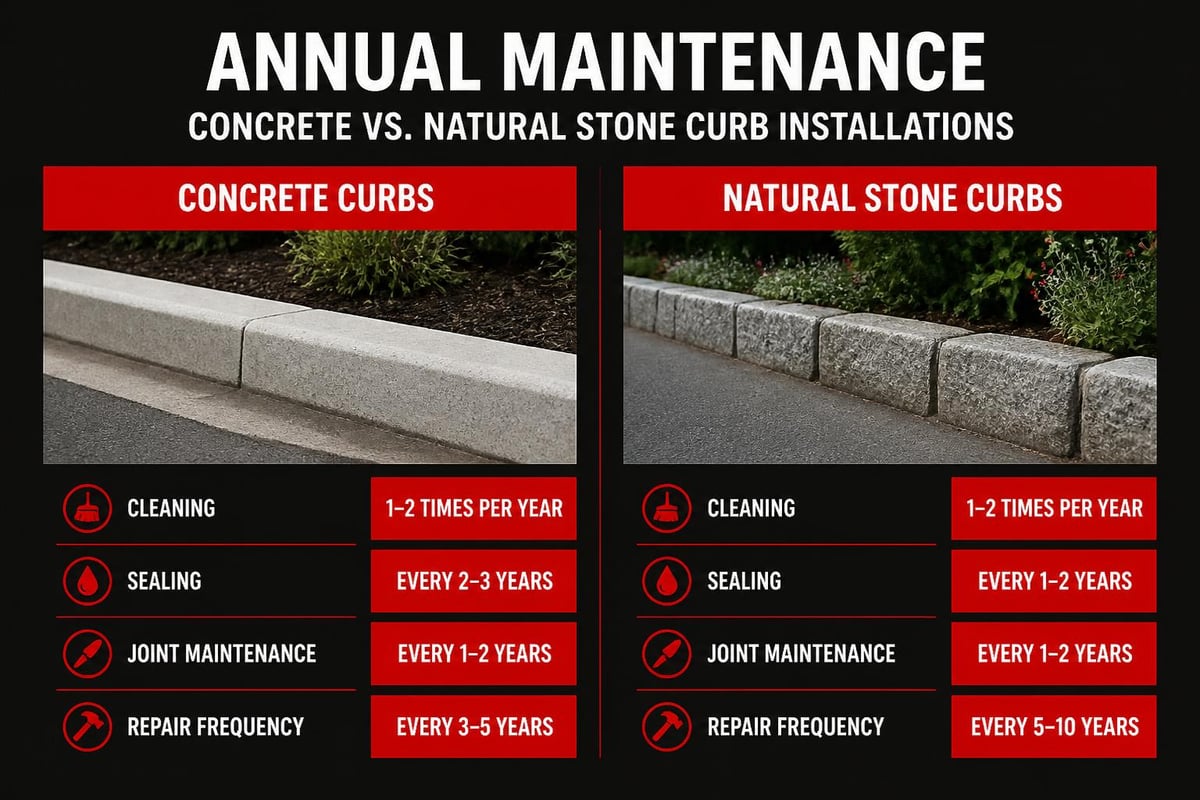
Granite requires virtually no maintenance beyond cleaning, justifying premium costs through exceptional durability. Softer sandstones and limestones may require periodic sealing in high-traffic areas and more frequent replacement of damaged units. However, natural stone typically allows easier individual unit replacement compared to concrete systems where colour matching proves challenging.
Sourcing Strategies for Different Project Scales
Procurement approaches differ markedly between small residential enhancements and major infrastructure schemes. Optimising sourcing strategies reduces costs whilst ensuring material availability aligns with construction schedules.
Small-Scale Residential Projects
Homeowners and small contractors benefit from purchasing curb stones for sale through builder's merchants offering mixed loads and flexible delivery. Minimum order quantities typically start at half-pallet lots (approximately 10-15 linear metres), suitable for driveway edging or garden pathways.
Consider purchasing slightly beyond calculated requirements, accounting for:
- Cutting waste around curves or obstacles (typically 5-8%)
- Potential breakage during handling (2-3%)
- Future repairs requiring colour-matched units
Local merchants familiar with natural stone installation requirements often provide valuable guidance on complementary materials and compatible bedding specifications.
Commercial and Highway Applications
Large-scale projects demand direct manufacturer relationships ensuring consistent product across multiple deliveries. Bulk purchasing typically yields 15-25% discounts compared to retail pricing, though this requires storage capabilities and advanced payment terms.
Specification should anticipate:
- Manufacturing lead times (2-4 weeks for standard products)
- Quality control inspection protocols before acceptance
- Delivery coordination with site access restrictions
- Storage requirements preventing damage before installation
Experienced contractors with portfolios including multiple commercial projects leverage established supplier relationships to negotiate favourable terms and guaranteed availability.
Environmental and Sustainability Factors
Modern procurement increasingly considers environmental impacts beyond immediate functionality. Curb stones for sale now include options addressing sustainability concerns through material sourcing, manufacturing processes, and end-of-life considerations.
Low-Carbon Concrete Options
Manufacturers progressively incorporate supplementary cementitious materials (SCMs) reducing embodied carbon in concrete products. Ground granulated blast furnace slag (GGBS) or pulverised fuel ash (PFA) can replace 30-50% of Portland cement whilst maintaining performance standards. Specifying these alternatives reduces carbon footprint by 25-40% compared to traditional formulations.
Recycled aggregate concrete presents another sustainable option, though typically limited to non-critical applications due to variable material properties. Verify performance testing confirms suitability for your specific requirements.
Natural Stone Sustainability
Locally quarried natural stone minimises transportation impacts whilst supporting regional economies. British-sourced granite and sandstone eliminate international shipping emissions, though availability and colour ranges prove more limited than imported options.
Ethical sourcing certifications verify responsible quarrying practices, particularly important when specifying imported materials. Reputable suppliers providing curb stones for sale should transparently document origin and extraction methods.
Technical Innovations and Future Developments
The curb stone market continues evolving through material science advances and changing infrastructure demands. Understanding emerging options positions projects to benefit from improved performance or reduced costs.
Permeable Kerb Systems
Innovative designs incorporate drainage channels within curb profiles, managing surface water at the road edge rather than relying solely on gully spacing. These systems reduce flooding risk whilst potentially decreasing drainage infrastructure costs. However, maintenance requirements increase due to sediment accumulation requiring periodic flushing.
Smart Kerb Integration
Future infrastructure may embed sensors within curb stones monitoring traffic patterns, detecting parking violations, or supporting autonomous vehicle navigation. While currently limited to pilot schemes, anticipating such integration influences specification decisions for major developments with long design horizons.
Enhanced Durability Materials
Ultra-high-performance concrete (UHPC) formulations offer compressive strengths exceeding 150 MPa with dramatically improved freeze-thaw resistance. Current cost premiums limit widespread adoption, though prices continue declining as manufacturing scales increase. For critical applications experiencing frequent impact or extreme exposure, these advanced materials warrant consideration.
Common Specification Errors to Avoid
Experience across numerous installations reveals recurring mistakes that compromise performance, increase costs, or create safety hazards. Learning from these errors prevents expensive corrections.
Inadequate Profile Selection
Specifying incorrect height or profile geometry for the application creates functional problems. Insufficient height fails to contain aggregate surfacing, whilst excessive reveal creates trip hazards. Match profiles to adjacent surfaces and anticipated loading conditions rather than defaulting to standard dimensions.
Ignoring Drainage Integration
Curbs significantly influence surface water management, yet specifications often overlook this critical interaction. Ensure top-of-kerb levels maintain required crossfall gradients and position joints appropriately relative to drainage inlets. Understanding curbs’ functional roles in comprehensive road design prevents water ponding and premature pavement failure.
Overlooking Movement Accommodation
Temperature variations and structural settlement generate movement that curb systems must accommodate without distress. Specify expansion joints at maximum 10-metre centres using compressible filler materials. Continuous rigid installations inevitably crack at weakest points, typically creating unsightly random breaks rather than controlled joints.
Selecting appropriate curb stones for sale demands balancing functional requirements, aesthetic preferences, and budgetary constraints whilst ensuring installation practices support long-term performance. Whether your project involves commercial infrastructure, highway surfacing, or residential driveways, the right materials properly installed deliver decades of reliable service. At JRG Civils, we bring extensive experience across projects of all scales, from major drive-through facilities to private driveways, ensuring every detail meets exacting standards. Contact our team to discuss how our civil engineering expertise can transform your vision into reality with precision and professionalism.