
Earthwork embankment construction represents one of the most critical aspects of civil engineering projects, from major motorways to commercial developments and residential driveways. These engineered structures provide essential support for roadways, railways, and various infrastructure elements, requiring meticulous planning, precise execution, and rigorous quality control. Understanding the fundamental principles of embankment construction ensures project success, longevity, and safety across all scales of development.
Understanding Earthwork Embankment Fundamentals
An earthwork embankment is a raised structure created by compacting successive layers of suitable fill material to achieve specific engineering requirements. These structures serve multiple purposes in modern infrastructure development.
The primary function involves creating level platforms for roads, buildings, or other structures where natural terrain proves unsuitable. Additionally, embankments provide elevation above flood-prone areas, support bridge approaches, and facilitate proper drainage management across project sites.
Core Components and Structure
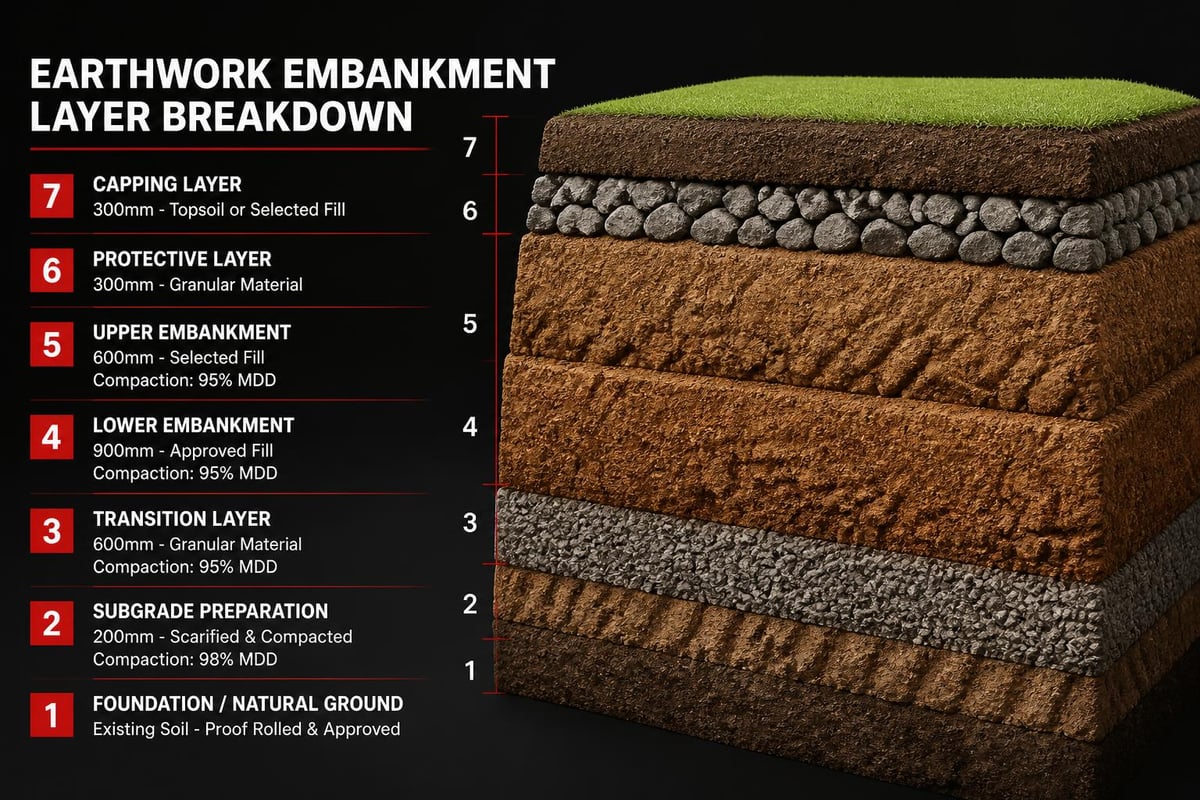
Every successful embankment construction comprises several essential elements working together to ensure structural integrity. The foundation preparation phase removes unsuitable materials and creates a stable base for subsequent layers.
Key structural elements include:
- Foundation layer: prepared subgrade cleared of organic material and weak soils
- Core fill: bulk material forming the main body of the embankment
- Selected fill: higher-quality material placed in upper layers for enhanced stability
- Capping layer: top surface providing a working platform for final surfacing
- Drainage systems: integrated features managing water flow and preventing saturation
The Caltrans Construction Manual provides comprehensive specifications for embankment layer thickness and compaction requirements, offering valuable guidance for projects of varying scales.
Material Selection and Specifications
Choosing appropriate fill materials represents a critical decision affecting long-term embankment performance. Material properties directly influence compaction achievability, load-bearing capacity, and resistance to settlement.
Suitable Fill Materials
Different project contexts demand varying material specifications. Granular materials such as sand and gravel offer excellent drainage characteristics and compact readily, making them ideal for embankment cores and selected fill zones.
Cohesive soils including clays and silts require careful moisture management during placement but provide good stability when properly compacted. Rock fill suits specific applications, particularly where high load-bearing capacity proves essential.
| Material Type | Advantages | Limitations | Typical Applications |
|---|---|---|---|
| Granular soils | Excellent drainage, easy compaction | Higher material cost | Selected fill, drainage layers |
| Cohesive soils | Good stability, readily available | Moisture-sensitive | Core fill, bulk earthwork |
| Rock fill | High strength, minimal settlement | Requires specialised equipment | Heavy-duty embankments |
| Selected cohesive | Balanced properties | Requires testing | Upper embankment layers |
Material testing before and during construction ensures compliance with project specifications. Laboratory analysis determines moisture-density relationships, plasticity indices, and California Bearing Ratio (CBR) values, guiding placement and compaction decisions.
The Michigan Department of Transportation’s roadway earthwork guide outlines material specifications and testing requirements applicable to various embankment applications.
Construction Methodology and Procedures
Systematic construction procedures ensure earthwork embankment structures meet design specifications and performance requirements. Each phase demands careful attention to detail and adherence to established protocols.
Foundation Preparation
Proper foundation preparation establishes the basis for embankment success. Site stripping removes topsoil, vegetation, and organic materials that would compromise stability. Where soft or unsuitable soils exist, excavation to competent material or ground improvement techniques become necessary.
Proof rolling identifies weak spots in the prepared foundation. Heavy equipment traverses the prepared surface, revealing areas requiring additional treatment before fill placement commences.
Layer Placement and Thickness
Fill material arrives at site in controlled quantities, spreading in uniform layers called lifts. Layer thickness directly affects achievable compaction, with thinner lifts generally producing superior results despite requiring more passes.
Standard lift thickness parameters:
- Granular materials: 150-300mm loose thickness depending on compaction equipment
- Cohesive soils: 150-250mm to ensure thorough compaction throughout the layer
- Rock fill: up to 600mm when using heavy vibrating rollers
- Final capping layers: 150mm maximum for critical surfaces
Professional civil engineering contractors adjust lift thickness based on material characteristics, available equipment, and project specifications to optimise construction efficiency whilst maintaining quality standards.
Compaction Requirements and Methods
Achieving specified compaction levels represents the most critical aspect of earthwork embankment construction. Inadequate compaction leads to excessive settlement, reduced load-bearing capacity, and premature structural failure.
Compaction Principles
Compaction increases soil density by removing air voids between particles. The process enhances strength, reduces permeability, and minimises future settlement. Optimal moisture content proves essential, as both excessively dry and overly wet conditions prevent effective compaction.
The relationship between moisture content and achievable density follows a predictable curve, with peak density occurring at optimum moisture content. Field moisture management through watering or drying ensures conditions remain within acceptable tolerances.
Equipment Selection
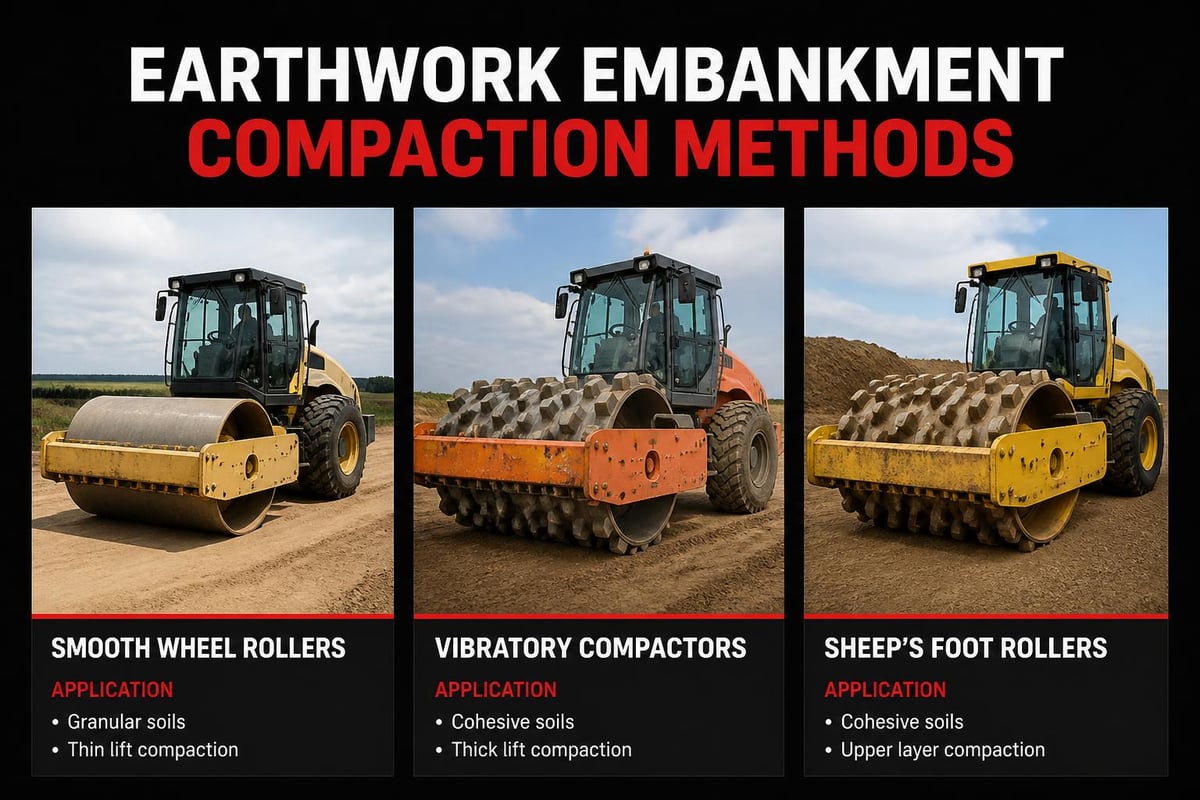
Different compaction equipment suits varying soil types and project requirements. Smooth wheel rollers effectively compact granular materials through static weight and kneading action. Vibratory rollers add dynamic force, proving particularly effective in cohesionless soils.
Sheep's foot or padfoot rollers feature protruding feet that penetrate cohesive soils, compacting from the bottom of each lift upward. Rubber-tyred rollers provide kneading action suitable for both cohesive and granular materials in finishing applications.
| Equipment Type | Best Suited For | Typical Specifications | Coverage Pattern |
|---|---|---|---|
| Smooth wheel roller | Granular materials, finishing | 8-12 tonnes static weight | Overlapping passes |
| Vibratory roller | Sand, gravel, rock fill | 10-15 tonnes with vibration | Systematic coverage |
| Padfoot roller | Cohesive soils | High contact pressure | Multiple passes required |
| Rubber-tyred roller | Mixed soils, final layers | Variable tyre pressure | Kneading action pattern |
The Transportation Research Board’s earthwork construction guide offers detailed insights into compaction concepts and equipment selection for various embankment applications.
Quality Control and Testing Protocols
Rigorous quality control ensures earthwork embankment construction meets specified standards throughout the build process. Testing protocols verify material properties and compaction achievement at regular intervals.
Field Density Testing
Field density tests compare achieved compaction against laboratory-determined maximum dry density. The sand cone method, nuclear density gauge, and drive cylinder tests represent common field testing approaches, each offering specific advantages.
Testing frequency typically follows specification requirements, commonly demanding tests every 500 cubic metres of placed material or at 100-metre intervals along the embankment length. Critical areas such as bridge approaches and structure interfaces require more intensive testing regimes.
Standard compaction targets include:
- Embankment core: 90-95% maximum dry density
- Selected fill zones: 95-98% maximum dry density
- Capping layers: 98-100% maximum dry density
- Areas beneath pavements: minimum 95% maximum dry density
Moisture Content Monitoring
Moisture content significantly influences compaction effectiveness and material behaviour. Field moisture testing accompanies density measurements, ensuring materials remain within acceptable tolerances relative to optimum moisture content.
When moisture content strays outside specified limits, corrective measures such as watering, aerating, or blending with drier materials restore appropriate conditions before compaction proceeds.
Drainage Integration and Water Management
Effective drainage design protects earthwork embankment structures from water-related degradation. Poor drainage leads to saturation, reduced strength, slope instability, and accelerated deterioration.
Drainage System Components
Comprehensive drainage systems incorporate multiple elements addressing different water sources and flow paths. Surface drainage features including crowned surfaces, ditches, and culverts direct rainfall away from embankment surfaces and foundations.
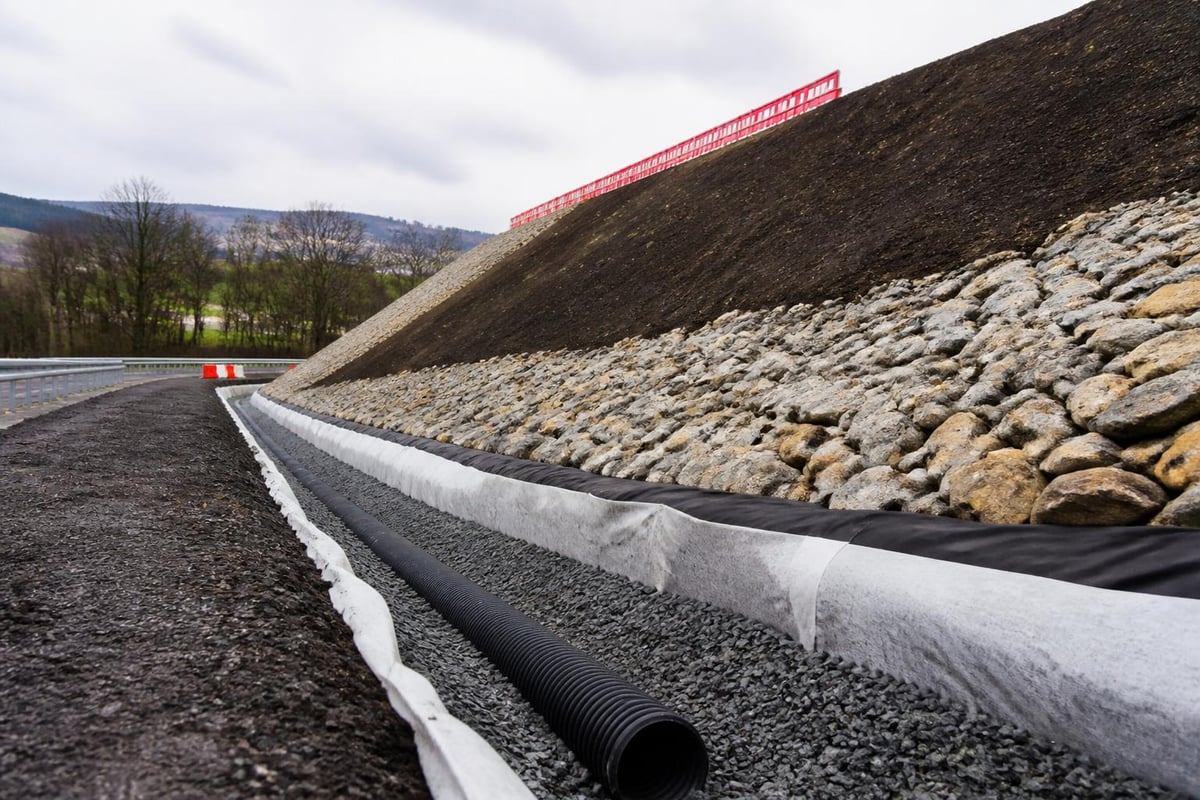
Subsurface drainage manages groundwater and seepage through the embankment body. French drains, geocomposite drainage layers, and weep holes prevent water accumulation within the structure. The European standards for earthworks planning and design provide comprehensive guidance on drainage integration for infrastructure embankments.
Filter fabrics prevent fine particle migration whilst permitting water passage, protecting drainage systems from clogging. Proper filter design considers both hydraulic conductivity and particle retention requirements.
Slope Protection Measures
Embankment side slopes require protection from erosion caused by rainfall, surface runoff, and weathering. Topsoiling and seeding establish vegetation that stabilises surfaces and manages water infiltration.
Where steeper slopes or higher water velocities exist, additional protection through geotextiles, riprap, or concrete facing may prove necessary. These measures particularly suit commercial projects such as domestic services and driveway construction where aesthetics combine with functional requirements.
Special Considerations for Different Applications
Earthwork embankment construction requirements vary considerably depending on project type, loading conditions, and environmental context. Tailoring approaches to specific applications optimises performance and longevity.
Highway and Roadway Embankments
Major transportation projects demand exacting standards due to heavy traffic loads and public safety considerations. Highway embankments typically incorporate higher-quality materials in upper layers, more stringent compaction requirements, and comprehensive drainage systems.
Transition zones where embankments meet cut sections or bridge approaches require particular attention. Differential settlement in these areas can create dangerous surface irregularities, necessitating enhanced construction controls and premium materials.
Commercial Development Platforms
Commercial projects including retail developments, industrial facilities, and hospitality venues often require level platforms created through embankment construction. These applications balance engineering requirements with cost considerations and construction schedules.
Ground improvement techniques may supplement traditional embankment construction where poor foundation conditions exist or rapid construction timelines prove essential. Preloading with temporary surcharge fills, wick drains, or cement stabilisation can accelerate settlement and enhance stability.
Residential and Small-Scale Projects
Smaller earthwork embankment structures for driveways, patios, and residential access roads follow the same fundamental principles as major infrastructure but operate at reduced scales. These projects still require proper material selection, systematic compaction, and adequate drainage to ensure satisfactory long-term performance.
Understanding appropriate construction standards prevents over-engineering whilst maintaining necessary quality levels. Geotechpedia’s embankment construction guidelines discuss foundation preparation and compaction control applicable across project scales.
Environmental and Sustainability Considerations
Modern earthwork embankment construction increasingly incorporates environmental awareness and sustainable practices. These approaches reduce project impacts whilst potentially offering cost benefits and enhanced performance.
Material Sourcing and Reuse
Sustainable material management prioritises reusing excavated materials where properties permit, reducing both disposal requirements and import costs. Site-won materials undergo testing and processing to meet specifications, minimising transportation impacts and external borrow requirements.
Where material improvement proves necessary, lime or cement stabilisation can upgrade marginal soils to acceptable standards. This approach particularly suits cohesive materials requiring enhanced strength or reduced plasticity.
Erosion and Sediment Control
Construction activities disturb soil surfaces, creating erosion potential and sediment runoff risks. Implementing erosion control measures protects water quality in surrounding areas and maintains embankment integrity during construction.
Temporary measures including silt fences, sediment basins, and surface stabilisation products manage runoff until permanent vegetation establishes. Progressive stabilisation, where completed sections receive immediate protection whilst construction continues elsewhere, reduces exposed soil areas.
| Sustainability Measure | Environmental Benefit | Project Advantage |
|---|---|---|
| Material reuse | Reduced disposal, lower carbon footprint | Lower costs, faster procurement |
| Local sourcing | Minimised transportation impacts | Reduced haulage costs |
| Soil stabilisation | Upgraded marginal materials | Eliminated import requirements |
| Progressive restoration | Reduced erosion, faster stabilisation | Improved site conditions |
Common Challenges and Solutions
Earthwork embankment construction encounters various challenges requiring experienced assessment and appropriate responses. Recognising potential issues and implementing effective solutions maintains project quality and schedule.
Settlement Management
All embankments experience some settlement as materials consolidate under self-weight and applied loads. Predicting and managing settlement through design allowances, staged construction, or preloading prevents serviceability problems.
Differential settlement, where uneven consolidation creates surface irregularities, poses particular concerns. Varying foundation conditions, inconsistent compaction, or inadequate transition zone treatment commonly cause this issue. Careful construction control and appropriate design details mitigate these risks.
Weather-Related Delays
Moisture-sensitive materials and compaction requirements make earthwork embankment construction vulnerable to weather impacts. Heavy rainfall can saturate materials, halt compaction activities, and damage partially completed works.
Weather management strategies include:
- Scheduling critical activities during favourable seasonal windows
- Maintaining adequate site drainage to remove surface water quickly
- Protecting completed layers with temporary coverings during vulnerable periods
- Planning alternative activities during unsuitable weather conditions
- Specifying less weather-sensitive materials where appropriate
Equipment Breakdowns and Logistics
Large-scale embankment construction depends on reliable equipment fleets and well-coordinated logistics. Equipment failures can halt production, whilst inadequate material supply creates costly delays and inefficient working patterns.
Preventative maintenance schedules, backup equipment availability, and robust supply chain management reduce vulnerability to these disruptions. Experienced contractors develop contingency plans addressing likely scenarios without excessive over-resourcing.
Regulatory Compliance and Standards
Earthwork embankment construction must satisfy various regulatory requirements and industry standards depending on project location, type, and scale. Understanding applicable frameworks ensures compliant, defensible construction practices.
National and Regional Standards
Different jurisdictions maintain specific earthwork standards reflecting local conditions, materials, and construction practices. The Indiana Department of Transportation’s earthwork specifications exemplify state-level requirements governing embankment construction, material standards, and compaction protocols.
European standards provide harmonised approaches across member nations, whilst British Standards offer detailed guidance for UK projects. Contractors must identify and comply with applicable standards for their project locations.
Documentation and Verification
Comprehensive documentation demonstrates compliance and provides valuable records for future reference. Daily reports, material test results, compaction records, and photographic evidence create an audit trail verifying proper construction procedures.
Quality assurance systems, whether formal certifications or internal protocols, structure documentation practices and ensure systematic compliance verification. Third-party inspection and testing provides independent verification for critical projects.
Long-Term Performance Monitoring
Post-construction monitoring assesses earthwork embankment performance and identifies emerging issues requiring intervention. Early detection of problems permits corrective action before serious deterioration develops.
Settlement Monitoring
Surveying embankment crest elevations at regular intervals quantifies ongoing settlement. Comparison against predicted settlement curves distinguishes normal consolidation from excessive movement warranting investigation.
Automated monitoring systems using precise levelling or satellite positioning provide continuous settlement data for critical structures. This technology particularly suits highway embankments where ongoing settlement might affect pavement performance and driving comfort.
Drainage System Maintenance
Regular inspection and maintenance of drainage features prevents system degradation and associated embankment problems. Clearing blocked culverts, repairing damaged ditches, and maintaining vegetation controls ensure continued drainage effectiveness.
Seasonal inspection programmes identify accumulated debris, erosion damage, or structural deterioration requiring attention. Prompt maintenance proves more cost-effective than addressing consequences of drainage system failure.
Successful earthwork embankment construction demands comprehensive understanding of fundamental principles, meticulous execution of proven methodologies, and rigorous quality control throughout the process. Whether developing major infrastructure, commercial platforms, or residential enhancements, these engineered structures require expertise spanning material science, construction management, and long-term performance considerations. At JRG Civils, we bring this expertise to projects across the UK, combining technical excellence with attention to detail that ensures your earthwork embankment meets exacting standards from foundation preparation through final completion. Contact us to discuss how our civil engineering capabilities can support your next project.