
An earthworks construction company forms the foundation of virtually every building project, whether commercial, residential, or infrastructure-related. These specialist contractors handle the crucial groundwork that transforms raw land into stable, properly prepared sites ready for development. From excavating foundations to creating drainage systems and constructing access roads, earthworks expertise determines whether subsequent construction phases proceed smoothly or encounter costly delays. Understanding what these companies do and how they operate helps project managers, developers, and property owners make informed decisions when planning construction projects.
What an Earthworks Construction Company Does
An earthworks construction company specialises in manipulating and reshaping the natural terrain to create suitable building platforms. This involves far more than simply moving dirt from one location to another. These firms possess expertise in soil mechanics, drainage engineering, compaction techniques, and site preparation methodologies that ensure long-term stability.
Core Services and Capabilities
The primary functions of an earthworks specialist encompass several critical operations:
- Site clearance and demolition to remove existing structures, vegetation, and obstacles
- Excavation and bulk earthmoving for foundations, basements, and underground utilities
- Grading and levelling to create precise slopes and elevations
- Soil stabilisation and compaction ensuring adequate load-bearing capacity
- Drainage system installation including French drains, soakaways, and surface water management
- Trenching for utilities such as water mains, sewerage, and electrical conduits
- Access road construction providing safe routes for construction vehicles and future users
Professional contractors follow established best practices in earthworks to ensure environmental compliance and project efficiency. The scope of work varies dramatically depending on site conditions, with some projects requiring minimal intervention whilst others demand extensive ground improvement works.
Specialist Equipment and Technology
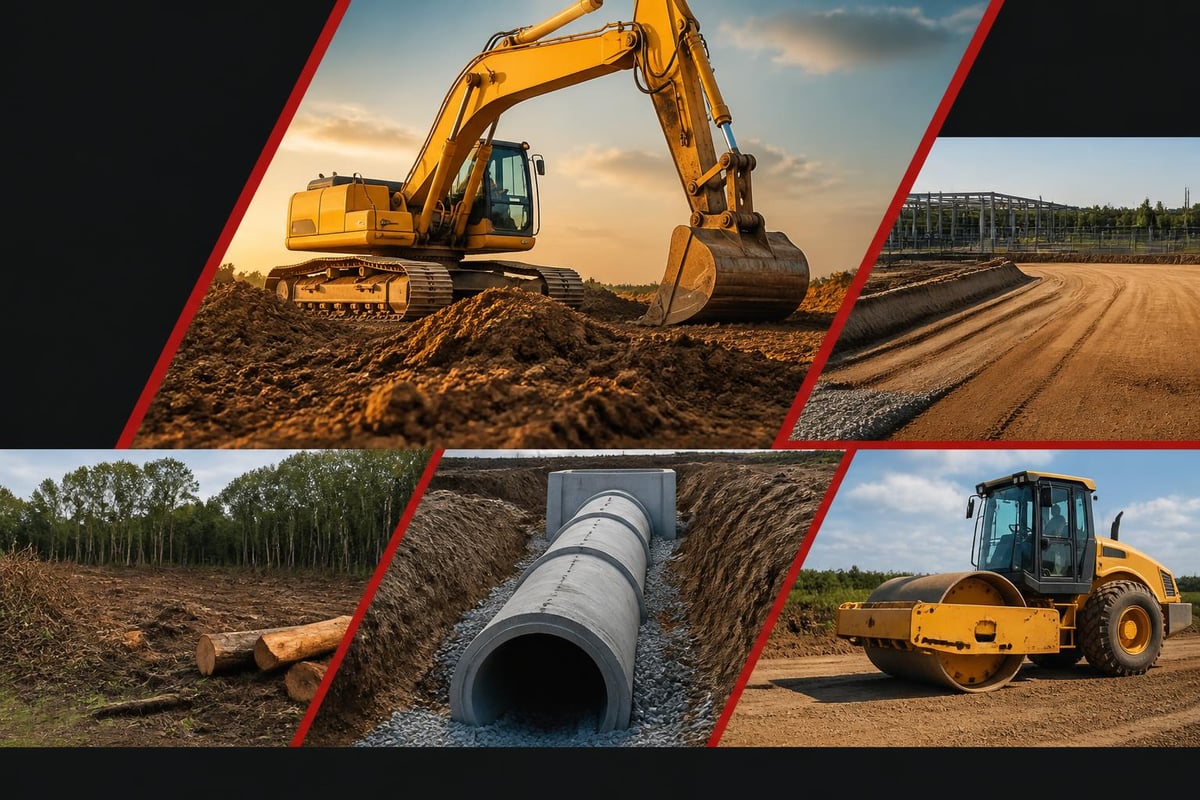
Modern earthworks operations rely on sophisticated machinery operated by skilled personnel. Excavators ranging from compact mini-diggers to massive tracked machines handle digging and material movement. Bulldozers push and spread materials across larger areas, whilst graders create precise slopes and finished surfaces. Compactors including vibrating rollers and plate compactors ensure proper soil density.
| Equipment Type | Primary Function | Typical Applications |
|---|---|---|
| Excavators | Digging, loading, trenching | Foundations, drainage, utilities |
| Bulldozers | Pushing, spreading, rough grading | Site clearance, bulk earthworks |
| Motor Graders | Fine grading, slope creation | Road construction, finished surfaces |
| Compaction Rollers | Soil densification | Sub-base preparation, embankments |
| Dump Trucks | Material transportation | Soil removal, aggregate delivery |
Advanced firms increasingly utilise GPS-guided machinery and digital surveying tools. These technologies enable precise execution of design specifications, reducing waste and improving accuracy. Some projects now incorporate Digital Twin technology for real-time monitoring and optimisation of earthwork operations.
Planning and Executing Earthworks Projects
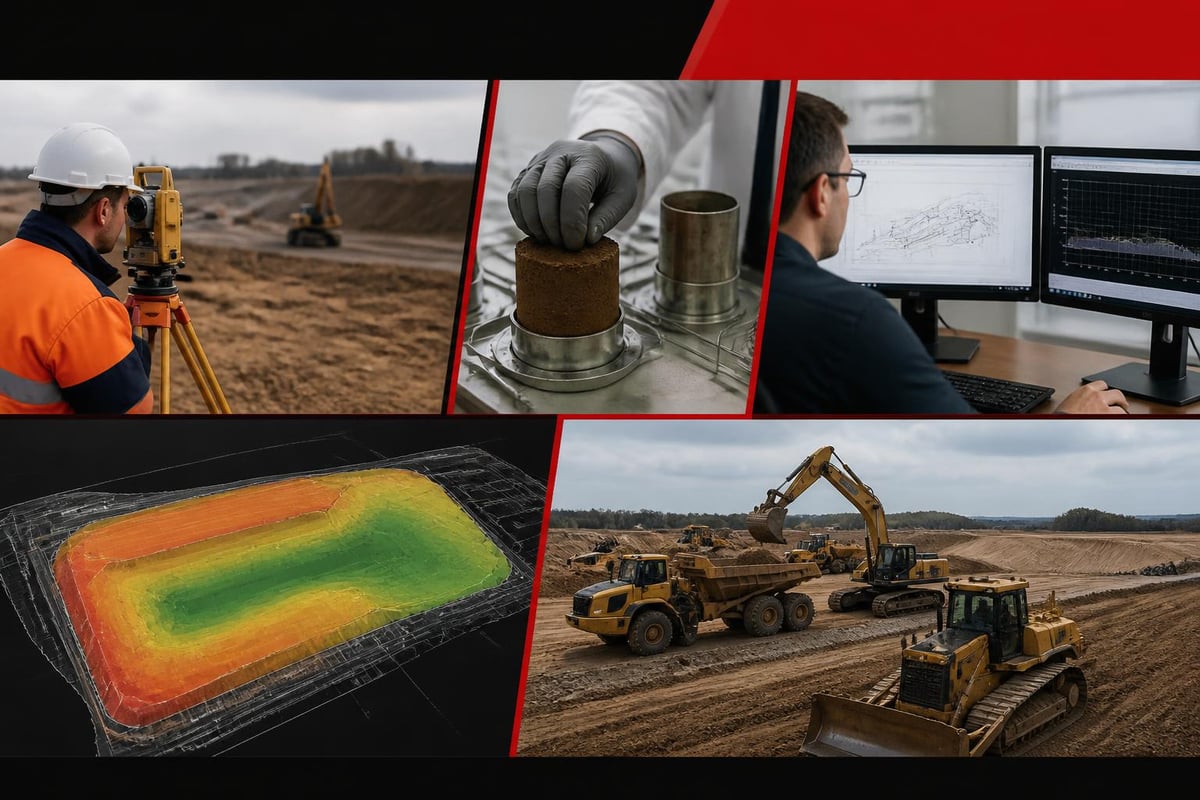
Successful earthworks require meticulous planning before machinery arrives on site. An earthworks construction company begins by conducting thorough site investigations to understand ground conditions, existing utilities, and potential challenges. Soil samples undergo laboratory testing to determine bearing capacity, moisture content, and suitability for reuse.
The design phase translates architectural and engineering requirements into precise earthwork specifications. Engineers calculate cut-and-fill volumes, determining how much material requires removal and how much needs importing. Balancing these quantities minimises transportation costs whilst ensuring the site meets design elevations.
Pre-Construction Considerations
Several factors influence project planning and execution:
- Geotechnical surveys identify soil types, contamination, and groundwater levels
- Utility mapping locates existing services to prevent damage during excavation
- Access route planning ensures heavy machinery can enter and exit safely
- Environmental assessments address drainage, erosion control, and ecological impacts
- Sequencing strategies coordinate earthworks with other construction activities
Understanding earthwork construction processes helps stakeholders appreciate the complexity involved. Weather conditions significantly impact operations, as excessive rain renders clay soils unworkable and causes programme delays. Experienced contractors schedule work appropriately and implement contingency measures.
Following recognised standards like the British Standard for earthworks ensures compliance with industry requirements. These guidelines cover everything from initial site investigation through to long-term maintenance considerations.
Quality Control and Compliance Standards
An earthworks construction company must maintain rigorous quality standards throughout project delivery. Inadequate compaction or poor drainage can compromise structural integrity, leading to settlement, cracking, or complete failure of buildings and pavements constructed above. Professional firms implement comprehensive testing regimes to verify compliance with specifications.
Testing and Verification Methods
Quality assurance involves multiple verification techniques:
- Density testing confirms adequate compaction using nuclear gauges or sand replacement methods
- Moisture content analysis ensures materials sit within acceptable ranges for compaction
- California Bearing Ratio (CBR) tests measure sub-grade strength for pavement design
- Plate bearing tests assess load-bearing capacity of finished platforms
- Surface level surveys verify achieved elevations match design requirements
These tests occur at prescribed intervals, with results documented to demonstrate compliance. When specifications aren't met, remedial works become necessary before subsequent construction proceeds. The European standards for earthworks construction provide detailed procedures for material handling and placement.
| Test Type | Purpose | Typical Frequency |
|---|---|---|
| Nuclear Density | Compaction verification | Every 500m² or layer |
| CBR Testing | Sub-grade strength | Per soil type/area |
| Level Surveys | Elevation accuracy | Continuous monitoring |
| Material Sampling | Specification compliance | Per source/delivery |
Contractors maintain detailed records including test certificates, photographic evidence, and daily site diaries. This documentation proves invaluable for resolving disputes and provides assurance to clients, building control officers, and warranty providers.
Drainage Systems and Water Management
Effective drainage constitutes one of the most critical aspects of earthworks. An earthworks construction company must design and install systems that prevent water accumulation, which otherwise causes soil saturation, reduced bearing capacity, and eventual structural damage. Both surface water and groundwater require careful management through integrated drainage solutions.
Surface water drainage typically involves creating appropriate gradients that direct runoff away from structures towards collection points. Gullies and channel drains gather surface water, whilst pipes and culverts convey it to soakaways, attenuation tanks, or public sewers. Underground drainage tackles groundwater through French drains, land drains, and sub-base drainage layers.
Drainage Design Principles
Professional drainage design considers multiple factors:
- Rainfall intensity and duration based on local climate data
- Soil permeability affecting infiltration rates and runoff generation
- Catchment areas contributing water to drainage systems
- Existing watercourses and discharge consent requirements
- Sustainable drainage system (SuDS) integration where appropriate
Sites with high groundwater levels or poor soil drainage present particular challenges. Contractors may need to install perimeter drainage, incorporate geotextile membranes, or improve soil characteristics through stabilisation techniques. The practical considerations for earthworks management emphasise how material behaviour under wet conditions affects construction programmes.
Commercial projects like the Costa Coffee and Greggs drive-through developments completed by specialists require robust drainage to handle increased impermeable surfacing. Car parks and access roads generate substantial runoff that must be managed to prevent flooding and comply with environmental regulations.
Earthworks for Different Project Types
Requirements vary considerably between commercial developments, residential properties, and infrastructure projects. An earthworks construction company adapts its approach based on project scale, soil conditions, and end-use requirements. Large commercial sites demand different techniques compared to domestic driveways or garden patios.
Commercial and Industrial Developments
Commercial projects typically involve extensive earthworks across larger areas. Shopping centres, industrial estates, and franchise developments require substantial site preparation including bulk excavation, sub-base construction, and comprehensive drainage networks. Heavy-duty pavements capable of supporting delivery vehicles and customer traffic demand well-compacted foundations built to exacting specifications.
These projects often encounter complications like contaminated land requiring remediation, underground obstructions necessitating design modifications, or challenging ground conditions demanding specialist techniques. Coordination with multiple trades becomes essential, as earthworks must progress to enable building construction, utilities installation, and external works simultaneously.
Residential and Domestic Projects
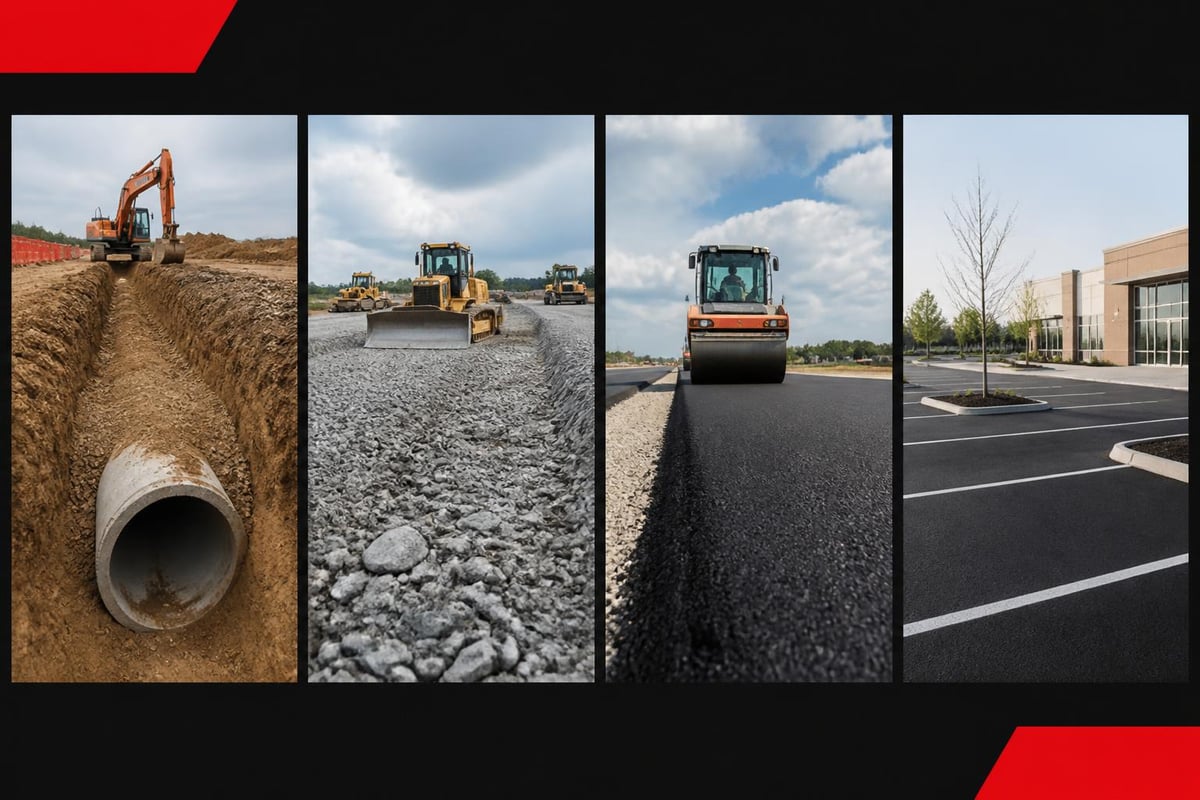
Residential earthworks operate at a smaller scale but demand equal attention to detail. Driveways require proper excavation depth, adequate sub-base thickness, and appropriate drainage to prevent surface water ponding. Patios need correct falls away from buildings and stable foundations that resist settlement. Garden landscaping may involve retaining walls, terracing, or ground remodelling.
Domestic clients benefit from working with established contractors who understand local ground conditions and building regulations. The attention to detail that characterises quality earthworks ensures driveways remain stable, drainage functions effectively, and finished surfaces meet expectations for years to come.
Safety and Environmental Responsibilities
Safety remains paramount throughout earthworks operations. An earthworks construction company implements comprehensive health and safety management systems addressing the numerous hazards inherent in excavation and earthmoving activities. Excavation collapse, machinery operation risks, underground services strikes, and access route safety all require careful control measures.
Contractors conduct risk assessments before commencing work, identifying potential dangers and implementing appropriate safeguards. Excavations deeper than 1.2 metres typically require shoring or benching to prevent collapse. Exclusion zones around operating machinery protect ground workers, whilst banksmen guide vehicle movements in congested areas.
Environmental Protection Measures
Environmental stewardship forms an integral part of modern earthworks practice:
- Erosion control using sediment fences, silt traps, and temporary seeding
- Dust suppression through water bowsers and road sweeping
- Noise management via equipment selection and working hour restrictions
- Waste minimisation by maximising on-site soil reuse
- Pollution prevention protecting watercourses from sediment and fuel spillages
Responsible contractors segregate topsoil for reuse in landscaping, recycle demolition materials where possible, and dispose of unsuitable materials at licensed facilities. Environmental permits may be necessary for certain activities, particularly when working near watercourses or on contaminated sites.
Material Selection and Specification
The materials used in earthworks significantly influence long-term performance. An earthworks construction company must select appropriate materials for different applications, considering factors like load-bearing requirements, drainage characteristics, and availability. Natural soils excavated on site may prove suitable for reuse in some applications but inadequate for others.
Type 1 sub-base consisting of crushed rock provides excellent load-bearing capacity for pavements and foundations. Type 3 sub-base offers a more economical alternative for lighter-duty applications. Sand works well for bedding drainage pipes and filling narrow trenches. Topsoil provides the growing medium for landscaped areas once earthworks complete.
Material Specification Table
| Material Type | Typical Uses | Key Properties |
|---|---|---|
| Type 1 Sub-base | Roads, car parks, heavy pavements | High CBR, excellent drainage, well graded |
| Type 3 Sub-base | Paths, light pavements, domestic drives | Moderate strength, economical, widely available |
| Crushed Concrete | General fill, light sub-base | Recycled option, variable quality, cost-effective |
| Sand | Pipe bedding, narrow trenches | Good workability, low strength, free-draining |
| Granular Fill | Embankments, general fill | Free-draining, stable when compacted |
Sourcing materials locally reduces transportation costs and environmental impact. However, quality must never be compromised to achieve cost savings. Reputable suppliers provide certification confirming materials meet specified standards, with regular testing verifying consistency.
Technology and Innovation in Modern Earthworks
The earthworks sector continues evolving through technological advancement. GPS machine control systems enable operators to achieve design grades with millimetre precision, dramatically reducing over-excavation and imported material quantities. Three-dimensional models uploaded to machine systems guide blade positions automatically, improving productivity whilst reducing skilled labour requirements.
Drone surveys create detailed site models quickly and cost-effectively. Regular aerial surveys track progress, calculate volumes, and identify potential issues before they escalate. Building Information Modelling (BIM) integration ensures earthworks designs coordinate seamlessly with architectural and services engineering models.
Digital Transformation Benefits
Modern technology delivers multiple advantages:
- Enhanced accuracy reducing material waste and rework
- Improved productivity through optimised machine utilisation
- Better quality control via real-time monitoring and verification
- Reduced environmental impact through precise material management
- Enhanced safety from reduced ground worker exposure
Forward-thinking contractors invest in these technologies, recognising the competitive advantages they provide. Clients benefit through faster project delivery, improved quality, and reduced costs compared to traditional methods.
Selecting the Right Earthworks Partner
Choosing an earthworks construction company requires careful evaluation of experience, capability, and reputation. Successful projects depend on contractor competence, so due diligence proves essential. Review previous projects of similar scale and complexity, checking whether the firm possesses relevant expertise.
Accreditations and certifications demonstrate commitment to professional standards. Look for membership of industry bodies, quality management systems like ISO 9001, and environmental accreditations such as ISO 14001. Health and safety performance indicators reveal how seriously contractors take worker welfare and risk management.
Evaluation Criteria
Consider these factors when selecting contractors:
- Demonstrated experience in similar project types and site conditions
- Financial stability ensuring project completion without cash flow issues
- Equipment ownership providing control over plant availability and quality
- Workforce competency with qualified operators and ground workers
- Insurance coverage protecting against potential liabilities
- References from previous clients confirming satisfaction
Requesting detailed methodology statements reveals how contractors approach projects. Professional firms provide comprehensive documentation explaining proposed working methods, quality control procedures, and programme management strategies. This transparency indicates organisational capability and attention to detail.
Established contractors like those operating across the North East and throughout the UK bring valuable local knowledge of ground conditions, material suppliers, and regulatory requirements. Their experience navigating regional challenges proves invaluable for avoiding delays and controlling costs.
Cost Factors and Budget Considerations
Earthworks costs vary considerably depending on site conditions, project scope, and specification requirements. An earthworks construction company provides quotations based on thorough site assessment and detailed understanding of client requirements. Several factors influence pricing, making accurate initial surveys essential for reliable budget estimates.
Ground conditions significantly impact costs. Soft, wet soils require stabilisation or replacement with imported materials. Rock excavation demands specialist equipment or breaking techniques. Contaminated ground necessitates removal and disposal at premium rates. These conditions may not be apparent until excavation commences, hence the importance of comprehensive site investigation.
Budget Influencing Factors
Principal cost drivers include:
- Excavation volumes and disposal requirements
- Imported material quantities and haulage distances
- Ground conditions affecting productivity and methodology
- Access constraints limiting equipment size or working hours
- Drainage complexity and component specifications
- Testing and quality assurance requirements
Obtaining multiple quotations enables cost comparison, but cheapest rarely means best value. Experienced contractors price work realistically based on proper assessment. Unrealistically low quotations often indicate inadequate understanding or corners that will be cut during execution.
Building contingencies into budgets proves prudent, as unforeseen ground conditions frequently emerge. Professional contractors highlight potential risks during tendering, enabling informed decision-making rather than nasty surprises mid-project.
Long-Term Performance and Maintenance
Quality earthworks provide stable platforms that require minimal maintenance over their design life. An earthworks construction company focused on long-term performance implements best practices throughout construction rather than simply meeting minimum specifications. This approach prevents costly remedial works and ensures structures built above remain stable.
Proper compaction prevents settlement that causes pavement cracking, building movement, and drainage failure. Adequate drainage stops water accumulation that softens sub-grades and reduces bearing capacity. Appropriate materials resist breakdown and maintain strength under repeated loading. These fundamentals determine whether earthworks succeed or fail over time.
Periodic inspection identifies emerging issues before they escalate. Surface water ponding indicates drainage problems requiring investigation. Pavement cracking may suggest inadequate sub-base thickness or compaction. Settlement around utilities points to poorly backfilled trenches. Addressing these issues promptly prevents progressive deterioration.
Understanding what an earthworks construction company does and how to select the right partner ensures your construction project starts on solid foundations. From initial site investigation through to final surface preparation, quality earthworks determine long-term performance and prevent costly remediation. JRG Civils brings extensive experience across commercial and residential projects throughout the UK, delivering the attention to detail and professional standards that ensure successful outcomes from the beginning of every job through to completion.