Modern road construction demands efficiency, precision, and durability. Slipform kerbing has emerged as a transformative technique that addresses all three requirements simultaneously. This continuous concrete forming method eliminates traditional joints, reduces labour costs, and accelerates project timelines whilst delivering superior structural integrity. For civil engineering contractors working on commercial developments, highways, and residential driveways, understanding slipform kerbing represents a significant competitive advantage in today's construction landscape.
What Is Slipform Kerbing and How Does It Work
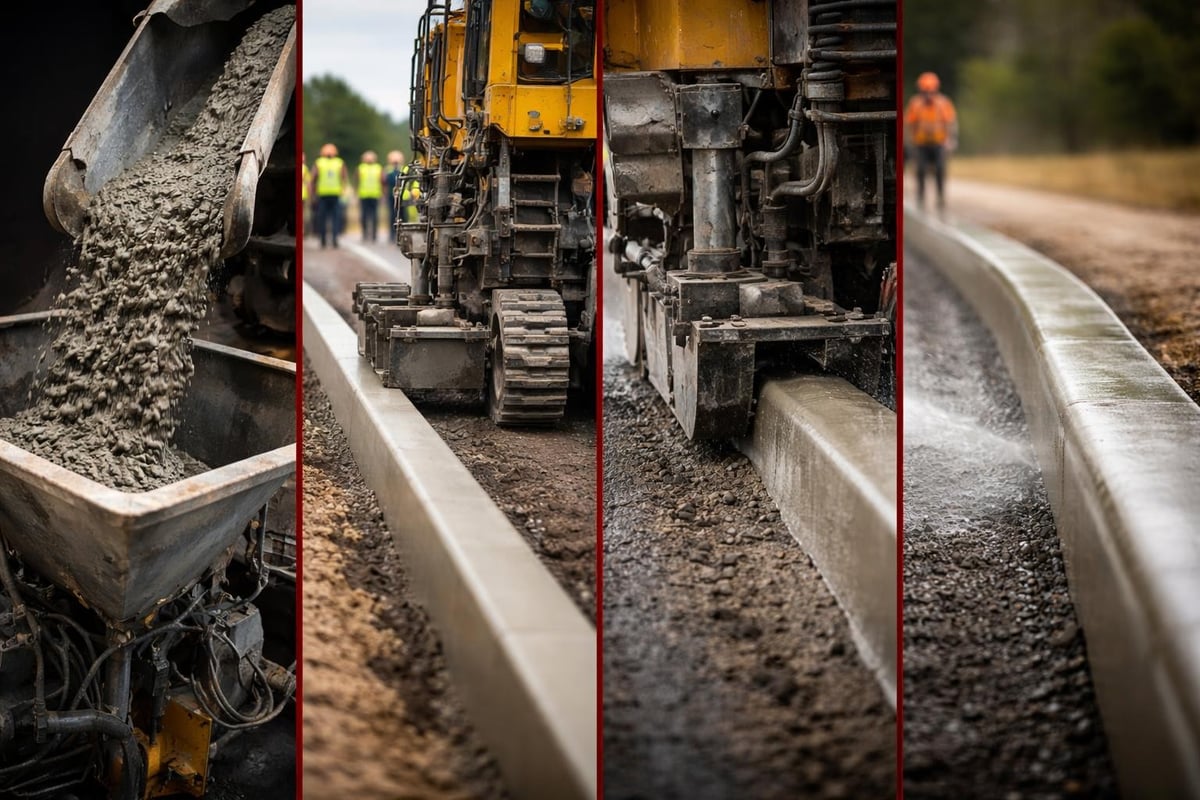
Slipform kerbing is a continuous concrete placement method that creates kerbs, channels, and edge barriers without the need for individual precast sections. The process utilises specialised machinery that extrudes concrete through a shaped mould whilst moving steadily along the designated path. As the machine advances, it leaves behind a perfectly formed, seamless kerb that begins curing immediately.
The equipment consists of a self-propelled paver with adjustable moulds that can be configured to various kerb profiles and dimensions. Fresh concrete is fed into the hopper, where it's compacted and shaped as the machine progresses. Internal vibrators ensure proper consolidation, eliminating air pockets and creating a dense, durable structure. The slipform paving process requires precise coordination between concrete delivery, machine speed, and environmental conditions.
Key Components of Slipform Kerbing Equipment
Modern slipform kerb machines incorporate sophisticated technology to achieve consistent results:
- Guided steering systems that follow string lines or laser guidance for precision alignment
- Variable speed controls allowing operators to adjust pace based on concrete consistency
- Interchangeable moulds accommodating different kerb profiles and specifications
- Vibration mechanisms ensuring thorough concrete compaction throughout the extrusion
- Height adjustment features maintaining consistent kerb dimensions on varied terrain
The automatic slipform kerb machines available today can handle projects ranging from small residential driveways to extensive highway installations. These machines typically require a skilled operator and support crew to maintain concrete supply, monitor quality, and perform immediate finishing touches where necessary.
Advantages of Slipform Kerbing Over Traditional Methods
The benefits of slipform kerbing extend across multiple dimensions of construction project management. Cost efficiency represents one of the most compelling advantages, with significant reductions in both material and labour expenses compared to precast kerb installation.
Speed and productivity mark perhaps the most noticeable improvement. Traditional methods require individual positioning of precast sections, careful leveling, and extensive backfilling. Slipform operations can complete hundreds of linear metres daily, drastically reducing project timelines. For commercial projects such as drive-through facilities or car parks, this acceleration translates directly to earlier revenue generation.
Structural and Quality Benefits
The continuous nature of slipform kerbing creates inherently stronger structures. Without joints acting as weak points, the kerb system better resists displacement, cracking, and deterioration. This monolithic construction proves particularly valuable in high-traffic areas or regions subject to freeze-thaw cycles.
| Feature | Slipform Kerbing | Precast Kerbing |
|---|---|---|
| Installation Speed | 300-500m per day | 80-150m per day |
| Joint Frequency | Expansion joints only | Every 0.5-1.0m |
| Labour Requirements | 3-4 person crew | 6-8 person crew |
| Equipment Mobility | Single machine | Multiple vehicles |
| Customisation | Instant profile changes | Limited to stock shapes |
| Weather Sensitivity | Moderate | Low |
According to Dirigo Slipform’s analysis, the elimination of joints reduces long-term maintenance requirements substantially. Traditional precast kerbing develops problems at joint locations where movement, infiltration, and differential settlement occur. Slipform kerbing minimises these vulnerabilities whilst providing superior load distribution characteristics.
Applications in Commercial and Residential Projects
Slipform kerbing demonstrates remarkable versatility across project types and scales. Commercial developments particularly benefit from the technique's efficiency and professional finish. Car parks, retail centres, and industrial estates require extensive kerbing to define traffic flow, protect landscaping, and manage surface water drainage.
Drive-through facilities present specific challenges that slipform kerbing addresses effectively. The curved paths, precise angles, and durability requirements of establishments like Costa Coffee or Greggs drive-throughs demand construction methods that deliver both accuracy and strength. The ability to create smooth curves without joints enhances both aesthetics and functionality.
Highway and Infrastructure Applications
Major road construction projects increasingly specify slipform kerbing for central reservations, edge barriers, and channel systems. The continuous installation process aligns perfectly with the linear nature of highway work, enabling contractors to maintain momentum throughout extended corridors. The comprehensive infrastructure solutions required for modern road networks benefit from this efficient approach.
Motorway projects utilise slipform techniques for:
- Safety barriers along high-speed sections
- Central reservation kerbing separating carriageways
- Drainage channels managing surface water runoff
- Edge protection preventing carriageway deterioration
- Junction kerbing guiding traffic flow patterns

Residential and Private Development
Private driveways, estate roads, and residential developments represent growing markets for slipform kerbing. Homeowners increasingly appreciate the clean, professional appearance of continuous concrete edging. The method proves especially suitable for longer driveways where traditional edging would introduce numerous joints and potential failure points.
Garden landscaping projects benefit from slipform kerbing's ability to create gentle curves and varied profiles. Contractors can adjust the machine's moulds to produce decorative edges, raised planters, or subtle level changes that enhance outdoor spaces whilst providing structural support.
Technical Considerations and Best Practices
Successful slipform kerbing requires careful attention to multiple technical factors. Concrete mix design plays a crucial role, as the material must possess specific characteristics to maintain shape immediately after extrusion whilst achieving adequate strength during curing.
The concrete requires sufficient stiffness to support itself without slumping, yet enough workability to flow through the machine and consolidate properly under vibration. Typical specifications call for:
- Slump values between 25-50mm for optimal extrusion characteristics
- Aggregate sizing carefully graded to pass through machine openings
- Cement content sufficient for early strength development
- Admixtures controlling set time and enhancing workability
- Fibre reinforcement in some applications for crack control
As noted by experienced contractors, the concrete mix quality directly influences project success. Inconsistent batching or inappropriate mix designs lead to surface defects, dimensional variations, or structural inadequacies.
Environmental and Site Conditions
Weather conditions significantly impact slipform kerbing operations. Temperature, humidity, and wind affect concrete curing rates and surface finish quality. Cold weather requires protective measures to prevent freeze damage during initial curing, whilst hot conditions demand fog spraying or curing compounds to prevent rapid moisture loss.
Site preparation determines alignment accuracy and operational efficiency:
- Sub-base compaction must meet specified density requirements
- String lines or laser guides require precise installation for accurate kerb placement
- Access routes need adequate width for concrete delivery vehicles
- Staging areas must accommodate equipment, materials, and crew facilities
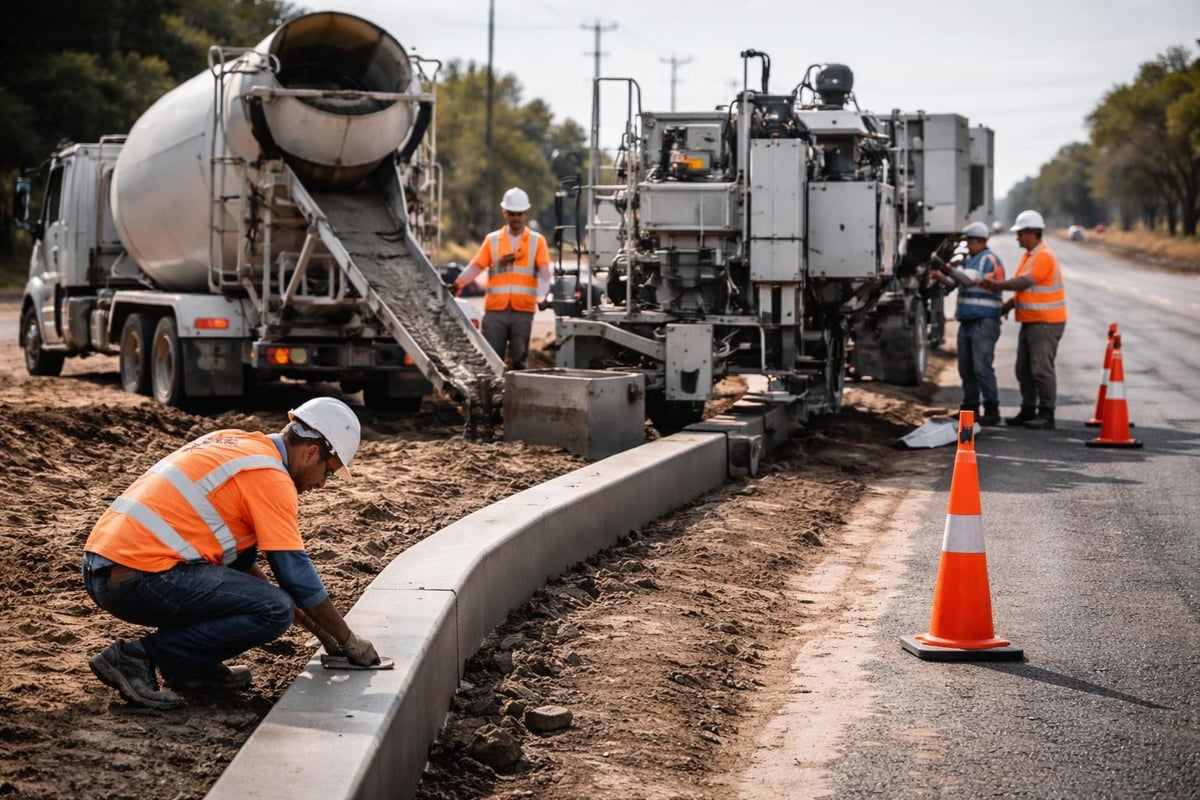
The slipform kerbing process demands coordination between multiple activities occurring simultaneously. Concrete batching plants must maintain consistent production, delivery vehicles require scheduling to prevent delays, and the installation crew needs continuous material supply to maintain momentum.
Equipment Selection and Operational Efficiency
Choosing appropriate slipform kerbing equipment depends on project scale, kerb specifications, and site conditions. Machines range from compact units suitable for residential work to large highway-specification pavers capable of producing multiple kerb profiles simultaneously.
Modern equipment incorporates technological advances that enhance productivity and quality. GPS guidance systems eliminate manual string lines on suitable projects, laser sensors maintain precise height control, and automated vibration systems adjust to concrete consistency variations. These features reduce operator skill requirements whilst improving consistency.
Training and Crew Development
Operating slipform kerbing equipment effectively requires specialised knowledge and practical experience. Crew members must understand concrete behaviour, machine mechanics, and quality control procedures. Investment in training programmes pays dividends through improved productivity, reduced rework, and enhanced safety performance.
| Crew Role | Primary Responsibilities | Skill Requirements |
|---|---|---|
| Machine Operator | Steering, speed control, quality monitoring | Equipment certification, concrete knowledge |
| Concrete Finisher | Surface finishing, edge detailing, joints | Manual skills, attention to detail |
| Grade Checker | Alignment verification, dimension control | Surveying basics, measurement tools |
| Concrete Coordinator | Batching communication, delivery timing | Logistics planning, problem-solving |
Quality Assurance and Specification Compliance
Meeting project specifications requires systematic quality control throughout slipform kerbing operations. Visual inspection identifies surface defects, dimensional variations, or alignment issues requiring immediate correction. Regular measurements verify compliance with specified profiles, heights, and widths.
Testing protocols typically include:
- Slump testing of each concrete batch to confirm consistency
- Cylinder sampling for compressive strength verification
- Dimensional surveys at regular intervals along completed sections
- Surface finish assessments comparing texture to specification requirements
- Joint spacing verification ensuring proper expansion joint placement
The ISO standards for slipform pavers provide comprehensive guidelines for equipment performance and operational procedures. Adherence to these standards ensures consistent results across diverse projects and locations.
Long-term Performance Monitoring
Properly installed slipform kerbing delivers decades of maintenance-free service. Regular inspection programmes identify minor issues before they develop into significant problems. Sealed expansion joints prevent water infiltration, whilst routine cleaning removes debris that might compromise structural integrity.
The advantages of slipform kerbing become particularly evident over time. Projects installed twenty years ago continue performing their intended functions without significant deterioration, validating the investment in quality installation practices.
Cost Analysis and Project Economics
Understanding the complete cost picture helps stakeholders make informed decisions about construction methods. Initial equipment investment represents a significant consideration, though hire options reduce capital requirements for contractors without regular slipform requirements.
Labour costs typically decrease by 40-60% compared to traditional methods. The smaller crew size and accelerated installation pace combine to deliver substantial savings on projects of any scale. Material costs often prove comparable or slightly lower, particularly when transport expenses for precast units are considered.
Return on Investment Calculations
For contractors considering equipment purchase, project volume determines payback periods. A machine costing £80,000-120,000 might complete 15-20 medium-scale projects annually, generating sufficient margin improvement to recover investment within 18-24 months. Subsequent projects benefit from reduced costs without equipment financing burdens.
Factors influencing profitability include:
- Project size with larger installations maximising efficiency gains
- Concrete pricing affecting overall material expenditure
- Labour rates determining savings from reduced crew requirements
- Equipment utilisation maintaining productive deployment throughout the year
- Maintenance costs preserving machine performance and reliability
Future Developments in Slipform Technology
Innovation continues advancing slipform kerbing capabilities. Automated steering systems reduce operator workload whilst improving accuracy, particularly on complex alignment projects. Enhanced vibration technologies better consolidate modern concrete mixes incorporating recycled materials or supplementary cementitious materials.
Digital integration represents a growing trend. Machine-mounted sensors collect installation data, creating permanent records of as-built conditions. This information supports quality assurance, facilitates maintenance planning, and provides documentation for project handover.
Sustainability considerations drive development of equipment capable of handling environmentally responsible concrete mixes. Lower-carbon cement formulations, recycled aggregate incorporation, and permeable kerb profiles respond to environmental concerns whilst maintaining structural performance requirements.
Slipform kerbing represents a proven, efficient construction technique delivering superior results across diverse civil engineering applications. The method's combination of speed, quality, and cost-effectiveness makes it the preferred choice for modern infrastructure projects. Whether you're planning commercial developments, highway improvements, or residential driveways, JRG Civils brings the expertise and equipment necessary to deliver exceptional slipform kerbing installations throughout the North East and across the UK.