
When developing commercial properties or residential sites that impact public highways, understanding the legal obligations for road alterations becomes essential. The section 278 highways act provides the legal framework enabling developers to carry out necessary highway improvements, from new access points to junction modifications. This legislation, formally part of the Highways Act 1980, governs how private developers can legally undertake works on public highways whilst ensuring these modifications meet required safety and construction standards.
Understanding the Section 278 Highways Act Framework
The section 278 highways act represents a crucial piece of legislation within the Highways Act 1980, specifically designed to facilitate agreements between local highway authorities and developers. This legal mechanism allows developers to execute works on public highways that would otherwise be illegal without proper authorization.
Under this framework, developers enter into formal agreements with the relevant highway authority before commencing any works. St Helens Borough Council explains the legal framework comprehensively, highlighting that these agreements protect both public interests and developer investments.
The fundamental purpose centres on maintaining highway safety standards whilst enabling necessary infrastructure improvements. When a development requires modifications to existing road layouts, traffic signals, pedestrian crossings, or new access points, the section 278 highways act provides the legal pathway.
Key Provisions Within Section 278 Agreements
Typical works covered under these agreements include:
- Creation of new vehicle access points to development sites
- Modification of existing junctions and roundabouts
- Installation or relocation of traffic signals and pedestrian crossings
- Road widening and realignment projects
- Provision of new footways, cycleways, and pedestrian facilities
- Street lighting installations and upgrades
- Drainage system improvements connected to highway works
The agreement binds developers to specific design standards, construction methodologies, and quality requirements set by the highway authority. Financial provisions within these agreements typically require developers to cover all costs associated with the works, including design fees, supervision costs, and future maintenance contributions.

The Application Process for Section 278 Agreements
Navigating the application process requires careful planning and early engagement with the relevant highway authority. North Northamptonshire Council provides guidance on the prerequisites and expected timelines for applications, which typically span several months.
Initial discussions should occur during the planning application stage. Developers benefit significantly from pre-application consultations, where highway authorities outline their requirements and identify potential design constraints. This early dialogue prevents costly redesigns and delays later in the process.
| Application Stage | Typical Duration | Key Activities |
|---|---|---|
| Pre-application consultation | 4-6 weeks | Initial design review, feasibility assessment |
| Formal application submission | 2-3 weeks | Complete drawings, technical specifications |
| Design review and approval | 8-12 weeks | Technical assessment, safety audits, revisions |
| Legal agreement drafting | 6-8 weeks | Terms negotiation, financial calculations |
| Agreement execution | 2-4 weeks | Final signatures, bond arrangements |
Documentation Requirements
Comprehensive documentation forms the backbone of successful applications. Highway authorities require detailed engineering drawings prepared to their specific standards, typically including topographical surveys, swept path analyses for vehicle movements, and visibility splay assessments.
Technical submissions must demonstrate compliance with current design standards, including the Design Manual for Roads and Bridges (DMRB) where applicable. Warwickshire County Council outlines the purpose and process extensively, detailing the documentation standards they expect from applicants.
Essential documents typically include:
- Detailed highway works drawings showing existing and proposed layouts
- Longitudinal and cross-sectional drawings
- Drainage design calculations and layouts
- Street lighting designs meeting current standards
- Traffic signal designs and phasing plans
- Construction methodology statements
- Road safety audit documentation
- Environmental impact assessments where required
Financial Considerations and Cost Structures
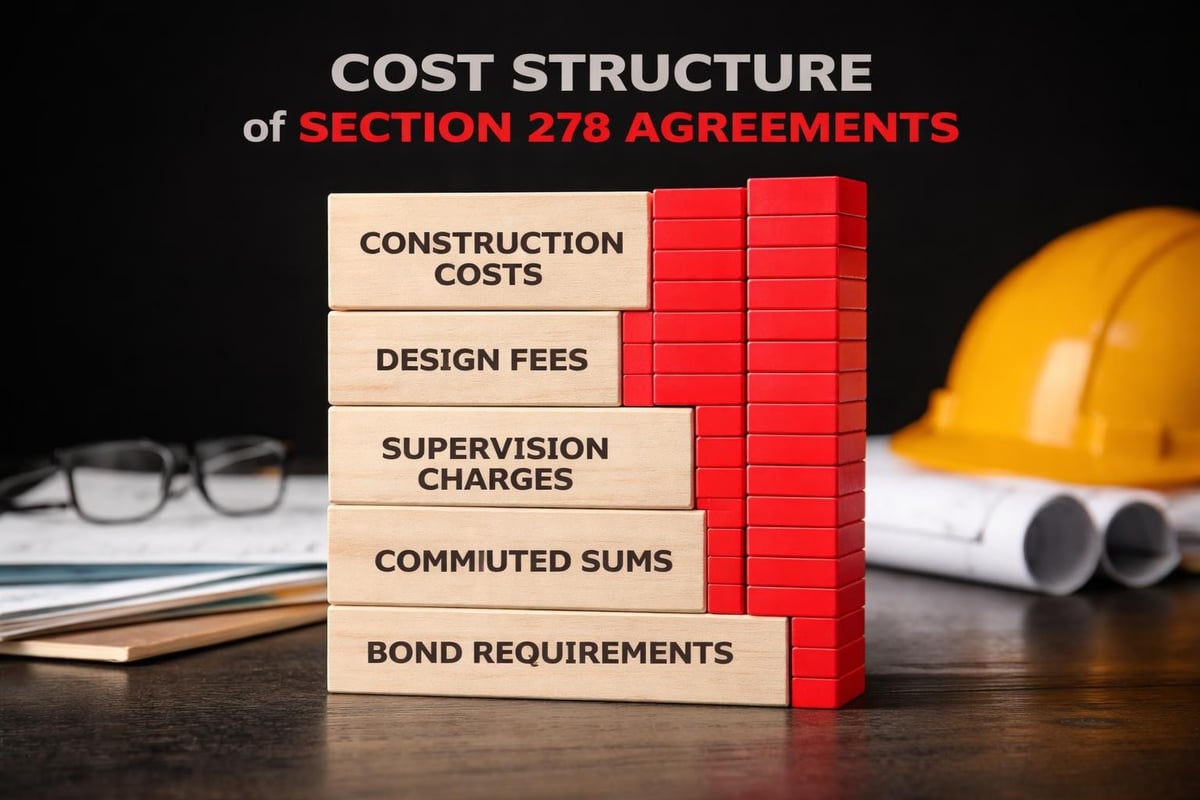
The section 278 highways act places full financial responsibility for approved works onto the developer. Understanding the complete cost structure proves essential for accurate project budgeting and financial planning throughout development phases.
Direct construction costs represent the most obvious expense, covering materials, labour, and specialist equipment required to execute the approved works. However, additional costs often surprise developers unfamiliar with the process.
Commuted Sum Payments Explained
Highway authorities require commuted sum payments to cover future maintenance obligations for newly constructed or modified highway infrastructure. Surrey County Council outlines expectations regarding commuted sums, which authorities calculate based on anticipated maintenance costs over extended periods, typically 20-40 years.
These payments ensure taxpayers don't shoulder the burden of maintaining infrastructure created primarily to serve private developments. Calculations consider material specifications, expected lifespan, and projected maintenance intervals for different elements.
| Cost Component | Typical Range | Purpose |
|---|---|---|
| Design fees | £5,000-£50,000 | Technical drawings, safety audits |
| Legal fees | £2,000-£10,000 | Agreement drafting, negotiation |
| Construction costs | £50,000-£500,000+ | Actual highway works execution |
| Supervision fees | 10-15% of construction | Authority inspection, quality control |
| Commuted sums | £20,000-£200,000+ | Future maintenance provision |
| Performance bonds | 125% of construction cost | Financial security during defects period |
Design Standards and Technical Compliance
Meeting rigorous design standards remains non-negotiable under section 278 highways act agreements. Highway authorities enforce these standards to ensure longevity, safety, and compatibility with existing highway infrastructure throughout their networks.
Design work must comply with national standards including the DMRB for major schemes and local authority design guides for smaller works. The Welsh Government provides official guidance particularly relevant for developments affecting motorways or trunk roads, where technical requirements become even more stringent.
Material Specifications and Quality Requirements
Highway authorities specify approved materials for different elements of construction. Surfacing materials must meet durability standards appropriate to anticipated traffic loading, whilst drainage components require certification to relevant British and European standards.
For surfacing works, specifications typically demand:
- Surface course materials tested to BS 594987 or equivalent standards
- Binder course conforming to mixture design requirements
- Sub-base materials meeting CBR strength requirements
- Proper compaction levels verified through testing
- Appropriate thickness for projected traffic volumes
Quality assurance processes run throughout construction phases. Highway authority inspectors conduct regular site visits, witness key construction stages, and review test results before authorising progression to subsequent phases. This supervision ensures compliance with approved designs and specifications.
Construction Phase Management
Once agreements are executed and bonds secured, construction phases begin under strict highway authority supervision. The City of Doncaster Council details the application process and supervision expectations, which developers must accommodate throughout construction programmes.
Experienced civil engineering contractors familiar with highway authority requirements prove invaluable during this phase. Their expertise in managing inspector relationships, arranging necessary testing, and maintaining required documentation prevents delays and ensures smooth progression through construction stages.
Site Management and Safety Protocols
Highway works present unique challenges compared to standard construction projects. Works often occur on live highways requiring traffic management measures that maintain public safety whilst enabling construction access.
Critical management considerations include:
- Chapter 8 compliant traffic management planning and implementation
- Regular liaison with highway authority supervisors and inspectors
- Material testing schedules coordinated with construction programmes
- Detailed record keeping including photographic evidence
- Defect rectification procedures meeting authority standards
- Weather dependency planning for critical surfacing operations
Working with contractors experienced in section 278 highways act projects significantly reduces risks. These specialists understand the procedural requirements, maintain relationships with local highway authorities, and possess the technical capabilities to deliver works meeting stringent standards consistently.
Inspection, Testing, and Adoption Procedures
The journey from construction completion to formal adoption involves rigorous inspection and testing protocols. Highway authorities cannot accept infrastructure failing to meet their standards, regardless of investment already committed by developers.
Testing regimes cover all materials used in construction. Aggregates, asphalt, concrete, and other materials require certification demonstrating compliance with specified standards. In-situ testing verifies proper compaction, layer thicknesses, and structural adequacy of completed works.
| Testing Type | Frequency | Purpose |
|---|---|---|
| Material certification | Every batch/load | Verify specification compliance |
| Compaction testing | Every 500m² or layer | Ensure structural integrity |
| Core sampling | As required by authority | Verify layer thicknesses, bonding |
| Surface regularity | Upon completion | Assess ride quality |
| Drainage testing | All new systems | Confirm functionality |
Defects Liability Period
Following practical completion, developers enter a defects liability period typically lasting 12 months. During this period, developers remain responsible for rectifying any defects arising from poor workmanship or material failures. Performance bonds remain in place throughout this period, providing financial security for the highway authority.
Only after successful completion of the defects period, final inspections confirming satisfactory condition, and resolution of any outstanding issues does the highway authority formally adopt the works. Adoption transfers maintenance responsibility from the developer to the highway authority, marking the final completion of section 278 obligations.

Common Challenges and How to Navigate Them
Even well-planned projects encounter challenges during section 278 highways act processes. Understanding common pitfalls enables proactive mitigation strategies that prevent costly delays and disputes.
Design rejections frequently occur when submissions fail to adequately address safety concerns or deviate from authority standards. Engaging experienced highway design consultants from project inception significantly reduces this risk. Their familiarity with local authority preferences and interpretation of national standards proves invaluable.
Frequent complications include:
- Underestimating commuted sum requirements during financial planning
- Insufficient traffic management planning for construction phases
- Material supply issues affecting construction programmes
- Weather delays during critical surfacing operations
- Utilities conflicts discovered during construction
- Testing failures requiring remedial works
Early contractor involvement helps identify potential construction challenges before agreements are finalised. Contractors experienced with highway works can advise on buildability, realistic programme durations, and potential cost variations that designers might overlook.
Managing Authority Relationships
Positive relationships with highway authority personnel facilitate smoother processes throughout all project stages. Regular communication, responsive handling of queries, and professional conduct during inspections build trust that proves beneficial when challenges arise.
Legal guidance from Field Seymour Parkes solicitors explains the typical provisions and obligations within these agreements, helping developers understand their commitments fully before entering into binding arrangements. Professional legal review of draft agreements protects developer interests whilst ensuring compliance with statutory requirements.
Strategic Planning for Development Projects
Successful navigation of section 278 highways act requirements begins during initial development feasibility assessments. Early identification of necessary highway works enables realistic programming and cost estimation that prevents unpleasant surprises during detailed planning stages.
Development viability calculations must incorporate the full scope of anticipated section 278 costs. Underestimating these expenses jeopardises project financial viability and can derail schemes that otherwise appear commercially attractive.
Engaging with highway authorities during pre-application discussions reveals their expectations and identifies potential concerns early. This dialogue enables design teams to address issues proactively rather than reactively responding to objections during formal application stages.
Timing Considerations and Critical Path Planning
Section 278 agreements significantly impact development programmes. The period from initial application to agreement execution typically spans 6-12 months, whilst construction and adoption can add another 12-24 months depending on work complexity.
Critical path analysis must account for these durations within overall development programmes. Starting the section 278 process early, potentially before detailed planning permission applications, prevents highway works becoming the critical constraint delaying development completion and revenue generation.
Professional project management coordinating design teams, legal advisors, contractors, and highway authority personnel ensures efficient progression through sequential stages. This coordination becomes particularly important for complex schemes involving multiple authorities or extensive highway modifications.
Selecting Appropriate Contractors and Consultants
The technical complexity and procedural requirements of section 278 highways act works demand specialist expertise. Selecting contractors and consultants with proven track records in similar projects significantly influences success probability and final outcomes.
When evaluating potential contractors, examining their experience with highway authority works provides valuable insights. Contractors familiar with inspection protocols, testing requirements, and authority expectations deliver smoother projects with fewer disputes and delays.
Key selection criteria should include:
- Demonstrable experience with Section 278 projects of comparable scale
- Understanding of relevant design standards and specifications
- Established relationships with local highway authorities
- Robust quality management systems meeting highway authority expectations
- Financial stability to support bonding requirements
- Appropriate insurance coverage for highway works
- Track record of successful project completions and adoptions
Quality civil engineering contractors invest in ongoing training, maintain current equipment suitable for highway works, and employ experienced personnel familiar with the unique requirements these projects demand. Their expertise translates directly into reduced risk, better cost control, and timely completion meeting all authority requirements.
Regional Variations and Authority-Specific Requirements
Whilst the section 278 highways act provides the overarching legal framework, individual highway authorities implement their own procedures, standards, and requirements within this framework. Understanding these local variations proves essential when planning projects across different authority areas.
Some authorities maintain detailed guidance packs outlining their specific requirements, application processes, and fee structures. Others require pre-application meetings before accepting formal submissions. Processing times, supervision approaches, and commuted sum calculation methodologies vary considerably between different authorities.
Developers working across multiple authority areas benefit from contractors with nationwide experience. These specialists understand regional differences and adapt their approaches accordingly, ensuring compliance with local requirements whilst maintaining consistent quality standards across all projects.
National contractors operating from regional bases, such as those covering the North East and nationwide, bring valuable experience from diverse authority interactions. This breadth of experience enables them to anticipate requirements, navigate procedural differences, and deliver successful outcomes regardless of location.
Understanding the section 278 highways act framework enables developers to plan effectively, budget accurately, and navigate the approval and construction processes successfully. Whether you're developing commercial sites requiring new access arrangements or residential schemes needing junction improvements, partnering with experienced civil engineering specialists ensures your highway works meet all requirements whilst supporting your broader development objectives. JRG Civils brings extensive experience in highway construction and civil engineering works, delivering projects that satisfy highway authority standards throughout the UK. Contact us to discuss how we can support your development's highway requirements from initial design through to final adoption.