
Earthwork forms the critical foundation of every successful road construction project, determining the longevity and performance of highways, commercial driveways, and residential access routes. Whether you're planning a major infrastructure development or a commercial car park, understanding the complexities of earthwork processes ensures projects meet structural requirements, budget constraints, and timeline expectations. From initial site surveys to final compaction, each stage demands precision, expertise, and adherence to engineering standards that will support decades of traffic loads.
Understanding the Fundamentals of Road Earthwork
Earthwork for road construction encompasses all operations involving the excavation, transportation, placement, and compaction of soil and rock materials to create a stable base for paving. This foundational phase transforms natural terrain into engineered surfaces capable of supporting significant structural loads.
The process begins with thorough site investigation and soil analysis. Engineers assess existing ground conditions, identifying soil types, water table levels, and load-bearing capacities. This information guides decisions about excavation depths, fill requirements, and stabilisation techniques.
Key components of earthwork operations include:
- Site clearing and stripping of topsoil layers
- Bulk excavation and removal of unsuitable materials
- Fill placement and systematic compaction
- Grading to achieve specified elevations and drainage profiles
- Subgrade preparation for subsequent pavement layers
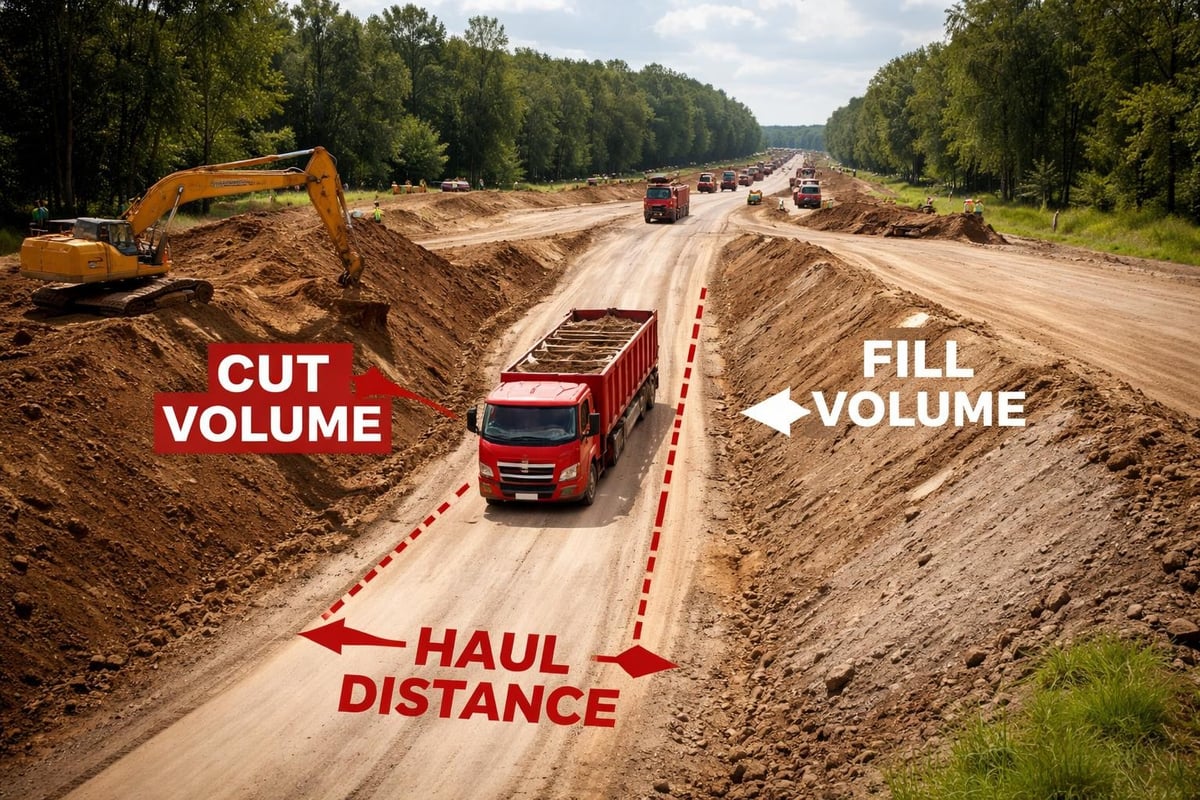
Understanding earthwork construction fundamentals helps project managers anticipate challenges and allocate resources effectively. The balance between cut and fill volumes significantly impacts project costs, making accurate earthwork calculations essential during the planning phase.
Pre-Construction Planning and Site Assessment
Successful earthwork for road construction depends on meticulous planning before equipment arrives on site. Geotechnical investigations provide critical data about soil composition, moisture content, and bearing capacity. Engineers use this information to design appropriate earthwork strategies that account for site-specific conditions.
Topographic surveys establish existing ground levels and identify areas requiring cutting or filling. Modern projects increasingly employ laser scanning and drone photogrammetry to create detailed digital terrain models. These technologies enable precise volume calculations and optimise haul routes for material movement.
| Planning Element | Purpose | Key Deliverable |
|---|---|---|
| Geotechnical Investigation | Soil analysis and bearing capacity | Soil classification report |
| Topographic Survey | Existing ground levels | Digital terrain model |
| Hydrological Assessment | Drainage requirements | Water management plan |
| Environmental Impact | Regulatory compliance | Environmental permits |
The detailed earthworks planning process ensures that potential obstacles are identified early, reducing costly delays during construction. Environmental considerations, including protected species habitats and archaeological sites, must be addressed during this phase.
Excavation Methods and Equipment Selection
Excavation techniques vary considerably depending on soil types, project scale, and site accessibility. Mass excavation for highway projects typically employs large scrapers and bulldozers to strip substantial soil volumes efficiently. Confined urban locations may require smaller excavators with precise control capabilities.
Rock excavation presents unique challenges. Hard geological formations often necessitate mechanical breaking or controlled blasting. Environmental restrictions increasingly limit blasting options, making hydraulic breakers and rock saws more prevalent on modern projects.
Common excavation equipment includes:
- Bulldozers – Site clearing and pushing operations
- Hydraulic excavators – Precision digging and loading
- Scrapers – Mass earthmoving over distance
- Graders – Fine grading and surface profiling
- Dump trucks – Material transportation
Equipment selection directly impacts productivity rates and fuel consumption. Matching machine capacity to haul distances optimises cycle times and reduces operational costs. Experienced contractors understand these relationships and deploy equipment combinations that maximise efficiency.
Managing Cut and Fill Operations
The relationship between cutting and filling determines earthwork economics. Projects with balanced earthworks minimise the need to import or export materials, substantially reducing haulage costs. Engineers design road alignments to achieve this balance wherever topography permits.
Cut sections require systematic excavation to design levels whilst maintaining stable slopes. Slope angles depend on soil types, with cohesive clays typically supporting steeper gradients than granular materials. Temporary works, including shoring and dewatering systems, may be necessary in deep cuttings.
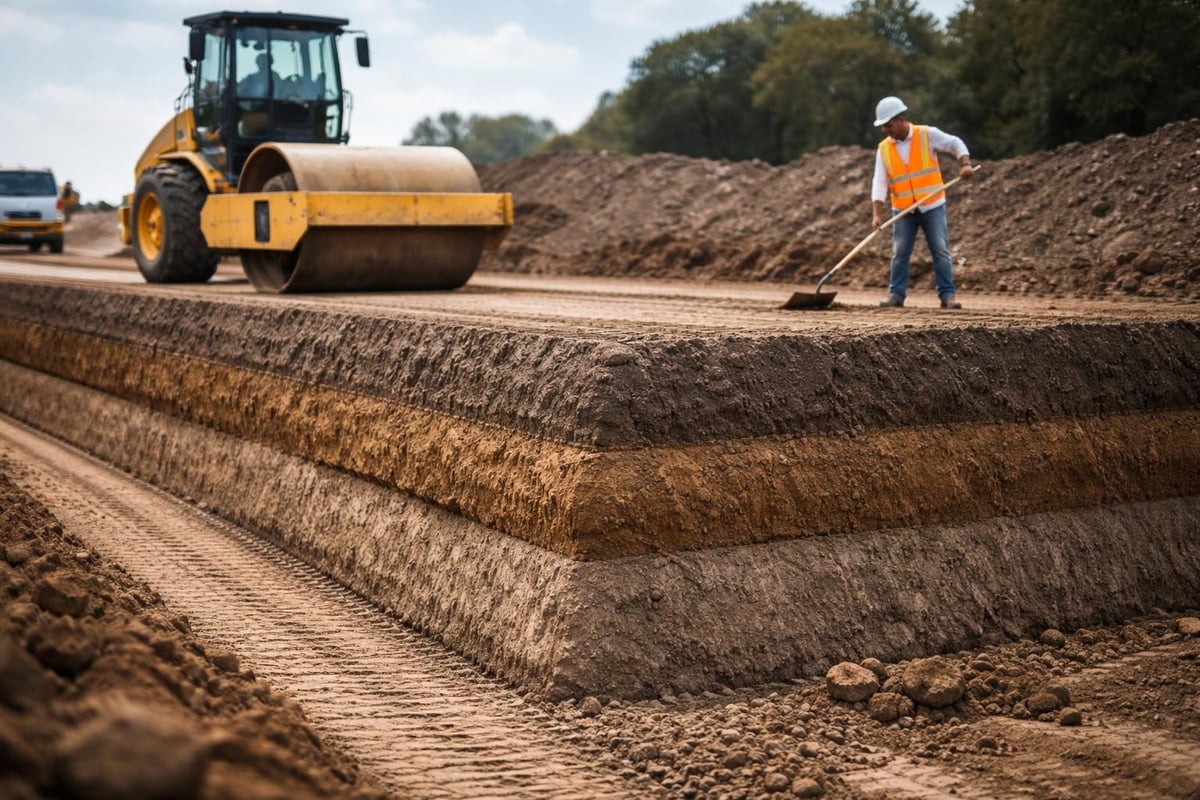
Fill embankments demand careful construction in controlled layers. The California Department of Transportation’s earthwork specifications provide comprehensive guidance on layer thickness, moisture conditioning, and compaction requirements. Each lift receives compaction before the next layer placement, ensuring uniform density throughout the embankment.
Compaction and Quality Control Standards
Compaction transforms loose soil into a dense, stable mass capable of supporting pavement structures and traffic loads. This critical process expels air voids whilst maintaining optimum moisture content, creating the load-bearing capacity essential for long-term road performance.
Different soil types require specific compaction methods. Cohesive soils respond well to sheepsfoot rollers that knead and compress material. Granular materials compact effectively under vibratory rollers that transmit dynamic forces through the soil structure.
Achieving Specified Density Requirements
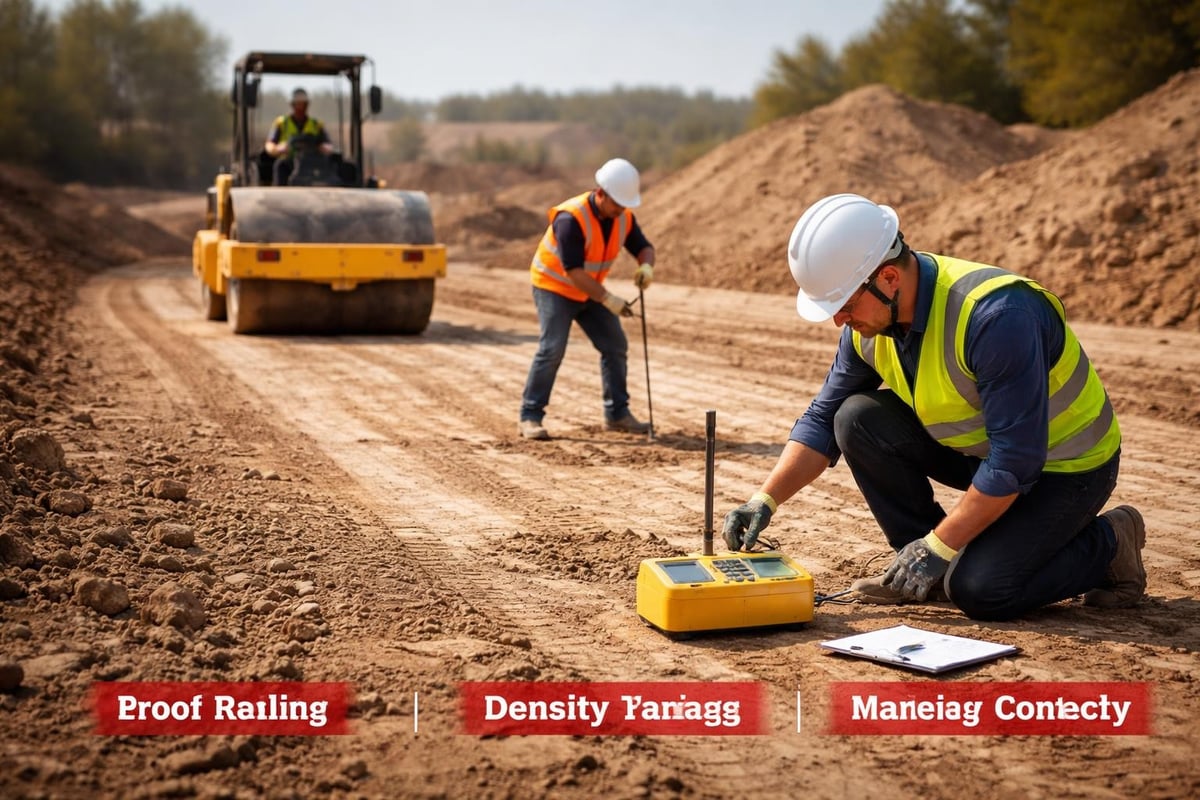
Earthwork for road construction typically specifies compaction as a percentage of maximum dry density determined through laboratory testing. Most highway specifications require 95% to 98% of maximum density for subgrade layers, with higher values for critical areas beneath pavement.
Field density testing ensures compliance with specifications. Nuclear density gauges provide rapid, non-destructive measurements across the work area. Sand cone tests offer an alternative verification method where nuclear equipment faces restrictions.
| Compaction Equipment | Best Application | Typical Lift Thickness |
|---|---|---|
| Smooth drum roller | Granular base course | 150-200mm |
| Vibratory roller | Cohesionless soils | 200-300mm |
| Sheepsfoot roller | Cohesive clays | 200-250mm |
| Pneumatic roller | Asphalt surfaces | Variable |
Moisture content significantly affects compaction efficiency. Soils compacted at optimum moisture achieve maximum density with minimum effort. Materials too dry resist compaction, whilst excessively wet soils cannot achieve target densities. Weather conditions influence moisture management strategies, with soil conditioning often necessary.
Drainage Integration and Subgrade Preparation
Water management ranks among the most critical aspects of earthwork for road construction. Inadequate drainage causes subgrade softening, accelerates pavement deterioration, and creates hazardous driving conditions. Comprehensive drainage systems must be integrated throughout earthwork operations.
Surface water controls prevent erosion during construction and channel runoff away from structural areas. Temporary drainage measures protect partially completed earthworks from storm damage. These installations often evolve into permanent drainage features as construction progresses.
Essential drainage components include:
- Longitudinal drains alongside road edges
- Cross drains beneath carriageway sections
- French drains for subsurface water interception
- Culverts for watercourse crossings
- Outfall structures to receiving waters
The Michigan Department of Transportation’s roadway earthwork guidance emphasises the importance of establishing drainage before final subgrade preparation. Saturated subgrades cannot achieve required compaction levels, delaying subsequent construction phases.
Creating a Stable Subgrade Platform
Subgrade preparation represents the final earthwork operation before pavement construction begins. This surface must meet stringent tolerances for elevation, crossfall, and bearing capacity. Graders equipped with laser guidance systems achieve the precision required for modern highway specifications.
Proof rolling identifies weak areas within the completed subgrade. Heavy rollers or loaded trucks traverse the surface, revealing locations where inadequate compaction or unsuitable materials compromise stability. Remedial treatment addresses these deficiencies before paving operations commence.
Commercial projects such as drive-through facilities demand exceptional subgrade quality to support concentrated wheel loads from delivery vehicles and constant traffic movements. The same principles apply to residential driveways, where proper earthwork prevents subsequent settlement and pavement cracking.
Material Specifications and Soil Stabilisation
Not all excavated materials prove suitable for reuse in embankments or subgrade construction. Soil classification systems categorise materials based on engineering properties, guiding decisions about appropriate applications. Organic soils, highly plastic clays, and contaminated materials typically require removal and replacement with specified fill.
Soil stabilisation techniques improve marginal materials, reducing disposal costs whilst enhancing subgrade performance. Chemical stabilisation using lime or cement transforms weak soils into competent construction materials. Mechanical stabilisation blends different soil types to achieve desired properties.
Chemical Stabilisation Applications
Lime stabilisation works particularly well with high-plasticity clays. The chemical reaction reduces plasticity, increases strength, and improves workability. Treatment depths vary from shallow mixing for subgrade modification to deep soil mixing for foundation improvement.
Cement stabilisation creates bound layers with significant structural capacity. This technique finds application in both temporary haul roads during construction and permanent pavement foundations. Mix designs specify cement content based on soil type and required strength characteristics.
- Site testing to determine soil characteristics and stabilisation requirements
- Material procurement of specified stabilising agents meeting quality standards
- Application using specialised spreading and mixing equipment
- Mixing to achieve uniform distribution throughout treatment depth
- Compaction before initial set occurs
- Curing under controlled conditions to develop design strength
Sustainable highway construction practices increasingly favour stabilisation over excavation and replacement. This approach reduces material transportation, lowers carbon emissions, and often accelerates project delivery.
Equipment Productivity and Project Scheduling
Earthwork productivity directly influences project timelines and costs. Understanding production rates enables accurate scheduling and resource allocation. Factors affecting productivity include equipment capacity, haul distances, material characteristics, and weather conditions.
Cycle time analysis breaks earthwork operations into component activities: loading, hauling, dumping, and returning. Optimising each element maximises overall productivity. GPS machine control systems increasingly automate grading operations, improving accuracy whilst reducing operator fatigue.
| Project Type | Typical Earthwork Duration | Key Constraints |
|---|---|---|
| Major highway | 6-18 months | Weather, environmental permits |
| Commercial access | 2-6 weeks | Site access, utility conflicts |
| Residential driveway | 3-7 days | Property boundaries, services |
Weather significantly impacts earthwork schedules. Heavy rainfall makes clay soils unworkable, whilst frozen ground prevents compaction. Successful contractors build contingency time into programmes and maintain flexibility to respond to conditions.
The relationship between earthwork and subsequent construction phases requires careful coordination. Delayed earthwork completion disrupts paving schedules, potentially pushing surfacing work into unfavourable weather periods. For businesses specialising in kerbing and highway surfacing, receiving properly prepared subgrades on schedule proves essential for maintaining project momentum.
Environmental Considerations and Regulatory Compliance
Modern earthwork for road construction operates within stringent environmental frameworks. Erosion and sediment control measures protect watercourses from construction runoff. Dust suppression techniques maintain air quality in populated areas. Noise and vibration monitoring ensures compliance with community agreements.
Environmental protection measures include:
- Silt fences and sediment basins to trap suspended solids
- Vegetation preservation zones protecting sensitive ecosystems
- Contaminated land protocols for unexpected discoveries
- Archaeological watching briefs during excavation
- Wildlife protection measures during sensitive seasons
Waste classification determines disposal requirements for unsuitable materials. Contaminated soils need specialist treatment or licensed disposal facilities. Proper documentation demonstrates regulatory compliance and protects contractors from future liability.
Site Restoration and Landscaping Integration
Earthwork operations extend beyond the immediate road corridor. Borrow pits supplying fill materials require restoration after extraction completes. Stockpile areas need reinstatement to original contours or planned landscaping schemes.
Understanding detailed earthworks includes recognising how temporary works affect long-term site conditions. Careful planning ensures earthwork operations minimise environmental disturbance whilst meeting construction requirements.
Cost Control and Budget Management
Earthwork typically represents 15% to 30% of total road construction costs, making accurate estimation crucial for project viability. Unit rates for excavation, fill, and compaction vary with material types, equipment requirements, and site constraints.
Unforeseen ground conditions represent the primary risk to earthwork budgets. Unexpected rock encounters, buried obstructions, or contaminated materials generate significant cost variations. Comprehensive site investigation reduces these risks but cannot eliminate uncertainty entirely.
Value engineering identifies opportunities to optimise earthwork costs without compromising quality. Alternative alignments, adjusted gradients, or material substitutions may yield substantial savings. Early contractor involvement brings practical construction knowledge into design development.
Managing Material Movements
Haul distance profoundly affects earthwork economics. Moving material 100 metres costs substantially less than transporting it several kilometres. Mass haul diagrams help engineers optimise cut-fill balance and minimise transportation costs.
Off-site disposal or material import adds significant expense. Tipping fees, haulage costs, and replacement material purchases accumulate quickly. Projects requiring these operations need robust cost control to prevent budget overruns. Client testimonials frequently highlight contractors who deliver earthwork phases within agreed budgets whilst maintaining quality standards.
Quality Assurance Documentation
Comprehensive documentation demonstrates earthwork compliance with specifications and provides verification for future reference. Daily records capture compaction test results, moisture content readings, and material sources. Photographic evidence documents conditions at key construction stages.
As-built surveys record final earthwork levels, enabling accurate quantity reconciliation. These measurements form the basis for payment applications and provide baseline data for pavement design verification.
Essential quality records include:
- Approved material sources and test certificates
- Compaction test results with location references
- Weather conditions and their impact on operations
- Non-conformance reports and corrective actions
- As-built survey data showing final earthwork geometry
Quality management systems ensure consistent documentation practices across projects. Digital platforms increasingly replace paper records, improving accessibility and enabling real-time progress monitoring. For contractors working across multiple sites simultaneously, centralised quality systems maintain standards regardless of project location.
Successful earthwork for road construction combines technical expertise, appropriate equipment selection, rigorous quality control, and proactive environmental management to create stable foundations for long-lasting highways and commercial developments. Whether you're planning a major infrastructure project or commercial premises requiring robust access routes, partnering with experienced civil engineering specialists ensures earthwork phases deliver the quality and precision your project demands. JRG Civils brings proven expertise to earthwork operations across the North East and throughout the UK, delivering projects from initial ground preparation through to final surfacing with meticulous attention to detail and commitment to excellence.