
When planning a new development, whether it's a commercial property, residential estate, or retail facility, connecting your site safely to the existing highway network is non-negotiable. This is where s278 works become essential. Section 278 of the Highways Act 1980 provides the legal framework for developers to carry out works on public highways, ensuring that new developments integrate seamlessly with existing infrastructure whilst maintaining safety standards for all road users.
Understanding Section 278 Agreements
Section 278 agreements are legal contracts between a developer and the local highway authority, permitting alterations, improvements, or additions to the public highway network. These agreements ensure that any modifications meet stringent safety and design standards before becoming part of the public realm.
The scope of s278 works extends far beyond simple road widening. These projects can include new junction formations, traffic signal installations, pedestrian crossings, cycle lanes, drainage systems, and street lighting. Warwickshire County Council provides comprehensive guidance on the types of work typically covered under these agreements.
Key characteristics of s278 works include:
- Developer-funded modifications to public highways
- Full design approval from the highway authority
- Compliance with current design standards and regulations
- Quality assurance throughout construction
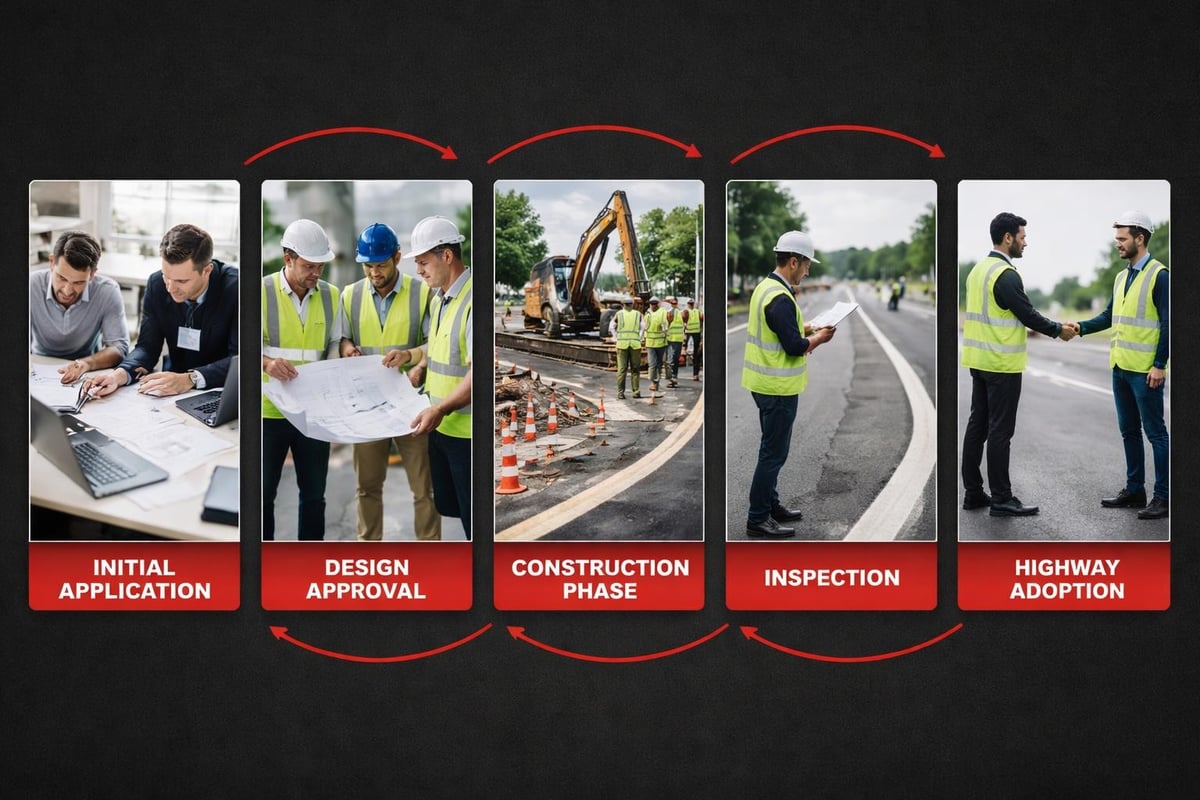
- Potential adoption into the public highway network
When Your Development Requires S278 Works
Not every development project necessitates s278 works, but most substantial schemes will trigger this requirement. Planning authorities typically identify the need during the application process, often following transport assessments that evaluate a development's impact on the surrounding road network.
Common Trigger Scenarios
Commercial developments generating significant traffic movements almost invariably require highway modifications. The construction of drive-through restaurants, supermarkets, or retail parks demands careful integration with existing junctions and may necessitate new access points with appropriate visibility splays and turning lanes.
Residential developments exceeding certain thresholds trigger s278 requirements. A new housing estate might require a modified junction, improved pedestrian facilities, or enhanced cycle infrastructure to accommodate increased usage safely. Sheffield City Council outlines specific circumstances that necessitate formal agreements.
Industrial and logistics facilities present unique challenges. These developments often require heavy goods vehicle access, necessitating strengthened road structures, widened carriageways, and improved sightlines at junctions.
| Development Type | Typical S278 Requirements | Timeline Considerations |
|---|---|---|
| Retail & Commercial | New junctions, traffic signals, pedestrian crossings | 6-12 months design and approval |
| Residential Estates | Junction improvements, footways, cycle lanes | 8-14 months full process |
| Industrial Units | HGV access routes, road strengthening, turning areas | 6-10 months depending on complexity |
| Mixed-Use Schemes | Comprehensive infrastructure packages | 12-18 months or longer |
The S278 Application and Approval Process
Navigating the s278 works process requires methodical planning and close collaboration with the highway authority. The journey begins long before any construction work commences, typically during the planning application stage when transport assessments identify necessary highway improvements.
Initial Stages and Design Development
The process commences with a formal application to the relevant highway authority. Birmingham City Council details the validation requirements, which typically include detailed drawings, technical specifications, and safety audits. Highway authorities assess applications against current design standards, including the Design Manual for Roads and Bridges (DMRB) where applicable.
Design submissions must demonstrate compliance with multiple criteria:
- Geometric design standards ensuring appropriate road widths, radii, and gradients
- Safety audit requirements covering all stages from preliminary through to post-opening
- Drainage calculations proving adequate surface water management
- Structural design for any retaining walls, bridges, or strengthened pavements
- Lighting designs meeting current illumination standards
- Traffic signal specifications if signalisation forms part of the scheme
The highway authority's technical approval team reviews submissions iteratively. Design modifications frequently emerge from this process, requiring resubmission and further scrutiny. This phase typically extends between three to six months, though complex schemes may require longer.
Legal Agreement and Financial Securities
Once designs receive technical approval, the legal agreement phase commences. This contract stipulates responsibilities, timescales, quality standards, and importantly, financial arrangements. Developers typically bear all costs associated with s278 works, including design fees, construction costs, supervision fees, and commuted sums for future maintenance.
Financial components include:
- Highway authority design check fees
- Construction supervision and inspection costs
- Commuted sum payments for ongoing maintenance
- Bond or financial security to guarantee completion
- Utility diversions and protection works

Executing S278 Works on Site
Construction of s278 works demands rigorous quality control and coordination. Highway authorities maintain strict oversight throughout the build process, with inspectors monitoring progress and compliance with approved designs. The execution phase transforms approved plans into physical infrastructure that will serve road users for decades.
Pre-Construction Requirements
Before breaking ground, contractors must satisfy numerous preconditions. Traffic management plans require approval, ensuring public safety during construction whilst maintaining highway functionality. The Peddimore S278 infrastructure project demonstrates the complexity of delivering major junction improvements whilst managing existing traffic flows.
Working within the public highway demands appropriate qualifications and accreditations. Operatives require New Roads and Street Works Act (NRSWA) qualifications, whilst supervisors need appropriate competencies. Contractors must hold relevant insurances and demonstrate experience delivering comparable schemes.
Construction Phase Management
The construction programme for s278 works requires careful phasing to minimise disruption. Works often proceed in stages, maintaining traffic flow whilst progressively implementing improvements. Night-time working frequently becomes necessary for modifications to busy junctions or traffic signal installations.
Quality assurance processes run throughout construction. Highway authority inspectors conduct regular site visits, checking materials compliance, construction methodology, and adherence to approved drawings. Non-conformances trigger corrective actions, potentially delaying programmes if significant issues emerge.
Testing and certification requirements vary based on work type:
- Kerbing and paving requires line and level checks, joint inspections
- Drainage systems necessitates CCTV surveys and pressure testing
- Road surfacing demands core samples, texture depth measurements, regularity testing
- Street lighting requires electrical certification and illumination surveys
- Traffic signals need extensive commissioning and safety validation
The Dunlopillo Site highway works in Harrogate illustrates the comprehensive approach required for s278 delivery, combining new roundabout construction with adoptable road infrastructure.
Real-World Applications and Case Studies
Examining completed s278 works provides valuable insights into practical delivery challenges and solutions. These projects demonstrate how theoretical requirements translate into constructed infrastructure serving communities across the UK.
Complex Junction Formations
Major residential developments often necessitate substantial junction modifications. The Germany Beck S278 works on the A19 exemplifies this challenge, where a 650-unit development required an entirely new complex junction. The project incorporated flood alleviation measures, demonstrating how s278 works frequently address multiple infrastructure challenges simultaneously.
Traffic management during construction presented significant challenges. The A19 carries substantial traffic volumes, necessitating meticulous planning to maintain highway functionality whilst constructing the new junction. Phased delivery allowed progressive implementation, minimising disruption whilst delivering essential infrastructure.
Urban Development Integration
City centre developments demand particularly sensitive s278 approaches. The Whitelock Street project in Leeds required comprehensive transport planning to integrate student accommodation into an existing urban fabric. Highway modifications needed to accommodate increased pedestrian movements whilst preserving historic streetscapes and maintaining bus services.
Such schemes highlight the multidisciplinary nature of s278 works. Transport planners, highway engineers, urban designers, and heritage specialists collaborate to deliver solutions satisfying multiple stakeholders. The resulting infrastructure must function efficiently whilst respecting contextual constraints.
Design Standards and Technical Requirements
S278 works must comply with numerous design standards, ensuring consistency, safety, and longevity across the highway network. These standards evolve periodically, with 2026 seeing continued emphasis on sustainable transport modes and climate resilience.
Current Design Framework
Highway authorities reference established design manuals when reviewing s278 submissions. The Design Manual for Roads and Bridges (DMRB) provides comprehensive guidance for trunk roads and major schemes, whilst local authorities often supplement this with their own design guides addressing specific local contexts.
Critical design considerations include:
- Geometric standards appropriate to road classification and anticipated usage
- Forward visibility and junction sightlines ensuring safe manoeuvring
- Pedestrian and cyclist provision meeting current inclusive design principles
- Drainage design accounting for climate change rainfall projections
- Sustainable drainage systems (SuDS) where practicable
- Street lighting achieving appropriate illumination levels whilst minimising light pollution
Safety audits form mandatory components of the s278 process. Independent auditors review designs at multiple stages, identifying potential safety concerns before construction commences. ENR Consulting Engineers emphasise the importance of early safety audit engagement to avoid costly design revisions.
Sustainability and Future-Proofing
Modern s278 works increasingly incorporate sustainability principles. Electric vehicle charging infrastructure, enhanced cycle facilities, and biodiversity considerations feature prominently in contemporary schemes. Highway authorities encourage designs that support modal shift towards sustainable transport whilst future-proofing infrastructure for emerging technologies.
Materials selection impacts long-term sustainability. Specifying recycled aggregates, warm mix asphalts, and locally sourced materials reduces carbon footprints whilst meeting performance requirements. Whole-life costing methodologies evaluate options beyond initial construction costs, considering maintenance requirements and eventual renewal.

Programme Management and Timescales
Understanding realistic timescales for s278 works proves essential for development programme planning. Underestimating the duration of agreement processes and construction frequently causes project delays, impacting development viability and delivery schedules.
Typical Timeline Breakdown
The s278 process spans multiple phases, each with inherent durations. Initial design development typically requires two to four months, depending on scheme complexity and designer experience. Subsequent highway authority review and approval adds three to six months, though complex schemes involving major infrastructure may extend considerably longer.
Legal agreement negotiation and completion adds further time. Solicitors review draft agreements, negotiate terms, and finalise documentation. This phase typically spans two to four months, though particularly complex agreements or multiple parties can extend timescales.
| Process Stage | Typical Duration | Key Activities |
|---|---|---|
| Design Development | 2-4 months | Survey, preliminary design, safety audit |
| Technical Approval | 3-6 months | Authority review, revisions, final approval |
| Legal Agreement | 2-4 months | Contract negotiation, financial securities |
| Pre-Construction | 1-2 months | Traffic management, contractor mobilisation |
| Construction | Variable | Depends on scope – 3-12 months typical |
| Final Approval | 1-2 months | Inspection, snagging, adoption process |
Construction duration varies enormously based on work scope. Simple junction modifications might complete within eight to twelve weeks, whilst major infrastructure projects span many months. SB Civil Engineering highlights how comprehensive planning ensures developments connect safely to highway networks whilst maintaining compliance throughout delivery.
Managing Dependencies and Risks
S278 works frequently form critical path items within development programmes. Development occupation may legally depend on highway works completion and adoption, creating significant commercial pressure to deliver on schedule. Identifying and managing dependencies early proves crucial for programme success.
Common risks affecting s278 programmes include:
- Utility apparatus conflicts requiring diversions
- Unforeseen ground conditions impacting construction methodology
- Traffic management restrictions limiting working hours
- Weather impacts, particularly for surfacing operations
- Materials supply chain disruptions
- Third-party land requirements for construction access
Costs and Financial Planning
Budgeting accurately for s278 works requires comprehensive understanding of cost components. Developers frequently underestimate total expenditure, encountering budget pressures when full costs crystallise. Early engagement with highway authorities and experienced contractors improves financial planning accuracy.
Cost Components Explained
Direct construction costs form the most obvious element, covering materials, labour, plant, and traffic management. However, numerous additional costs emerge throughout the s278 process. Highway authority fees cover design checking, legal agreement preparation, construction supervision, and adoption procedures. These fees vary between authorities but typically represent 10-15% of construction costs.
Commuted sum payments compensate highway authorities for future maintenance liabilities. These one-off payments cover anticipated maintenance costs over a defined period, typically 20-30 years. Calculations consider pavement type, traffic loading, climate factors, and current maintenance rates. Commuted sums can represent substantial proportions of total s278 costs, particularly for extensive infrastructure.
Bond requirements provide financial security ensuring work completion. Highway authorities typically require bonds covering 125-150% of estimated construction costs, returned upon successful completion and adoption. These bonds protect public interests, ensuring works reach completion even if developers encounter financial difficulties.
Utility diversions frequently prove necessary when s278 works conflict with existing apparatus. Statutory undertakers charge commercial rates for diversions, with costs varying dramatically based on apparatus type and complexity. Early utility searches and consultation reduce unexpected costs.
Value Engineering Opportunities
Despite regulated frameworks, opportunities exist for cost optimisation without compromising quality or safety. Early highway authority engagement identifies potential value engineering during design development, avoiding expensive late-stage revisions. Experienced designers familiar with specific authority requirements produce compliant designs more efficiently.
Material selection impacts both initial costs and commuted sums. Higher-quality materials commanding premium prices may reduce whole-life costs through extended durability, potentially lowering commuted sum calculations. This balance requires careful evaluation with quantity surveyors and highway authority valuations teams.
Construction methodology choices significantly influence costs. Innovative traffic management reducing construction duration lowers traffic management costs whilst minimising public disruption. Contractor experience delivering s278 works improves efficiency, reducing preliminaries and accelerating programmes.
Coordination with Other Development Activities
S278 works rarely exist in isolation. Developers must coordinate highway modifications with broader development activities, managing interfaces between multiple workstreams and contractors. This coordination proves essential for programme efficiency and cost control.
Sequencing and Phasing Strategies
Logical sequencing optimises delivery. Early s278 works enable site access for main development contractors, though premature construction risks damage from subsequent heavy construction traffic. Many developments implement s278 works in phases, constructing temporary access arrangements initially, then completing permanent infrastructure as development progresses.
Section 38 agreements often run parallel to s278 works, covering new adoptable roads within developments. These processes share common requirements and frequently involve the same highway authority teams. Coordinated applications streamline approvals, though careful planning prevents confusion between agreement types.
Utility installations require careful coordination with highway works. Services typically install within adoptable highway verges and carriageways, necessitating collaboration between utility providers, s278 contractors, and development teams. Early utility design coordination identifies conflicts before construction, avoiding expensive remedial works.
Practical completion timing requires strategic planning. Development occupation may await s278 completion and formal adoption, particularly where safe highway access forms a planning condition. Understanding critical dependencies enables realistic programme planning and proactive risk mitigation.
Working with Highway Authorities and Stakeholders
Successful s278 delivery depends on effective stakeholder relationships. Highway authorities, whilst regulatory gatekeepers, provide valuable technical expertise supporting quality outcomes. Constructive engagement throughout the process yields better results than adversarial approaches.
Building Productive Relationships
Early engagement proves invaluable. Pre-application discussions with highway authority development control teams clarify requirements, identify potential challenges, and establish realistic expectations. These conversations inform design development, reducing subsequent revision cycles and approval timescales.
Regular communication maintains momentum throughout approval processes. Scheduled progress meetings provide forums for addressing queries, discussing technical matters, and resolving emerging issues collaboratively. Proactive communication demonstrates professional approach, building authority confidence in development teams.
Technical competence earns respect and facilitates approval processes. Highway authorities work more readily with teams demonstrating appropriate expertise and understanding of design standards. Engaging experienced highway designers and contractors familiar with local authority requirements streamlines delivery.
Documentation quality impacts approval efficiency. Complete, accurate submissions processed quickly, whilst incomplete or unclear submissions trigger requests for additional information, extending timescales. Professional presentation demonstrates attention to detail, reflecting positively on overall development quality.
Managing Multiple Stakeholders
Complex s278 works involve numerous stakeholders beyond highway authorities. Statutory undertakers, emergency services, public transport operators, and local communities all hold legitimate interests. Effective stakeholder management prevents objections derailing programmes.
Statutory consultations form mandatory process components. Emergency services review access arrangements ensuring operational vehicles can navigate new infrastructure safely. Bus operators assess impacts on services, potentially requiring temporary route diversions during construction. Early consultation identifies concerns permitting design refinements before approval.
Community engagement, whilst not always mandatory for s278 works, proves beneficial for major schemes. Local residents affected by construction activities appreciate advance notification and opportunities to understand project benefits. Positive community relations reduce complaints and facilitate smoother delivery.
Technical Delivery Expertise Required
Delivering compliant s278 works demands multidisciplinary expertise spanning design, construction, and project management disciplines. Understanding technical requirements ensures schemes meet exacting standards whilst avoiding costly mistakes.
Design Team Capabilities
Highway engineering design requires specific competencies beyond general civil engineering knowledge. Designers must understand geometric design principles, drainage calculations, pavement design methodologies, and safety engineering fundamentals. Professional qualifications and demonstrable experience provide assurance of appropriate capabilities.
Safety audit expertise forms a mandatory requirement. Independent auditors holding appropriate qualifications and experience review designs systematically, identifying potential safety concerns. The Road Safety Audit process follows structured stages, with audits at preliminary design, detailed design, pre-opening, and post-opening phases.
Drainage design increasingly demands SuDS expertise. Sustainable drainage systems require hydraulic design skills, understanding of treatment processes, and appreciation of maintenance requirements. Designers must demonstrate compliance with current SuDS standards and local authority policies.
Construction Expertise and Accreditations
Highway construction demands specialised capabilities. NRSWA qualifications prove essential for operatives working in public highways, covering safe working practices, traffic management, and reinstatement standards. Supervisory staff require appropriate competency demonstration through qualifications or experience portfolios.
Quality assurance systems ensure consistent delivery. NHSS (National Highway Sector Schemes) accreditations demonstrate contractor capabilities for specific work types. These sector schemes cover activities including pavement construction, drainage installation, and traffic signal installation, providing assurance of technical competence.
Traffic management expertise prevents accidents and minimises disruption. Chapter 8 training equips operatives with knowledge for implementing temporary traffic management safely. Complex schemes may require specialist traffic management designers producing detailed plans for highway authority approval.
Successful s278 works delivery requires comprehensive planning, technical expertise, and collaborative stakeholder engagement to ensure developments connect safely and compliantly with public highway networks. Whether you're planning a commercial development, residential estate, or mixed-use scheme requiring highway modifications, professional civil engineering support proves essential for navigating the s278 process efficiently. At JRG Civils, we bring extensive experience delivering highway infrastructure across the UK, from design through to practical completion and adoption, ensuring your development achieves safe, compliant highway access on schedule and within budget.