
Large-scale construction projects demand meticulous ground preparation before any structural work can commence. From commercial developments to infrastructure projects, the foundation of success lies in properly executed bulk earthworks. This fundamental civil engineering process transforms raw land into construction-ready sites through systematic earth-moving, grading, and compaction. Whether you're developing a drive-through facility, constructing highways, or preparing residential sites, understanding the intricacies of bulk earthworks ensures project efficiency, cost control, and long-term structural integrity.
Understanding Bulk Earthworks in Modern Construction
Bulk earthworks encompasses the large-scale movement and manipulation of soil, rock, and other ground materials to prepare land for construction. This critical phase establishes the groundwork for everything from commercial car parks to residential driveways.
The process fundamentally involves three primary operations: cutting (removing excess material from high points), filling (depositing material into low areas), and compacting (densifying the soil to achieve required bearing capacity). These operations work in concert to create level, stable platforms that meet engineering specifications.
Primary Components of Bulk Earthworks Operations
The scope of bulk earthworks extends far beyond simple excavation. Modern projects require precise coordination of multiple disciplines:
- Site clearance and demolition of existing structures
- Topsoil stripping and stockpiling for later reinstatement
- Cut and fill operations to achieve design levels
- Benching and battering for slope stability
- Installation of drainage systems to manage water flow
- Compaction to specified densities for load-bearing capacity
Each component demands specific expertise and equipment. The comprehensive earthworks services required for commercial projects differ significantly from smaller residential undertakings, though the fundamental principles remain consistent.
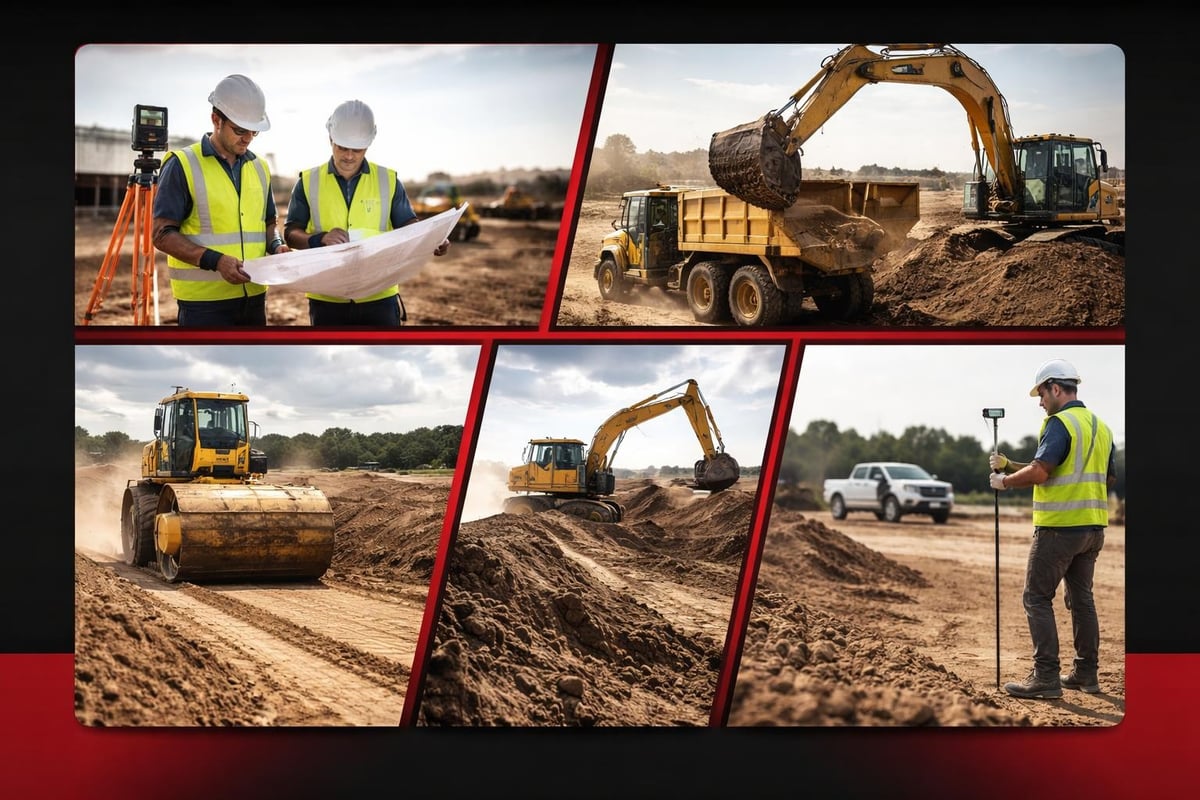
Equipment Selection for Efficient Earthworks
Selecting appropriate machinery directly impacts project timelines, costs, and outcomes. Modern bulk earthworks operations rely on sophisticated equipment designed for specific tasks.
Excavators form the backbone of most earthworks projects. Ranging from 1.5-tonne mini excavators for confined spaces to 50-tonne machines for large-scale excavation, these versatile machines handle digging, loading, and precise grading operations. Their adaptability makes them indispensable across project scales.
Specialist Machinery and Their Applications
| Equipment Type | Primary Function | Ideal Application |
|---|---|---|
| Bulldozers | Pushing and spreading material | Large area grading, site clearance |
| Dump trucks | Material transportation | Moving spoil, importing fill |
| Graders | Fine levelling and profiling | Road construction, final surfaces |
| Compactors | Soil densification | Achieving specified compaction levels |
| Scrapers | Cut, haul, and spread in one pass | Balanced cut-fill operations |
Modern projects increasingly incorporate GPS and machine control technology, enabling operators to achieve millimetre accuracy whilst reducing surveying requirements. This technological advancement has revolutionised efficiency in bulk earthworks, particularly for highway surfacing and commercial developments where precise levels are critical.
The choice between tracked and wheeled machinery depends on ground conditions, site access, and operational requirements. Tracked machines excel in soft or uneven terrain, whilst wheeled loaders offer superior mobility on prepared surfaces.
Cut and Fill Balance: Optimising Material Movement
Achieving an optimal cut-fill balance represents one of the most crucial aspects of economical bulk earthworks. This engineering principle minimises the need to import or export material, directly reducing haulage costs and environmental impact.
The balance calculation involves:
- Detailed topographical survey to establish existing ground levels
- Design level determination based on drainage, accessibility, and building requirements
- Volume calculations for areas requiring cutting versus filling
- Bulking and shrinkage factors accounting for material density changes
- Haul distance optimisation to minimise double-handling
A well-designed cut-fill strategy can reduce project costs by 15-30% whilst accelerating programme delivery. For sites with significant level changes, this approach proves particularly valuable.
Material Suitability and Classification
Not all excavated material proves suitable for reuse as fill. Classification systems categorise materials based on engineering properties:
- Class 1A: Granular material, free-draining, excellent for structural fill
- Class 2A-2C: Sandy/clayey soils with varying moisture sensitivity
- Class 5: Cohesive soils requiring moisture conditioning
- Class 6: Chalk, requiring special handling
- Class 7: Unsuitable material requiring disposal or treatment
Laboratory testing determines moisture content, plasticity, and compaction characteristics. This analysis ensures that reused material meets specification requirements for bearing capacity and settlement behaviour.
Compaction Standards and Quality Assurance
Proper compaction transforms loose fill into stable, load-bearing ground. Inadequate compaction leads to settlement, structural damage, and costly remediation. Professional earthworks contractors employ rigorous testing regimes to verify compliance.
Specification requirements typically mandate compaction to 95-100% of maximum dry density (MDD) determined through standard Proctor tests. The exact requirement varies based on the material's structural role and anticipated loading.
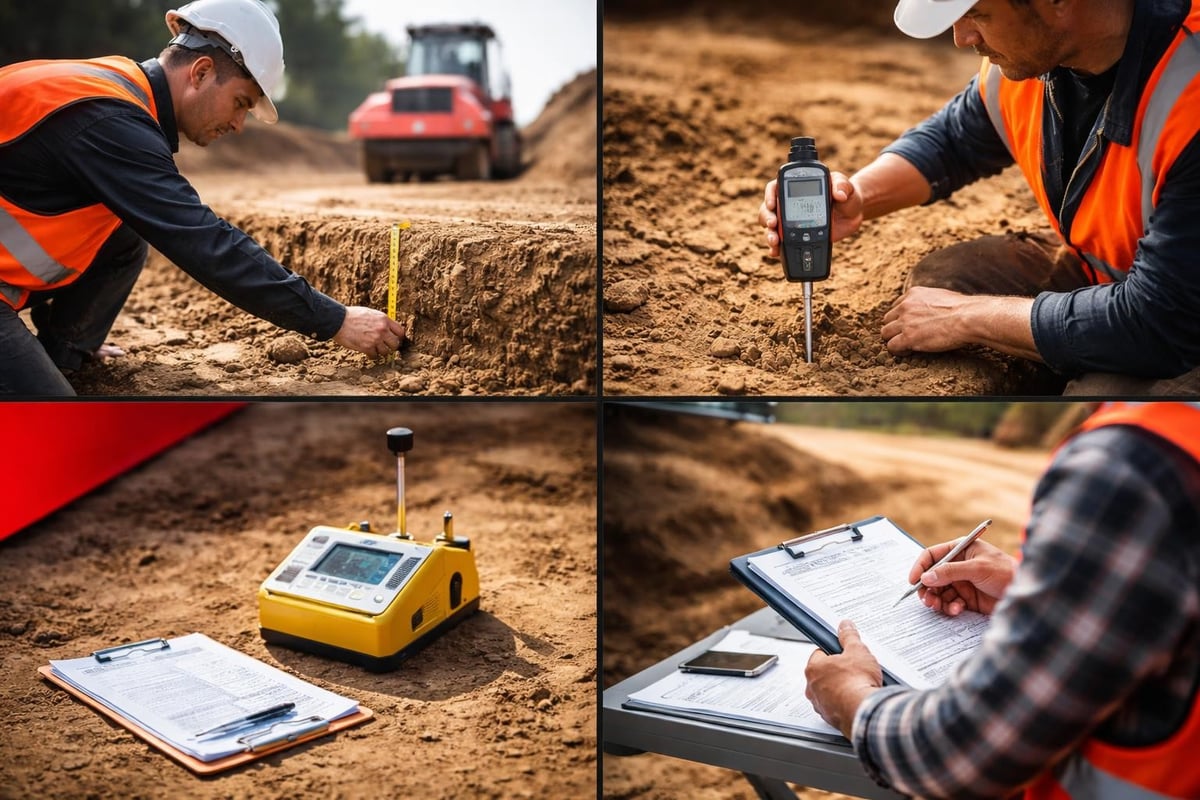
Testing Methods and Frequencies
| Test Type | Purpose | Typical Frequency |
|---|---|---|
| Nuclear density gauge | In-situ density measurement | Every 500m² per layer |
| Sand replacement | Density verification | Calibration/dispute resolution |
| Plate bearing | Stiffness assessment | Formation level |
| CBR testing | Bearing capacity | Design validation |
Modern projects incorporate continuous monitoring through intelligent compaction systems fitted to rollers. These systems provide real-time feedback and comprehensive coverage maps, ensuring uniform compaction across the entire site.
Layer thickness critically affects achievable compaction. Most specifications limit lift thickness to 150-250mm, depending on plant capability and material type. Thicker layers prevent adequate densification at depth, creating weak zones that compromise long-term performance.
Drainage Integration During Earthworks
Effective water management during and after bulk earthworks prevents ground instability, erosion, and construction delays. Temporary and permanent drainage systems must be considered throughout the earthworks phase.
Temporary measures protect the works during construction:
- Perimeter ditches to divert surface water
- Settlement ponds for sediment control
- Dewatering systems for excavations below groundwater
- Surface water pumping arrangements
- Erosion control measures on exposed slopes
Permanent drainage infrastructure typically includes:
- Sub-surface drainage beneath roads and hardstanding areas
- French drains around structures and retaining walls
- Attenuation systems for surface water management
- Carrier drains to convey water to discharge points
- Infiltration systems where ground conditions permit
Installing drainage infrastructure during bulk earthworks proves far more economical than retrospective installation. Coordinating earthworks with drainage works streamlines programme delivery and reduces overall project costs.
Site-Specific Challenges in Bulk Earthworks
Every site presents unique challenges requiring adaptive solutions. Ground conditions, contamination, access constraints, and existing services all influence methodology.
Common Ground Conditions and Mitigation
Made ground characterises many brownfield sites, particularly former industrial locations. This variable material requires careful investigation and often necessitates removal or treatment before development proceeds. Projects involving demolition and site remediation demand specialist expertise to manage unknown ground conditions safely.
High groundwater complicates excavation and compaction operations. Dewatering systems, from wellpoints to deep wells, maintain dry working conditions. However, dewatering requires environmental permits and monitoring to prevent impacts on adjacent properties or water courses.
Rock excavation significantly impacts programme and budget. Distinguishing between weathered material amenable to excavator ripping and competent rock requiring hydraulic breakers or blasting proves critical during tender estimation.
Contaminated land demands specialist handling protocols, classification testing, and licensed disposal routes. The civil engineering expertise required for contaminated site remediation exceeds standard earthworks operations, involving environmental specialists and regulatory compliance.
Cost Factors and Budget Considerations
Bulk earthworks costs vary considerably based on project-specific factors. Understanding these variables enables accurate budgeting and value engineering opportunities.
Volume represents the primary cost driver, but unit rates fluctuate based on:
- Material type and excavation difficulty
- Haul distances for material movement
- Compaction requirements and testing frequency
- Import/export requirements and material costs
- Site access and working space constraints
- Programme duration and seasonal weather impacts
Typical unit rates for 2026 UK projects range from £8-15 per cubic metre for straightforward cut-fill operations, increasing to £25-40 per cubic metre where difficult ground, restricted access, or contamination complicate works.
Value Engineering Opportunities
- Optimising cut-fill balance to minimise haulage
- Material reuse strategies reducing disposal and import costs
- Phased operations allowing other trades to commence earlier
- Equipment selection matching plant to task requirements
- Programme sequencing avoiding seasonal weather impacts
For commercial projects such as drive-through facilities, efficient bulk earthworks can represent 12-18% of overall construction costs. Residential developments typically allocate 8-12% to earthworks, whilst highway projects may reach 20-25% due to extensive earthwork requirements and stringent specifications.
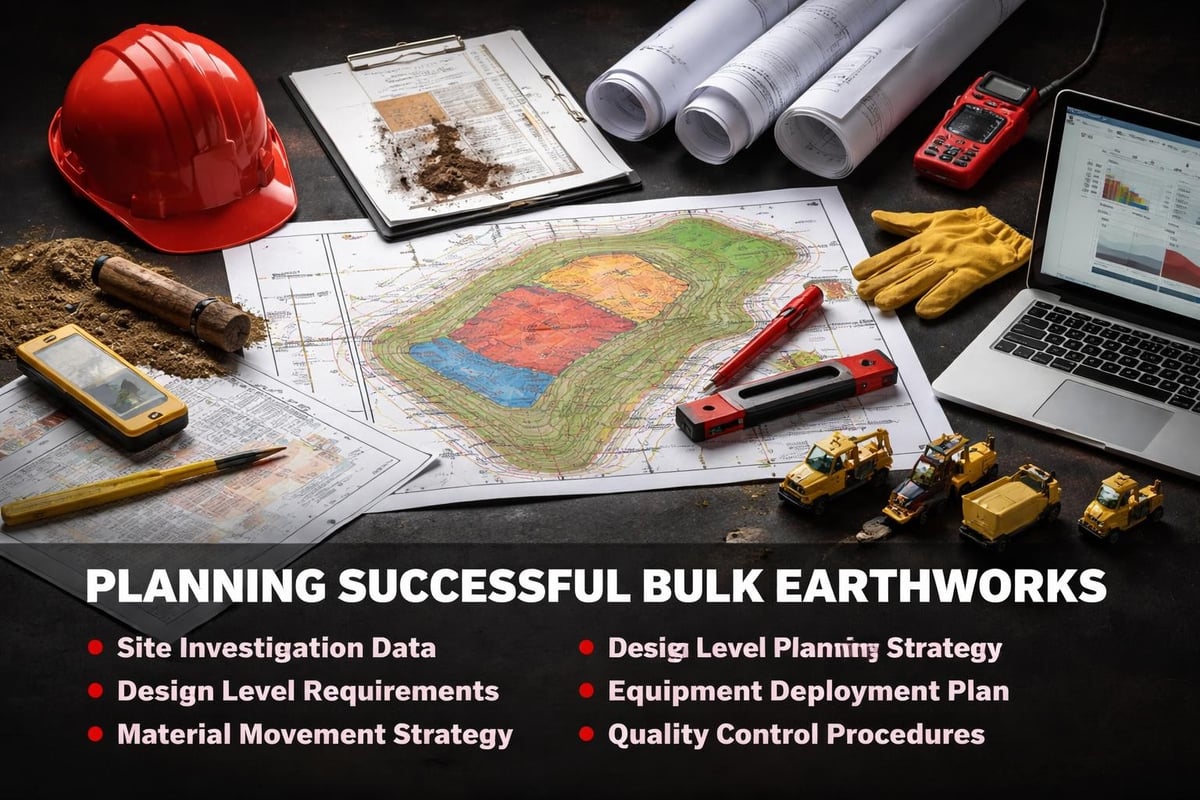
Regulatory Compliance and Environmental Considerations
Bulk earthworks operations operate within a comprehensive regulatory framework protecting environmental and public interests. Compliance proves non-negotiable for professional contractors.
Planning conditions frequently mandate specific earthworks methodologies, working hours, and environmental protections. Contractors must demonstrate adherence through method statements and risk assessments.
Key Regulatory Requirements
The Construction (Design and Management) Regulations 2015 establish health and safety responsibilities throughout project lifecycles. Principal contractors must ensure safe systems of work for excavation, material handling, and temporary works.
Environmental permits may be required for:
- Dewatering discharges to watercourses or sewers
- Soil treatment or disposal operations
- Dust suppression and air quality management
- Noise and vibration control measures
The CL:AIRE Definition of Waste Code of Practice provides frameworks for beneficial reuse of excavated materials, potentially avoiding waste classification and reducing disposal costs. Understanding these legal frameworks protects contractors from regulatory breaches whilst optimising material management strategies.
Quality Management Systems for Earthworks
Systematic quality management ensures bulk earthworks meet design specifications and performance requirements. Professional contractors implement documented procedures covering all aspects of operations.
Inspection and test plans (ITPs) define hold points, witness points, and documentation requirements. These plans typically specify:
- Pre-commencement surveys and setting out verification
- Material approval testing before placement
- Layer thickness checks during operations
- Compaction testing at specified frequencies
- Level surveys confirming achievement of design
- Final inspection and handover documentation
Digital documentation systems increasingly replace paper-based records, providing real-time visibility of progress and compliance status. Photographic records, GPS tracking, and electronic test certificates create comprehensive audit trails.
Non-conformances require formal recording and resolution. Where compaction tests fail, remedial measures might include additional rolling passes, moisture adjustment, or material replacement. Systematic approaches prevent isolated issues escalating into widespread defects.
Integration with Subsequent Construction Phases
Successful bulk earthworks create optimal platforms for subsequent construction activities. Coordination between earthworks contractors and following trades maximises efficiency and prevents abortive works.
Formation levels must account for subsequent pavement construction, whether tarmac surfacing for driveways, concrete hardstanding, or block paving. Accurate level control during earthworks eliminates costly adjustments later.
For projects involving highways surfacing, the earthworks phase establishes sub-formation to specified CBR values. This foundation supports the pavement layers above, directly influencing long-term performance and maintenance requirements.
Service installation often occurs during or immediately following bulk earthworks. Coordinating earthworks with utility diversions, new service installations, and drainage works prevents multiple mobilisations and ground disturbance cycles.
Handover Procedures
Professional transitions between construction phases require:
- As-built surveys confirming achieved levels
- Compaction test results demonstrating compliance
- Material certificates for imported fill
- Photographic records of completed works
- Identification of any variations from design
This documentation proves essential for design warranty purposes and future maintenance planning. Missing or incomplete records can delay subsequent trades and create disputes regarding responsibility for defects.
Advanced Techniques in Modern Earthworks
Innovation continues transforming bulk earthworks efficiency and precision. Leading contractors adopt emerging technologies to enhance productivity whilst maintaining quality standards.
3D machine control systems enable operators to work to digital terrain models without traditional setting out. Excavators and dozers equipped with GPS guidance achieve design levels within ±25mm, dramatically reducing surveying requirements and rework. These systems particularly benefit complex projects with extensive level changes.
Innovative earthworks approaches explore sustainable alternatives to traditional methods, including recycled materials and reduced-carbon techniques. Environmental considerations increasingly influence methodology selection as the construction industry addresses climate change imperatives.
Ground improvement techniques extend beyond traditional excavation and replacement. Methods including dynamic compaction, stone columns, and soil stabilisation with lime or cement transform poor ground into construction-ready platforms, often proving more economical than deep excavation and import of suitable fill.
Project Examples Demonstrating Earthworks Complexity
Real-world applications illustrate the diversity of bulk earthworks requirements across different project types.
Commercial drive-through facilities demand precise grading to achieve appropriate drainage falls whilst accommodating vehicle circulation, queuing lanes, and parking areas. Earthworks must coordinate with underground fuel tanks (where applicable), service diversions, and extensive drainage networks. Level changes between public highways and site platforms require careful design to maintain acceptable gradients for all users.
Highway construction projects involve extensive bulk earthworks creating cuttings, embankments, and level platforms for carriageways. These projects balance volumes over considerable distances, requiring sophisticated haulage strategies and temporary works designs. Environmental mitigation, including landscape earthworks and ecological compensation areas, adds complexity beyond core highway construction.
Residential developments present different challenges, particularly where retaining multiple level changes within confined plots. Bulk earthworks must create building platforms, access roads, and garden levels whilst managing surface water and protecting existing boundary features. Coordinating earthworks with foundation construction and service installations proves critical for programme efficiency.
Understanding bulk earthworks principles, from material classification through to final compaction verification, enables informed decision-making throughout project development. Whether you're planning commercial infrastructure, highway improvements, or residential enhancements, professional earthworks execution establishes the foundation for construction success. At JRG Civils, our civil engineering expertise encompasses all aspects of bulk earthworks, from initial site preparation through to final surfacing and completion. Based in the North East and operating across the UK, we deliver projects ranging from large commercial developments to private driveways with the same commitment to excellence and attention to detail. Contact our team to discuss how our earthworks capabilities can support your next project.