
Driveway kerbing represents a critical component in modern property development, serving both functional and aesthetic purposes that extend far beyond simple boundary definition. Whether constructing a residential driveway or managing large-scale commercial projects, understanding the nuances of proper kerbing installation ensures longevity, effective drainage, and enhanced visual appeal. This comprehensive guide explores everything property owners and contractors need to know about driveway kerbing in 2026.
Understanding the Purpose of Driveway Kerbing
Driveway kerbing serves multiple essential functions that contribute to both the practical performance and visual impact of your property. The primary role involves creating a clear boundary between your paved driveway surface and adjacent landscaping, preventing materials from migrating and maintaining distinct zones within your outdoor space.
Effective water management stands as one of the most critical functions. Properly installed kerbing directs surface water runoff away from your property's foundation and towards designated drainage systems. This prevention of soil erosion protects your landscaping investment whilst ensuring compliance with modern stormwater management regulations.
Structural Benefits
Beyond aesthetics, kerbing provides essential structural support to your driveway edges. Without adequate edge restraint, tarmac and block paving surfaces gradually spread under vehicle weight, leading to premature deterioration and costly repairs.
- Prevents surface spreading and maintains driveway dimensions
- Reduces edge crumbling caused by traffic loads
- Extends overall lifespan of the paved surface
- Minimises maintenance requirements over time
The haunching behind kerb stones creates a concrete wedge that anchors the entire installation, distributing loads effectively across the driveway structure. This engineering principle remains fundamental whether working on domestic driveways or commercial drive-through facilities.
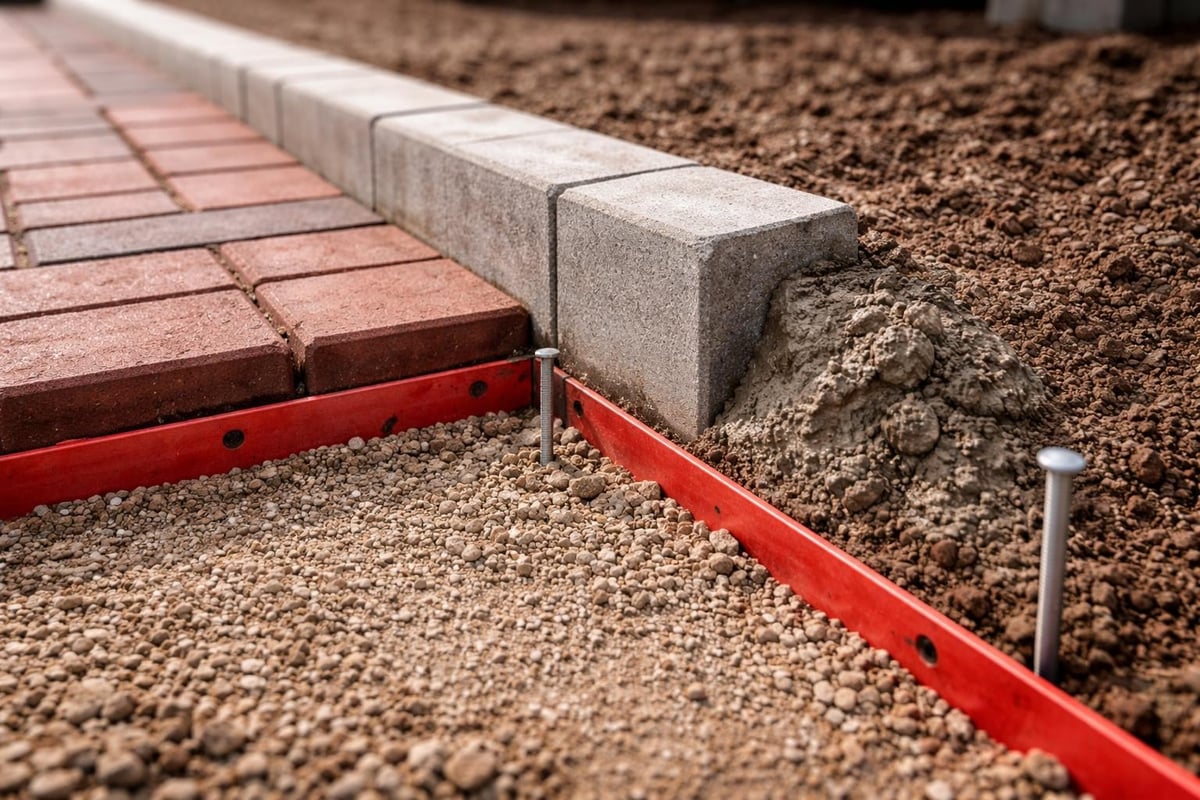
Material Options for Driveway Kerbing
Selecting appropriate materials for your driveway kerbing project depends on various factors including budget, aesthetic preferences, traffic loads, and environmental conditions. Each material offers distinct advantages suited to different applications.
| Material Type | Durability | Cost Range | Best Applications | Maintenance Level |
|---|---|---|---|---|
| Concrete Kerbs | Excellent (30+ years) | £8-15 per metre | Commercial, high traffic | Low |
| Natural Stone | Excellent (50+ years) | £25-60 per metre | Premium residential | Medium |
| Block Paving Edging | Very Good (20-25 years) | £12-20 per metre | Residential driveways | Low |
| Timber Edging | Fair (5-10 years) | £5-12 per metre | Temporary, decorative | High |
Concrete Kerbing Solutions
Concrete remains the most popular choice for driveway kerbing across both residential and commercial sectors. Pre-cast concrete kerbs offer consistent quality, precise dimensions, and excellent durability under demanding conditions.
Standard profiles include:
- Bull-nosed kerbs for gentle transitions
- Half-battered kerbs for drainage channels
- Straight-faced kerbs for formal boundaries
- Dropped kerbs for vehicle access points
The manufacturing process ensures uniform strength and weather resistance, with modern concrete kerbs engineered to withstand freeze-thaw cycles common in UK climates. Many suppliers now offer kerbs in various colours and finishes, allowing coordination with existing paving materials.
Natural Stone Options
For premium installations, natural stone kerbing delivers unmatched aesthetic appeal and exceptional longevity. Granite, limestone, and sandstone kerbs complement traditional architecture whilst providing superior durability compared to manufactured alternatives.
Stone kerbing particularly suits period properties and conservation areas where planning requirements demand sympathetic materials. The initial investment proves worthwhile through reduced lifecycle costs and timeless visual appeal.
Installation Process and Best Practices
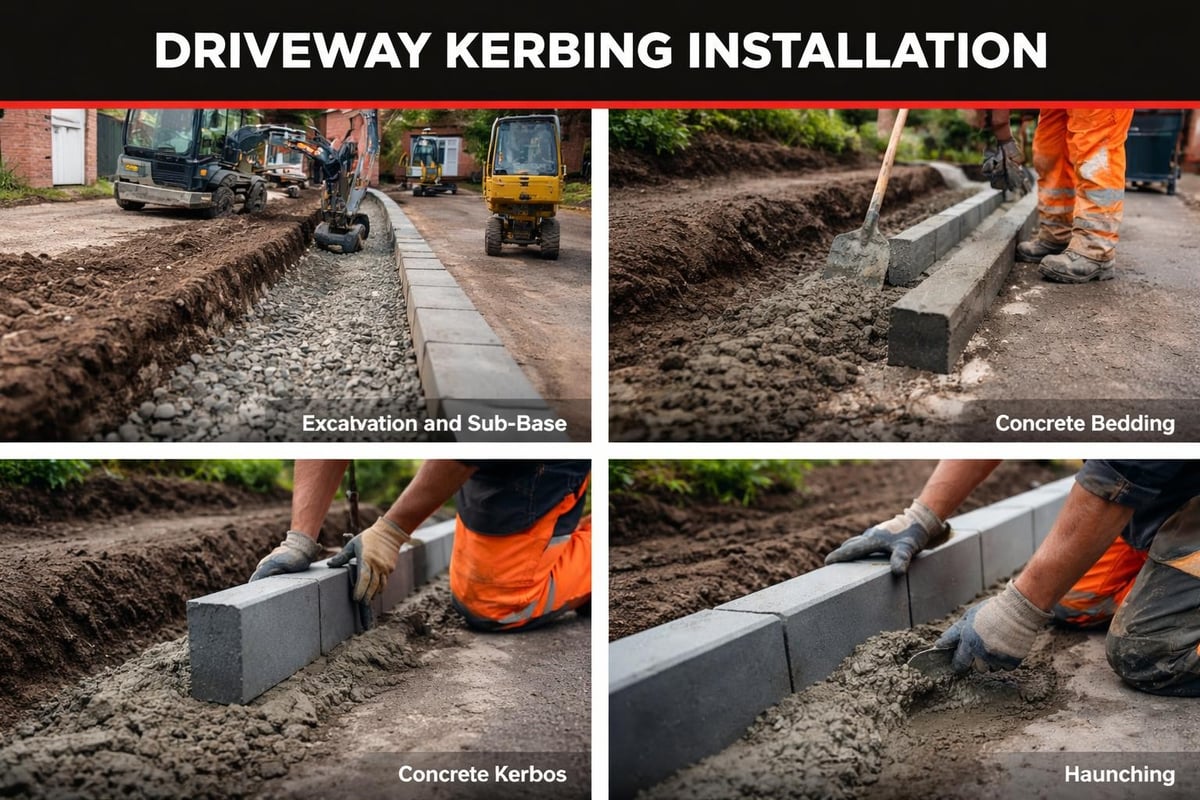
Achieving professional results with driveway kerbing requires meticulous preparation and adherence to established civil engineering standards. The kerb installation process follows specific protocols ensuring structural integrity and proper drainage performance.
Site Preparation
Thorough groundwork establishes the foundation for successful kerbing installation. This phase includes:
- Excavating to appropriate depths (typically 150-200mm below finished kerb level)
- Creating stable sub-base using Type 1 MOT aggregate
- Ensuring adequate compaction using plate vibrators
- Establishing correct falls for drainage (minimum 1:60)
Poor preparation leads to settlement issues, misalignment, and premature failure. Professional contractors allocate sufficient time for this crucial stage rather than rushing towards visible progress.
Setting and Haunching
Once the sub-base achieves proper compaction, kerbs are set on a concrete bed and secured with haunching. The concrete mix typically comprises 6:1 ballast to cement ratio, providing adequate strength without excessive rigidity.
Haunching specifications:
The concrete backing extends approximately two-thirds up the rear face of the kerb, tapering outwards to create a stable wedge. This configuration prevents forward movement whilst allowing slight flexibility that accommodates ground movement without cracking.
Line and level accuracy demands constant attention throughout installation. String lines establish precise alignment whilst spirit levels ensure consistent heights relative to finished surface levels. Professional teams typically maintain tolerances within 3mm over 3 metres.
Design Considerations for Different Property Types
Driveway kerbing requirements vary significantly between residential properties and commercial installations. Understanding these distinctions ensures appropriate specification and budgeting for your specific project.
Residential Driveway Applications
Domestic driveways typically accommodate lighter vehicles and lower traffic frequencies compared to commercial settings. This allows for more diverse material choices and design flexibility whilst maintaining adequate performance standards.
Key residential considerations:
- Aesthetic coordination with house architecture
- Integration with existing boundary treatments
- Accommodation of drainage requirements
- Provision for future maintenance access
- Compliance with planning permissions
Many homeowners select kerbing that complements their property's character rather than prioritising maximum structural capacity. A Victorian terrace might feature reclaimed granite setts, whilst contemporary developments often specify clean-lined concrete profiles in neutral tones.
Commercial and High-Traffic Installations
Commercial projects demand robust specifications capable of withstanding heavy goods vehicles, frequent turning movements, and intensive use. The kerbing installations completed for drive-through facilities require engineering-grade solutions with enhanced structural capacity.
Standard residential kerbs measure 125mm x 255mm in cross-section. Commercial applications frequently specify larger profiles (150mm x 305mm or greater) providing increased mass and stability. The haunching extends deeper and wider to distribute concentrated loads from articulated vehicles and delivery lorries.
| Application Type | Recommended Kerb Size | Haunching Depth | Concrete Grade |
|---|---|---|---|
| Residential | 125mm x 255mm | 150mm | C20/25 |
| Light Commercial | 150mm x 255mm | 200mm | C25/30 |
| Heavy Commercial | 150mm x 305mm | 250mm | C28/35 |
| Highways | 125mm x 255mm (HB2) | 200mm | C28/35 |
Common Issues and How to Avoid Them
Even with professional installation, driveway kerbing can develop problems if certain factors aren't properly addressed during design and construction phases. Avoiding common driveway installation mistakes protects your investment and prevents costly remedial works.
Settlement and Movement
Differential settlement occurs when inadequate sub-base preparation or poor drainage creates unstable ground conditions. Kerbs sink unevenly, creating trip hazards and allowing water to pond against property foundations.
Prevention strategies include:
- Thorough ground investigation before commencing works
- Removal of unsuitable materials (topsoil, organic matter)
- Installation of adequate drainage beneath kerb lines
- Use of geotextile membranes in poor ground conditions
Professional ground assessment proves particularly important when working with clay soils prone to expansion and contraction with moisture changes.
Inadequate Joints and Connections
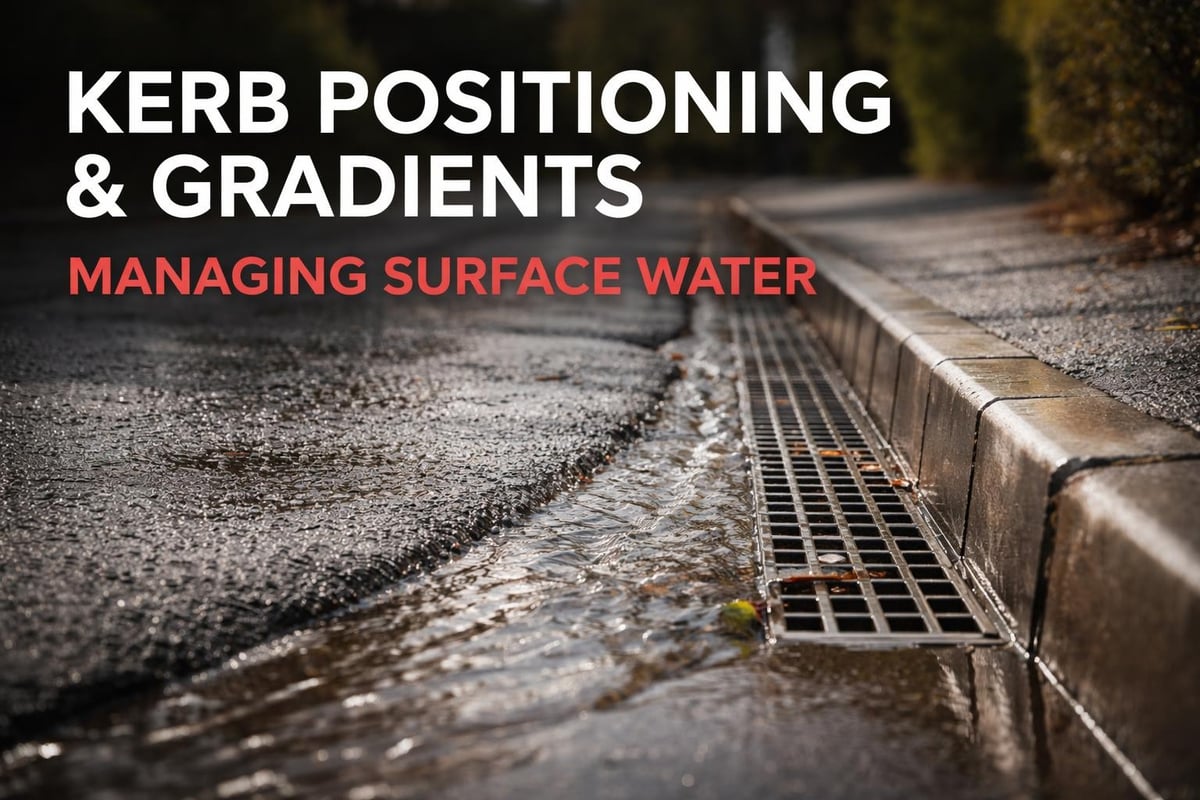
Kerb joints require careful attention to prevent weakness points where cracking typically initiates. Butt joints between individual kerb units must align tightly with minimal gaps, whilst expansion joints accommodate thermal movement in longer runs.
Modern practice incorporates expansion joints at maximum 10-metre intervals for concrete kerbing, using compressible filler materials that prevent crack transmission whilst maintaining surface continuity. These joints prove essential in exposed locations subject to significant temperature variations.
Drainage Conflicts
Kerb and drainage integration determines whether surface water flows efficiently away from structures or accumulates causing damage. Kerb heights must coordinate with gully positions, channel blocks, and outfall locations.
The relationship between driveway surface levels, kerb top heights, and adjacent ground levels creates the hydraulic gradient driving water movement. Professional designers model these relationships ensuring positive drainage under all conditions including heavy rainfall events.
Maintenance and Long-Term Care
Well-installed driveway kerbing requires minimal maintenance when constructed to appropriate standards. However, periodic inspection and minor interventions extend service life and preserve appearance.
Regular Inspection Schedule
Annual visual inspections identify emerging issues before they escalate into major problems:
- Check for settlement or movement
- Inspect joints for deterioration
- Clear drainage channels of debris
- Remove vegetation growth between kerb and paving
- Assess concrete condition for spalling or cracking
Addressing minor defects promptly prevents water ingress that accelerates deterioration through freeze-thaw action during winter months.
Cleaning and Stain Removal
Concrete and stone kerbing accumulates dirt, algae, and staining from vehicles and environmental exposure. Proper kerb maintenance preserves visual appeal and prevents organic growth causing surface degradation.
- Pressure washing (maximum 1500 PSI) removes surface contamination
- Specialist cleaners address oil stains and tyre marks
- Algaecide treatments prevent moss and lichen establishment
- Repointing maintains joint integrity where mortar deteriorates
Avoid aggressive cleaning methods that damage surface finishes or accelerate wear on softer stone materials.
Cost Factors and Budget Planning
Understanding the components contributing to driveway kerbing costs enables realistic budget planning and informed decision-making. Prices vary considerably based on materials, site conditions, access constraints, and project scale.
Material Costs
Kerb stones and edging materials represent the most visible cost element but typically account for only 30-40% of total project expenditure. Standard concrete kerbs range from £8-15 per linear metre, whilst premium natural stone options extend to £60 per metre or beyond.
Specialist profiles including bull-nosed, quadrant, and radius kerbs command premium pricing reflecting manufacturing complexity. Custom colours and finishes similarly increase material costs by 15-30% compared to standard grey concrete.
Labour and Installation
Professional installation costs typically exceed material expenses, ranging from £25-50 per linear metre depending on ground conditions and access. Complex sites requiring extensive groundwork or working in confined spaces inflate labour requirements substantially.
Factors influencing installation costs:
- Site accessibility for machinery and materials delivery
- Ground conditions requiring additional excavation or stabilisation
- Coordination with other trades and utility diversions
- Working around existing structures and landscaping features
- Requirements for traffic management on occupied sites
Obtaining detailed quotations from experienced civil engineering contractors ensures comprehensive pricing covering all project elements rather than focusing solely on material costs.
Environmental Considerations
Modern driveway kerbing projects increasingly incorporate sustainability principles addressing environmental concerns around materials, water management, and urban heat island effects.
Sustainable Materials Selection
Specifying locally sourced materials reduces transportation emissions whilst supporting regional economies. Many concrete manufacturers now offer kerbs incorporating recycled aggregates and supplementary cementitious materials reducing embodied carbon.
Natural stone quarried domestically provides sustainable alternatives to imported materials, particularly when selecting regional stone types suited to local architectural vernacular.
Permeable Paving Integration
Driveway kerbing plays a crucial role in permeable paving systems managing surface water sustainably. Rather than directing runoff into overburdened drainage networks, modern installations incorporate kerbs that allow controlled infiltration into underlying soils.
Specialist permeable kerb designs include weep holes or gaps facilitating water passage whilst maintaining edge restraint functionality. These systems reduce flooding risk and replenish groundwater supplies rather than overwhelming sewage treatment facilities.
Regulatory Compliance and Planning
Driveway kerbing installation must comply with various regulatory requirements including building regulations, planning permissions, and highways standards where work affects public areas.
Building Regulations Requirements
Part H of the Building Regulations governs drainage and waste disposal, establishing minimum standards for surface water management. Driveway kerbing that directs runoff onto public highways or neighbouring properties potentially contravenes these requirements.
Designers must demonstrate that proposed installations adequately manage surface water through approved drainage systems or infiltration methods. This typically requires coordination with building control officers during planning stages.
Highways Act Considerations
Creating or modifying vehicular access crossing public pavements requires formal approval from highway authorities. The kerbing installation forms part of the dropped kerb specification ensuring safe transitions for vehicles and pedestrians.
Standard dropped kerb details specify maximum gradients, minimum widths, and kerb profiles ensuring accessibility compliance. Non-compliant installations may require costly remedial works and potentially attract enforcement action.
Planning Permission
Most driveway alterations fall under permitted development rights avoiding formal planning applications. However, properties in conservation areas, listed buildings, or developments exceeding certain size thresholds require explicit planning consent.
The kerbing design contributes to overall visual impact assessed during planning evaluation. Sympathetic material selection and appropriate detailing help secure approval for applications in sensitive locations.
Professional Installation versus DIY Approaches
The decision between professional contractors and DIY installation depends on project scale, technical complexity, available equipment, and individual capabilities. Driveway kerbing demands precision, appropriate materials, and specialist knowledge ensuring satisfactory long-term performance.
When to Engage Professionals
Complex installations including curved layouts, steep gradients, integration with drainage systems, and commercial applications warrant professional expertise. Civil engineering contractors bring:
- Specialist equipment including concrete mixers, compaction plant, and laser levels
- Technical knowledge of structural requirements and drainage principles
- Experience managing complications arising during groundworks
- Professional indemnity insurance protecting against installation defects
- Compliance with health and safety regulations for construction activities
The quality assurance provided by established contractors justifies premium pricing through reduced failure risk and guaranteed workmanship.
DIY Considerations
Small, straightforward projects on level sites may suit competent DIY enthusiasts possessing basic groundwork skills. Success requires:
- Accurate setting out and level control
- Adequate excavation and sub-base preparation
- Proper concrete mixing and placement
- Understanding of drainage principles
- Access to appropriate tools and equipment
Underestimating complexity or cutting corners on preparation frequently results in poor outcomes requiring professional remediation exceeding original contractor quotations.
Driveway kerbing represents an essential investment in property infrastructure, delivering functional performance and aesthetic enhancement when executed to professional standards. Whether planning residential improvements or commercial developments, understanding material options, installation requirements, and long-term maintenance ensures successful outcomes. With expertise across both large-scale commercial projects and residential driveways, JRG Civils delivers civil engineering excellence throughout the North East and across the UK, combining technical knowledge with meticulous attention to detail for every project.