
Earth works excavating forms the foundation of virtually every major construction and infrastructure project undertaken across the United Kingdom. Whether preparing sites for commercial developments, constructing highways, or creating residential driveways, the precision and expertise applied during earthworks directly influence the longevity and stability of the final structure. Understanding the complexities of excavation work, from soil analysis to safety protocols, enables contractors and project managers to deliver exceptional results whilst maintaining the highest standards of worker protection and environmental responsibility.
Understanding Earth Works Excavating Fundamentals
Earth works excavating encompasses a broad range of activities involving the removal, relocation, and manipulation of soil, rock, and other subsurface materials. This discipline sits at the intersection of engineering precision and practical construction expertise, requiring detailed knowledge of ground conditions, structural requirements, and regulatory compliance.
The primary objectives of earthworks excavating extend beyond simple soil removal. Projects demand careful consideration of load-bearing capacities, drainage requirements, and long-term settlement characteristics. Professional contractors must evaluate existing ground conditions, identify potential hazards such as underground utilities, and develop comprehensive excavation strategies that align with project specifications.
Classification of Excavation Types
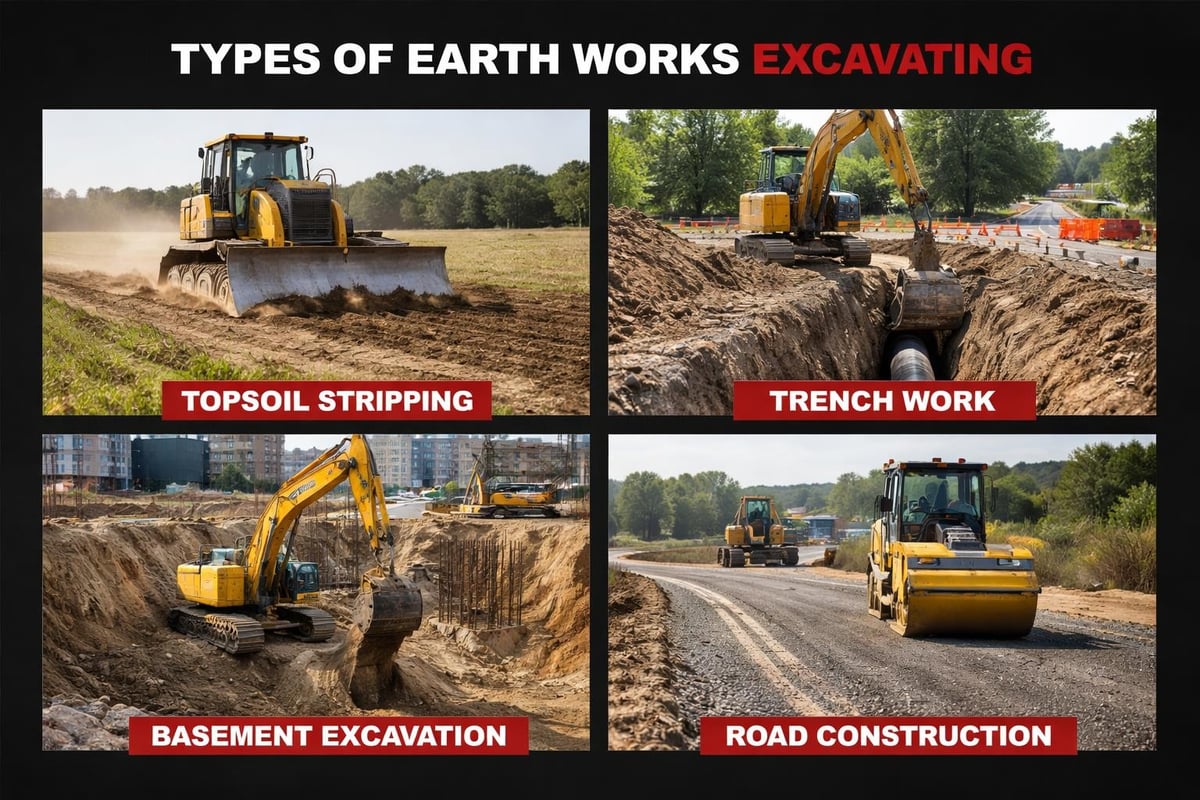
Different projects require distinct excavation approaches, each with specific technical requirements and safety considerations:
- Topsoil stripping: Removal of upper organic layers to reach stable subgrade material
- Cut and fill operations: Balancing excavated material across a site to achieve desired levels
- Trench excavation: Creating narrow, deep channels for utilities, drainage, or foundations
- Basement excavation: Large-scale removal for below-ground structures
- Road construction excavation: Precision grading and removal for highway and driveway projects
Material characteristics significantly influence excavation methodology. Clay soils behave differently from sandy substrates, whilst rocky terrain demands specialised equipment and techniques. Understanding these variations allows contractors to select appropriate machinery, establish realistic timelines, and anticipate challenges before they impact project delivery.
Essential Equipment for Modern Earthworks Projects
Contemporary earth works excavating relies on sophisticated machinery designed to maximise efficiency whilst minimising environmental impact. Equipment selection directly correlates with project scope, site accessibility, and soil conditions encountered during preliminary assessments.
| Equipment Type | Primary Application | Typical Project Scale |
|---|---|---|
| Hydraulic Excavators | General digging, trenching, material handling | Small to large commercial |
| Bulldozers | Pushing, spreading, rough grading | Large-scale developments |
| Motor Graders | Precision levelling, road construction | Highway and infrastructure |
| Backhoe Loaders | Versatile digging and loading | Residential and small commercial |
| Compactors | Soil densification, road base preparation | All project types |
Hydraulic excavators have become the workhorse of modern excavating operations, offering precision control and adaptability across diverse applications. These machines excel in trenching operations, foundation excavation, and material loading, with attachment versatility allowing contractors to switch between buckets, breakers, and grading tools as project requirements evolve.
Motor graders prove indispensable for highway surfacing and driveway construction, delivering the precise tolerances required for proper drainage and surface finish. Their ability to create consistent cross-slopes and maintain tight elevation tolerances makes them essential for road design projects where water management and structural integrity remain paramount.
Technological Advances in Excavation
Modern earth works excavating increasingly incorporates GPS-guided systems and 3D machine control technology. These innovations enable operators to achieve design specifications with millimetre accuracy, reducing material waste and minimising the need for rework. Laser-guided grading systems automatically adjust blade positions, ensuring consistent results across large surface areas whilst reducing operator fatigue and human error.
Telematics systems now provide real-time data on equipment performance, fuel consumption, and maintenance requirements. This information allows project managers to optimise fleet utilisation, schedule preventative maintenance, and identify productivity bottlenecks before they impact critical path activities.
Safety Standards and Regulatory Compliance
Safety considerations dominate every aspect of professional earth works excavating, with comprehensive excavation safety protocols establishing minimum standards for worker protection. Cave-ins represent the most serious hazard in excavation work, accounting for numerous fatalities and serious injuries across the construction industry annually.
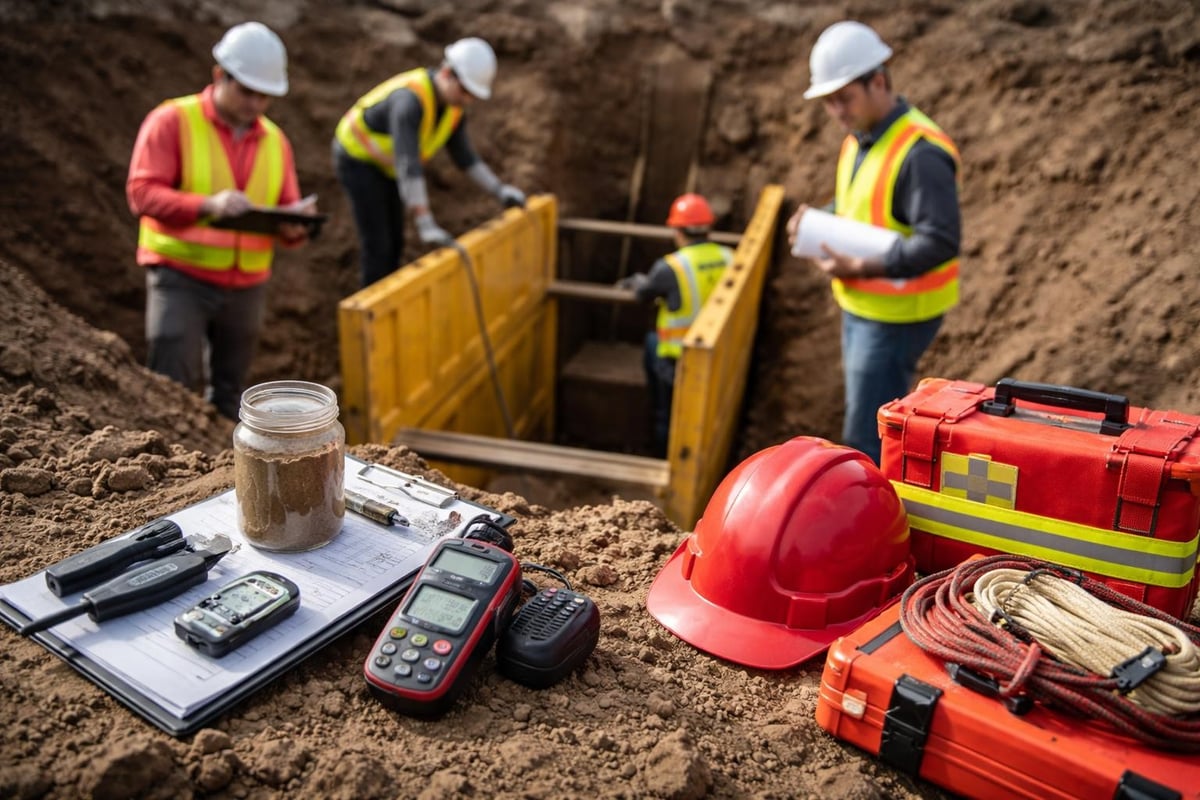
Proper soil analysis forms the first line of defence against excavation hazards. Competent persons must evaluate ground conditions before work commences, classifying soils according to their stability characteristics and determining appropriate protective measures. OSHA’s trenching and excavation guidance provides detailed frameworks for soil classification and protective system selection.
Protective Systems and Shoring Requirements
Excavations exceeding 1.5 metres in depth typically require protective systems unless work occurs in stable rock. Three primary protection methods dominate modern excavating practice:
- Sloping and benching: Cutting excavation walls at angles that prevent collapse based on soil type
- Shoring: Installing temporary support structures using hydraulic or timber systems
- Shielding: Protecting workers within trench boxes or similar protective enclosures
Shielding and shoring techniques must be designed by qualified engineers and installed according to manufacturer specifications. Regular inspections before each shift and following weather events ensure protective systems maintain their integrity throughout project duration.
Atmospheric monitoring becomes essential in deep excavations or confined spaces where oxygen depletion or hazardous gas accumulation may occur. Continuous air quality testing, combined with adequate ventilation systems, protects workers from invisible but potentially lethal atmospheric hazards.
Civil Engineering Standards for Earthworks
Civil engineering earthworks standards establish technical specifications that govern material handling, compaction requirements, and quality control procedures. These standards ensure excavated areas provide adequate support for subsequent construction phases whilst maintaining long-term stability under anticipated loading conditions.
Compaction specifications vary according to project requirements and intended use. Highway construction demands higher compaction densities than residential garden areas, with specifications typically requiring 95-98% of maximum dry density as determined by Proctor testing methods. Achieving these densities requires proper moisture content control, appropriate compaction equipment, and systematic testing throughout the placement process.
Material Specification and Testing
Quality earthworks excavating incorporates rigorous material testing protocols to verify compliance with engineering specifications:
- Particle size distribution analysis: Ensuring appropriate gradation for intended application
- Plasticity index testing: Evaluating clay content and shrink-swell potential
- California Bearing Ratio (CBR): Measuring subgrade strength for pavement design
- Moisture-density relationships: Optimising compaction effectiveness
- Chemical analysis: Identifying potentially reactive or contaminating substances
Documentation forms an integral component of quality assurance programmes. Detailed records of material sources, test results, and placement locations provide verification of specification compliance and create valuable reference information for future maintenance or expansion activities.
Best Practices for Commercial and Infrastructure Projects
Large-scale commercial developments and infrastructure projects present unique challenges that distinguish them from smaller residential work. Coordination amongst multiple trades, adherence to strict timelines, and management of complex logistics require sophisticated planning and execution strategies.
Construction manual earthwork guidelines emphasise the importance of comprehensive site preparation before excavation commences. This includes establishing clear access routes, designating material stockpile areas, and implementing erosion control measures that protect both the site and surrounding properties from sediment migration.
| Project Phase | Key Considerations | Quality Checkpoints |
|---|---|---|
| Pre-excavation | Utility location, site access, erosion control | Survey verification, permit approval |
| Bulk excavation | Material classification, haul route management | Elevation checks, material testing |
| Fine grading | Drainage conformance, compaction achievement | Laser scanning, density testing |
| Final acceptance | As-built documentation, surface tolerance | Independent verification, client walkthrough |
Projects such as drive-through restaurants and commercial retail developments demand precise coordination between earthworks contractors and architectural teams. Foundation elevations must align with building design, drainage systems require integration with civil infrastructure, and access routes need configuration to accommodate both construction activities and future operational requirements.
Managing Cut and Fill Operations
Efficient earth works excavating maximises the beneficial use of excavated material within the project footprint. This approach reduces haulage costs, minimises environmental impact, and accelerates project completion. Mass haul diagrams help engineers optimise material movement, identifying opportunities to balance cuts and fills whilst minimising double-handling.
Material unsuitable for structural fill applications still offers value in landscaping, temporary roads, or environmental berm construction. Segregating materials during excavation according to their characteristics enables contractors to deploy each soil type in its most appropriate application, reducing waste disposal costs and improving project economics.
Residential Applications and Private Developments
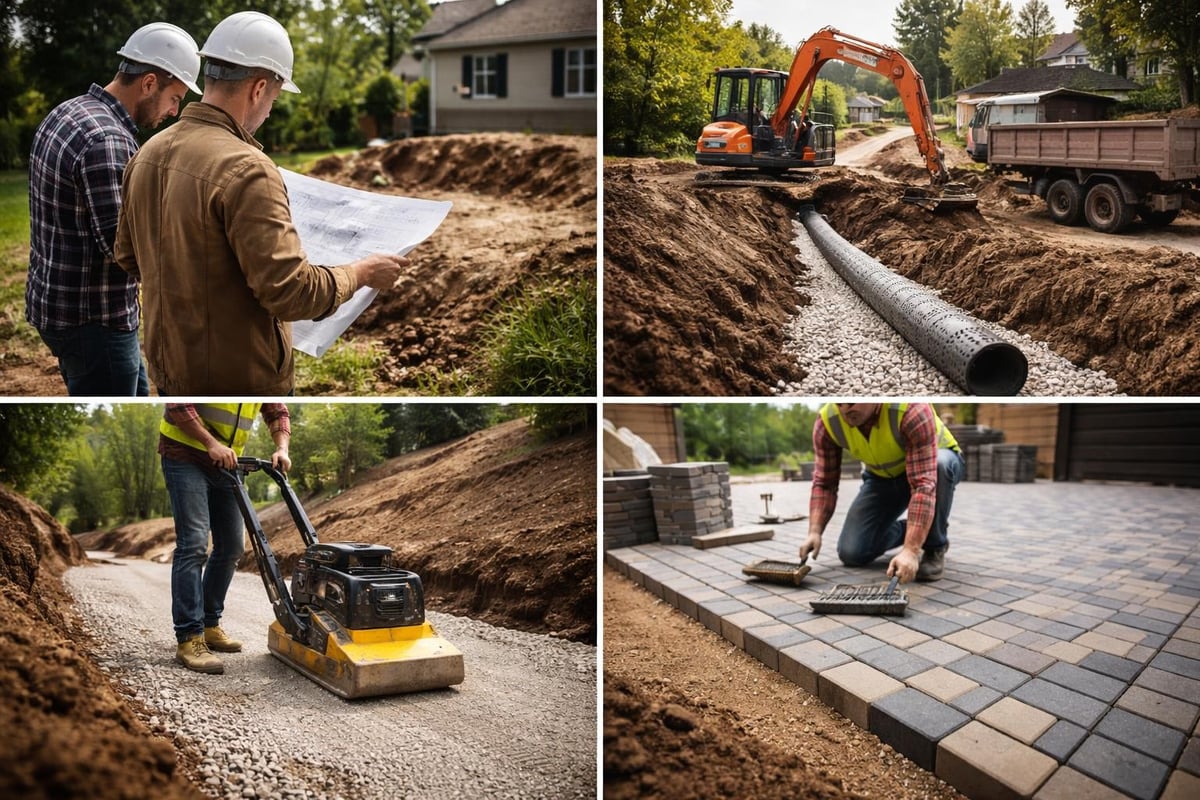
Whilst large commercial projects capture headlines, earth works excavating plays an equally vital role in residential developments and private property improvements. Driveway construction, patio installation, and garden landscaping all require the same fundamental excavation principles applied at appropriately scaled levels.
Residential projects often present space constraints that limit equipment access and material handling options. Compact excavators and mini-diggers provide the manoeuvrability required in tight locations whilst still delivering professional results. These smaller machines prove particularly valuable when working around existing structures, mature trees, or underground utilities where precision control outweighs raw productivity.
Driveway and Patio Construction Excellence
Creating durable driveways and patios begins with proper excavation and base preparation. Inadequate depth, poor drainage provision, or insufficient compaction inevitably lead to premature failure regardless of surface material quality. Professional contractors excavate to appropriate depths accounting for sub-base, base course, and wearing surface thicknesses.
Drainage design receives particular attention in residential earthworks. Surface water must be directed away from structures, preventing foundation undermining and basement infiltration. This requires careful consideration of cross-falls, longitudinal gradients, and connection points to existing drainage systems.
The successful completion of projects for clients across the North East demonstrates how attention to detail during excavation phases translates directly into long-term performance and customer satisfaction. Properly executed earthworks create stable platforms that resist settlement, manage water effectively, and provide reliable foundations for decorative surface treatments.
Environmental Considerations and Sustainable Practices
Modern earth works excavating increasingly incorporates environmental stewardship alongside technical excellence. Responsible contractors implement measures to minimise ecological disruption, protect water quality, and reduce carbon emissions associated with excavation activities.
Erosion and sediment control measures protect watercourses from contamination and prevent topsoil loss during construction. Silt fencing, sediment traps, and stabilised construction entrances intercept sediment-laden runoff before it leaves the site. These systems require regular maintenance and adjustment as site conditions evolve throughout project duration.
Material Reuse and Waste Minimisation
Sustainable excavating practices prioritise material reuse within project boundaries. Topsoil stripped during initial site preparation receives careful stockpiling for later redistribution in landscaped areas. This approach preserves valuable organic material whilst reducing both import and disposal costs.
Contaminated soil discovery triggers specific handling protocols to prevent environmental harm and ensure regulatory compliance. Proper characterisation, segregation, and disposal through licensed facilities protect both workers and the broader environment from hazardous substance exposure.
Quality Control and Project Documentation
Comprehensive quality control programmes distinguish professional earth works excavating from basic groundworks. Systematic testing, detailed documentation, and independent verification ensure projects meet engineering specifications and provide reliable performance throughout their design life.
Field density testing occurs at regular intervals during fill placement, with nuclear densometers or sand cone apparatus verifying achievement of specified compaction levels. Failed tests trigger remedial compaction before additional material placement, preventing the incorporation of inadequate work into the permanent structure.
Survey control maintains excavation accuracy throughout project execution. Establishing benchmark elevations and reference points enables operators to verify depths, grades, and alignments against design drawings. Modern GPS systems provide real-time positioning feedback, allowing immediate corrections and reducing reliance on manual grade checking.
As-built documentation captures actual field conditions, including deviations from original design, unexpected subsurface conditions, and utility locations encountered during excavation. This information proves invaluable for future maintenance activities, expansion projects, or forensic investigations should performance issues subsequently arise.
Future Trends in Excavation Technology
The excavation industry continues evolving through technological innovation and changing client expectations. Autonomous and semi-autonomous equipment promises enhanced productivity and improved safety by removing operators from hazardous environments. Electric and hybrid powertrains reduce emissions and noise pollution, making earth works excavating more compatible with urban environments and sensitive locations.
Building Information Modelling (BIM) integration connects excavation activities with broader project workflows, enabling real-time progress tracking and facilitating coordination amongst design disciplines. Digital twin technology allows stakeholders to visualise completed earthworks before physical work commences, identifying potential conflicts and optimising construction sequences.
Data analytics platforms process information from multiple sources, identifying patterns that inform decision-making and predict potential problems. Machine learning algorithms analyse historical project data to improve estimating accuracy, optimise equipment deployment, and refine productivity forecasting.
Professional earth works excavating requires the integration of technical knowledge, practical experience, and unwavering commitment to safety and quality standards. From initial site assessment through final grade verification, each phase demands careful attention to detail and adherence to established best practices. Whether undertaking major infrastructure development or residential property improvements, partnering with experienced professionals ensures projects achieve their performance objectives whilst maintaining the highest standards of workmanship. For civil engineering excellence across the North East and throughout the UK, discover how JRG Civils delivers exceptional results on projects of all scales, from commercial developments to private driveways and patios.