
When property development requires changes to existing highways, developers quickly encounter a crucial piece of legislation that governs how these modifications must be carried out. Section 278 of the Highways Act 1980 establishes the legal framework for highway improvements connected to development projects across England and Wales. Understanding the s278 process is essential for anyone planning commercial or residential development that impacts public roads, junctions, or access points.
What Is an S278 Agreement?
An s278 agreement is a legal contract between a developer and the local highway authority that permits alterations or improvements to the public highway. Named after Section 278 of the Highways Act 1980, this mechanism ensures that any highway works meet proper engineering standards and integrate seamlessly with existing infrastructure.
The agreement covers a wide range of highway modifications, from creating new vehicle access points to redesigning junctions for improved traffic flow. Most commonly, developers require s278 agreements when their projects necessitate changes to road layouts, installation of traffic signals, modification of kerb lines, or construction of pedestrian crossings.
Key elements typically covered by s278 agreements include:
- New or modified vehicle access points
- Junction improvements and reconfigurations
- Traffic signal installations and upgrades
- Pedestrian crossing facilities
- Street lighting enhancements
- Drainage systems and connections
- Road widening or realignment works
The Sheffield City Council guidance provides comprehensive details about the scope and requirements of these agreements, highlighting the technical standards that must be met throughout the process.
Legal Framework and Authority Responsibilities
Highway authorities possess statutory responsibility for maintaining public highways to appropriate standards. Through s278 agreements, they retain control over the quality and specification of works whilst allowing developers to fund and implement necessary improvements. This arrangement protects public interests whilst enabling development to proceed.

The S278 Application Process
Initiating an s278 agreement requires careful planning and engagement with the relevant highway authority well before construction begins. Early consultation prevents delays and ensures designs meet authority standards from the outset.
Stage One: Pre-Application Engagement
Developers should contact the highway authority during the planning stage to discuss proposed works and determine whether an s278 agreement will be required. This initial dialogue clarifies expectations and identifies potential design constraints before detailed plans are prepared.
Most authorities now provide specific guidance documents and application checklists. The West Northamptonshire Council guidance offers a detailed overview of prerequisites and procedural requirements that developers must satisfy.
| Stage | Key Activities | Typical Timeline |
|---|---|---|
| Pre-application | Initial consultation, scope definition | 2-4 weeks |
| Design development | Technical drawings, specifications | 6-12 weeks |
| Agreement drafting | Legal documentation, fee calculation | 4-8 weeks |
| Approval | Authority review and sign-off | 4-6 weeks |
Stage Two: Design and Technical Approval
Once the scope is agreed, developers or their appointed consultants prepare detailed designs conforming to highway authority standards. These designs undergo rigorous technical assessment, often requiring multiple revisions before approval.
Engineering consultants play a vital role here, translating development requirements into compliant highway designs. Specialists in s278 works understand authority expectations and can navigate technical requirements efficiently.
The design phase typically includes:
- Detailed highway layout drawings
- Longitudinal and cross-sectional profiles
- Drainage design and calculations
- Street lighting proposals
- Traffic signal specifications
- Materials specifications and schedules
- Construction phasing plans
- Road safety audits
Stage Three: Legal Agreement and Financial Security
Following design approval, the formal legal agreement is drafted, setting out obligations, timelines, and quality standards. Developers must provide financial security, typically through a bond or cash deposit, covering the estimated construction costs plus a contingency allowance.
The agreement also addresses liability insurance requirements, inspection arrangements, and defect rectification periods. Most authorities require a maintenance bond to cover potential defects for 12 months following practical completion.
Financial Considerations and Cost Components
S278 agreements involve various costs beyond the physical construction works themselves. Understanding the complete financial picture enables accurate budgeting and prevents unexpected expenditure during project delivery.
Primary cost elements include:
- Design and consultancy fees
- Highway authority administration charges
- Legal fees for agreement preparation
- Construction and materials costs
- Site supervision and inspection fees
- Commuted sums for future maintenance
- Performance bonds and insurance
Commuted sums deserve particular attention, as they represent the authority's estimated cost of maintaining the new infrastructure over a defined period, typically 20-25 years. These sums are calculated using prescribed formulae based on the type and extent of works.
Fee Structures and Administration Charges
Highway authorities charge fees to cover their costs in processing applications, reviewing designs, supervising construction, and administering the agreement. Fee structures vary between authorities but generally comprise an initial application fee plus hourly rates for technical review and site inspections.
The Warwickshire County Council s278 programmes page provides transparency around their approach to managing these agreements, including typical timescales and process stages.

Common Types of S278 Works
Development projects trigger s278 requirements in diverse scenarios, each presenting unique engineering challenges and regulatory considerations. Commercial developments typically necessitate more extensive highway modifications than residential schemes, though both require equal attention to safety and functionality.
Junction Improvements and Access Creation
Creating new access points onto classified roads represents one of the most frequent s278 applications. These works must consider sight lines, traffic flow, pedestrian safety, and integration with existing highway geometry.
Junction improvements often accompany retail or leisure developments where increased traffic volumes necessitate enhanced capacity. The design and implementation of s278 works requires specialist knowledge of highway engineering standards and traffic modelling techniques.
Pedestrian and Cycling Facilities
Modern planning authorities increasingly demand improvements to pedestrian and cycling infrastructure as conditions of planning permission. S278 agreements frequently incorporate new footways, cycle lanes, crossing facilities, and associated traffic calming measures.
These sustainable transport enhancements align with broader policy objectives around active travel and reduced vehicular dependency. They also improve accessibility for all users, including those with mobility impairments.
| Work Type | Common Applications | Key Design Considerations |
|---|---|---|
| Access creation | Commercial units, residential estates | Visibility splays, turning radii |
| Junction modifications | Retail parks, mixed-use developments | Capacity analysis, signal timing |
| Pedestrian crossings | Schools, community facilities | Walking desire lines, accessibility |
| Traffic calming | Residential developments | Speed reduction, community acceptance |
Working with Civil Engineering Contractors
Selecting an experienced civil engineering contractor is crucial for successful s278 delivery. The contractor must understand highway authority expectations, maintain quality throughout construction, and manage the complex approval and inspection processes.
Professional contractors bring several advantages to s278 projects:
- Established relationships with local highway authorities
- Experience in meeting technical specifications and standards
- Knowledge of inspection protocols and approval requirements
- Capability to manage multiple stakeholders effectively
- Resources to handle programme adjustments and variations
For businesses undertaking commercial developments, partnering with specialists who have delivered similar projects provides assurance and reduces risk. Those who have completed multiple franchise developments, for instance, understand the specific requirements of commercial access arrangements and associated highway works.
Construction Phase Management
Once the s278 agreement is executed and design approved, construction can commence under the highway authority's supervision. The authority conducts regular inspections to verify compliance with approved plans and specifications.
Contractors must provide advance notice of key construction stages, allowing inspectors to attend at critical points such as formation level, sub-base installation, and surface course laying. Any deviations from approved designs require formal approval through a variation process.
The application process for s278 agreements outlined by Sheffield City Council emphasises the importance of maintaining clear communication throughout construction to ensure timely completion and approval.
Technical Standards and Design Requirements
Highway works under s278 agreements must conform to current design standards, primarily those published in the Design Manual for Roads and Bridges (DMRB) and local highway authority specifications. These standards ensure consistency, safety, and longevity across the highway network.
Materials and Construction Specifications
Highway authorities specify approved materials for different highway elements, from road construction layers to drainage components and street furniture. Using non-approved materials typically results in rejection and costly remediation.
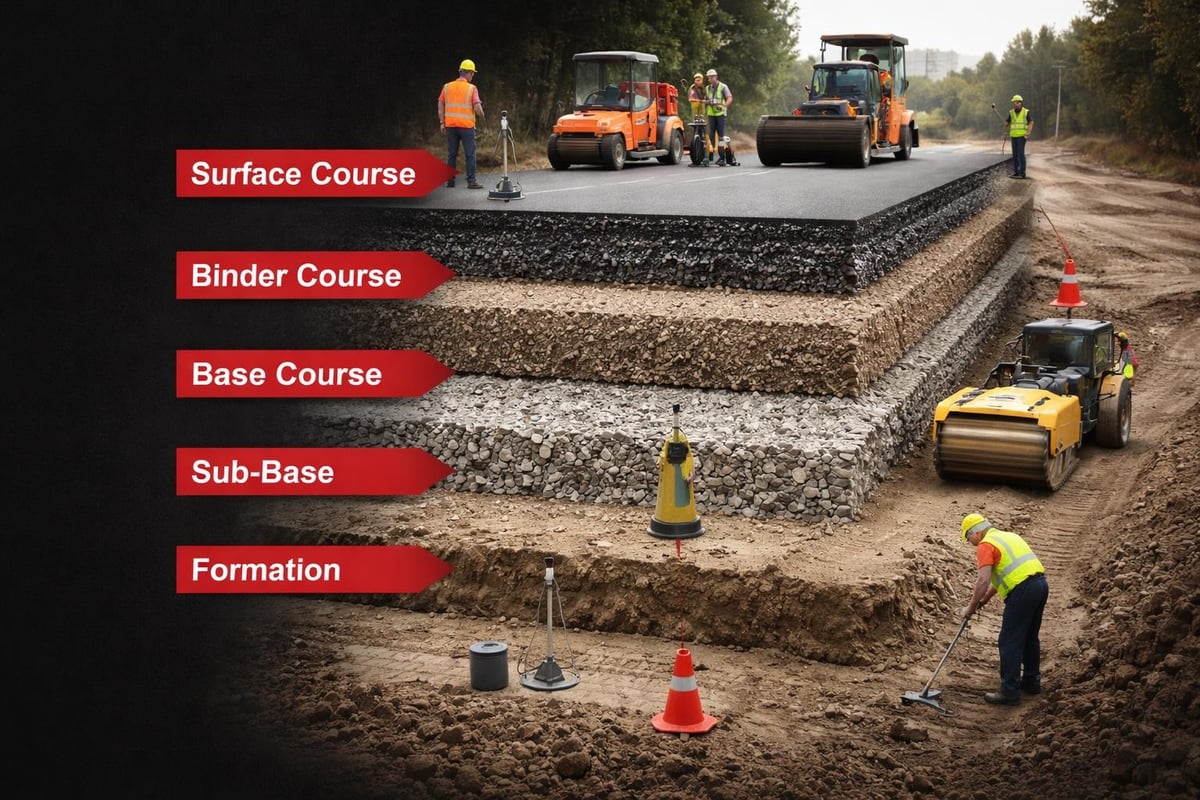
Road construction typically follows a prescribed layer structure:
- Formation level preparation and stabilisation
- Capping layer (where ground conditions require)
- Sub-base installation and compaction
- Base course or roadbase
- Binder course
- Surface course with appropriate texture depth
Each layer undergoes testing to verify thickness, compaction, and material properties before the subsequent layer is permitted. This rigorous approach ensures the highway asset performs as designed throughout its service life.
Drainage and Service Integration
Proper highway drainage is fundamental to pavement longevity and safety. S278 designs must demonstrate effective surface water management, usually requiring connection to existing drainage systems or construction of new infrastructure.
Service diversions frequently complicate s278 works, particularly in urban locations where underground utility apparatus is dense. Early engagement with utility companies identifies conflicts and allows diversion works to be programmed appropriately.
Regional Variations and Authority-Specific Requirements
Whilst s278 legislation applies uniformly across England and Wales, individual highway authorities implement their own procedural requirements and technical specifications. Developers working across multiple local authority areas must adapt to these variations.
Some authorities provide detailed guidance documents and standardised application forms, whilst others require more bespoke approaches. The Croydon Council highways agreements page exemplifies comprehensive guidance that clarifies expectations for developers.
Understanding Local Context
Highway authorities consider local traffic conditions, accident records, and strategic priorities when reviewing s278 proposals. A junction design acceptable in one authority area might require modification elsewhere due to different traffic patterns or safety concerns.
Rural authorities may have different priorities compared to urban councils, particularly regarding public transport access, cycling provision, and pedestrian facilities. Understanding these local contexts improves design acceptance and reduces revision cycles.
Risk Management and Quality Assurance
S278 projects carry inherent risks that require proactive management throughout the process. Delays in approval, design changes during construction, adverse ground conditions, and utility conflicts can all impact programme and cost.
Effective risk mitigation strategies include:
- Early highway authority engagement during planning
- Comprehensive ground investigation before design
- Utility searches and verification surveys
- Adequate contingency allowances in budgets
- Experienced design consultants and contractors
- Regular communication with all stakeholders
- Formal change control procedures
Quality assurance extends beyond construction materials and workmanship to encompass design compliance, safety standards, and environmental considerations. Highway authorities may require independent certification of certain aspects, particularly structural elements and traffic signal systems.
Road Safety Audits
Road safety audits form a mandatory component of most s278 schemes, examining designs at various stages to identify potential safety concerns. Independent auditors assess proposals from the perspective of all road users, recommending modifications where hazards are identified.
The audit process typically occurs at:
- Preliminary design stage
- Detailed design stage
- Pre-opening stage (following construction)
- Post-opening stage (12 months after opening)
Addressing audit recommendations sometimes requires design revisions that impact costs and programmes, reinforcing the importance of getting designs right from the outset.
The Role of Professional Consultants
Given the technical complexity and procedural requirements of s278 agreements, many developers engage specialist consultants to manage the process on their behalf. These professionals provide valuable expertise in highway engineering, planning coordination, and authority liaison.
Transport planning consultants assess development trip generation, model traffic impacts, and design mitigation measures. Highway engineers translate these requirements into buildable schemes that satisfy authority standards. Project managers coordinate the various disciplines and maintain programme momentum.
Understanding what the s278 process involves helps developers appreciate the value these consultants bring and make informed decisions about resource allocation.
S278 Versus S38 Agreements
Developers sometimes confuse s278 agreements with Section 38 agreements, though they serve distinct purposes. Whilst s278 covers modifications to existing highways, Section 38 of the Highways Act 1980 governs the adoption of new roads constructed within developments.
Larger developments often require both types of agreement: s38 for estate roads that will become maintainable at public expense, and s278 for improvements to existing highways external to the development site.
| Agreement Type | Purpose | Typical Application | Adoption Outcome |
|---|---|---|---|
| S278 | Modify existing highway | Junction improvements, new access | Already adopted highway |
| S38 | Construct new highway | Estate roads in developments | Highway becomes adopted |
The flowchart from North Yorkshire County Council illustrates the relationship between different agreement types and helps developers determine which applies to their circumstances.
Environmental and Sustainability Considerations
Contemporary highway design increasingly incorporates environmental protection and sustainability principles. S278 schemes must consider sustainable drainage systems (SuDS), biodiversity impacts, carbon emissions, and whole-life environmental performance.
Permeable paving materials, infiltration systems, and green infrastructure features are now commonly integrated into highway designs. These approaches manage surface water sustainably whilst providing environmental benefits beyond traditional drainage solutions.
Highway authorities may require environmental assessments for significant s278 works, particularly those affecting sensitive locations or involving substantial earthworks. Air quality impacts receive particular scrutiny in urban areas and where developments generate significant traffic increases.
Post-Completion and Adoption
Following construction completion and final inspection, the highway authority issues a completion certificate confirming the works meet the agreed specification. However, the developer's obligations continue through a defects liability period, typically 12 months.
During this period, the developer remains responsible for rectifying any defects arising from workmanship or materials. The maintenance bond lodged at the agreement's outset provides security for the authority should the developer fail to address defects.
Once the defects period expires satisfactorily, the authority releases the bond and formally adopts the new or modified highway. Maintenance responsibility transfers to the authority, funded through the commuted sum paid by the developer.
Long-Term Asset Management
The commuted sum calculation reflects the additional maintenance burden created by new infrastructure. Authorities use these funds to maintain assets to appropriate standards over their design life, ensuring public safety and network performance.
For complex installations such as traffic signals or intelligent transport systems, ongoing maintenance costs can be substantial. Developers should factor these commuted sums into project viability assessments from the earliest planning stages.
Key Considerations for Commercial Developments
Commercial developments often trigger more extensive s278 requirements than residential schemes due to higher traffic generation and specific operational needs. Drive-through restaurants, retail parks, and industrial estates all present unique access challenges.
The timing of highway works relative to development construction requires careful coordination. Access infrastructure must be operational before the development opens, necessitating early progression of s278 agreements. For businesses with extensive experience in commercial projects, understanding these timescales is second nature.
Peak hour access capacity becomes critical for commercial uses, requiring detailed traffic modelling and often signal-controlled junctions. These complex installations increase both design timescales and construction costs compared to simpler priority junctions.
Lessons from Industry Experience
Organisations with track records in delivering s278 works develop valuable insights that benefit subsequent projects. Understanding authority preferences, building relationships with highway officers, and maintaining quality standards throughout construction all contribute to smoother approvals and successful outcomes.
The importance of documentation cannot be overstated. Comprehensive records of materials testing, inspection attendance, design revisions, and correspondence protect all parties and facilitate final approval. Professional contractors maintain rigorous quality management systems that satisfy authority requirements.
Flexibility and problem-solving abilities prove essential when unexpected issues arise. Ground conditions differing from investigations, utility conflicts, or design adjustments during construction all require swift resolution whilst maintaining compliance with the s278 agreement.
Understanding s278 agreements is fundamental for anyone involved in development that impacts public highways, from initial feasibility through to final adoption. The process demands technical expertise, procedural knowledge, and effective stakeholder management to deliver compliant infrastructure on programme and within budget. Whether you're planning commercial facilities or residential enhancements, partnering with experienced civil engineering specialists ensures your highway works meet all requirements. JRG Civils brings comprehensive expertise in delivering s278 works across the UK, combining technical excellence with professional project management to achieve successful outcomes for clients throughout the development process.