
When planning any development project that impacts public highways, understanding the legal obligations surrounding road alterations becomes essential. A section 278 agreement represents one of the most significant legal mechanisms developers encounter when their projects require modifications to existing highway infrastructure. Whether you're constructing a new commercial development with enhanced access points, building residential properties requiring improved junctions, or creating drive-through facilities like coffee shops or restaurants, navigating these agreements efficiently can mean the difference between project success and costly delays.
Understanding Section 278 Agreements and Their Legal Framework
A section 278 agreement derives its authority from the Highways Act 1980, the primary legislation governing highway management in England and Wales. This legal instrument enables developers to enter formal arrangements with local highway authorities to execute necessary works on public highways associated with development projects.
The fundamental purpose centres on ensuring that any highway alterations meet statutory standards whilst protecting public safety and maintaining road network integrity. These agreements establish clear responsibilities, technical specifications, and financial obligations between all parties involved.
Key Components of Highway Agreements
Every section 278 agreement typically encompasses several critical elements that govern the relationship between developer and authority:
- Scope of works: Detailed specifications of all highway modifications required
- Technical approvals: Engineering standards and design requirements
- Financial arrangements: Cost estimates, payment schedules, and commuted sums
- Programme timelines: Construction phases and completion deadlines
- Maintenance provisions: Long-term responsibility clarification
- Bond requirements: Financial guarantees ensuring work completion
The legal framework provided by local authorities ensures consistency across different regions whilst allowing for site-specific adaptations. Highway authorities maintain strict oversight throughout the entire process, from initial design submission through to final certification.

The Application Process and Technical Requirements
Initiating a section 278 agreement requires meticulous preparation and thorough documentation. The application process demands early engagement with highway authorities, ideally during pre-planning stages to identify potential complications before they escalate into project-threatening issues.
Local authorities such as West Sussex County Council provide comprehensive guidance on their specific application procedures, including necessary forms and supporting documentation. Starting this dialogue early allows developers to understand local requirements, anticipated timescales, and potential cost implications.
Design Stage Requirements
The design phase represents perhaps the most technically demanding aspect of any section 278 agreement. Highway authorities scrutinise proposals against rigorous engineering standards, safety protocols, and long-term maintenance considerations.
Professional highway design services, such as those offered by specialist consultants, ensure submissions meet approval standards first time. This expertise proves invaluable when navigating complex junction improvements, pedestrian crossing facilities, or traffic signal installations.
Design submissions must demonstrate:
- Compliance with Design Manual for Roads and Bridges (DMRB) standards
- Adequate provision for all road users including pedestrians and cyclists
- Appropriate drainage solutions integrated with existing systems
- Future maintenance accessibility considerations
- Road safety audit completion at appropriate stages
- Traffic management proposals during construction phases
Technical drawings require exceptional accuracy, with even minor discrepancies potentially triggering rejection and requiring costly resubmissions. Many commercial projects, including drive-through developments similar to those completed by civil engineering contractors, benefit from experienced professionals who understand both design requirements and practical construction constraints.
Financial Considerations and Cost Management
Understanding the financial implications of a section 278 agreement forms an essential component of project budgeting. Costs vary significantly depending on project scale, location, existing infrastructure condition, and the complexity of required modifications.
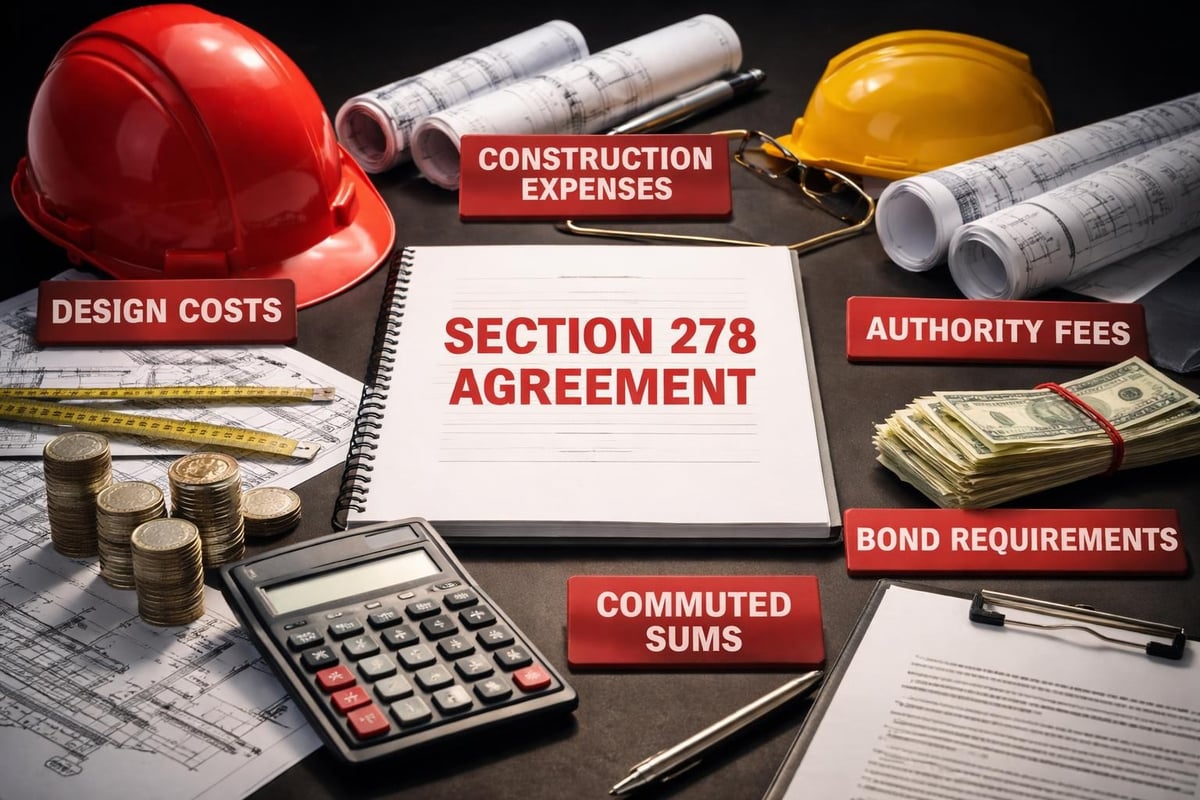
Detailed cost breakdowns reveal that expenses extend beyond physical construction works. Developers must account for design fees, legal costs, authority inspection charges, commuted sums for future maintenance, and bond arrangements.
Cost Components Breakdown
| Cost Element | Typical Range | Purpose |
|---|---|---|
| Design Fees | £5,000-£50,000 | Professional highway design and approvals |
| Legal Fees | £2,000-£10,000 | Agreement drafting and completion |
| Construction Works | £20,000-£500,000+ | Physical highway alterations |
| Authority Fees | 10-15% of works | Inspection and administration |
| Commuted Sums | Variable | Future maintenance contributions |
| Bond Costs | 1-5% annually | Financial guarantee provision |
Commuted sums deserve particular attention as they represent long-term financial commitments. Highway authorities calculate these payments based on anticipated maintenance requirements over defined periods, typically 10-25 years. New surface materials, drainage systems, or street lighting installations all attract commuted sum obligations.
Bond Requirements and Financial Guarantees
A section 278 agreement bond provides the highway authority with financial security, ensuring works reach completion even if developers encounter financial difficulties. These instruments protect public interests by guaranteeing that highway modifications don't remain unfinished, potentially creating safety hazards or traffic disruption.
Specialist providers arrange section 278 agreement bonds on behalf of developers, typically requiring bonds valued at 125% of estimated construction costs. This premium accounts for potential cost escalations and ensures sufficient funds exist to complete works under any circumstances.
Types of Bond Arrangements
Different bond structures suit varying project requirements and developer circumstances:
- Cash deposits: Simplest arrangement but ties up working capital
- Bank guarantees: Traditional approach requiring established banking relationships
- Insurance bonds: More accessible option for smaller developers
- Parent company guarantees: Viable for developers within larger corporate structures
The bond period typically extends until the highway authority formally adopts completed works, which may occur months or even years after physical completion. Understanding these timeframes proves crucial for financial planning and working capital management.
Construction Phase Management and Quality Control
Once designs receive approval and agreements are executed, construction phases commence under strict highway authority supervision. The practical delivery of highway works demands exceptional attention to detail, adherence to approved plans, and continuous quality assurance.
Experienced civil engineering contractors understand that highway works operate under different constraints compared to standard construction projects. Public safety considerations, traffic management requirements, and potential disruption to road users necessitate meticulous planning and execution.
Quality Assurance Protocols
Highway authorities implement rigorous inspection regimes throughout construction:
- Pre-commencement meetings: Confirming understanding of all requirements
- Material approvals: Testing and certification before installation
- Stage inspections: Authority engineers reviewing work at critical points
- Independent testing: Third-party verification of construction quality
- As-built documentation: Accurate records of completed works
- Snagging inspections: Identifying remedial requirements before adoption
Weather conditions, material availability, and coordination with utility companies frequently impact programme delivery. Maintaining open communication with highway authority inspectors helps navigate inevitable challenges whilst preserving project momentum.
Professional civil engineering teams bring valuable experience from previous highway projects, understanding how to anticipate inspection requirements and deliver works that meet adoption standards first time. This expertise significantly reduces the risk of expensive rectification works or project delays.

Common Project Types Requiring Section 278 Agreements
Understanding which developments typically trigger section 278 agreement requirements helps developers anticipate obligations during early planning stages. While every project presents unique circumstances, certain development categories consistently require highway modifications.
Commercial developments frequently necessitate improved access arrangements, particularly retail facilities, drive-through restaurants, and service stations. These projects often require new junction formations, traffic signal installations, or pedestrian crossing facilities to accommodate increased traffic movements safely.
Development Categories and Typical Requirements
| Development Type | Common Highway Works | Agreement Complexity |
|---|---|---|
| Drive-through facilities | New access, queuing lanes, signals | Medium-High |
| Residential estates | Junction improvements, footways | Medium |
| Industrial units | Heavy vehicle access, visibility splays | Medium |
| Retail developments | Pedestrian crossings, bus stops | High |
| Office complexes | Cycle facilities, parking restrictions | Low-Medium |
Residential developments ranging from single dwellings to large housing estates require careful consideration of access standards, visibility requirements, and pedestrian connectivity. Even modest developments may trigger agreement requirements if existing highway conditions prove inadequate for anticipated traffic generation.
Industrial and commercial warehouse facilities present particular challenges due to heavy goods vehicle movements. Junction geometry, road surface strengthening, and turning area provisions often require substantial highway modifications necessitating detailed agreements.
Regional Variations and Local Authority Requirements
Whilst the Highways Act 1980 provides overarching legislative framework, individual highway authorities maintain specific procedures, technical standards, and fee structures. Developers operating across multiple regions must adapt to these variations, with different councils implementing distinct approaches to agreement administration.
Some authorities publish comprehensive supplementary planning documents outlining their expectations, whilst others maintain more informal guidance. Understanding local preferences before submitting applications prevents unnecessary iterations and accelerates approval processes.
Pre-Application Engagement Benefits
Early dialogue with highway authorities yields multiple advantages:
- Clarification of technical requirements specific to the locality
- Identification of potential design challenges before formal submissions
- Cost estimate refinement based on local fee structures
- Programme timeline establishment reflecting authority resources
- Relationship building with officers who'll oversee the project
Regional infrastructure priorities also influence agreement requirements. Authorities focusing on sustainable transport may emphasise cycling provisions and public transport connectivity, whilst rural authorities might prioritise agricultural vehicle accommodation and drainage capacity.
Documentation and Template Resources
Proper documentation underpins successful section 278 agreement completion. From initial applications through final certification, maintaining comprehensive records proves essential for smooth project delivery and future reference.
Customisable agreement templates provide useful starting points, though legal advice ensures provisions adequately protect all parties' interests. Standard templates require adaptation to specific project circumstances, local authority preferences, and site-specific requirements.
Essential documentation typically includes:
- Technical drawings: General arrangements, construction details, drainage layouts
- Design calculations: Pavement design, drainage capacity, traffic modelling
- Method statements: Construction sequencing and traffic management
- Risk assessments: Health and safety provisions for highway works
- Quality plans: Testing schedules and inspection protocols
- Programme charts: Construction timelines and milestone dates
Highway authorities increasingly require digital submissions in specific formats, with building information modelling (BIM) adoption growing across the sector. Understanding these requirements early prevents last-minute reformatting exercises that delay approvals.
Risk Management and Contingency Planning
Highway works inherently carry risks that extend beyond typical construction projects. Public safety responsibilities, potential third-party claims, and authority enforcement powers necessitate comprehensive risk management strategies.
Insurance arrangements require particular attention, with public liability cover, professional indemnity insurance, and contractor all-risks policies all playing important roles. Section 278 agreements typically specify minimum insurance requirements that developers and their contractors must maintain throughout construction periods.
Common Risk Factors
Successfully delivered highway projects anticipate and mitigate various risk categories:
- Design risks: Unforeseen ground conditions or utility conflicts
- Programme risks: Weather delays or material supply disruptions
- Cost risks: Price escalations or additional authority requirements
- Quality risks: Non-compliance with specifications requiring remediation
- Third-party risks: Damage to adjacent properties or utilities
- Adoption risks: Authority rejection of completed works
Experienced contractors understand how to manage these risks through thorough site investigations, robust programming, quality materials specification, and continuous communication with authority inspectors. This proactive approach minimises the likelihood of disputes or costly variations.
Long-Term Implications and Maintenance Obligations
Section 278 agreements create lasting relationships between developers and highway authorities extending well beyond construction completion. Understanding long-term implications helps developers make informed decisions about design specifications and material selections.
Adoption procedures represent the final stage of section 278 agreement completion. Highway authorities conduct detailed inspections verifying that all works comply with approved designs and meet adoption standards. Only after satisfactory completion do authorities assume maintenance responsibility for new highway assets.
The period between practical completion and formal adoption varies considerably, typically ranging from twelve months to several years depending on authority resources and project complexity. During this interim period, developers remain responsible for maintaining works to adoptable standards, rectifying any defects, and addressing authority concerns.
Commuted sum payments compensate authorities for enhanced maintenance burdens resulting from development-related highway modifications. These calculations consider material specifications, anticipated replacement cycles, and ongoing operational costs. Selecting durable materials and proven construction methods can reduce commuted sum obligations whilst ensuring long-term asset performance.
Strategic material selection proves particularly important for developments in areas experiencing heavy traffic volumes or harsh weather conditions. Premium surface materials, robust drainage systems, and quality street furniture justify higher initial investments through reduced long-term maintenance requirements and lower commuted sums.
Working with Professional Partners
Successfully navigating section 278 agreement processes often requires collaboration with multiple professional disciplines. Highway engineers, planning consultants, legal advisers, and specialist contractors each contribute essential expertise to project delivery.
Selecting appropriately experienced professionals significantly influences project outcomes. Practitioners familiar with local authority procedures, regional preferences, and technical requirements deliver smoother approval processes and more efficient construction phases. Their established relationships with authority officers facilitate problem-solving and expedite decision-making.
Civil engineering contractors with demonstrated highways experience bring practical knowledge that complements design team expertise. Understanding how theoretical designs translate into constructed reality helps anticipate potential complications and develop workable solutions. This practical perspective proves invaluable when balancing authority requirements against project constraints and commercial realities.
Projects ranging from major commercial developments to smaller access improvements benefit from professional input proportionate to their scale and complexity. Even straightforward applications require careful preparation, accurate documentation, and appropriate technical knowledge to avoid costly mistakes or prolonged approval delays.
Navigating section 278 agreements successfully requires careful planning, technical expertise, and thorough understanding of both legal requirements and practical construction considerations. Whether you're developing commercial premises requiring new access arrangements or residential projects needing improved highway connectivity, professional guidance ensures efficient delivery and compliance with all obligations. At JRG Civils, we bring extensive experience in highway works and civil engineering projects across the UK, delivering excellent standards from initial design through to completion, ensuring your development proceeds smoothly and meets all highway authority requirements.