
Precast kerbing represents a cornerstone of modern civil engineering and highways construction, offering unmatched consistency, durability, and installation efficiency. Whether you're planning a commercial development, residential driveway, or major highways project, understanding the advantages and specifications of precast concrete kerb units enables informed decision-making that delivers long-term value. From manufacturing standards to installation techniques, this comprehensive guide explores everything you need to know about precast kerbing solutions in 2026.
What Is Precast Kerbing and Why It Matters
Precast kerbing consists of concrete kerb units manufactured in controlled factory environments before being transported to site for installation. This differs fundamentally from in-situ methods where concrete is poured and formed on location.
The manufacturing process ensures consistent quality across every unit. Factory conditions allow precise control over concrete mix ratios, curing temperatures, and dimensional accuracy. This controlled environment eliminates many variables that affect on-site concrete work, such as weather conditions, inconsistent mixing, and variable curing times.
Key characteristics of precast kerbing include:
- Uniform strength and density throughout each unit
- Precise dimensional tolerances for seamless alignment
- Immediate availability for rapid installation
- Reduced on-site labour requirements
- Consistent aesthetic appearance across projects
The relevance to civil engineering projects cannot be overstated. When constructing highways, commercial car parks, or residential driveways, kerbing defines edges, channels water, and provides structural support to paved surfaces. Quality matters immensely in these applications, as failures can lead to edge subsidence, drainage issues, and costly remedial work.

Manufacturing Standards and Quality Specifications
Understanding the standards governing precast kerbing manufacture ensures you specify appropriate products for your project requirements. The European Standard EN 1340 establishes comprehensive requirements for unreinforced, cement-bound precast concrete kerb units, channels, and complementary fittings used in trafficked paved areas.
Strength Classifications
Precast kerbing must meet specific compressive strength requirements based on intended application. The concrete kerb mountability standards define classifications that ensure appropriate performance characteristics.
| Strength Class | Minimum Compressive Strength | Typical Applications |
|---|---|---|
| Class 1 | 35 MPa | Light traffic residential areas |
| Class 2 | 40 MPa | Standard highways and commercial |
| Class 3 | 50 MPa | Heavy-duty industrial applications |
Water absorption limits also form critical quality parameters. Maximum absorption rates typically must not exceed 6% by mass, ensuring frost resistance and long-term durability in British climates.
Dimensional Tolerances
Manufacturing precision directly impacts installation efficiency and finished appearance. Typical tolerances for precast concrete components include product tolerances, erection tolerances, and interfacing tolerances.
For standard precast kerbing, acceptable dimensional variations typically range from ±3mm for length and height to ±2mm for thickness. These tight tolerances enable contractors to achieve consistent alignment and minimal joint widths during installation.
Types and Profiles of Precast Kerbing
Different project requirements demand specific kerb profiles and configurations. Understanding available options ensures optimal selection for your particular application.
Standard Profiles
Half-battered kerbs feature a sloped face and represent the most common profile for highways and urban infrastructure. The angled face assists with drainage and provides a defined edge whilst allowing controlled mountability where necessary.
Flat-topped kerbs offer horizontal upper surfaces suitable for pedestrian areas and locations requiring wheelchair accessibility. These profiles integrate seamlessly with paving slabs and tactile paving systems.
Bull-nosed kerbs incorporate rounded edges for aesthetic applications in landscaping and decorative features. The curved profile softens visual appearance whilst maintaining functional edge definition.
- Identify the primary function (drainage, edge retention, traffic barrier)
- Consider aesthetic requirements and architectural context
- Evaluate traffic loads and mountability needs
- Assess integration with adjacent paving materials
- Specify appropriate strength class for expected loading
Specialist Applications
Some projects require bespoke precast kerbing solutions. Radius units enable curved alignments for roundabouts, turning circles, and organic landscape designs. Corner units provide pre-manufactured right-angle transitions, eliminating on-site cutting and ensuring clean intersections.
Channel units combine kerbing with integral drainage channels, offering dual functionality in space-constrained installations. These prove particularly valuable in commercial car parks and industrial yards where efficient surface water management is essential.
Installation Best Practices and Techniques
Proper installation techniques determine the longevity and performance of precast kerbing systems. Following established procedures ensures optimal results whilst minimising future maintenance requirements.
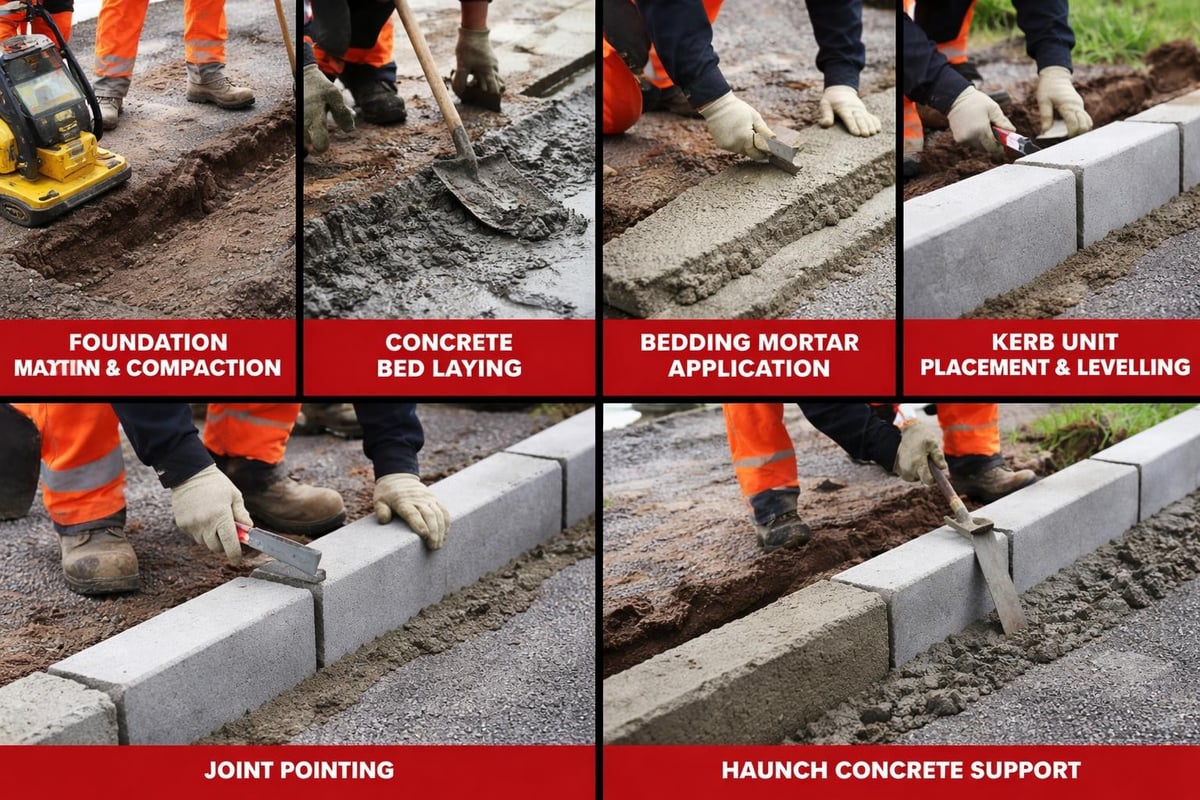
The Bosun kerbs installation guide provides detailed methodology applicable across various project types. Key considerations include foundation preparation, bedding materials, alignment control, and joint treatment.
Foundation and Bedding Requirements
Adequate foundation support prevents differential settlement and maintains alignment over time. Excavate to sufficient depth to accommodate:
- Compacted sub-base material (typically 100-150mm)
- Concrete foundation bed (minimum 100mm thickness)
- Bedding mortar layer (25-50mm)
- Kerb unit height to achieve required reveal
The concrete foundation should extend beyond the kerb width on both faces. A common specification requires 150mm rear support and 100mm front projection, creating a stable base that resists rotation and movement.
Alignment and Level Control
Establishing accurate string lines at the required finished height ensures consistent alignment throughout installation. Regularly check both horizontal and vertical alignment using:
Horizontal control: String lines set at precise offsets from known survey stations or existing features
Vertical control: Laser levels or optical instruments referenced to site benchmarks
Straightness: Sight along completed sections to identify any deviations requiring adjustment
Bedding mortar should be firm enough to support the kerb weight whilst remaining workable for adjustment. A typical mix ratio of 1:3 cement:sharp sand provides appropriate characteristics for most applications.
Comparative Advantages Over Alternative Methods
Evaluating precast kerbing against alternative installation methods highlights specific benefits relevant to different project contexts.
Precast vs Slipform Kerbing
Slipform kerbing involves extruding concrete continuously using specialised machinery that moves along the proposed alignment. Whilst slipform kerbing offers advantages for long, straight sections, precast units excel in scenarios requiring:
| Factor | Precast Kerbing | Slipform Kerbing |
|---|---|---|
| Installation flexibility | Immediate placement, any weather | Weather-dependent, requires dry conditions |
| Complex alignments | Excellent for curves and angles | Best for long straight runs |
| Site access | Minimal equipment requirements | Requires specialist machinery access |
| Quality assurance | Pre-tested strength before installation | Relies on on-site curing conditions |
For the diverse projects undertaken by civil engineering contractors, including commercial developments and residential enhancements, precast kerbing provides versatility that slipform methods cannot match.
Cost Efficiency Considerations
Initial material costs for precast kerbing may appear higher than in-situ alternatives. However, total project costs often favour precast solutions when accounting for:
- Reduced labour hours due to faster installation
- Elimination of formwork requirements
- Immediate trafficking without extended curing periods
- Lower risk of installation failures requiring remedial work
- Consistent quality reducing callbacks and warranty claims
Quality Assurance and Inspection Protocols
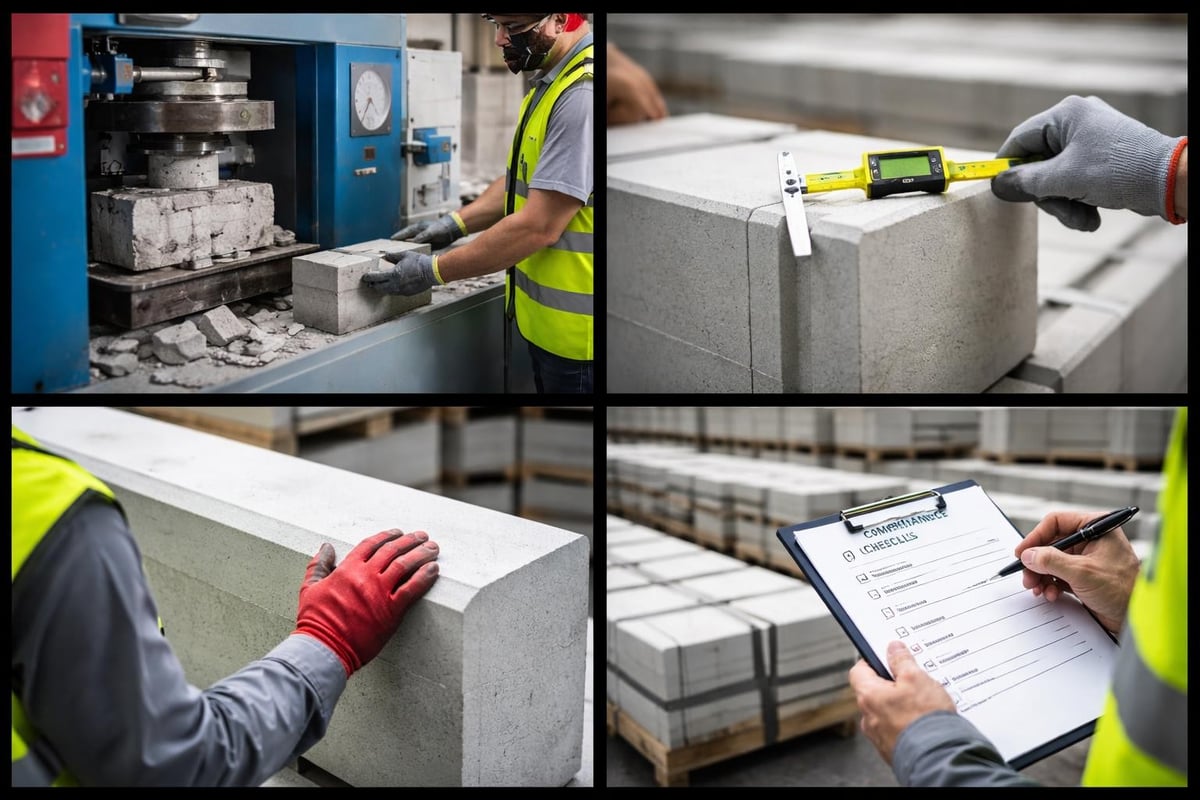
Ensuring precast kerbing meets specification requirements protects project outcomes and long-term performance. Implementing robust quality assurance processes at both procurement and installation stages proves essential.
Pre-Installation Checks
Inspect delivered units before installation commences. Reject any components showing:
- Cracks, chips, or spalling exceeding acceptable limits
- Dimensional variations outside specified tolerances
- Surface defects compromising appearance or integrity
- Discolouration suggesting improper curing or contamination
Reputable manufacturers provide test certificates confirming compliance with relevant standards. Verify these documents reference the specific batch delivered to your site.
Post-Installation Verification
Following installation completion, systematic inspection ensures workmanship meets project specifications:
- Alignment accuracy: Maximum deviation of 10mm over 3m lengths
- Level consistency: Variations not exceeding 3mm in 3m sections
- Joint widths: Uniform spacing within 3-5mm range
- Haunch concrete: Properly compacted support extending minimum 150mm behind kerb
- Surface finish: Free from damage, staining, or contamination
Photographic records provide valuable documentation for project handover and future reference.
Maintenance and Long-Term Durability
Precast kerbing manufactured to appropriate standards and installed correctly delivers decades of service with minimal maintenance requirements. Understanding potential issues and preventive measures optimises lifecycle performance.
Common Deterioration Mechanisms
Freeze-thaw damage occurs when absorbed water expands during freezing cycles, causing internal stresses. Specifying low water absorption units and ensuring adequate drainage prevents this issue in British climates.
Chemical attack from de-icing salts or industrial contaminants can degrade concrete over time. High-quality mixes with appropriate cement types provide enhanced resistance to aggressive environments.
Impact damage from vehicles or maintenance equipment typically affects exposed corners and arrises. Strategic placement and adequate setbacks from traffic lanes minimise this risk.
Preventive Maintenance Strategies
- Regular inspection identifying early signs of deterioration
- Prompt repair of minor damage preventing progressive failures
- Maintaining effective drainage preventing water accumulation
- Cleaning vegetation growth from joints and interfaces
- Monitoring adjacent paving for settlement affecting kerb support
The ASTM standard for precast concrete barriers provides relevant guidance on materials and manufacturing processes ensuring safety and durability, applicable to kerbing applications.
Sustainability and Environmental Considerations
Modern civil engineering increasingly prioritises environmental responsibility alongside traditional performance criteria. Precast kerbing offers several sustainability advantages relevant to contemporary project requirements.
Manufacturing Efficiency
Factory production enables optimisation of concrete mixes, minimising cement content whilst maintaining required strength. Controlled batching reduces waste compared to on-site mixing, where excess material often cannot be efficiently utilised.
Reusable moulds generate negligible waste across thousands of production cycles. This contrasts sharply with single-use formwork required for in-situ concrete work.
Environmental benefits of precast manufacturing include:
- Precise material quantities eliminating over-ordering
- Recycling of water used in production processes
- Centralised quality control reducing defective products
- Efficient energy use through optimised curing protocols
- Reduced transportation through consolidated deliveries
Lifecycle Assessment
Durability directly impacts environmental performance. Precast kerbing installations lasting 50+ years avoid the embodied carbon and disruption associated with premature replacement. This longevity proves particularly valuable in highways applications where reconstruction traffic management generates significant indirect environmental impacts.
End-of-life considerations also favour precast systems. Concrete kerbs can be crushed and recycled as aggregate for new construction, creating circular economy benefits. Mechanical removal proves straightforward compared to demolishing monolithic in-situ structures.
Application Scenarios Across Project Types
Understanding how precast kerbing serves different project types enables appropriate specification and optimises value delivery.
Commercial Developments
Drive-through facilities, retail car parks, and commercial premises require robust edge definition managing vehicle trafficking whilst providing clear pedestrian delineation. Projects like Costa Coffee and Greggs developments demand kerbing that withstands repeated vehicle loading whilst maintaining appearance standards reflecting brand identity.
High-strength precast units specified to Class 2 or Class 3 standards ensure adequate performance under these demanding conditions. The ability to closely match kerbing to paving colours and textures supports cohesive aesthetic outcomes.
Highways and Infrastructure
Major road schemes represent the traditional domain of precast kerbing. The various types of precast kerbs serve specific functions from traffic channelisation to drainage control and pedestrian protection.
Highways applications particularly value the consistency precast manufacturing delivers. When installing kilometres of kerbing, dimensional accuracy and uniform appearance prove critical to professional finished quality.
Residential Projects
Driveways, patios, and garden features increasingly incorporate precast kerbing for functional and aesthetic reasons. Homeowners appreciate the clean lines and immediate usability precast solutions provide compared to cast-in-place alternatives requiring extended curing.
The range of profiles and finishes available enables creative design whilst maintaining practical benefits. Exposed aggregate finishes, varied colours, and decorative profiles transform functional elements into landscape features.
Handling and Site Logistics
The precast installation guidelines emphasise proper handling procedures ensuring safety and preventing damage to units during storage, lifting, and placement.
Storage Requirements
Stockpile precast kerbing on firm, level ground preventing distortion or cracking. Support units at appropriate intervals, typically 600mm from each end and at mid-span for longer sections. Avoid stacking heights exceeding manufacturer recommendations, as excessive loads can damage lower units.
Protect stored units from contamination by soil, vegetation, or construction materials. Cover stockpiles during extended storage periods, though ensure adequate ventilation preventing moisture accumulation.
Lifting and Placement
Use appropriate lifting equipment and techniques matched to unit size and weight. Nylon slings positioned at designated lift points prevent damage to arrises and surfaces. Never drag or drop units, as impact loading can cause hidden cracks compromising structural integrity.
Position lifting equipment to enable precise placement without excessive adjustment once bedded. This preserves bedding mortar consistency and reduces labour time.
Integration with Modern Construction Methods
Contemporary construction increasingly adopts digital planning and precision methodologies. Precast kerbing aligns excellently with these approaches, offering predictable outcomes and simplified project management.
Digital Design Integration
Building Information Modelling (BIM) workflows accommodate precast kerbing as defined components with precise dimensions and properties. This enables accurate quantity surveying, clash detection with underground services, and coordinated design development.
Manufacturers increasingly provide digital product libraries compatible with standard CAD and BIM platforms. These resources streamline specification and ensure as-designed matches as-built outcomes.
Programme Benefits
Precast kerbing supports accelerated construction programmes through immediate availability and installation efficiency. Units can be manufactured during preliminary site works, arriving precisely when installation becomes practical.
This synchronisation reduces site occupation duration, minimises traffic management requirements on highways projects, and enables faster progression to subsequent work packages. For commercial developments requiring rapid completion, these programme advantages deliver tangible financial benefits through earlier revenue generation.
The expertise developed through projects ranging from major commercial works to residential enhancements demonstrates how adaptable precast kerbing proves across diverse applications. Understanding product specifications, installation requirements, and quality standards ensures optimal outcomes regardless of project scale or complexity.
Precast kerbing delivers consistent quality, installation efficiency, and long-term durability essential for successful civil engineering projects. Whether you're planning highways infrastructure, commercial developments, or residential enhancements, professional installation ensures optimal performance and appearance. Based in the North East and operating across the UK, JRG Civils brings expertise from major franchise projects to private driveways, delivering excellence in every finishing detail. Contact us to discuss how our civil engineering capabilities can support your next project.