
When planning commercial or residential developments that impact public highways, developers must navigate a complex regulatory framework. Section 278 of the Highways Act 1980 provides the legal mechanism for developers to modify, improve, or construct works affecting public roads. Understanding this process is essential for civil engineering firms, property developers, and contractors working on projects that require highway alterations, from new access points to complete junction redesigns.
What Is a Section 278 Agreement?
A section 278 agreement is a legally binding contract between a developer and the local highway authority that permits works to be carried out on the public highway. This legislative framework, established under the Highways Act 1980, ensures that any modifications to existing roads meet the required safety standards and technical specifications set by the relevant authority.
The agreement serves multiple purposes beyond simply granting permission. It establishes the scope of works, defines quality standards, determines who bears financial responsibility, and sets out inspection procedures. Developers cannot legally commence highway works without this formal arrangement in place, making it a critical component of the planning process.
St Helens Council provides comprehensive guidance on what these agreements entail and their role in development projects. The process protects both public interests and developer investments by creating clear expectations and responsibilities from project inception through to completion.
Common Works Covered Under Section 278
Highway modifications encompass a broad spectrum of civil engineering works. Typical projects include:
- New vehicle access points for commercial or residential developments
- Junction improvements and traffic signal installations
- Pedestrian crossing facilities and footway widening
- Street lighting installations and upgrades
- Drainage systems and surface water management
- Road realignment and carriageway alterations
- Bus stop infrastructure and public transport facilities
Each project type requires different technical assessments and design standards. The complexity varies significantly depending on the scale of intervention, traffic volumes, and existing highway conditions.
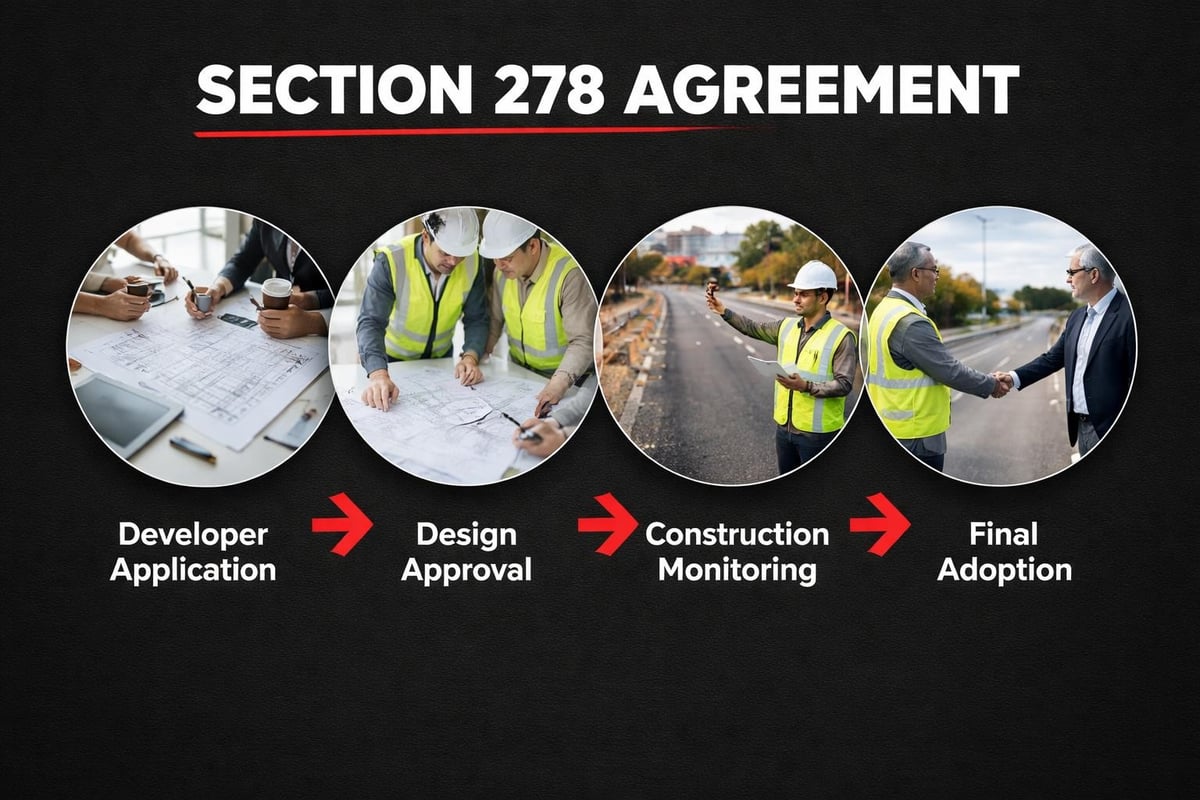
The Application Process for Section 278 Agreements
Securing a section 278 agreement involves multiple stages that require careful planning and coordination. The timeline typically extends over several months, and developers should account for this when scheduling project delivery.
Initial Consultation and Pre-Application
Before submitting a formal application, engaging with the local highway authority proves invaluable. This preliminary discussion helps identify potential issues, clarify technical requirements, and establish realistic timelines. Highway authorities can advise on design standards, safety audit requirements, and likely costs during these early conversations.
Many authorities now offer pre-application services for a fee, providing detailed feedback on proposed schemes before formal submission. This investment often saves time and reduces the risk of later revisions or rejections.
Formal Application Requirements
The application package must include comprehensive documentation demonstrating the proposed works meet all technical and safety standards. West Northamptonshire Council outlines detailed application checklists that developers must complete.
| Document Type | Purpose | Key Requirements |
|---|---|---|
| Technical Drawings | Detail exact scope of works | Scale plans, cross-sections, specifications |
| Safety Audit | Demonstrate road safety compliance | Stage 1 and Stage 2 audits by independent auditor |
| Traffic Assessment | Evaluate impact on highway network | Flow data, capacity analysis, signal timings |
| Drainage Design | Manage surface water | Calculations, outfall details, adoption strategy |
| Cost Estimate | Establish financial commutment | Detailed breakdown, contingency provision |
Additional documentation may include environmental assessments, utilities diversions plans, and temporary traffic management proposals. The completeness of the initial submission significantly influences processing times.
Design Approval and Technical Review
Once submitted, the highway authority undertakes a thorough technical review of all submitted materials. This examination verifies compliance with current design standards, including the Design Manual for Roads and Bridges (DMRB) where applicable, and local highway authority specifications.
The review process typically involves:
- Initial validation to ensure all required documents are present
- Technical assessment by highway engineers reviewing design adequacy
- Safety audit review to confirm no significant safety concerns exist
- Consultation with relevant internal departments and external bodies
- Formal approval or request for amendments and resubmission
This stage can take between eight to sixteen weeks depending on complexity and authority workload. Developers should maintain regular communication with case officers to address queries promptly and avoid unnecessary delays.
Financial Considerations and Cost Structure
The financial aspects of section 278 agreements extend beyond simple construction costs. Developers must understand the full cost structure to budget accurately for highway works within their overall project finances.
Application and Administration Fees
Highway authorities charge fees for processing applications and administering agreements. Manchester City Council details permission costs and associated guidance for applicants. These fees typically range from £1,500 to £5,000 for straightforward schemes, with more complex projects commanding higher charges reflecting the additional technical scrutiny required.
Administrative costs cover the authority's internal expenses for design checking, site inspections, and agreement management throughout the project lifecycle.
Construction and Implementation Costs
The actual construction expenditure forms the largest financial component. Developers can choose between two delivery models:
Developer-Led Delivery: The developer appoints their own contractor to execute the works under highway authority supervision. This approach offers greater control over timing and contractor selection but requires robust project management capabilities.
Authority-Led Delivery: The highway authority undertakes the works directly, recovering full costs from the developer. This model reduces developer risk and management burden but may offer less flexibility on programming and potentially higher costs.
Both approaches require developers to provide financial security, typically through a bond or deposit, ensuring funds are available to complete works should the developer default.

Commuted Sums and Long-Term Maintenance
A critical but sometimes overlooked cost component is the commuted sum. This payment covers the future maintenance liability that the highway authority assumes once works are completed and adopted. Buckinghamshire Council provides detailed guidance on applying for agreements including commuted sum calculations.
Authorities calculate these sums based on the type and extent of new highway infrastructure, typically covering 15 to 30 years of anticipated maintenance. For example, new street lighting columns attract higher commuted sums than simple kerbing modifications due to their ongoing energy and replacement costs.
Implementation and Construction Phase
Once the agreement is executed and all pre-commencement conditions satisfied, construction can begin. This phase demands careful coordination between the developer, contractor, highway authority, and other stakeholders to ensure works proceed smoothly and safely.
Pre-Construction Requirements
Before breaking ground, several critical approvals and arrangements must be secured:
- Traffic Management approval for any lane closures or diversions
- Utility diversions confirmed and protected
- Public liability insurance at specified levels
- Method statements approved by the highway authority
- Site compound locations agreed and established
- Emergency contact procedures documented and shared
The highway authority typically requires at least two weeks' notice before works commence, allowing them to schedule inspection resources and update road users about upcoming disruptions.
Quality Control and Inspection Regime
Highway authorities maintain strict quality standards throughout construction. Warwickshire County Council outlines objectives and processes for section 278 programmes, emphasising quality assurance at every stage.
Inspections occur at key hold points:
- Setting out verification before permanent works begin
- Structural layer inspections for pavement construction
- Drainage installation checks before backfilling
- Surface course approval before final surfacing
- Snagging inspections before practical completion
Each inspection must pass before subsequent works proceed. Failed inspections require remedial action at the developer's expense, potentially causing programme delays. Maintaining detailed records of materials, test results, and as-built information facilitates smooth inspection processes.
Defects Liability and Final Adoption
Following practical completion, a defects liability period begins, typically lasting twelve months. During this time, the developer remains responsible for rectifying any defects arising from poor workmanship or materials. The highway authority retains financial security throughout this period.
Only after successfully completing the defects period and final inspection does the highway authority formally adopt the new works into the publicly maintainable highway network. This adoption marks the conclusion of the developer's obligations under the section 278 agreement.
Regional Variations and Local Authority Differences
Whilst section 278 provides the overarching legislative framework, individual highway authorities implement their own procedures, standards, and fee structures. This variation reflects local priorities, capacity constraints, and specific highway network characteristics.
Processing Times and Resource Availability
Different authorities operate with varying resources and workloads, directly impacting application processing times. Some metropolitan authorities handle hundreds of applications annually and maintain dedicated development teams, whilst smaller rural authorities may process only a handful of agreements each year.
Doncaster Council explains their policy on amending existing highways, illustrating how local considerations shape implementation approaches. Developers working across multiple authority areas must adapt to these differences, potentially engaging local specialists familiar with specific authority requirements.
Technical Standards and Design Requirements
Highway authorities specify which design standards apply within their jurisdiction. Larger authorities typically reference national standards like the DMRB, whilst also maintaining supplementary local guidance covering specific aspects such as:
- Adoptable surfacing materials and specifications
- Street lighting column types and spacing
- Drainage design standards and outfall requirements
- Junction visibility splays and geometry
- Footway and cycleway widths
- Street furniture specifications
Understanding these local nuances early in the design process prevents costly revisions and delays later.
Common Challenges and How to Overcome Them
Even well-prepared developers encounter obstacles during the section 278 process. Recognising common pitfalls and implementing strategies to address them improves project outcomes.
Inadequate Early Engagement
Attempting to finalise designs before consulting the highway authority frequently leads to problems. Highway engineers may identify fundamental issues requiring substantial redesign, wasting time and money. Early, open dialogue establishes design parameters and identifies potential showstoppers before significant resources are committed.
Incomplete Applications
Submitting applications with missing information guarantees delays. Worcester County Council provides detailed application guidance including required documentation, helping developers compile complete submission packages first time.
Creating internal checklists cross-referenced against authority requirements ensures nothing is overlooked. Appointing experienced highway consultants often proves cost-effective, as their familiarity with authority expectations and design standards accelerates the process.
Underestimating Timescales
Developers frequently underestimate the time required to secure and implement section 278 agreements. From initial application to final adoption can easily span twelve to eighteen months for moderately complex schemes. This timeline must integrate with wider development programmes to avoid critical path delays.
Building realistic contingency into project programmes protects against unexpected complications. Regular progress monitoring and proactive communication with the highway authority help identify emerging delays early, when corrective action remains possible.
Working with Experienced Civil Engineering Contractors
The technical complexity and regulatory requirements of highway works under section 278 agreements demand contractors with specific expertise and track record. Selecting the right delivery partner significantly influences project success.
Essential Contractor Capabilities
Contractors undertaking section 278 works must demonstrate:
- Technical competence in highway construction standards and specifications
- Quality management systems meeting highway authority requirements
- Health and safety credentials appropriate for working in live traffic environments
- Experience with highway authority processes and inspection regimes
- Financial stability to support bonding and insurance requirements
- Programme management skills to coordinate multiple stakeholders
Firms with established relationships with local highway authorities often navigate the process more efficiently, understanding informal preferences alongside formal requirements. Their experience interpreting technical specifications and managing inspector expectations reduces friction and accelerates delivery.
The Role of Specialist Civil Engineering Firms
Specialist civil engineering contractors bring valuable expertise to section 278 projects. Companies with experience across commercial developments, infrastructure projects, and highway modifications understand the interdependencies between different work packages and can anticipate potential complications before they materialise.
This specialist knowledge proves particularly valuable on complex schemes involving multiple interfaces, such as new commercial developments requiring comprehensive access arrangements, parking facilities, and pedestrian infrastructure. Contractors familiar with projects like drive-through restaurants or retail developments understand the specific highway authority concerns these generate and can propose solutions aligned with approval requirements.

Best Practices for Successful Section 278 Delivery
Organisations regularly delivering highway works under section 278 agreements develop systematic approaches that improve efficiency, reduce costs, and minimise programme risk. These best practices span planning, execution, and closeout phases.
Strategic Planning and Timeline Management
Integrate section 278 requirements into project planning from the outset. Identify highway works scope during feasibility stage and establish indicative timelines for agreement procurement and delivery. This early recognition allows the section 278 process to run in parallel with other approval streams rather than becoming a sequential bottleneck.
Consider the following timeline framework for typical schemes:
| Phase | Duration | Key Activities |
|---|---|---|
| Pre-application consultation | 4-6 weeks | Authority engagement, scope definition |
| Design development | 8-12 weeks | Technical design, safety audits, documentation |
| Application submission and approval | 10-16 weeks | Authority review, amendments, formal approval |
| Legal agreement completion | 4-8 weeks | Drafting, negotiation, execution |
| Pre-construction approvals | 2-4 weeks | Traffic management, method statements |
| Construction phase | Variable | Delivery, inspections, testing |
| Defects period | 52 weeks | Monitoring, remediation, final adoption |
Documentation and Record Keeping
Maintaining comprehensive project records throughout the section 278 process proves invaluable. Detailed documentation supports smooth inspections, facilitates defect resolution, and provides evidence of compliance with agreement terms.
Essential records include:
- All correspondence with the highway authority
- Design calculations and basis of design reports
- Materials test certificates and compliance documentation
- Photographic records of construction progress
- Inspection reports and approvals
- As-built drawings reflecting actual construction
- Meeting minutes and site diary entries
Digital document management systems enable efficient organisation and retrieval of this information when required.
Stakeholder Communication and Management
Successful section 278 delivery depends on effective stakeholder management. Beyond the core relationship with the highway authority, projects often involve:
- Planning authorities enforcing planning conditions
- Utility companies protecting or diverting apparatus
- Public transport operators affected by temporary works
- Businesses and residents experiencing disruption
- Emergency services requiring access maintenance
- Environmental agencies regulating drainage discharge
Establishing clear communication protocols and maintaining regular dialogue with all parties prevents misunderstandings and facilitates collaborative problem-solving when challenges arise.
Future Developments and Evolving Standards
The highways sector continues evolving, with changing priorities around sustainability, active travel, and digital infrastructure influencing section 278 agreements and highway design standards. Developers and contractors must stay informed about these trends to ensure their proposals align with current policy directions.
Sustainability and Environmental Considerations
Highway authorities increasingly prioritise environmental performance in new highway works. This focus manifests through requirements for sustainable drainage systems (SuDS), specification of recycled materials, and reduced carbon construction methods. Section 278 agreements now commonly include conditions addressing environmental protection during construction and ongoing operational impacts.
Proactive developers incorporating sustainable design principles from project inception find these requirements easier to accommodate than those attempting retrofits after initial designs are complete.
Active Travel Infrastructure
Government policy emphasises walking and cycling infrastructure as part of the broader decarbonisation agenda. Section 278 agreements increasingly require developers to provide or enhance active travel facilities, including segregated cycleways, improved pedestrian crossings, and connectivity to existing networks.
Barnsley Council’s supplementary planning document provides comprehensive guidance on section 278 agreements and their role in delivering highway improvements, including emerging active travel requirements.
Digital Infrastructure and Smart Highways
The integration of digital technologies into highway networks creates new considerations for section 278 works. Ducting for future communication networks, intelligent traffic signal systems, and electric vehicle charging infrastructure increasingly feature in highway modification schemes. Forward-thinking developers accommodate these elements during initial construction, avoiding disruptive retrofitting later.
Understanding the section 278 process and its implications for development projects enables developers to plan effectively, budget accurately, and deliver highway works that satisfy both regulatory requirements and project objectives. With proper planning, experienced professional support, and proactive stakeholder engagement, the section 278 process becomes a manageable component of successful development delivery. Whether you're planning a major commercial development or smaller-scale highway modifications, having the right civil engineering partner makes all the difference. JRG Civils brings extensive experience delivering highway projects to exacting standards, working collaboratively with developers and highway authorities across the UK to ensure your section 278 works are completed on time, within budget, and to the highest quality standards.