
Curb stones represent a fundamental component of civil engineering infrastructure, serving critical functions that extend far beyond their simple appearance at road edges. These concrete or stone barriers define boundaries between roadways and pedestrian areas whilst managing water drainage, protecting pavement edges, and enhancing overall traffic safety. Whether you're planning a commercial car park, residential driveway, or extensive highway project, understanding curb stones ensures your investment delivers lasting value and performance.
Understanding Curb Stone Types and Applications
The selection of appropriate curb stones depends heavily on the specific requirements of your project. Different profiles serve distinct purposes, and choosing the correct specification ensures optimal functionality and longevity.
Standard Curb Stone Profiles
Barrier curbs stand as the most common type, typically measuring 150mm to 200mm in height. These robust installations prevent vehicles from mounting pavements and provide clear delineation between traffic areas and pedestrian zones. Commercial projects such as drive-through facilities and car parks frequently specify barrier curbs for their proven safety performance.
Mountable curbs feature a sloped profile allowing vehicles to cross when necessary. These installations typically measure 75mm to 100mm in height and prove invaluable in areas requiring occasional vehicular access. Residential driveways and certain commercial applications benefit from this versatility.
Rolled curbs present a curved profile that gently guides water whilst allowing limited vehicle mounting. These suit residential streets and areas where aesthetic appeal combines with functional requirements.
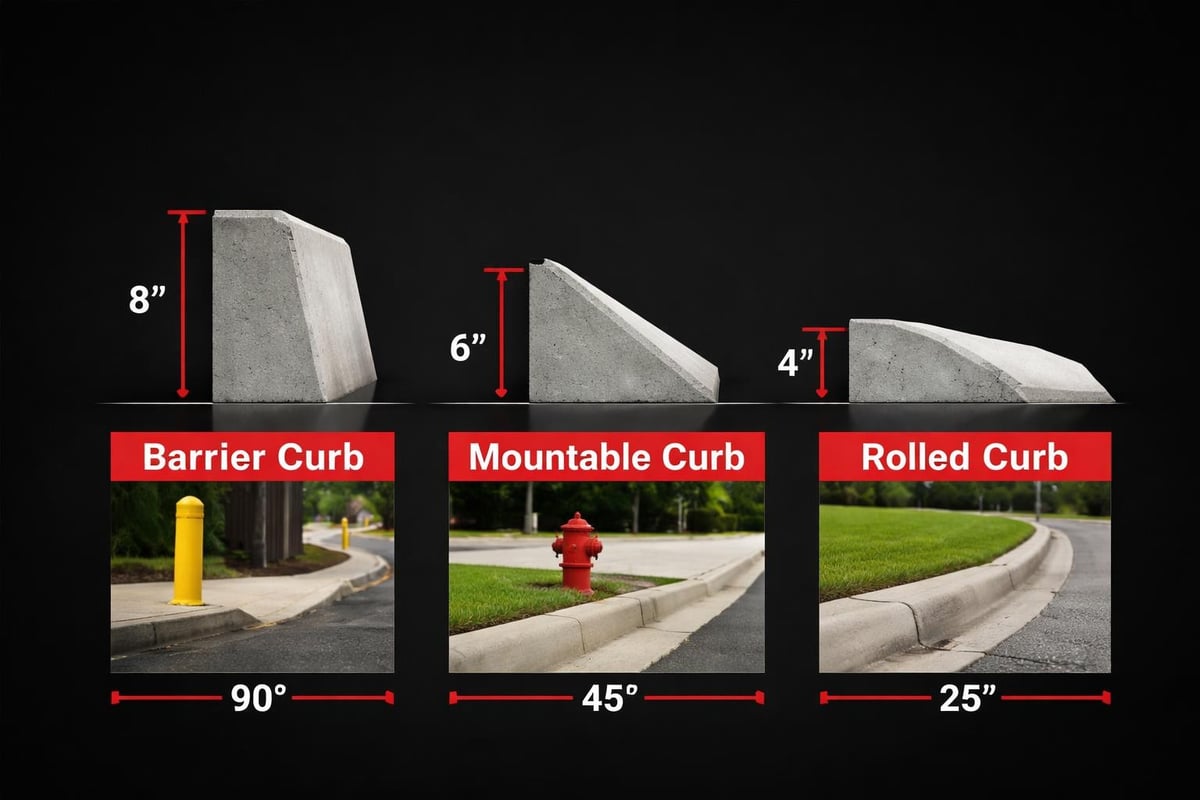
| Curb Type | Typical Height | Primary Function | Best Applications |
|---|---|---|---|
| Barrier | 150-200mm | Vehicle restraint | Highways, car parks |
| Mountable | 75-100mm | Controlled access | Driveways, residential |
| Rolled | 100-125mm | Drainage & aesthetics | Urban streets, estates |
| Decorative | Variable | Visual appeal | Landscaping, patios |
The construction process and standards for curb stones emphasize proper material selection and installation methodology to ensure durability and compliance with engineering requirements.
Material Selection and Specification Standards
Choosing appropriate materials for curb stones directly impacts project longevity, maintenance requirements, and overall performance. The decision process must consider environmental conditions, traffic volumes, and aesthetic requirements.
Concrete Curb Stones
Pre-cast concrete curb stones dominate modern civil engineering projects due to their consistency, strength, and cost-effectiveness. These units undergo rigorous quality control during manufacture, ensuring dimensional accuracy and structural integrity.
Key specifications include:
- Minimum compressive strength of 40 N/mm²
- Maximum water absorption rates below 6%
- Freeze-thaw resistance certification
- Appropriate aggregate sizing and cement content
Quality management guidelines establish comprehensive standards for materials used in road construction, ensuring durability and regulatory compliance throughout the supply chain.
Natural Stone Options
Granite, limestone, and sandstone curb stones offer distinctive aesthetic qualities and exceptional longevity. These materials particularly suit conservation areas, high-end residential developments, and projects requiring specific architectural character.
Natural stone specifications demand attention to:
- Dimensional tolerances and surface finish
- Resistance to weathering and chemical exposure
- Consistent colour and texture batches
- Appropriate sourcing and sustainability credentials
Understanding current and future standards for natural stone curbs helps ensure compliance with evolving industry requirements whilst maintaining quality throughout project delivery.
Professional Installation Methodology
Successful curb stone installation requires meticulous preparation, appropriate equipment, and adherence to established procedures. Poor installation compromises structural integrity and accelerates deterioration, regardless of material quality.
Site Preparation Requirements
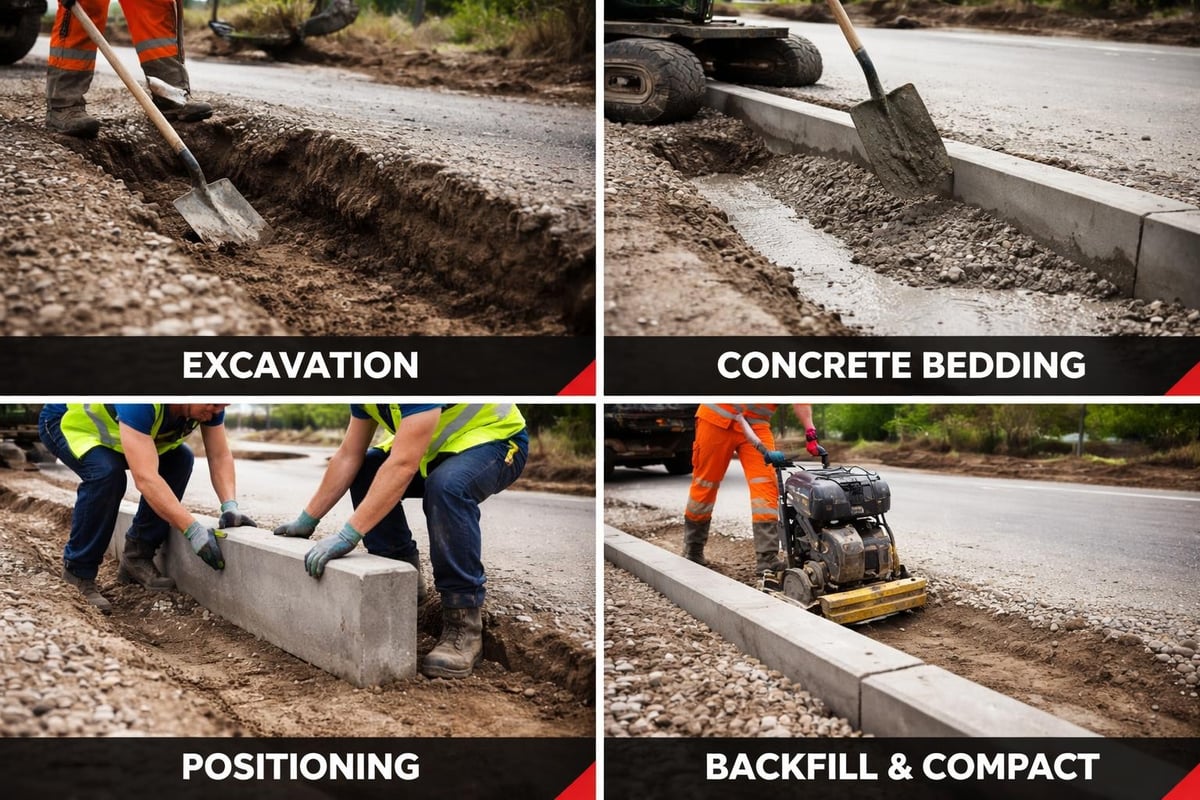
Foundation excavation must achieve correct depth and width to accommodate the curb stone plus concrete bedding. Typically, excavations extend 150mm below finished curb level and 300mm behind the rear face.
Sub-base preparation involves compaction to specified density levels, ensuring stable support for the concrete foundation. Most specifications require 95% maximum dry density throughout the sub-base layer.
Line and level establishment demands precision surveying to maintain correct alignment and gradient. String lines, laser levels, and regular checking prevent cumulative errors that compromise drainage performance and visual appearance.
Bedding and Haunching Techniques
The detailed procedures for curb stone laying work specify concrete bedding depths, haunching dimensions, and curing requirements that ensure long-term stability.
- Mix concrete bedding to ST4 specification (minimum 25 N/mm² strength)
- Lay bedding at consistent 100mm depth along prepared excavation
- Position curb stones accurately to line and level whilst concrete remains workable
- Apply haunching to both faces, extending minimum 150mm up the curb face
- Compact backfill in layers behind the haunch once concrete achieves initial set
Critical installation parameters:
- Concrete bedding thickness: 100-150mm
- Rear haunch width: 150-200mm from back face
- Front haunch width: 100mm minimum
- Joint spacing: typically 10mm maximum
- Curing period: minimum 24 hours before trafficking
Drainage Integration and Performance
Curb stones play vital roles in surface water management systems, directing runoff towards drainage infrastructure whilst preventing water damage to pavement structures. Proper integration with drainage systems maximizes their effectiveness.
Channel and Gulley Coordination
Longitudinal gradients along curb lines should maintain minimum 1:80 fall towards drainage points. This ensures consistent water movement without ponding that might freeze or accelerate pavement deterioration.
Gully spacing depends on rainfall intensity, catchment area, and surface permeability. Standard practice positions gullies at 20-40 metre intervals along conventional roads, with closer spacing in areas experiencing higher water volumes.
Innovative approaches to curb design for stormwater management demonstrate how thoughtful engineering reduces runoff velocity whilst capturing sediment, improving overall water quality in urban environments.
Joints and Expansion Provisions
Properly detailed joints accommodate thermal movement whilst preventing water ingress that might destabilize foundations or cause frost damage.
- Construction joints occur at natural break points, typically at day work boundaries
- Expansion joints appear at maximum 50-metre intervals using compressible filler
- Contraction joints prevent random cracking through controlled weakness planes
- Sealant application protects joint integrity and prevents debris accumulation
Quality Assurance and Inspection Protocols
Maintaining consistent quality throughout curb stone installation demands systematic inspection at critical stages. Well-defined acceptance criteria prevent defects whilst ensuring compliance with project specifications.
Pre-Installation Checks
Material verification confirms curb stones meet specified dimensions, strength characteristics, and visual quality standards. Random sampling and testing validate manufacturer compliance before installation commences.
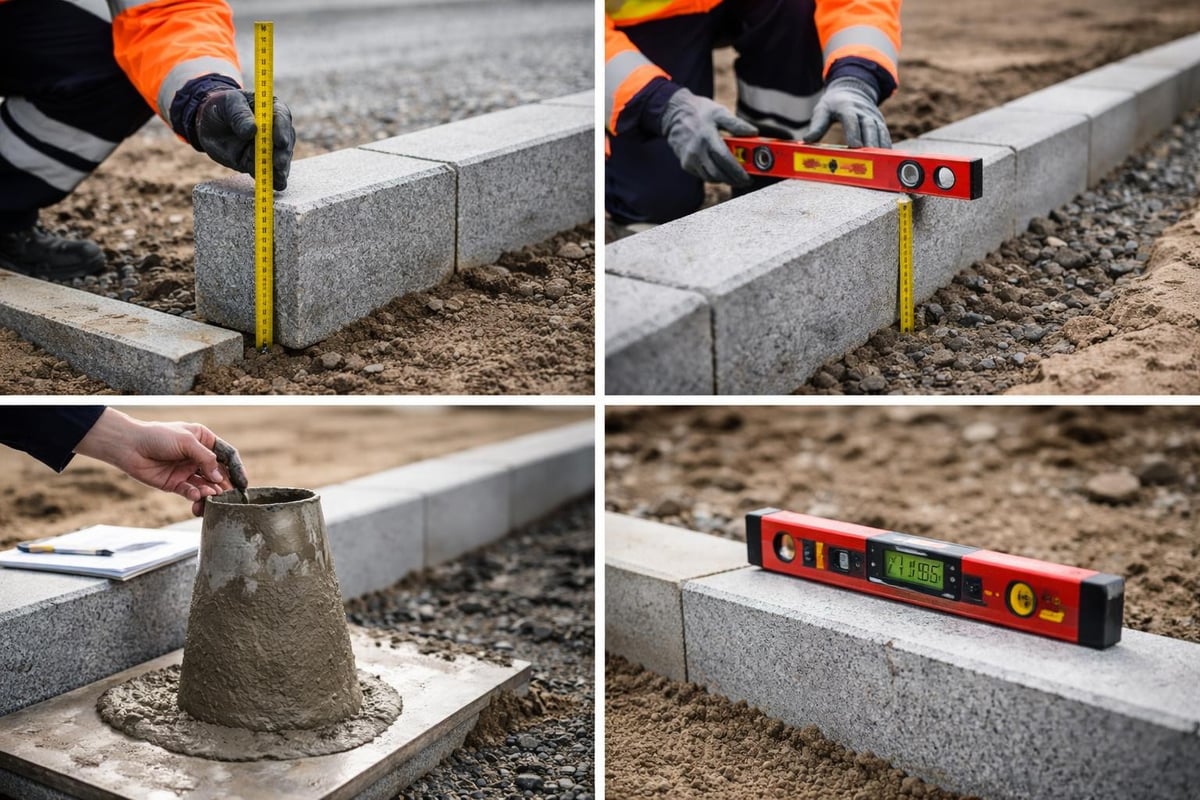
Setting out accuracy requires verification against project drawings, with permissible tolerances typically ±10mm horizontally and ±5mm vertically over 10-metre lengths.
The optimal acceptance standards for construction specifications provide frameworks for statistical quality control that enhance consistency whilst managing project costs effectively.
Post-Installation Assessment
| Inspection Point | Acceptance Criteria | Measurement Method |
|---|---|---|
| Line accuracy | ±10mm over 10m | String line/laser |
| Level tolerance | ±5mm over 10m | Precision level |
| Joint width | 5-10mm consistent | Feeler gauge |
| Face alignment | ±3mm variation | Straight edge |
| Concrete cure | No trafficking 24hrs | Visual/time log |
Final verification encompasses complete visual inspection, dimension confirmation, and drainage performance testing before project handover. Documentation should capture as-built conditions and any approved variations from original specifications.
Maintenance and Longevity Considerations
Well-installed curb stones deliver decades of reliable service when supported by appropriate maintenance regimes. Understanding common deterioration mechanisms enables proactive intervention that extends asset life.
Common Degradation Patterns
Joint deterioration frequently manifests as sealant failure, allowing water penetration and subsequent foundation weakening. Regular inspection and timely re-sealing prevent minor issues escalating into structural problems requiring extensive repairs.
Surface spalling results from freeze-thaw cycles, de-icing salt exposure, or inadequate concrete quality. Prompt attention to damaged sections prevents progressive deterioration affecting adjacent units.
Settlement and displacement indicate foundation problems or inadequate installation practices. Early intervention stabilizes affected sections before complete reconstruction becomes necessary.
Preventative Maintenance Strategies
- Annual joint inspections identify deteriorating sealant requiring replacement
- Surface cleaning removes debris that traps moisture and accelerates degradation
- Drainage verification ensures gullies remain clear and gradients function correctly
- Vegetation control prevents root damage and maintains clean appearance
- De-icing management employs curb-friendly materials minimizing concrete damage
Comprehensive understanding of curb definition, functions, and maintenance standards supports informed decision-making throughout the asset lifecycle, from initial specification through long-term maintenance planning.
Advanced Technologies in Curb Management
Modern civil engineering increasingly employs sophisticated technologies for curb stone inspection, monitoring, and management. These innovations enhance safety, reduce maintenance costs, and improve overall infrastructure performance.
Automated Detection Systems
CurbNet frameworks for curb detection utilize LiDAR point cloud segmentation technology, enabling automated identification and condition assessment across extensive road networks. This technology supports proactive maintenance scheduling and accurate asset inventories.
Benefits of automated inspection include:
- Comprehensive coverage without traffic disruption
- Consistent assessment criteria eliminating subjective variation
- Detailed condition databases supporting maintenance prioritization
- Cost reduction through targeted intervention planning
Digital Documentation and Asset Management
Modern project delivery demands comprehensive digital records capturing installation details, material specifications, and maintenance histories. These databases inform lifecycle planning whilst supporting warranty claims and future modification projects.
Integration with broader infrastructure management systems enables coordinated maintenance planning that optimizes resource allocation and minimizes disruption to road users and adjacent property owners.
Commercial and Residential Applications
Curb stones feature prominently across diverse project types, each presenting unique requirements and challenges. Understanding these variations ensures appropriate specification and installation practices.
Large Commercial Developments
Drive-through facilities, retail car parks, and commercial estates demand robust curb installations managing significant traffic volumes whilst maintaining aesthetic appeal. Projects like Costa Coffee and Greggs drive-throughs require careful coordination between curb positioning, drainage infrastructure, and traffic flow patterns.
Commercial project considerations:
- Heavy vehicle loading requirements
- Frequent turning movements demanding durable materials
- Precise dimensional control for traffic safety
- Integration with landscaping and surface water systems
- Compliance with accessibility regulations
Residential Enhancements
Domestic driveways, patios, and garden features benefit from curb stones providing clean boundaries, supporting different surface materials, and managing water runoff. These installations balance functional requirements with aesthetic preferences.
Property owners seeking professional civil engineering services can explore comprehensive solutions through JRG Civils’ portfolio of residential and commercial projects, benefiting from expertise developed across diverse applications throughout the North East and wider UK regions.
Regulatory Compliance and Standards
Professional curb stone installation must satisfy various regulatory requirements, industry standards, and local authority specifications. Navigating this landscape ensures projects proceed smoothly whilst delivering compliant outcomes.
National and Local Standards
British Standards provide detailed specifications for materials, dimensions, and installation practices. Key documents include standards for concrete products, natural stone, and construction workmanship that establish baseline quality requirements.
Highway authority specifications often impose additional requirements reflecting local conditions, traffic patterns, and maintenance philosophies. Early consultation prevents costly modifications during construction phases.
Safety and Accessibility Requirements
Modern infrastructure increasingly emphasizes inclusive design principles ensuring curb installations accommodate all users safely and conveniently.
- Dropped kerbs at pedestrian crossings meeting gradient and tactile paving requirements
- Visibility standards ensuring curb positioning doesn't obstruct sightlines
- Surface characteristics providing adequate slip resistance in wet conditions
- Maintenance provisions keeping facilities accessible throughout their service life
Environmental and Sustainability Factors
Contemporary civil engineering embraces sustainability principles throughout material selection, construction methodology, and lifecycle management. Curb stone specifications increasingly reflect these priorities.
Material Sourcing Considerations
Local material procurement reduces transportation emissions whilst supporting regional economies. Concrete curb stones manufactured within reasonable distances offer environmental advantages over distant natural stone sources.
Recycled content utilization in concrete mixes reduces primary resource consumption without compromising performance. Many modern specifications encourage or mandate minimum recycled aggregate percentages.
Natural stone sustainability demands verification of responsible quarrying practices, transportation efficiency, and long-term availability. Well-specified natural stone offers exceptional longevity offsetting higher initial environmental costs.
Permeable Solutions
Innovative curb designs increasingly integrate with permeable paving systems, managing surface water through infiltration rather than conventional drainage infrastructure. These approaches reduce flood risk whilst replenishing groundwater resources.
Implementation requirements include:
- Appropriate sub-base specification supporting infiltration
- Curb profiles allowing controlled overflow during extreme events
- Regular maintenance preventing system clogging
- Consideration of ground conditions and contamination risks
Successful curb stone installation combines appropriate material selection, meticulous installation practices, and ongoing maintenance commitment to deliver infrastructure performing reliably for decades. Whether you're planning commercial developments, highway projects, or residential enhancements, professional expertise ensures optimal outcomes that balance functionality, aesthetics, and long-term value. JRG Civils brings proven civil engineering excellence to projects throughout the UK, delivering the precision and quality your curb stone installation demands from initial planning through final completion.