
Granite kerbing has become the gold standard for edging solutions in both commercial and residential paving projects. This natural stone material offers exceptional durability, aesthetic appeal, and long-term value that surpasses alternative kerbing materials. Whether you're planning a driveway installation, highway project, or commercial development, understanding the properties, installation requirements, and benefits of granite kerbing ensures optimal results that stand the test of time.
Understanding Granite Kerbing and Its Applications
Granite kerbing serves multiple critical functions in civil engineering and paving projects. This hardwearing natural stone creates defined boundaries between different surface materials whilst providing structural support to paved areas. The inherent strength of granite makes it particularly suitable for applications where edges experience significant loading, from heavy commercial vehicle traffic to residential driveways.
Material Characteristics That Set Granite Apart
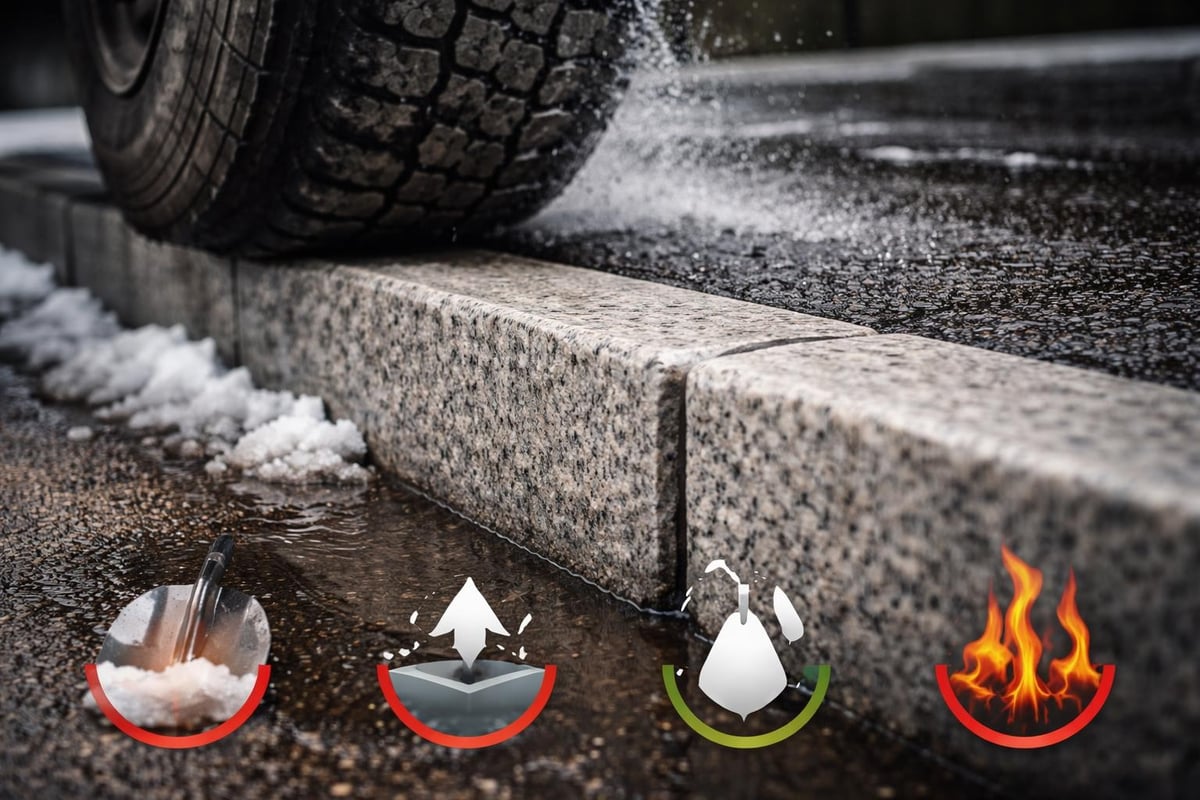
The geological formation of granite creates a material with exceptional compressive strength, typically ranging from 150 to 250 MPa. This density makes granite kerbing highly resistant to wear, weathering, and impact damage. The low porosity of properly sealed granite prevents water absorption, reducing the risk of frost damage during winter months.
Key performance characteristics include:
- Compressive strength exceeding most alternative kerbing materials
- Minimal water absorption rates (typically below 0.4%)
- Resistance to de-icing salts and chemical exposure
- Natural slip resistance on exposed surfaces
- UV stability maintaining appearance over decades
Temperature fluctuations have minimal impact on granite's structural integrity. Unlike concrete kerbing, which can develop cracks through freeze-thaw cycles, granite kerbing maintains its form even in harsh climate conditions. This resilience translates to reduced maintenance requirements and extended service life, often exceeding 50 years in highway applications.
Installation Methods and Best Practices
Proper installation determines the longevity and performance of any granite kerbing project. The installation process requires careful attention to foundation preparation, alignment, and bedding techniques. Understanding these fundamentals ensures optimal results whether you're working on a domestic driveway or a commercial car park.
Foundation Preparation Requirements
The foundation layer must provide stable support across the entire kerb line. Excavation depth depends on kerb height and expected loading conditions. For standard residential driveways, a foundation depth of 150mm typically suffices, whilst highway applications may require 300mm or more.
A well-compacted sub-base forms the critical load-bearing layer. Type 1 MOT aggregate compacted in 75mm layers achieves the necessary density and drainage characteristics. The installation procedures for rigid laying emphasise the importance of achieving consistent compaction throughout the foundation.
| Foundation Layer | Material Specification | Compaction Requirement |
|---|---|---|
| Sub-base | Type 1 MOT | 95% maximum dry density |
| Bedding | ST1 concrete (1:3:6) | Hand-tamped or compacted |
| Haunching | ST2 concrete (1:2:4) | Full height, both sides |
| Backfill | Free-draining granular | Layered compaction |
Setting and Alignment Techniques
Granite kerbing installation demands precision alignment to achieve professional results. Establishing accurate string lines at the correct height and offset ensures consistency across the entire installation. Each kerb unit should be positioned to these lines, checked with a spirit level, and adjusted before the bedding mortar sets.
The bedding layer typically consists of a semi-dry concrete mix (ST1) laid to approximately 25mm thickness. Each granite unit is carefully positioned and tapped down using a rubber mallet, checking alignment both longitudinally and vertically. Guidelines for kerbstone installation provide detailed specifications for achieving correct positioning.
Critical alignment checks include:
- Longitudinal alignment to string line (±5mm tolerance)
- Vertical face alignment using spirit level
- Consistent reveal height above adjacent surfacing
- Uniform joint spacing (typically 3-6mm)
- Grade following natural drainage patterns
Haunching provides essential lateral support to prevent kerb movement. Applied to both sides of the kerb, concrete haunching should extend to at least two-thirds of the kerb height and be shaped to shed water away from the foundation.
Specifications for Different Project Types
Granite kerbing specifications vary significantly based on project requirements and expected loading conditions. Highway projects demand different dimensions and installation standards compared to residential driveways, whilst commercial developments often fall somewhere between these extremes.
Highway and Road Applications
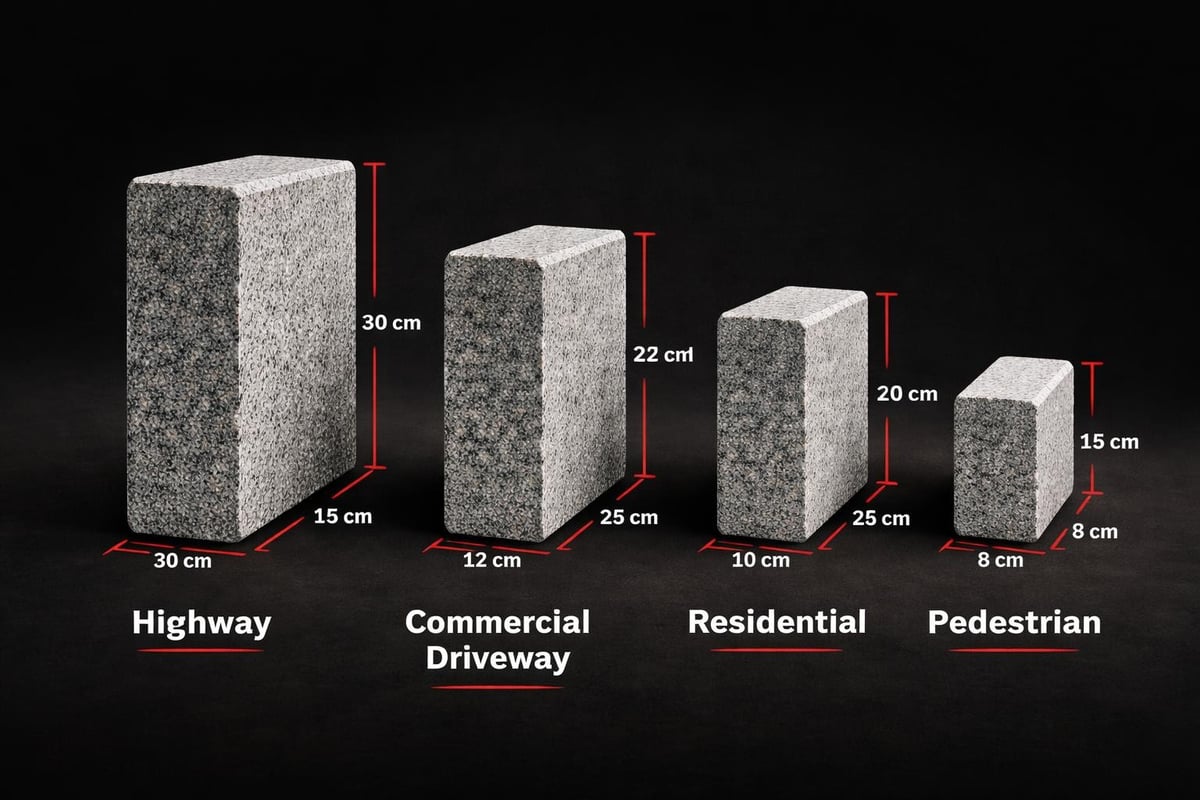
Highway granite kerbing typically measures 125mm x 255mm in cross-section, though variations exist for specific applications. The substantial mass and profile of highway kerbs withstand impacts from vehicles and heavy goods vehicles whilst clearly defining carriageway edges. Research on granite kerbstone performance under heavy traffic loads demonstrates the material's suitability for demanding applications.
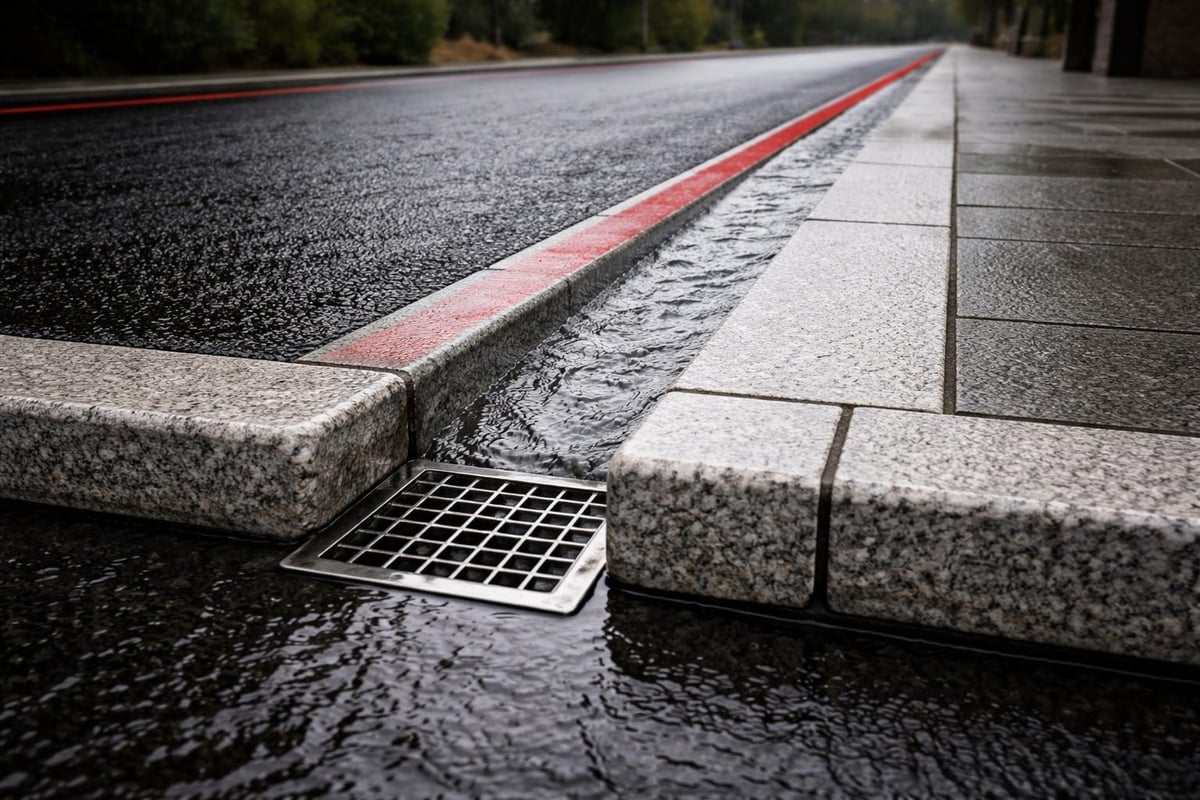
Drainage kerbs incorporate channels or openings to facilitate surface water management. These specialised units integrate seamlessly with highway drainage systems, directing water flow to gullies and preventing standing water on carriageways. The durability of granite makes it ideal for these applications where constant water flow might degrade lesser materials.
Residential and Commercial Driveways
Residential granite kerbing typically uses smaller profiles, commonly 100mm x 200mm or 80mm x 150mm sections. These dimensions provide adequate edge restraint for domestic paving whilst maintaining proportional aesthetics appropriate to residential settings. The versatility of granite allows for various finishes, from polished faces for contemporary designs to textured surfaces for traditional properties.
Commercial projects benefit from granite kerbing's ability to withstand concentrated loading. Car parks, service yards, and loading bays experience regular heavy vehicle movements that quickly damage inferior edging materials. The investment in granite kerbing proves economical when maintenance costs and replacement frequency are factored into whole-life costing.
Design Considerations and Aesthetic Options
Beyond functional performance, granite kerbing contributes significantly to project aesthetics. The natural variation in granite colouring and texture offers design flexibility whilst maintaining the practical benefits of this durable material. Careful specification ensures the kerbing complements the overall design vision whilst meeting performance requirements.
Colour and Texture Selections
Granite sourcing locations influence colour characteristics. Silver grey remains the most common specification for UK projects, offering neutral tones that complement various paving materials. Black granite creates bold contrast in contemporary designs, whilst pink and red granites suit heritage and traditional settings.
Surface finishes affect both appearance and functionality:
- Flamed finish: Creates textured surface with excellent slip resistance
- Honed finish: Smooth but not polished, suitable for most applications
- Polished finish: High-gloss appearance for premium installations
- Sawn finish: Natural, slightly rough texture as cut from block
- Split face: Rustic appearance with natural fracture patterns
Curved and Radius Kerbing
Complex layouts often require curved sections to follow site geometry. Granite kerbing excels in these applications through either purpose-cut radius units or small straight sections laid to approximate curves. For tight radii below 5 metres, custom-cut curved units provide the smoothest appearance and strongest installation.
The manufacturing process for curved granite kerbing involves either sawing from larger blocks to specific radii or splitting along natural grain lines for rustic applications. Matching curved and straight sections ensures visual consistency throughout projects. Experienced contractors understand the importance of maintaining joint patterns and alignment when transitioning between straight and curved sections.
Drainage Integration and Water Management
Effective water management represents a critical function of properly installed granite kerbing. The edge detail between paving surfaces and kerbs either facilitates or impedes drainage, directly impacting the longevity of the entire paved area. Strategic kerb positioning and detailing ensures optimal surface water clearance.
Surface Water Flow Patterns
Crossfall gradients direct water from paved surfaces towards kerb lines. Typical crossfall specifications range from 1:40 to 1:60, creating sufficient gradient for water movement without affecting vehicle or pedestrian comfort. The impermeability of granite kerbing forces water to flow longitudinally along the kerb line towards designated drainage points.
Channel blocks and drainage kerbs accelerate water removal from surface areas. These specialised units incorporate slots or channels that intercept flowing water and direct it into underground drainage systems. The positioning of these units at regular intervals prevents water accumulation during heavy rainfall events.
| Drainage Feature | Spacing Requirement | Application Type |
|---|---|---|
| Gully connections | 15-20m centres | Highway kerbing |
| Channel blocks | 10-15m centres | Commercial paving |
| Permeable joints | Continuous | Residential driveways |
| Cross drainage | As required by levels | Sloped sites |
Preventing Water Damage
Standing water poses significant risks to paving integrity. Proper kerb installation prevents water pooling by maintaining consistent grades and ensuring joints don't impede flow. The bedding and haunching concrete should be detailed to prevent water accumulation behind kerb faces, which can undermine foundations through freeze-thaw action.
Permeable options exist for environmentally sensitive sites. While granite itself is impermeable, installation techniques can incorporate permeable joints filled with resin-bound gravel or similar materials. This approach allows water infiltration whilst maintaining edge restraint and structural support.
Maintenance and Long-Term Performance
The minimal maintenance requirements of granite kerbing contribute significantly to its whole-life value proposition. Unlike timber edging requiring regular treatment or concrete kerbing prone to spalling, granite kerbing maintains performance with minimal intervention. Understanding appropriate maintenance protocols extends service life even further whilst preserving aesthetic qualities.
Routine Maintenance Procedures
Regular cleaning removes organic matter, dirt, and debris that can accumulate along kerb lines. Pressure washing at moderate settings (below 100 bar) effectively cleans granite surfaces without damaging the stone or mortar joints. Annual cleaning typically suffices for most installations, though areas under trees may benefit from more frequent attention.
Joint maintenance ensures structural integrity remains intact. Mortar joints should be inspected annually and repointed where deterioration is evident. Modern resin-based jointing compounds offer enhanced durability and flexibility compared to traditional cement mortars, particularly in applications experiencing vibration or thermal movement.
Annual inspection checklist includes:
- Joint condition and mortar integrity
- Kerb alignment and any settlement evidence
- Surface staining or biological growth
- Damage from impacts or heavy loading
- Drainage efficiency along kerb line
Repair and Replacement Procedures
Individual damaged units can be replaced without disturbing adjacent kerbing when properly installed. The process involves carefully removing haunching concrete, extracting the damaged unit, and installing a replacement following original installation procedures. Matching replacement granite to existing units ensures visual consistency, though weathering patterns may take time to equalise.
Stain removal techniques vary depending on the contaminant. Oil stains respond to alkaline degreasers, whilst organic staining from leaves or vegetation typically requires biological cleaning agents. The installation and maintenance guidance for granite provides insights into preserving stone appearance through appropriate care.
Cost Considerations and Value Analysis
Investment in granite kerbing represents a significant upfront cost compared to alternative materials. However, comprehensive value analysis must consider longevity, maintenance requirements, and aesthetic contribution throughout the installation's service life. For many applications, particularly those involving heavy use or requiring extended durability, granite kerbing proves most economical.
Initial Investment Factors
Material costs for granite kerbing vary based on specification, finish, and sourcing. Standard silver-grey units with sawn finish typically represent the most economical option, whilst coloured granite or polished finishes command premium pricing. Curved units and bespoke dimensions add further costs due to additional manufacturing requirements.
Installation costs depend on project complexity and site conditions. Straightforward runs on level ground with good access prove most economical to install. Challenging sites requiring extensive excavation, poor ground requiring additional foundation works, or complex geometries increase labour requirements and overall project costs.
| Cost Component | Budget Range (£/metre) | Factors Affecting Price |
|---|---|---|
| Material supply | £15-£45 | Specification, finish, colour |
| Foundation works | £8-£20 | Ground conditions, depth required |
| Installation labour | £12-£25 | Complexity, access, alignment precision |
| Ancillary materials | £5-£12 | Concrete, aggregates, joints |
Whole-Life Cost Comparison
Durability analysis demonstrates granite kerbing's value over extended timeframes. Concrete kerbing may require replacement after 15-20 years in demanding applications, whilst timber edging deteriorates within 5-10 years. Granite kerbing installations regularly exceed 50-year service lives with minimal maintenance, often outlasting the paving materials they contain.
Maintenance cost savings accumulate significantly over decades. The minimal intervention required for granite kerbing contrasts sharply with regular treatment, repair, or replacement needs of alternative materials. This reduced maintenance burden proves particularly valuable in highway applications where traffic management costs amplify any maintenance activity.
Environmental Considerations and Sustainability
Sustainability increasingly influences material selection in civil engineering projects. Granite kerbing presents both environmental advantages and considerations that merit evaluation within broader project sustainability assessments. Understanding these factors enables informed decision-making aligned with environmental objectives.
Quarrying and Sourcing Impacts
Natural stone extraction involves environmental impacts including landscape disturbance, energy consumption, and transportation emissions. Responsible quarry operators implement restoration programmes, minimising long-term environmental effects. Sourcing granite from UK quarries reduces transportation distances and associated carbon emissions compared to imported materials.
The exceptional durability of granite kerbing contributes positively to environmental assessments. Materials requiring frequent replacement generate ongoing environmental impacts through repeated manufacturing, transportation, and installation cycles. A single granite kerbing installation serving for decades avoids these repeated impacts.
Recycling and End-of-Life Options
Granite kerbing retains value throughout its service life and beyond. Reclaimed granite kerbs find ready markets for reuse in new projects, extending material utility whilst avoiding quarrying impacts. The inert nature of granite means even crushed material serves effectively as aggregate in construction applications.
Projects pursuing environmental certifications benefit from granite's credentials. The material contributes positively to BREEAM and similar assessment frameworks through durability, recyclability, and low maintenance requirements. Specifying locally sourced granite further enhances environmental performance through reduced transportation impacts.
Technical Specifications for Contractors
Detailed technical specifications ensure granite kerbing installations meet performance requirements and achieve expected service lives. Contractors require comprehensive information covering materials, installation procedures, and quality standards. Clear specifications prevent ambiguity whilst establishing accountability for project outcomes.
Material Specification Standards
British and European standards govern granite kerbing materials and installation. BS EN 1343 specifies requirements for kerbs, channels, edgings and quadrants of natural stone, establishing dimensional tolerances, material properties, and performance characteristics. Compliance with these standards ensures material suitability for intended applications.
Dimensional tolerances affect installation quality and appearance. Standard tolerances permit variations of ±2mm in cross-sectional dimensions and ±5mm in length. Tighter tolerances produce superior visual results but increase material costs. The specification should balance aesthetic requirements against budget constraints.
Key specification elements include:
- Stone type and geological source
- Dimensional requirements and tolerances
- Surface finish specification
- Edge profile details
- Quality assurance and testing requirements
Installation Quality Standards
Workmanship quality significantly influences final outcomes. Specifications should reference relevant installation guidance, such as those detailed in professional installation resources, whilst establishing project-specific requirements. Quality control measures ensure consistent standards throughout installation.
Setting out accuracy determines overall installation quality. Permissible deviations from design alignment, level, and spacing should be explicitly stated. Typical highway specifications permit ±10mm deviation from design alignment over 3-metre straightedge measurements, whilst premium installations may require tighter tolerances.
Integration with Modern Paving Systems
Contemporary paving projects increasingly incorporate granite kerbing within comprehensive surface solutions. The material integrates seamlessly with block paving, tarmac, resin-bound surfacing, and pattern-imprinted concrete. Understanding these integration requirements ensures cohesive results where different materials meet.
Block Paving Applications
Granite kerbing provides essential edge restraint for block paving installations. The kerb height and positioning must accommodate block thickness whilst maintaining appropriate reveals. Typically, kerbs are set to position the upper surface 6-10mm above finished block paving level, preventing block migration whilst facilitating drainage.
Cutting blocks to fit against kerb faces requires precision to achieve tight joints and professional appearance. Modern cutting equipment enables accurate shaping, though some wastage inevitably occurs. Planning block laying patterns to minimise cuts along kerb lines improves efficiency whilst reducing material waste.
Tarmac and Asphalt Interfaces
Hot-rolled asphalt and tarmac surfacing rely on granite kerbing for lateral restraint during compaction and throughout service life. The kerb must be fully installed and haunched before surfacing commences, providing a stable edge against which surfacing materials can be compacted. Proper substrate preparation and installation techniques ensure optimal integration between materials.
Joint detailing between tarmac and granite kerbing affects both appearance and performance. A neat, consistent joint width (typically 6-10mm) filled with hot-applied joint sealant prevents water ingress whilst accommodating thermal movement. Regular joint maintenance preserves this critical interface.
Safety Considerations and Risk Management
Safety factors influence granite kerbing specifications and installation procedures. Both installation phase risks and long-term safety performance require consideration. Proper planning and execution minimise risks to workers, users, and the public throughout project delivery and subsequent use.
Installation Phase Safety
Manual handling risks arise from granite kerbing's substantial weight. Standard highway kerbs weighing 50-75kg per linear metre require mechanical lifting equipment or team handling procedures. Site-specific risk assessments identify appropriate control measures based on unit weights, access constraints, and available equipment.
Working near live traffic demands robust traffic management measures. Highway kerbing projects typically require lane closures, temporary barriers, and appropriate signage. Coordination with highways authorities and adherence to traffic management regulations protects workers and road users throughout installation activities.
Long-Term User Safety
Trip hazards can develop if kerbs settle or become displaced. Proper foundation preparation and installation procedures prevent movement that could create dangerous level differences. Regular inspections identify emerging issues before they pose significant risks.
Visibility considerations affect kerb safety, particularly in highway applications. The natural colour variation in granite provides visual contrast with adjacent surfacing, aiding kerb detection. Reflective studs or markers can be incorporated where enhanced visibility benefits safety, particularly on high-speed roads or complex junction layouts.
Granite kerbing delivers exceptional performance, longevity, and aesthetic quality across diverse civil engineering applications from highways to residential driveways. The initial investment proves economical when maintenance savings and extended service life are considered within whole-life cost analysis. Whether you're planning commercial developments, highway projects, or residential enhancements, professional installation ensures optimal results. JRG Civils brings extensive experience in granite kerbing installation across the North East and throughout the UK, delivering the attention to detail and quality workmanship that ensures your project achieves lasting success.