
Earth filling represents one of the most fundamental processes in civil engineering, forming the backbone of countless construction projects across the United Kingdom. From commercial developments to residential driveways, this essential technique involves depositing and compacting soil materials to create stable, load-bearing surfaces that support infrastructure for decades to come. Understanding the complexities of earth filling ensures project success, longevity, and compliance with stringent British standards.
Understanding Earth Filling Fundamentals
Earth filling encompasses the systematic placement, spreading, and compaction of soil materials to raise ground levels, fill excavations, or create embankments. This process transforms loose earth into a solid foundation capable of supporting structures, roads, and drainage systems. The technique requires careful consideration of soil types, moisture content, compaction requirements, and environmental factors.
The primary objectives of earth filling include:
- Creating stable foundations for buildings and infrastructure
- Achieving specified elevation levels across construction sites
- Providing structural support for highways and driveways
- Establishing proper drainage gradients
- Replacing unsuitable native soils with engineered fill materials
The distinction between earth filling and simple backfilling lies in the engineering precision required. Whilst backfilling merely returns excavated material to a trench, earth filling demands calculated material selection, layered placement, and rigorous compaction to meet load-bearing specifications.
Material Selection for Earth Filling Projects
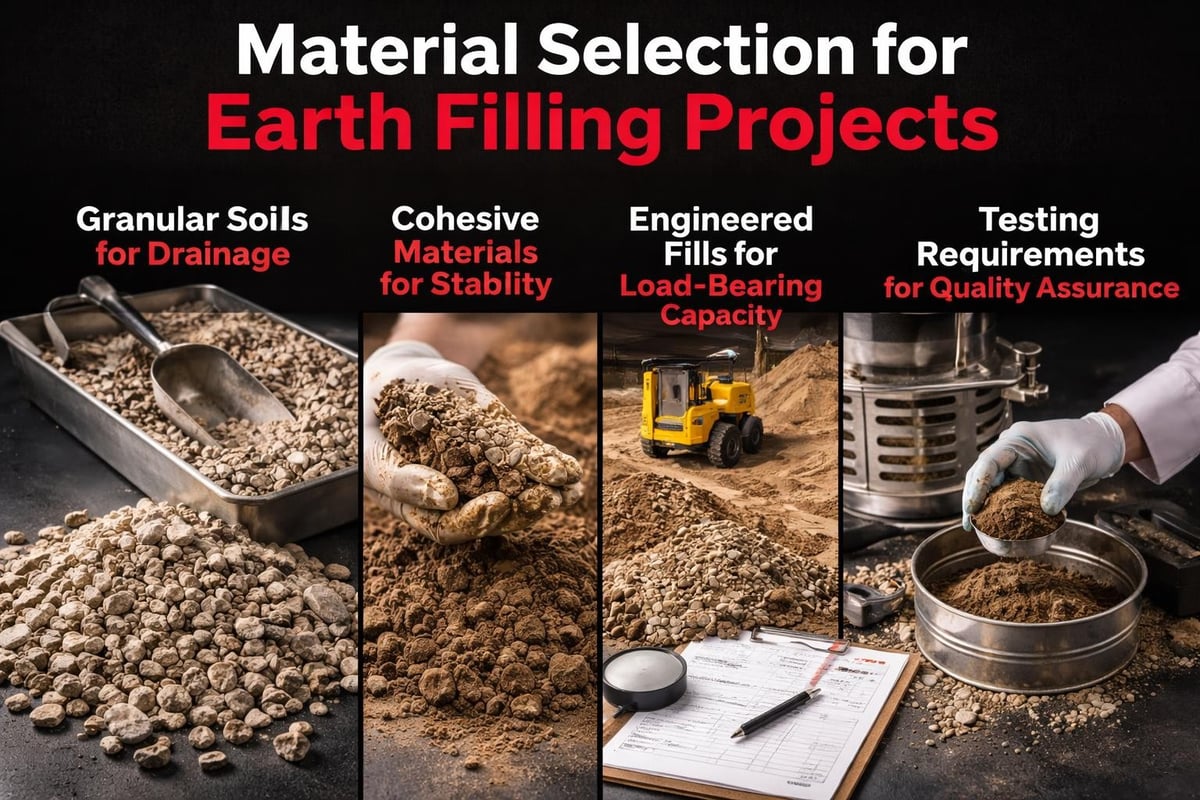
Selecting appropriate fill materials fundamentally determines project outcomes. Soil characteristics such as particle size distribution, plasticity index, and organic content directly influence compaction efficiency and long-term stability. The EN 16907-1:2018 standard outlines principles and general rules for earthworks, providing comprehensive guidelines on materials and quality control measures.
| Material Type | Characteristics | Best Applications | Limitations |
|---|---|---|---|
| Granular Soil | Free-draining, easy compaction | Highways, drainage layers | Poor cohesion, requires containment |
| Cohesive Clay | High bearing capacity when dry | Structural foundations | Moisture-sensitive, slow drainage |
| Sand-Gravel Mix | Excellent compaction, stable | Driveways, patios | Requires proper gradation |
| Crushed Stone | Superior load distribution | Heavy-duty applications | Higher material costs |
Engineers must evaluate existing ground conditions through comprehensive site investigations before specifying fill materials. Unsuitable soils containing excessive organic matter, peat, or contaminated substances require removal and replacement with certified fill meeting British Standards specifications.
Earth Filling Techniques and Methodology
Preparation and Site Clearance
Successful earth filling begins with thorough site preparation. Vegetation, topsoil, and unsuitable materials must be stripped away to expose competent ground. This ensures proper bonding between existing soil and new fill materials, preventing differential settlement and structural failures.
The exposed surface requires scarification to create mechanical bonding with the first fill layer. Without this critical step, a slip plane may develop between the natural ground and imported fill, leading to catastrophic slope failures or uneven settlement beneath structures.
Layered Placement Strategy
Earth filling proceeds through systematic layer placement, with each lift typically ranging between 150mm and 300mm thickness before compaction. Thicker layers prevent adequate compaction throughout the material depth, creating weak zones that compromise structural integrity.
Modern earth filling projects employ specific methodologies:
- Survey and mark elevation benchmarks across the site
- Place fill material in uniform layers using appropriate plant equipment
- Spread material evenly to specified thickness using graders or dozers
- Compact each layer systematically with suitable rolling equipment
- Test compaction density according to project specifications
- Record results and proceed to the next layer upon approval
The quality control of soil compaction using ASTM standards provides detailed testing protocols that ensure each layer achieves required density before subsequent lifts commence.
Compaction Requirements and Equipment
Compaction transforms loose fill into a dense, load-bearing mass by reducing air voids between soil particles. The process increases shear strength, reduces permeability, and minimizes future settlement. Achieving specified compaction levels requires matching equipment types to soil characteristics.
Compaction equipment selection:
- Smooth wheeled rollers for granular materials and binding layers
- Sheepsfoot rollers for cohesive clay soils requiring kneading action
- Vibratory plate compactors for confined areas and trench work
- Grid rollers for rocky fills and larger particle materials
- Pneumatic tyred rollers for final surface preparation
Moisture content critically influences compaction efficiency. Soil must be near optimum moisture content, where maximum density occurs with minimum compaction effort. Excessively dry soil resists compaction, whilst saturated material becomes unstable and unworkable.
Quality Assurance in Earth Filling Operations
Quality control measures separate professional earth filling from amateur operations. Systematic testing, documentation, and compliance verification ensure projects meet engineering specifications and regulatory requirements. The comprehensive approach employed by experienced contractors delivers reliable, long-lasting results.
Field Testing Procedures
Nuclear density gauge testing provides rapid, non-destructive measurement of in-place density and moisture content. This method enables real-time quality control, allowing immediate corrective action when compaction falls below specifications. Sand cone tests offer an alternative where nuclear equipment proves impractical.
Testing frequency typically follows a grid pattern, with minimum test locations specified per project area or fill volume. Large commercial projects may require tests every 1000 square metres, whilst critical highway structures demand more intensive verification.
| Test Type | Purpose | Frequency | Acceptance Criteria |
|---|---|---|---|
| Density Testing | Verify compaction | Every layer, multiple points | ≥95% Standard Proctor |
| Moisture Content | Ensure optimal compaction | Concurrent with density | Within ±2% of optimum |
| Plate Bearing | Assess bearing capacity | Selected locations | Per design specification |
| California Bearing Ratio | Long-term performance | Representative samples | Project-specific values |
Documentation and Compliance
Professional earth filling operations maintain comprehensive records demonstrating compliance with specifications and British Standards. Documentation includes material source certificates, moisture-density relationships, field test results, and photographic evidence of construction stages.

Applications Across Civil Engineering Projects
Highway and Road Construction
Earth filling forms the foundation of modern highway infrastructure, creating embankments that support carriageways across varying terrain. These structures must withstand heavy traffic loads, environmental stresses, and decades of service without excessive settlement or deformation. Proper earth filling techniques ensure motorways and trunk roads maintain design profiles throughout their operational life.
Highway embankments require particularly stringent compaction specifications, often demanding 95% or greater Standard Proctor density. Sub-grade preparation beneath road pavements involves selective material placement, with granular drainage layers preventing moisture intrusion that weakens structural layers.
Commercial and Industrial Developments
Large-scale commercial projects, including the drive-through facilities constructed by experienced contractors, rely on extensive earth filling to achieve level building platforms. These developments often involve significant cut-and-fill operations, balancing excavated material against import requirements to optimize project economics.
The ground floor slabs supporting commercial buildings, car parks, and service areas demand uniform support to prevent differential settlement. Professional earth filling creates these consistent bearing conditions through controlled material placement and rigorous compaction verification.
Residential Driveways and Patios
Residential applications require the same engineering principles scaled to smaller projects. Driveways and patios demand stable sub-bases created through proper earth filling techniques, preventing the cracking and settlement that plague poorly constructed installations.
Homeowners benefit from professional earth filling when expanding properties, creating level gardens, or addressing drainage issues. The techniques proven on major infrastructure projects scale effectively to residential work when applied with appropriate expertise and attention to detail.
Environmental Considerations and Sustainability
Modern earth filling practices incorporate environmental protection and sustainability principles throughout project execution. Responsible contractors minimize ecological disruption whilst delivering engineered solutions meeting stringent performance requirements.
Environmental best practices include:
- Sourcing fill materials from licensed, sustainable quarries
- Implementing erosion control measures during construction
- Managing surface water runoff to prevent siltation
- Protecting existing trees and vegetation where possible
- Segregating and reusing suitable on-site soils
- Preventing contamination of watercourses
The rammed earth construction technique demonstrates how traditional earth filling methods align with contemporary sustainability goals. Whilst primarily a building technique, rammed earth principles inform modern compaction approaches and highlight soil's potential as a low-carbon construction material.
Drainage Integration
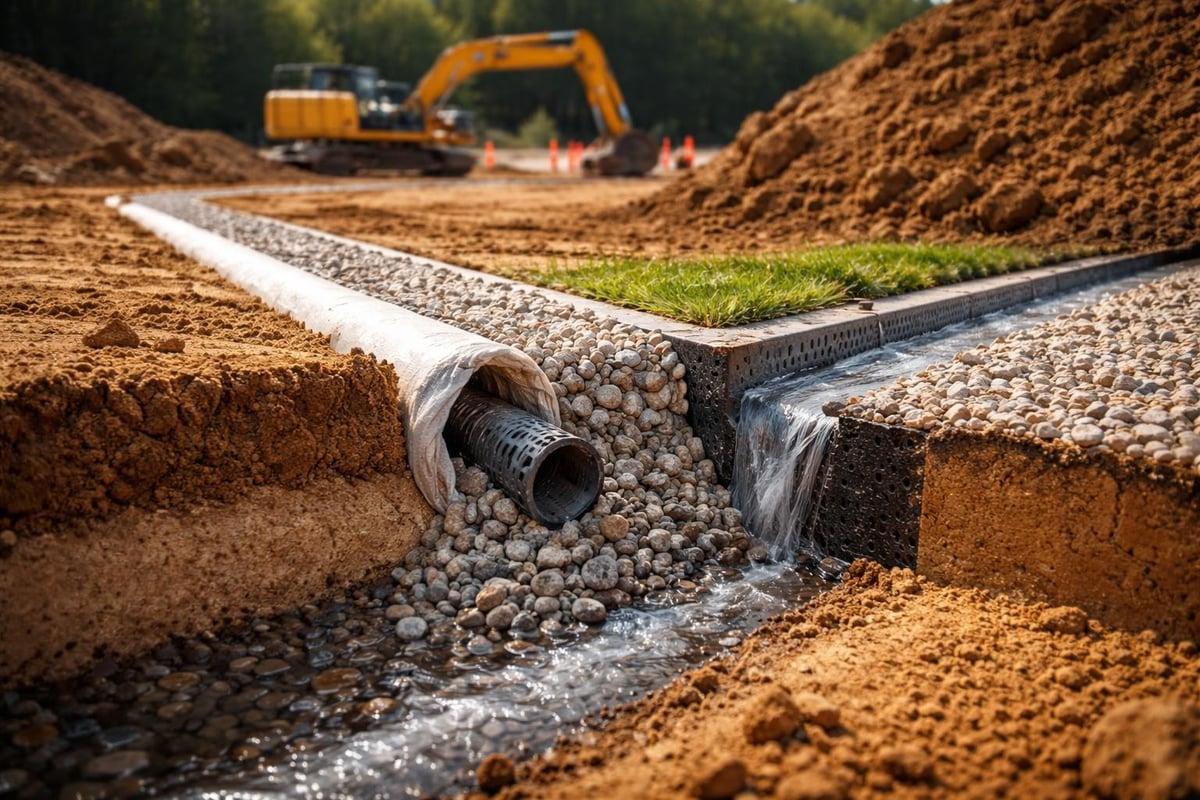
Effective earth filling designs incorporate drainage systems preventing water accumulation within fill materials. Trapped moisture reduces soil strength, promotes settlement, and compromises long-term stability. French drains, permeable layers, and surface grading direct water away from critical areas.
Climate considerations influence earth filling specifications across different UK regions. Areas experiencing high rainfall require enhanced drainage provisions, whilst coastal locations demand protection against tidal influences and salt contamination.
Advanced Earth Filling Methods
Geosynthetic Reinforcement
Geotextiles and geogrids enhance earth filling performance in challenging conditions. These synthetic materials provide tensile reinforcement, separation between dissimilar soils, and filtration preventing fine particle migration. Steep embankments, weak subgrades, and heavy loading scenarios benefit from geosynthetic incorporation.
Reinforced earth filling enables construction on sites previously considered unsuitable, expanding development possibilities whilst maintaining safety margins. The technique proves particularly valuable when working above soft clays or peat deposits that cannot economically be excavated and replaced.
Dynamic Compaction
Exceptionally deep fills or remediation of poorly compacted historical earth filling may require dynamic compaction. This technique involves repeatedly dropping heavy weights from height, generating shock waves that densify soil to significant depths. Specialized applications include port developments, industrial sites, and brownfield regeneration projects.
Stabilization Techniques
Chemical stabilization enhances marginal fill materials, transforming unsuitable soils into engineered fills meeting project requirements. Lime, cement, or proprietary binders react with soil particles, improving strength, reducing plasticity, and accelerating moisture removal. This approach reduces material importation costs whilst utilizing site-won soils.
Regulatory Framework and Standards Compliance
United Kingdom earth filling projects operate within comprehensive regulatory frameworks ensuring public safety and environmental protection. The Construction (Design and Management) Regulations 2015 establish responsibilities for planning, managing, and monitoring construction work, including earth filling operations.
Key regulatory considerations:
- Planning permissions for significant ground level alterations
- Building control approval for works affecting structural stability
- Environmental permits when using waste-derived materials
- Health and safety planning throughout project execution
- Utility protection preventing damage to buried services
British Standards provide technical specifications governing material properties, testing methods, and acceptance criteria. BS 6031:2009 addresses earthworks code of practice, whilst BS 1377 specifies soil testing procedures. Professional contractors maintain current knowledge of applicable standards, ensuring projects achieve compliance through systematic application of proven methodologies.
The soil requirements and construction methods specified in various jurisdictions demonstrate how different regions address earth filling challenges. Whilst these international examples may not directly apply to UK projects, they illustrate universal principles underlying competent earth filling practice.
Project Planning and Execution
Site Investigation and Design
Comprehensive site investigation precedes all significant earth filling projects. Geotechnical engineers conduct soil surveys, evaluate existing ground conditions, and design appropriate fill specifications. This investigation phase identifies potential challenges including buried obstructions, contaminated ground, or weak strata requiring special treatment.
Design documents specify fill materials, compaction requirements, layer thicknesses, and testing frequencies. Detailed drawings indicate finished levels, slopes, drainage provisions, and construction sequencing. Professional contractors utilize these documents to plan resource deployment, ensuring efficient project delivery.
Programme Management
Earth filling operations integrate with broader construction programmes, creating critical paths that influence overall project duration. Weather dependency makes scheduling particularly challenging, as prolonged rainfall halts compaction work and may damage partially completed fills.
Experienced contractors develop realistic programmes accounting for seasonal variations, material delivery logistics, and testing requirements. Buffer periods accommodate inevitable delays, preventing cascade effects through subsequent construction phases.
Understanding earth filling principles, from material selection through compaction verification, empowers informed decision-making across civil engineering projects. Whether planning major highway infrastructure or residential improvements, these fundamental techniques deliver stable, long-lasting foundations supporting decades of reliable service. JRG Civils brings extensive experience in earth filling across commercial, highway, and residential projects throughout the North East and beyond, combining technical expertise with meticulous attention to detail that ensures your project achieves its full potential from ground level up.