
Pinkerbs represent a fundamental component in civil engineering and highway construction, serving as the critical interface between road surfaces and adjacent areas. These robust concrete kerb units, characterised by their distinctive pink or red colouring, have become an industry standard for delineating boundaries, managing water runoff, and providing structural integrity to surfaced areas. From major motorway developments to residential driveways, pinkerbs deliver both functional and aesthetic benefits that make them indispensable in modern surfacing projects.
Understanding Pinkerbs and Their Applications
Pinkerbs are manufactured concrete kerbing units that derive their name from their characteristic pink or reddish-brown colour, achieved through the addition of specific aggregates and pigments during production. These precast concrete elements are designed to withstand significant loads whilst maintaining their structural integrity over extended periods.
The primary function of pinkerbs extends beyond simple visual demarcation. They provide essential edge restraint for flexible pavements, preventing lateral movement of surfacing materials under traffic loads. This restraint function proves particularly vital in areas subject to heavy goods vehicles or frequent turning movements.
Standard Specifications and Dimensions
UK highways specifications define precise requirements for pinkerbs used in public realm projects. The most commonly specified units conform to BS EN 1340:2003, which establishes manufacturing standards, dimensional tolerances, and performance characteristics.
| Specification | Typical Measurement | Application |
|---|---|---|
| Standard Height | 125mm face | General highway use |
| Heavy Duty Height | 150mm face | HGV routes, commercial |
| Length | 915mm | Standard unit |
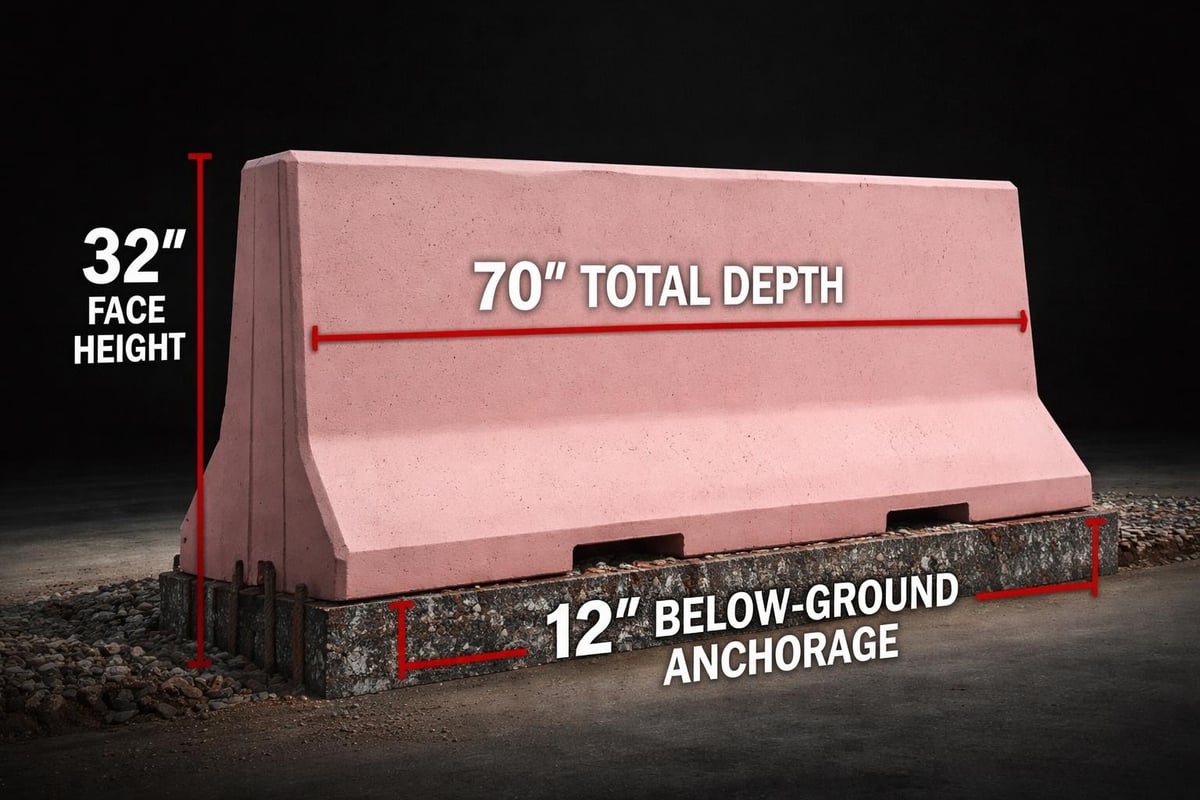
| Depth | 255mm | Below ground fixing |
These dimensions ensure pinkerbs provide adequate restraint whilst remaining manageable during installation. The below-ground depth delivers the necessary anchorage to resist overturning forces from vehicle impact and surface water pressure.
Installation Methodology for Pinkerbs
Proper installation of pinkerbs requires meticulous attention to alignment, foundation preparation, and bedding techniques. The longevity and performance of any surfaced area depend significantly on the quality of kerb installation, making this a critical phase in civil engineering projects.
Foundation preparation begins with excavation to the correct depth, accounting for the full pinkerb unit plus bedding material. A minimum foundation depth of 100mm compacted granular sub-base provides adequate support for standard applications, whilst heavy-duty installations may require 150mm or greater.
Step-by-Step Installation Process
- Excavate the kerb line to the required depth and width, ensuring stable subgrade conditions
- Compact the formation using appropriate mechanical equipment to achieve specified density
- Place and compact sub-base material in layers not exceeding 100mm thickness
- Establish line and level using string lines and profile boards at regular intervals
- Prepare concrete bedding using ST4 mix (1:3:6 or equivalent) to 100mm depth minimum
- Position pinkerbs accurately to line and level, tapping gently with a rubber mallet
- Fill joints with mortar or approved jointing material, typically 10mm nominal width
- Provide rear haunching with concrete to two-thirds height for lateral support
- Allow curing period before backfilling or placing adjacent surfacing materials
The haunching behind pinkerbs serves a crucial structural purpose, preventing backward rotation under impact loads and distributing forces into the surrounding ground. Many failed kerb installations can be attributed to inadequate or absent haunching.
Pinkerbs in Commercial and Highway Projects
Major infrastructure developments and commercial projects demand robust edging solutions that comply with stringent specifications whilst delivering decades of maintenance-free service. Pinkerbs fulfil these requirements across diverse applications, from motorway hard shoulders to retail park access roads.
Highway authorities specify pinkerbs for road schemes based on their proven durability and consistent manufacturing quality. The standardised dimensions facilitate rapid installation, reducing traffic management costs and programme durations on live carriageway works.
Commercial Application Scenarios
Retail and hospitality developments benefit particularly from pinkerbs, where vehicle movements concentrate at entrance points and drive-through facilities. The edge restraint prevents surface deformation at these critical locations, maintaining safe, level access routes.
Fast-food drive-throughs, coffee shop car parks, and similar facilities experience repetitive trafficking patterns that generate significant stresses on surfacing edges. Civil engineering specialists recognise that pinkerbs installed to correct specifications prevent premature failure at these vulnerable points.
Industrial estates and logistics facilities present another demanding application environment. Heavy goods vehicles executing tight turning manoeuvres impose substantial lateral forces on kerb lines. Properly installed pinkerbs contain these forces, protecting the structural integrity of adjacent pavements and landscaped areas.
| Project Type | Pinkerb Benefits | Typical Specification |
|---|---|---|
| Drive-through facilities | Edge restraint at turning points | HB2 125mm face |
| Car park access roads | Visual guidance, water management | HB2 125mm face |
| Industrial estate roads | Heavy duty edge support | HB2 150mm face |
| Pedestrian crossing points | Level transition, tactile integration | HB2 125mm face |
Residential Driveway Applications
Beyond large-scale commercial and highway projects, pinkerbs deliver significant advantages for residential driveways and private access routes. Homeowners increasingly specify these professional-grade materials for domestic projects, seeking the durability and aesthetic appeal that pinkerbs provide.
A properly constructed driveway with pinkerb edging offers superior longevity compared to installations using alternative edging methods. The robust concrete construction resists frost damage, chemical attack from de-icing salts, and mechanical damage from vehicle wheels.
Design Considerations for Driveways
Driveway designs incorporating pinkerbs must address several key factors to achieve optimal results. The kerb line establishes the boundary between the surfaced area and adjacent soft landscaping or lawn areas, preventing soil migration onto the finished surface.
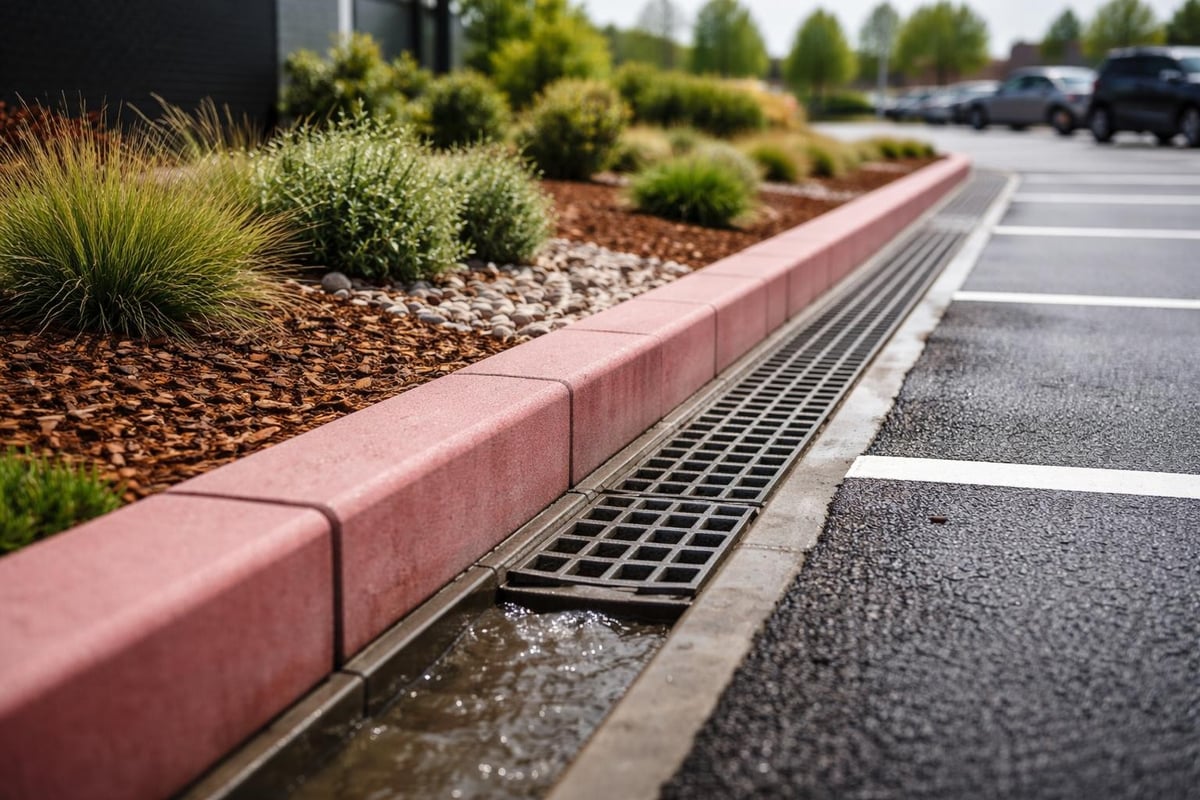
Drainage management represents a critical consideration. Pinkerbs positioned with appropriate falls direct surface water towards designated drainage points, preventing pooling and ice formation during winter months. The kerb face creates a positive barrier against water ingress into vulnerable edge zones.
Pattern imprinted concrete driveways, block paving, and tarmac surfacing all benefit from pinkerb edge restraint. Without this containment, freeze-thaw cycles cause progressive edge deterioration, leading to costly repairs and unsightly appearance.
Colour coordination between pinkerbs and surfacing materials creates visually cohesive schemes. The natural pink-red tone of standard pinkerbs complements many popular surfacing choices, from charcoal block paving to traditional tarmac finishes.
Material Properties and Performance Characteristics
The superior performance of pinkerbs stems from carefully controlled manufacturing processes that deliver consistent material properties. High-quality aggregates, precise cement ratios, and thorough compaction during production create dense, durable concrete with minimal porosity.
Compressive strength typically exceeds 50 N/mm², providing ample capacity to resist crushing forces from vehicle overrun and impact events. This strength level substantially exceeds the minimum requirements specified in relevant British Standards, offering extended service life even under demanding conditions.
Durability and Maintenance Requirements
Freeze-thaw resistance proves particularly important in the UK climate, where winter conditions subject kerbing to repeated freezing and thawing cycles. Quality pinkerbs manufactured with air-entrained concrete and low water-cement ratios demonstrate excellent resistance to frost damage.
Chemical resistance protects pinkerbs from attack by de-icing salts, vehicle fluids, and acidic rainwater. The dense concrete matrix prevents penetration of aggressive substances that might otherwise cause deterioration of reinforcement or concrete spalling.
Maintenance requirements for pinkerbs remain minimal throughout their service life. Occasional cleaning removes organic growth and soil deposits, whilst joint inspection identifies any areas requiring repointing. This low-maintenance characteristic delivers significant whole-life cost advantages compared to alternative edging systems requiring regular replacement or repair.
- Expected service life: 40+ years under normal conditions
- Cleaning frequency: Annual jet washing typically adequate
- Joint maintenance: Inspect every 3-5 years, repoint as necessary
- Replacement indicators: Significant cracking, spalling, or displacement
Integration with Drainage Systems
Effective surface water management relies on well-designed kerb lines that direct runoff towards drainage infrastructure. Pinkerbs fulfil a vital role in this system, creating defined flow paths and preventing uncontrolled water movement across surfaced areas.
Highway drainage designs position gully pots at strategic locations along kerb lines, with pinkerbs channelling water towards these collection points. The tight joints between individual units prevent water escaping through the kerb line, ensuring efficient capture and removal from the carriageway.
Combined Drainage Solutions
Specialist pinkerb units incorporate drainage channels or slots that facilitate water passage whilst maintaining edge restraint. These combined kerb-drainage units prove particularly valuable in areas where conventional gully spacing proves inadequate for the runoff volumes generated.
Professional surfacing contractors recognise that proper integration between pinkerbs and drainage systems prevents the surface water ponding that accelerates pavement deterioration. The correct falls, gradients, and gully positions ensure water reaches drainage infrastructure efficiently.
Sustainable drainage systems (SuDS) increasingly influence modern surfacing projects, with permeable pavements and infiltration basins replacing traditional drainage approaches. Even in these applications, pinkerbs maintain relevance by defining boundaries between permeable and impermeable zones, directing excess flows towards attenuation features.
Quality Assurance and Compliance
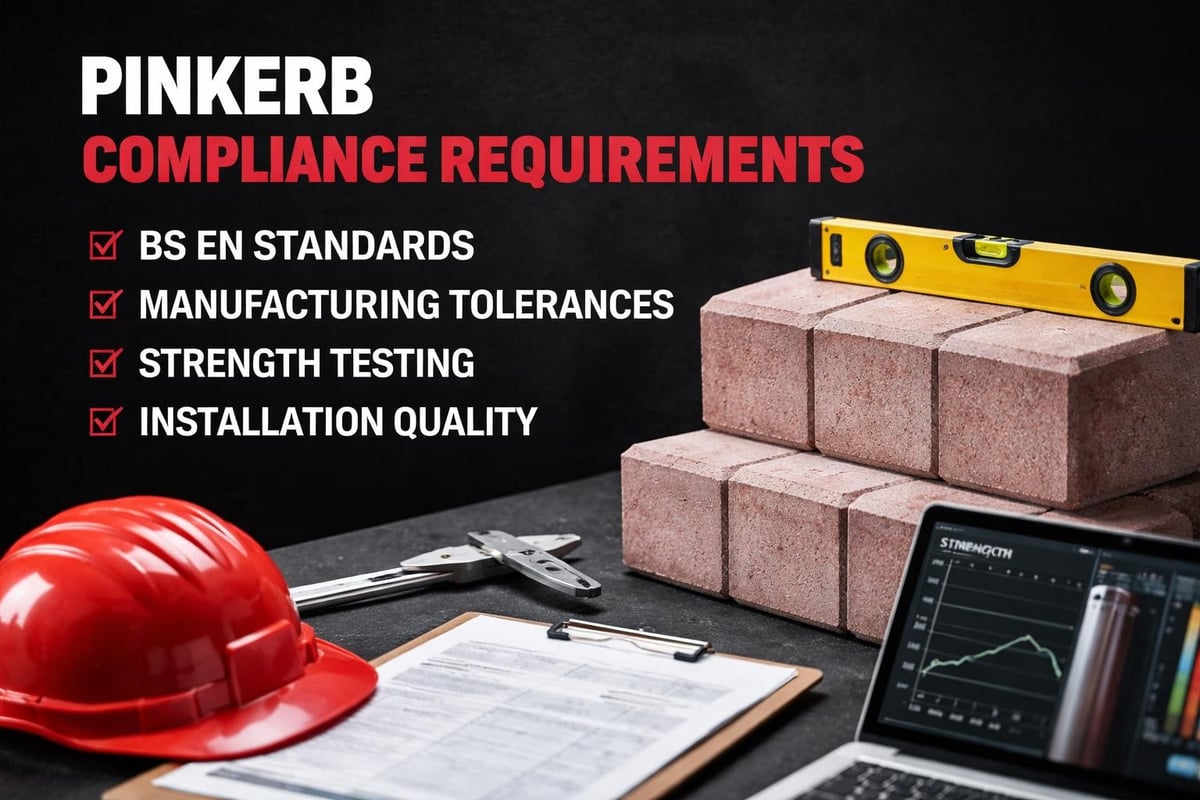
Construction projects specifying pinkerbs must ensure supplied materials meet relevant standards and performance requirements. Quality assurance processes verify dimensional accuracy, strength characteristics, and durability properties before units leave the manufacturing facility.
CE marking provides evidence of compliance with harmonised European standards, although post-Brexit regulations now reference UKCA marking for certain products. Manufacturers maintain detailed quality documentation demonstrating conformity with BS EN 1340:2003 and related specifications.
Site installation quality proves equally critical to overall performance. Experienced civil engineering teams follow established methodologies that ensure alignment accuracy, adequate bedding, and proper haunching. These installation standards determine whether pinkerbs deliver their full design life or suffer premature failure.
Cost Considerations and Value Analysis
Financial planning for projects incorporating pinkerbs requires understanding both material costs and installation expenses. Whilst pinkerbs represent a premium option compared to basic concrete kerbs, their enhanced durability and performance characteristics justify the additional investment.
Material costs vary according to specification, with standard HB2 units typically priced per linear metre. Bulk purchasing for larger projects achieves economies of scale, whilst smaller residential schemes incur proportionally higher unit rates due to minimum order quantities and delivery charges.
Whole-Life Cost Benefits
Long-term value analysis demonstrates pinkerbs' economic advantages. The extended service life minimises replacement costs, whilst low maintenance requirements reduce ongoing expenditure. Projects planned with 60-year design lives benefit particularly from durable edging solutions that match pavement longevity.
Comparing pinkerbs against alternative edging systems reveals significant whole-life cost advantages:
| Edging System | Initial Cost | Expected Life | Maintenance | Total 40-Year Cost |
|---|---|---|---|---|
| Pinkerbs | Medium-High | 40+ years | Minimal | Medium |
| Standard kerbs | Medium | 30-40 years | Low | Medium |
| Timber edging | Low | 10-15 years | High | High |
| Plastic edging | Low | 15-20 years | Medium | Medium-High |
The analysis demonstrates that initial cost differentials diminish when viewed across realistic service life periods. Projects prioritising quality and longevity recognise pinkerbs as cost-effective solutions delivering superior value.
Environmental and Sustainability Factors
Modern construction practices increasingly emphasise environmental responsibility and sustainable material choices. Pinkerbs contribute positively to project sustainability credentials through their durability, recyclability, and locally sourced manufacturing.
Concrete production carries environmental impacts associated with cement manufacture, but pinkerbs' extended service life spreads this carbon footprint across decades of service. Avoiding premature replacement reduces the cumulative environmental burden compared to shorter-lived alternatives requiring repeated replacement cycles.
Local sourcing minimises transport emissions, with UK manufacturers supplying pinkerbs from regional production facilities. This distribution model reduces delivery distances and supports regional employment, contributing to broader sustainability objectives beyond pure carbon accounting.
At end-of-life, concrete pinkerbs undergo crushing and recycling as aggregate for new construction projects or sub-base materials. This circularity prevents waste disposal whilst creating useful secondary materials that displace virgin aggregate extraction.
Technical Innovations and Future Developments
The pinkerbs sector continues evolving, with manufacturers developing enhanced products addressing emerging requirements. High-strength formulations provide improved impact resistance for locations subject to vehicle strikes, whilst modified surface textures enhance aesthetic appeal.
Coloured variants expand design possibilities beyond standard pink-red tones, enabling better integration with architectural schemes and corporate branding requirements. Pigment technology delivers consistent, fade-resistant colours that maintain appearance throughout extended service lives.
Smart infrastructure integration represents an emerging application area, with kerbing systems incorporating sensors for traffic monitoring, flood detection, or street lighting control. Whilst these developments remain primarily experimental in 2026, they indicate potential future directions for traditionally passive kerbing products.
Sustainable manufacturing processes reduce the carbon intensity of pinkerb production through alternative cement formulations, recycled aggregate incorporation, and renewable energy adoption at production facilities. These initiatives help construction projects achieve carbon reduction targets whilst maintaining product performance standards.
Pinkerbs deliver essential functionality across commercial highways, retail developments, and residential driveways through robust edge restraint, effective drainage management, and long-term durability. Whether planning major infrastructure schemes or private access improvements, selecting quality materials and ensuring proper installation maximises performance and value. JRG Civils brings extensive experience in civil engineering and surfacing projects across the North East and throughout the UK, delivering professional installations that meet exacting standards. Contact our team to discuss how we can support your next surfacing project with expert advice and quality workmanship.