
When planning a commercial or residential development that requires alterations to public highways, understanding the financial implications of Section 278 agreements becomes essential. These legal agreements between developers and local highway authorities govern modifications to existing roads, junctions, access points, and associated infrastructure. For contractors and developers alike, section 278 costs represent a significant portion of project budgets, often ranging from thousands to hundreds of thousands of pounds depending on the scope and complexity of the works. Navigating this financial landscape requires detailed knowledge of the various fee structures, administrative charges, and long-term maintenance obligations that accompany these statutory agreements.
Understanding the Core Components of Section 278 Costs
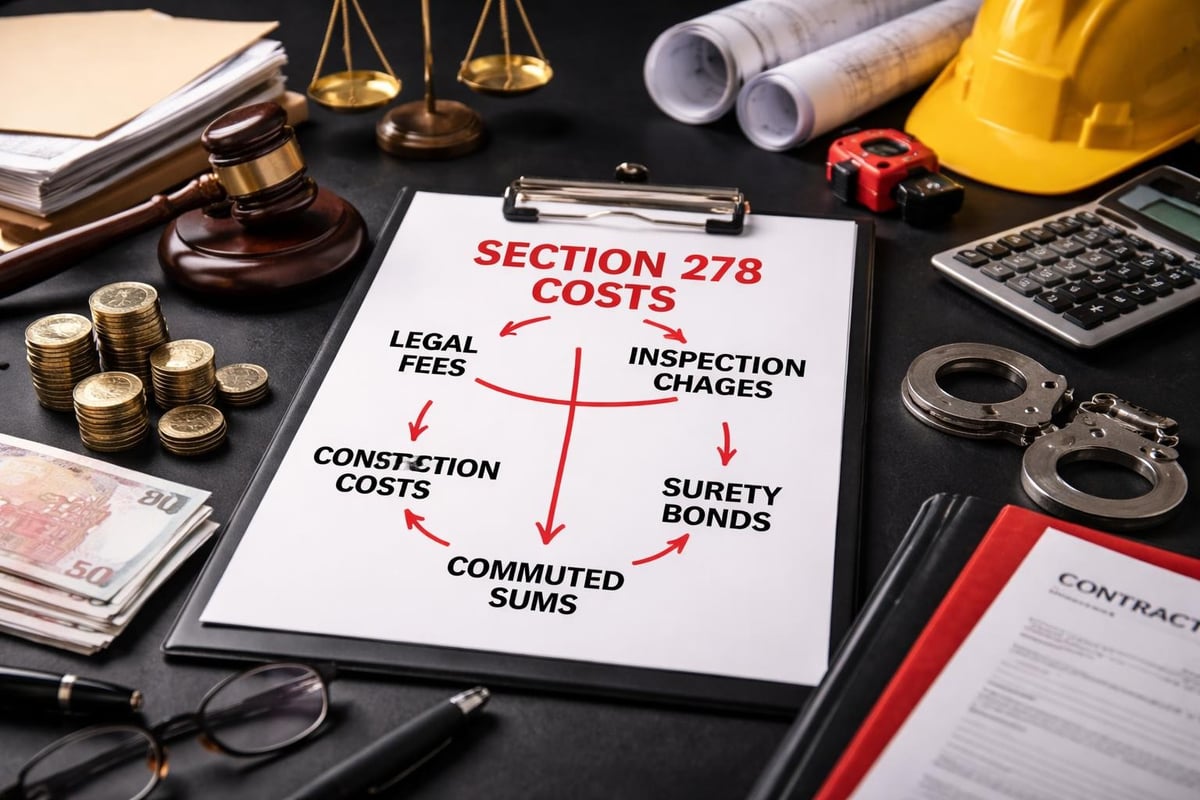
Section 278 costs encompass far more than the physical construction work itself. The financial structure typically includes several distinct elements that developers must account for when budgeting for highway alterations.
Legal and administrative fees form the foundation of any Section 278 agreement. Most local authorities charge a standard legal fee for drawing up and executing the agreement, with Barnsley’s Section 278 process indicating legal costs of approximately £1,000, a figure that remains relatively consistent across different councils nationwide. These legal fees cover the preparation of the formal agreement, ensuring compliance with highways legislation, and establishing the legal framework for the works.
Beyond the legal fees, developers face substantial inspection and supervision charges. These costs represent the local highway authority's oversight throughout the design, approval, and construction phases.
Design Review and Technical Approval Fees
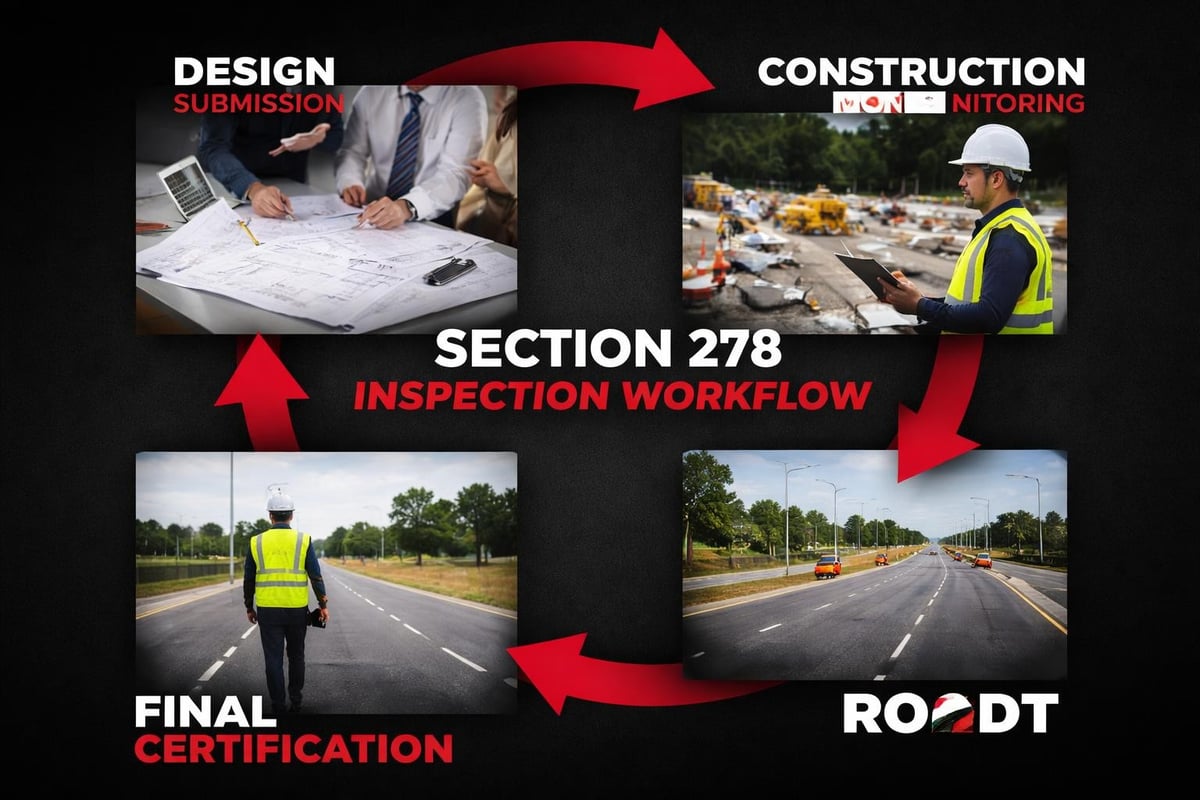
The design review process represents a critical stage where section 278 costs begin to accumulate significantly. Local highway authorities employ teams of engineers and technical specialists to scrutinise proposed designs, ensuring they meet safety standards, technical specifications, and long-term maintenance requirements.
Birmingham City Council’s Section 278 fee structure demonstrates the substantial nature of these charges, with a minimum technical approval and inspection fee of £14,616 for schemes exceeding £15,000 in construction value. This minimum threshold illustrates how even modest highway alterations can incur significant administrative costs.
The design review process typically involves multiple submissions and iterations:
- Initial concept review – preliminary assessment of proposed alterations
- Detailed design submission – comprehensive technical drawings and specifications
- Safety audit responses – addressing concerns raised during formal road safety audits
- Technical approval – final sign-off on construction-ready designs
- As-built drawing verification – confirming constructed works match approved designs
Each stage requires professional review by qualified highway engineers, contributing to the overall inspection fee percentage.
Fee Structures Across Different Local Authorities
One of the most challenging aspects of budgeting for section 278 costs lies in the variation between different local highway authorities. Whilst the legal framework remains consistent under the Highways Act 1980, each council sets its own fee structure based on local policies and resource requirements.
| Local Authority | Inspection Fee Rate | Legal Fee | Minimum Fee |
|---|---|---|---|
| St Helens | 10% of works cost | £1,000 | Not specified |
| Coventry | 15% (£20k-£50k) to 9% (>£600k) | Variable | Not specified |
| Neath Port Talbot | 11% (>£15k) | Not specified | £165 |
| Buckinghamshire | 12% | Not specified | £5,000 |
This table demonstrates the considerable variation in how councils calculate supervision fees. St Helens Borough Council applies a flat 10% rate for design checks and supervision, whilst Coventry City Council employs a sliding scale that decreases as project values increase, recognising economies of scale for larger developments.
Calculating Percentage-Based Fees
The percentage-based fee structure means that section 278 costs scale proportionally with project complexity and value. For a highway alteration project with an estimated construction cost of £100,000, a local authority charging 10% supervision fees would add £10,000 to the overall project budget, excluding legal fees and other charges.
Derbyshire County Council’s fee structure provides particularly detailed guidance on this sliding scale approach. Their charges range from £300 for works valued under £1,000 to £119,700 plus 2% for works exceeding £2 million, demonstrating how major infrastructure projects face substantial administrative costs.
Key factors influencing supervision percentages:
- Complexity of the proposed highway alterations
- Duration of the construction programme
- Number of site inspections required
- Technical expertise needed for specialist works
- Authority's resource allocation and staffing levels
Surety Bonds and Financial Securities
Beyond the direct fees payable to local highway authorities, developers must also secure financial guarantees that protect the council's interests throughout the project lifecycle. These securities represent a significant component of overall section 278 costs, often catching developers unprepared during the budgeting phase.
A surety bond or performance guarantee typically amounts to 100-150% of the total estimated construction cost. According to specialists in Section 278 agreements, this substantial security ensures that if a developer fails to complete the works or executes them to an unsatisfactory standard, the local highway authority possesses sufficient funds to remedy defects or complete the project using alternative contractors.
For a £200,000 highway alteration project, this requirement translates to securing a bond worth £200,000 to £300,000. Whilst this doesn't represent money paid upfront, obtaining such bonds involves premium payments to financial institutions, typically ranging from 1% to 3% of the bond value annually.
Commuted Sum Calculations
Commuted sums represent another crucial financial element within section 278 costs. These payments compensate the local highway authority for the future maintenance burden created by new highway infrastructure. When a developer introduces new road surfaces, traffic signals, drainage systems, or street lighting, the council assumes responsibility for maintaining these assets over their design life.
The calculation methodology for commuted sums varies between authorities but generally considers:
- Type of highway infrastructure being installed
- Expected maintenance frequency and costs
- Design life of the asset (typically 20-40 years)
- Net present value calculations accounting for inflation
- Authority's standard maintenance cost rates
Common assets requiring commuted sums:
- Traffic signals and pedestrian crossings – high maintenance costs due to electrical components
- Street lighting columns and equipment – regular inspection and energy consumption
- Drainage systems and gullies – ongoing cleansing and maintenance
- Landscaping and soft estate – seasonal maintenance requirements
- Specialist road surfaces – materials requiring specific maintenance approaches
Pre-Application and Abortive Fee Considerations
Many developers overlook the initial costs associated with Section 278 agreements during the pre-planning and feasibility stages. These early-stage section 278 costs can accumulate significantly, particularly for projects that undergo substantial design changes or ultimately don't proceed.
Barnsley’s guidance on Section 278 agreements highlights abortive fee agreements ranging from £3,000 to £5,000. These fees cover the highway authority's time and resources invested in reviewing proposals that don't progress to formal agreement stage.
Pre-application advice services, whilst optional, often prove valuable for complex schemes. Birmingham City Council and other authorities offer structured pre-application processes with associated fees that allow developers to gain preliminary feedback on proposals before committing to full design development. This investment can prevent costly redesigns later in the process.
Budget Contingency Planning
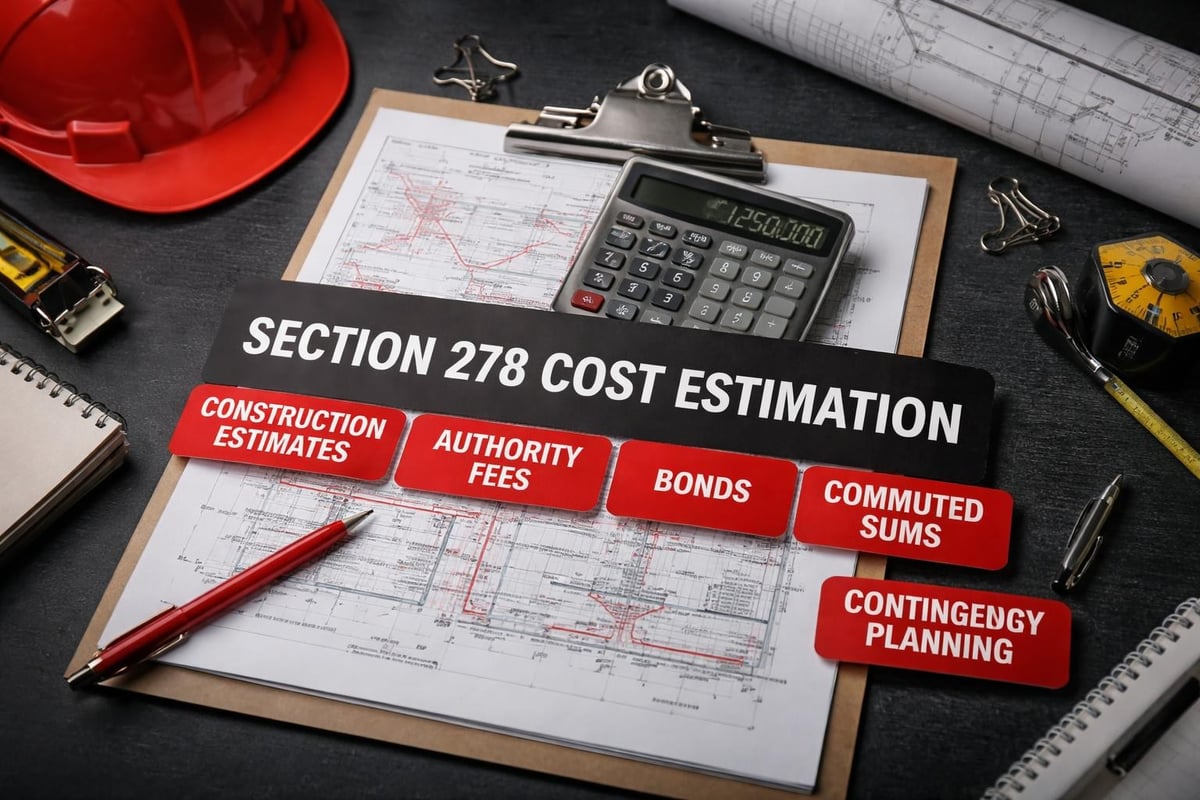
Given the variable nature of section 278 costs and the potential for design iterations, prudent developers allocate contingency funds within their project budgets. Industry professionals typically recommend contingencies of 15-25% above the estimated Section 278 costs to account for:
- Design changes requested by the highway authority
- Additional survey or investigative work requirements
- Unforeseen ground conditions affecting construction costs
- Extended programme durations increasing supervision fees
- Inflation between cost estimation and construction phases
Cost Implications for Different Development Types
The nature of a development significantly influences the scale and composition of section 278 costs. A simple bellmouth access for a single residential property differs dramatically from a complex junction improvement serving a major commercial development.
Small-Scale Residential Access
For straightforward residential driveways requiring minor highway modifications, section 278 costs remain relatively modest. A typical bellmouth access might involve construction costs of £8,000-£15,000, with supervision fees adding another £800-£2,250 (at 10% rate), plus £1,000 legal fees. The total Section 278 agreement costs for such projects typically range from £10,000-£20,000.
Commercial Development Highway Works
Commercial projects such as drive-through restaurants, retail parks, or business estates require more substantial highway alterations. Link Engineering’s cost breakdown provides indicative figures showing construction costs from £50,000 to several hundred thousand pounds for new junction arrangements, with corresponding supervision fees, bonds, and commuted sums multiplying the total investment required.
Drawing on experience with projects like Costa Coffee and Greggs drive-throughs, commercial developments typically face section 278 costs including:
- Junction improvement works (£150,000-£400,000 construction)
- Right-turn lanes and traffic signal installations (£80,000-£250,000)
- Pedestrian crossing facilities (£40,000-£100,000)
- Supervision fees at 10-15% (£15,000-£60,000+)
- Legal fees (£1,000-£2,000)
- Surety bonds (1-3% annual premium on 100-150% of works value)
- Commuted sums (variable, potentially £20,000-£100,000+)
Regional Variations and Authority-Specific Requirements
Understanding that section 278 costs vary significantly by region proves essential for accurate project budgeting. Buckinghamshire Council’s highways development fees demonstrate how some authorities implement minimum fee thresholds (£5,000) alongside percentage-based charges (12% of total engineering works cost), with reduced rates for larger projects exceeding £500,000.
This regional variation reflects different council priorities, resource availability, and local policy approaches. Metropolitan authorities with high development pressure often maintain more structured fee schedules with dedicated development management teams, whilst smaller rural authorities may adopt more flexible approaches.
Factors contributing to regional cost variations:
- Local authority staffing levels and specialist expertise
- Volume of development applications processed annually
- Council policy on cost recovery versus development promotion
- Complexity of local highway network and traffic conditions
- Historical precedents and established fee structures
Managing and Reducing Section 278 Costs
Whilst section 278 costs represent unavoidable obligations for development projects requiring highway works, strategic approaches can optimise expenditure and prevent unnecessary cost escalation.
Early engagement with the local highway authority proves consistently valuable. By initiating discussions during the pre-planning stage, developers can understand specific requirements, identify potential issues, and refine proposals before investing in detailed designs. This proactive approach minimises abortive work and reduces the likelihood of costly design revisions later in the process.
Design Efficiency and Value Engineering
Working with experienced civil engineering professionals who understand highway authority requirements delivers significant value. Detailed guidance on Section 278 processes emphasises how proper initial design reduces review cycles and inspection requirements, directly impacting the supervision fees charged.
Design optimisation strategies include:
- Minimising highway land take – reducing the extent of works within the public highway
- Standardising junction geometries – using proven designs that meet authority standards
- Specifying approved materials – avoiding bespoke specifications requiring special approvals
- Phasing works efficiently – reducing the inspection and supervision duration
- Integrating with existing infrastructure – minimising disruption to existing highway assets
Professional Programme Management
Effective programme management throughout the Section 278 process helps control costs by ensuring timely responses to authority queries, maintaining construction progress, and achieving swift certification of completed works. Delays extend the supervision period and can trigger additional inspection fees, particularly where authorities charge time-based rates for extended projects.
| Cost Control Measure | Potential Saving | Implementation Difficulty |
|---|---|---|
| Early authority engagement | 10-20% reduction in abortive costs | Low |
| Optimised design | 5-15% reduction in construction costs | Medium |
| Efficient programme delivery | 5-10% reduction in supervision fees | Medium |
| Competitive tendering | 8-15% reduction in construction costs | Low |
| Professional project management | 10-25% overall cost avoidance | Low-Medium |
Long-Term Financial Considerations
Beyond the immediate section 278 costs associated with design, construction, and adoption, developers should consider the longer-term financial implications of highway infrastructure decisions. Whilst commuted sums transfer maintenance responsibility to the local highway authority, the choice of materials, design standards, and construction quality influences these calculations.
Specifying higher-quality materials and robust design solutions can reduce commuted sum requirements by demonstrating lower whole-life maintenance costs. For instance, choosing durable block paving over standard asphalt for low-speed access roads might increase initial construction costs by 15-20% but could reduce commuted sum obligations by 30-40% due to extended service life and reduced maintenance frequency.
This whole-life costing approach aligns with sustainable development principles and can deliver overall project savings despite higher upfront capital investment. Progressive highway authorities increasingly recognise and reward such approaches through their commuted sum calculations.
Navigating section 278 costs requires careful planning, detailed understanding of local authority requirements, and strategic budget management to ensure development projects remain financially viable. Whether you're planning a commercial development requiring complex junction improvements or residential access works, partnering with experienced civil engineering contractors makes a substantial difference in controlling costs and delivering successful outcomes. At JRG Civils, we bring comprehensive expertise in highway works and Section 278 agreements across the North East and throughout the UK, ensuring your project progresses smoothly from initial design through to highway adoption with transparent cost management at every stage.