
When undertaking commercial or residential development projects that impact public highways, developers must navigate complex legal frameworks governing road infrastructure. Two critical mechanisms facilitate highway works and adoption: Section 278 and Section 38 agreements under the Highways Act 1980. Understanding the distinction between these agreements, their application processes, and financial implications ensures smooth project delivery whilst maintaining compliance with local authority requirements. For civil engineering contractors working on development sites, franchise installations, or commercial projects, comprehensive knowledge of these legal instruments proves essential for accurate project planning and cost estimation.
Understanding Section 278 and Section 38 Agreements
A section 278 38 agreement encompasses two separate but complementary legal mechanisms. Section 278 agreements permit developers to carry out works on existing adopted highways at their own expense, whilst Section 38 agreements facilitate the construction of new roads to adoptable standards before transfer to the local highway authority.
Section 278 Agreement Fundamentals
Section 278 agreements enable developers to execute highway improvements, alterations, or enhancements to existing public roads. These works typically arise when development projects require modified access points, traffic calming measures, or upgraded junction capacity.
Common Section 278 works include:
- Creation of new vehicle access points or dropped kerbs
- Installation of pedestrian crossing facilities
- Junction improvements and traffic signal modifications
- Carriageway widening or realignment
- Street lighting installations or upgrades
- Footway extensions and accessibility improvements
The legal framework governing Section 278 agreements establishes that developers bear full financial responsibility for design, construction, supervision, and future maintenance contributions through commuted sums.
Section 38 Agreement Essentials
Section 38 agreements govern the construction of entirely new roads within development sites. These roads must be built to highway authority specifications before adoption as publicly maintainable highways. Until formal adoption occurs, developers retain maintenance responsibilities and associated liabilities.
New residential estates, commercial parks, and franchise developments with drive-through facilities frequently require Section 38 agreements. The process ensures that road infrastructure meets rigorous standards for geometry, construction, drainage, and safety before local authorities accept long-term maintenance obligations.
Application Process and Technical Requirements
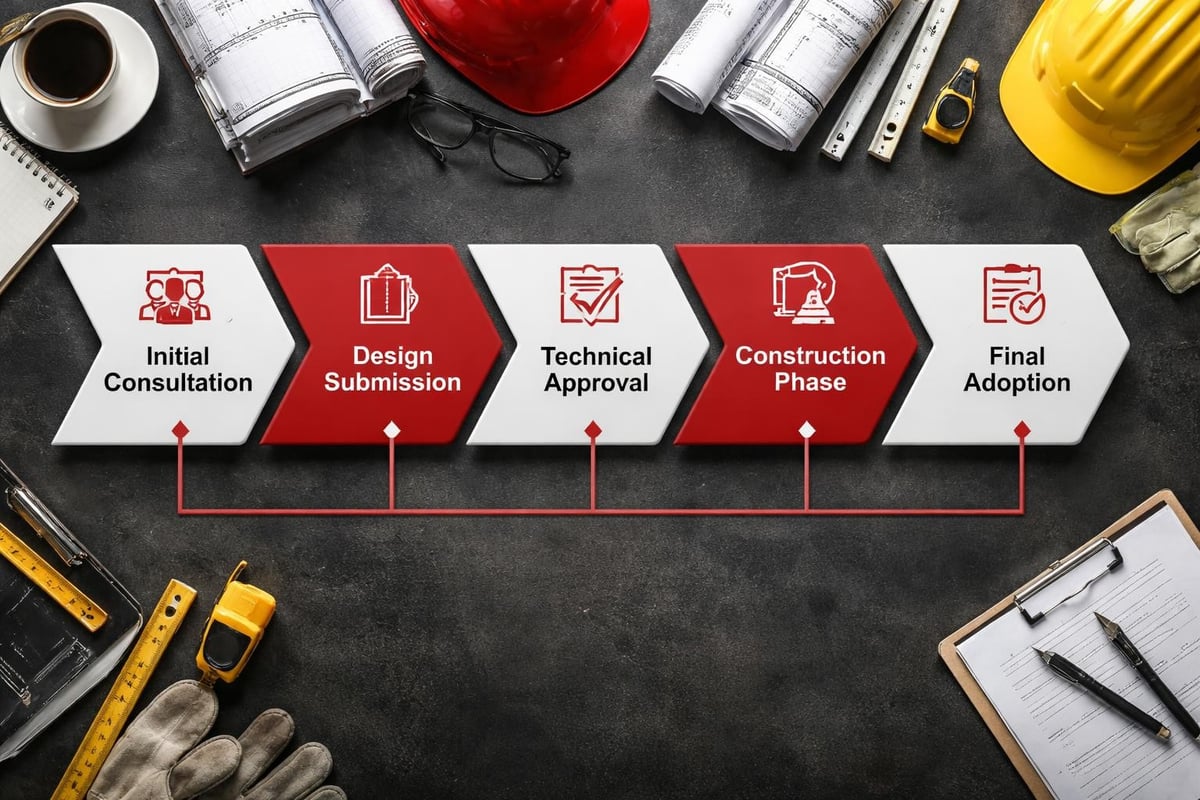
Navigating the section 278 38 agreement application process requires methodical planning and early engagement with highway authorities. Different councils maintain varying procedures, but fundamental steps remain consistent across jurisdictions.
Initial Consultation and Feasibility
Before submitting formal applications, developers should initiate pre-application discussions with the relevant highway authority. This consultation phase identifies potential constraints, determines whether Section 278 or Section 38 mechanisms apply, and establishes preliminary design parameters.
Highway authorities assess proposed works against local transport strategies, safety records, and capacity planning. Early dialogue prevents costly redesigns and accelerates subsequent approval stages. West Sussex County Council provides comprehensive guidance on preparing applications and understanding technical requirements.
Design Development and Submission
Detailed designs must demonstrate compliance with highway authority standards, incorporating appropriate materials, construction techniques, and safety provisions. Design submissions typically include:
- Site layout plans showing existing and proposed highway arrangements
- Longitudinal and cross-sectional drawings with levels and gradients
- Drainage designs and surface water management strategies
- Traffic management plans for construction phases
- Street lighting and signage proposals
- Materials specifications and construction method statements
Highway authorities conduct thorough technical reviews, often requesting modifications to ensure adoptable standards. The iterative design process can extend timelines significantly, particularly for complex junction improvements or extensive new road networks.
Financial Obligations and Cost Recovery
Section 278 agreements require developers to fund all associated costs, including design review fees, supervision charges, commuted sums, and administrative expenses. West Northamptonshire Council’s updated rates demonstrate typical fee structures implemented across England.
| Cost Component | Description | Typical Range |
|---|---|---|
| Application Fee | Initial processing and review | £1,500 – £3,000 |
| Technical Approval | Design checking and approval | 10% – 15% of works value |
| Supervision Fee | Site inspections during construction | 15% – 20% of works value |
| Commuted Sum | Future maintenance contribution | Calculated per asset type |
| Legal Fees | Agreement preparation and completion | £2,000 – £5,000 |
Commuted sums represent particularly significant financial considerations. These one-off payments compensate highway authorities for maintaining additional infrastructure over prescribed periods, typically calculated at 25 or 30 years depending on asset type. Islington Council’s guidance note explains calculation methodologies and the rationale behind these charges.
Construction Phase Management and Compliance
Once agreements are executed, construction must proceed according to approved designs whilst maintaining stringent quality control. Highway authorities exercise substantial oversight powers to ensure compliance with adoptable standards.
Site Operations and Inspection Protocols
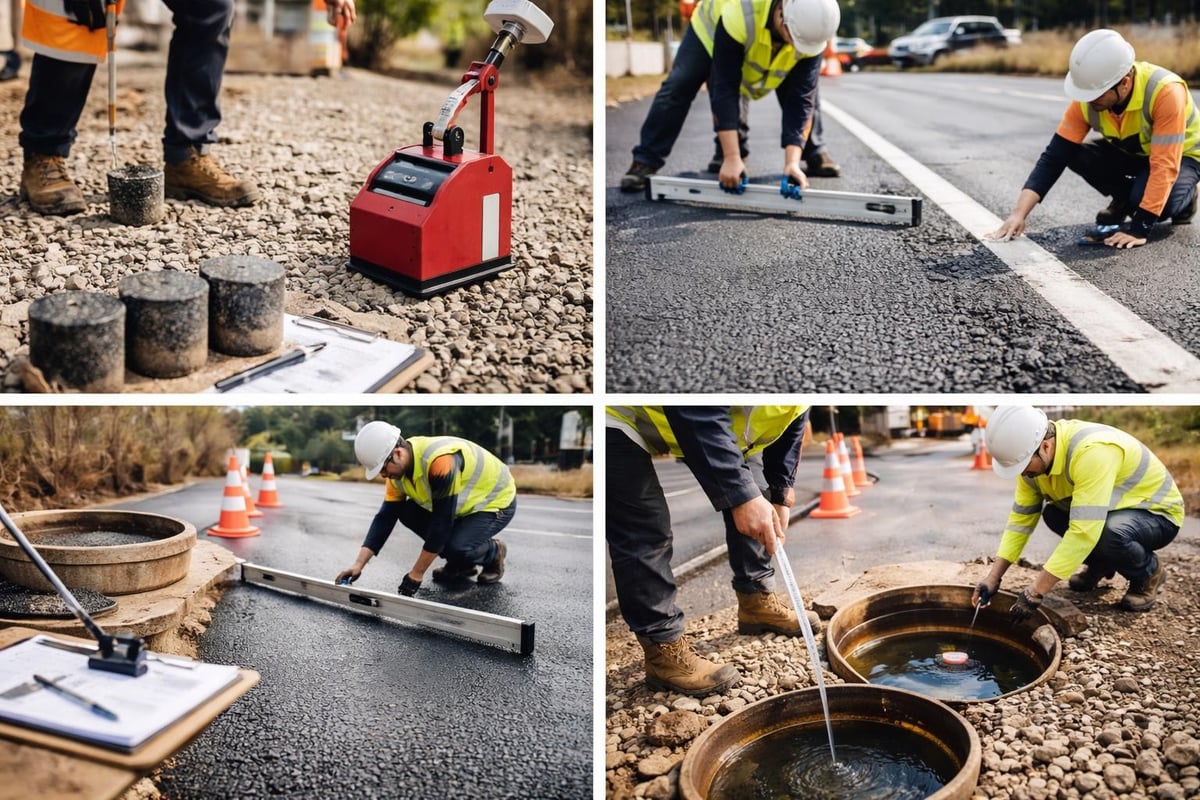
Construction teams must notify highway authorities at designated hold points throughout the build programme. Inspectors verify material quality, workmanship standards, and conformity with approved designs before authorising progression to subsequent stages.
Critical inspection stages include:
- Excavation and subgrade preparation
- Sub-base and capping layer installation
- Binder course and wearing course surfacing
- Kerb line and edging construction
- Drainage system testing and commissioning
- Street furniture and signage installation
Failed inspections trigger remedial requirements before work can continue. Contractors must maintain detailed records, material test certificates, and photographic evidence throughout construction to support final adoption applications.
Quality Assurance and Material Standards
Highway authorities mandate specific material specifications to ensure longevity and performance. Surfacing materials, drainage components, kerbing, and street furniture must comply with British Standards and local authority supplementary guidance.
For civil engineering specialists undertaking commercial projects, understanding these specifications proves crucial. Drive-through facilities for franchise operations require robust construction capable of withstanding repeated heavy vehicle movements, tight turning circles, and intensive use patterns. Skimping on material quality or construction methodology creates long-term liabilities and risks rejection during final inspections.
Timing Considerations and Project Planning
Section 278 38 agreement timelines significantly impact development programmes. Realistic scheduling accounts for approval periods, construction phases, and post-completion certification processes.
Pre-Construction Timeline
From initial consultation to construction commencement, developers should anticipate substantial lead times:
- Pre-application consultation: 4-6 weeks
- Design development and submission: 8-12 weeks
- Technical review and approval: 12-16 weeks
- Legal agreement drafting: 8-12 weeks
- Agreement execution and bond arrangement: 4-6 weeks
Total pre-construction periods frequently extend beyond twelve months for complex schemes. Somerset County Council’s explanation of the section 278 38 agreement process highlights these typical durations and emphasises the importance of early planning.
Construction and Adoption Periods
Construction duration varies according to works scope, but highway authority supervision requirements often extend programmes beyond standard civil engineering timescales. Additional time allocations account for inspection hold points, material testing, and potential remedial requirements.
Section 38 roads cannot achieve adoption status until completion certificates are issued and maintenance periods expire. Twelve-month maintenance periods are standard, during which developers remain responsible for defect rectification. Only after satisfactory maintenance period completion do roads transfer to highway authority ownership.
Common Challenges and Risk Mitigation
Developers and contractors regularly encounter obstacles when progressing section 278 38 agreement projects. Anticipating these challenges enables proactive risk management and contingency planning.
Design Approval Delays
Highway authorities operate under resource constraints, often creating bottlenecks during technical review stages. Design resubmissions following initial rejections compound these delays. Engaging experienced highway design consultants who understand local authority preferences reduces iteration cycles and accelerates approvals.
Cost Escalation and Budget Management
Initial cost estimates frequently underestimate final expenditure. Commuted sum calculations, supervision fees, and unforeseen ground conditions create budget pressures. Comprehensive site investigations, detailed cost planning, and contingency allowances protect against financial overruns.
Budget risk factors include:
- Utility diversions and statutory undertaker works
- Archaeological investigations and mitigation
- Ground contamination remediation
- Enhanced construction specifications
- Extended supervision periods
Coordination with Utility Providers
Highway works invariably interact with underground utilities. Early engagement with statutory undertakers identifies conflicts and facilitates coordinated diversion programmes. Failure to address utility matters during design stages creates construction delays and expensive last-minute diversions.
Practical Implications for Commercial Projects
For contractors undertaking franchise developments, commercial installations, and infrastructure projects, section 278 38 agreement requirements directly influence project feasibility and delivery strategies.
Drive-Through and Franchise Developments
Fast-food franchises with drive-through facilities typically require both Section 278 works for highway access modifications and potentially Section 38 agreements for internal circulation roads. Junction improvements, visibility splays, and queuing lane provisions trigger Section 278 requirements, whilst new estate roads serving multiple units necessitate Section 38 processes.
Recent projects including multiple franchise installations demand careful coordination between building programmes and highway works. Access restrictions during construction affect site logistics, whilst adoption timelines influence practical completion dates and handover arrangements. The procedural flowchart from North Yorkshire County Council illustrates how these processes integrate with broader development programmes.
Residential and Commercial Infrastructure
Large-scale residential developments invariably require extensive Section 38 agreements covering entire estate road networks. Commercial parks similarly need adoptable access roads, service yards, and pedestrian infrastructure. Understanding the interplay between Section 278 and Section 38 mechanisms ensures comprehensive coverage of all highway-related obligations.

Strategic Planning and Professional Expertise
Successfully navigating section 278 38 agreement processes requires specialist knowledge spanning legal, technical, and commercial domains. Developers benefit from assembling experienced professional teams including highway engineers, legal advisors, and contractors familiar with adoptable standards.
Engaging Specialist Contractors
Civil engineering contractors with proven section 278 38 agreement experience deliver significant value through:
- Accurate cost estimation incorporating all highway authority fees
- Design input ensuring constructability and adoptability
- Quality construction meeting inspection requirements
- Programme management accounting for approval timelines
- Liaison with highway authorities throughout project lifecycles
Contractors who have successfully completed multiple franchise projects, commercial developments, and highway improvement schemes bring practical insights that mitigate common pitfalls. Their experience with materials specifications, construction methodologies, and local authority expectations streamlines delivery and reduces risk exposure.
Documentation and Record Keeping
Comprehensive documentation proves essential throughout section 278 38 agreement projects. Maintaining organised records supports smooth inspections, addresses queries efficiently, and facilitates final certification processes.
| Document Category | Required Records | Retention Period |
|---|---|---|
| Design Documentation | Approved drawings, calculations, specifications | Permanent |
| Material Certificates | Test results, compliance documentation | Minimum 12 years |
| Inspection Records | Site reports, photographs, approval notices | Minimum 12 years |
| As-Built Information | Final drawings, utility records, drainage details | Permanent |
| Financial Records | Invoices, fee payments, bond documentation | Minimum 6 years |
Digital document management systems enable efficient retrieval and sharing with highway authorities, reducing administrative burdens and supporting audit trails.
Regional Variations and Local Authority Policies
Whilst Section 278 and Section 38 provisions derive from national legislation, individual highway authorities implement varying procedures, fee structures, and technical standards. Understanding these regional differences proves crucial for contractors operating across multiple jurisdictions.
Fee Structure Variations
Application fees, technical approval charges, and supervision percentages differ significantly between councils. Some authorities have implemented fixed-fee schedules, whilst others calculate charges proportionally based on estimated works values. Kirklees Council’s guidance note clarifies distinctions between agreement types and associated cost implications within their jurisdiction.
Commuted sum calculation methodologies also vary. Some councils apply standard rate cards per asset type, whilst others undertake bespoke assessments considering specific maintenance requirements and local cost factors.
Technical Standards and Design Guides
Highway authorities maintain individual design guides specifying geometric standards, material requirements, and construction details. Worcestershire County Council’s Streetscape Design Guide exemplifies comprehensive technical documentation establishing adoptable standards.
Contractors working across England must familiarise themselves with relevant local standards for each project location. Assuming universal applicability of one authority's requirements creates design conflicts and approval delays.
Future Developments and Legislative Context
The legislative framework governing section 278 38 agreement processes continues evolving. Proposals for reforming Section 106 agreement processes include considerations affecting Section 278 and Section 38 mechanisms, potentially introducing standardised procedures and streamlined approval pathways.
Government initiatives promoting infrastructure investment and housing delivery may influence how highway authorities administer these agreements. Digital planning systems, standardised technical specifications, and accelerated determination periods could emerge from ongoing reform discussions.
Developers and contractors should monitor legislative developments and maintain flexibility in project planning approaches. Early engagement with highway authorities remains paramount regardless of procedural changes, ensuring alignment with current requirements whilst anticipating future modifications.
Understanding section 278 38 agreement requirements enables accurate project planning, realistic cost estimation, and compliant delivery of highway infrastructure. Whether undertaking franchise developments, commercial projects, or residential schemes, early engagement with highway authorities and experienced civil engineering contractors proves essential for successful outcomes. With extensive experience delivering commercial works including drive-through facilities and comprehensive infrastructure solutions, JRG Civils provides the specialist expertise needed to navigate section 278 38 agreement processes efficiently whilst maintaining the highest construction standards across projects throughout the UK.