
When planning permission is granted for a development, local planning authorities frequently attach conditions that must be satisfied before work can commence. Among the most significant of these requirements is the s278 planning condition, which governs alterations to public highways necessitated by new developments. Understanding this condition is essential for developers, contractors, and property owners embarking on projects that affect highway infrastructure. Whether you're constructing a new commercial site with vehicle access, developing residential properties, or creating drive-through facilities, the s278 planning condition will likely form a critical component of your project's legal and practical framework.
What Is an S278 Planning Condition
The s278 planning condition derives its authority from Section 278 of the Highways Act 1980, which enables developers to enter into legal agreements with highway authorities for works affecting adopted public highways. This legislative provision creates a framework whereby developers can legally modify, improve, or alter highway infrastructure as required by their development proposals.
Unlike standard planning conditions that might address landscaping or building materials, an s278 planning condition specifically requires developers to complete an agreement before commencing highway works. The condition typically states that no development shall commence until the developer has entered into a Section 278 agreement with the relevant highway authority.
Key characteristics of s278 planning conditions include:
- Legal obligation to enter a formal agreement with the highway authority
- Requirement for detailed design approval before construction
- Financial security provisions including bonds and deposits
- Technical compliance with highway design standards
- Independent safety audits and inspections

The Birmingham City Council’s guidance on Section 278 agreements provides comprehensive details on the application process and requirements that developers must navigate when this condition applies to their project.
The Difference Between S278 Conditions and Agreements
It's important to distinguish between the planning condition itself and the subsequent agreement. The s278 planning condition is attached to your planning permission and sets out the requirement. The Section 278 agreement is the separate legal contract you must execute with the highway authority to discharge that condition.
This distinction matters because you cannot begin development until you've satisfied the condition by completing the agreement. The timeline for negotiating and executing these agreements can extend from several months to over a year, depending on the complexity of proposed works.
When Does an S278 Planning Condition Apply
Planning authorities impose s278 planning conditions when developments necessitate changes to existing highway infrastructure. These conditions protect public safety, maintain highway standards, and ensure that development-related highway alterations meet required specifications.
Common scenarios triggering an s278 planning condition include:
- New vehicle access points onto public highways
- Junction modifications to accommodate increased traffic
- Pedestrian crossing facilities required by development
- Highway widening or realignment
- Traffic signal installations or modifications
- Footway and cycleway improvements
- Street lighting enhancements along affected routes
Commercial developments particularly frequently encounter this condition. Drive-through facilities, retail parks, business estates, and industrial sites typically require substantial highway modifications. The Warwickshire County Council’s S278 programmes demonstrate how these agreements support infrastructure improvements whilst reducing congestion and enhancing safety.
Residential developments similarly trigger s278 planning conditions when estate roads connect to adopted highways, when visibility splays require highway land, or when increased traffic necessitates junction improvements. Even relatively modest developments can require Section 278 agreements if highway safety concerns arise.
Assessment Criteria Used by Highway Authorities
Highway authorities evaluate whether an s278 planning condition is necessary based on several technical considerations. Traffic impact assessments submitted with planning applications inform this decision, alongside highway safety audits and capacity analyses.
| Assessment Factor | Evaluation Criteria | Typical Threshold |
|---|---|---|
| Traffic Generation | Vehicle movements per day | 50+ two-way movements |
| Junction Capacity | Ratio of Flow to Capacity | RFC > 0.85 |
| Visibility Standards | Stopping sight distance | Below required standard |
| Pedestrian Safety | Footway provision | Missing or substandard |
| Accessibility | Public transport links | Development-dependent |
The highway authority's assessment determines not only whether the condition applies but also the scope of works required within the agreement.
The S278 Agreement Process
Successfully navigating the s278 planning condition requires understanding the multi-stage process involved in executing and delivering the agreement. Each stage presents specific requirements, timelines, and potential obstacles that developers must address systematically.
Initial Application and Feasibility
The process begins with submitting an application to the highway authority, typically accompanied by preliminary design proposals. This stage establishes the scope of works, identifies constraints, and determines the technical requirements your designs must satisfy.
Required documentation at application stage:
- Planning permission decision notice
- Initial highway design drawings
- Traffic impact assessment
- Stage 1 Road Safety Audit
- Topographical survey
- Utilities survey information
The highway authority reviews your submission and provides feedback on design principles, technical standards, and procedural requirements. This feasibility stage can take between six to twelve weeks, depending on the authority's workload and the complexity of your proposals.
Detailed Design Development
Following acceptance of the initial proposals, you'll develop detailed designs that comply with the highway authority's design standards. These standards typically reference the Design Manual for Roads and Bridges (DMRB) and local supplementary design guidance.
Your detailed designs must demonstrate compliance across multiple technical disciplines including geometric design, drainage, street lighting, traffic signals, and structural elements. Independent Road Safety Audits at Stage 2 (detailed design) are mandatory, and all identified problems must be resolved before approval.
The St Helens Borough Council’s explanation of Section 278 agreements emphasizes the importance of these technical approvals before legal completion of the agreement.
Legal Agreement Execution
Once designs receive technical approval, the legal agreement is drafted and negotiated. This contract establishes the rights, obligations, and financial arrangements governing the works.
Standard S278 agreement clauses include:
- Detailed specification of approved works
- Programme and construction timelines
- Financial bond or deposit requirements
- Inspection and approval processes
- Defects liability period (typically 12 months)
- Commuted sum payments for maintenance
- Indemnity and insurance provisions
Financial securities represent a significant consideration. Highway authorities typically require bonds equivalent to 125-150% of the estimated construction cost, providing protection should the developer fail to complete works satisfactorily.

Legal fees for preparing and completing the agreement are recoverable from the developer, alongside administrative costs and technical approval fees. Budget thoroughly for these costs, which can range from £5,000 to £50,000 depending on project scale.
Construction and Delivery Requirements
After executing the s278 planning condition agreement, construction phase obligations commence. The highway authority maintains strict oversight throughout delivery, ensuring works meet approved designs and technical specifications.
Pre-Construction Requirements
Before commencing on-site works, several procedural steps must be completed. These include submitting detailed construction methodology statements, traffic management plans, and materials specifications for approval.
Pre-start submissions typically required:
- Construction Environmental Management Plan (CEMP)
- Traffic Management Plan approved by the authority
- Materials testing certificates and sample approvals
- Insurance certificates demonstrating required coverage
- Programme of works with inspection hold points
- Nominated supervisor details and contact information
The highway authority schedules inspection points throughout construction, ensuring compliance at critical stages. Failing these inspections results in remedial works and programme delays, making quality control essential.
Quality Assurance and Testing
Highway works demand rigorous quality assurance exceeding standard construction requirements. Materials testing, compaction verification, and dimensional accuracy checks occur throughout construction, with results submitted to the highway authority's inspectors.
Common testing requirements include:
| Test Type | Frequency | Standard |
|---|---|---|
| Aggregate Grading | Per 1000 tonnes | BS EN 13043 |
| Asphalt Cores | Every 500m² | BS 594987 |
| Compaction Tests | Every 500m² | 95% refusal density |
| Kerb Line Accuracy | Continuous | ±10mm tolerance |
| Surface Regularity | Every 100m | 3m straightedge |
The Wandsworth Borough Council’s information on highway agreements details the technical standards developers must achieve when executing these agreements.
Adoption and Handover
Following practical completion of the works, a defects liability period commences, typically lasting twelve months. During this period, the developer remains responsible for rectifying any defects arising from workmanship or materials.
The highway authority conducts a final inspection before formally adopting the works into the publicly maintained highway. This adoption transfers maintenance responsibility to the authority, concluding the developer's obligations under the s278 planning condition agreement.
Common Challenges and How to Overcome Them
Developers frequently encounter obstacles when navigating s278 planning conditions. Understanding these challenges and implementing proactive strategies significantly improves delivery outcomes and reduces delays.
Prolonged Approval Timescales
Highway authorities operate with finite resources, and design approval processes can extend beyond anticipated timescales. This creates programme risk, particularly when planning permission requires development to commence within specific timeframes.
Mitigation strategies include:
- Engaging with the highway authority pre-planning to understand requirements
- Submitting high-quality designs requiring minimal revisions
- Building realistic approval timescales into project programmes
- Maintaining regular communication throughout the process
- Using experienced highway design consultants familiar with local authority standards
The Gipsy Lane S278 works project demonstrates how proper planning and coordination can deliver complex highway realignment successfully.
Technical Design Complications
Highway design involves multiple interrelated disciplines, and coordinating these elements whilst satisfying highway authority requirements presents significant technical challenges. Utility diversions, land ownership boundaries, and existing highway structures frequently complicate designs.
Early utility searches and topographical surveys inform design development, reducing abortive work. Engaging utility companies early enables diversions to be programmed alongside highway works, avoiding sequential delays.
Financial Uncertainty
Estimating costs accurately proves challenging when design details remain to be finalised and when highway authority fees lack transparency. Budget overruns create financial pressure and can jeopardise development viability.
Request detailed fee schedules from the highway authority at the outset, covering all anticipated charges including design approvals, legal fees, inspection costs, and administrative charges. Include contingency allowances of 15-20% for unforeseen complications or design changes.
Integration with Wider Development Programmes
The s278 planning condition doesn't exist in isolation but forms part of a complex web of planning obligations, building regulations, and statutory requirements. Successful developers coordinate these elements to maintain programme efficiency.
Relationship with Other Planning Conditions
Planning permissions typically include multiple conditions requiring discharge before development commences. These might include archaeological investigations, contamination assessments, drainage approvals, and landscaping details. The s278 planning condition often has the longest lead time and should be prioritised accordingly.
Creating a conditions matrix tracking each requirement, its discharge status, and interdependencies with other conditions helps maintain programme control. Some conditions can be discharged in parallel, whilst others follow sequential dependencies.
Coordination with Section 38 Agreements
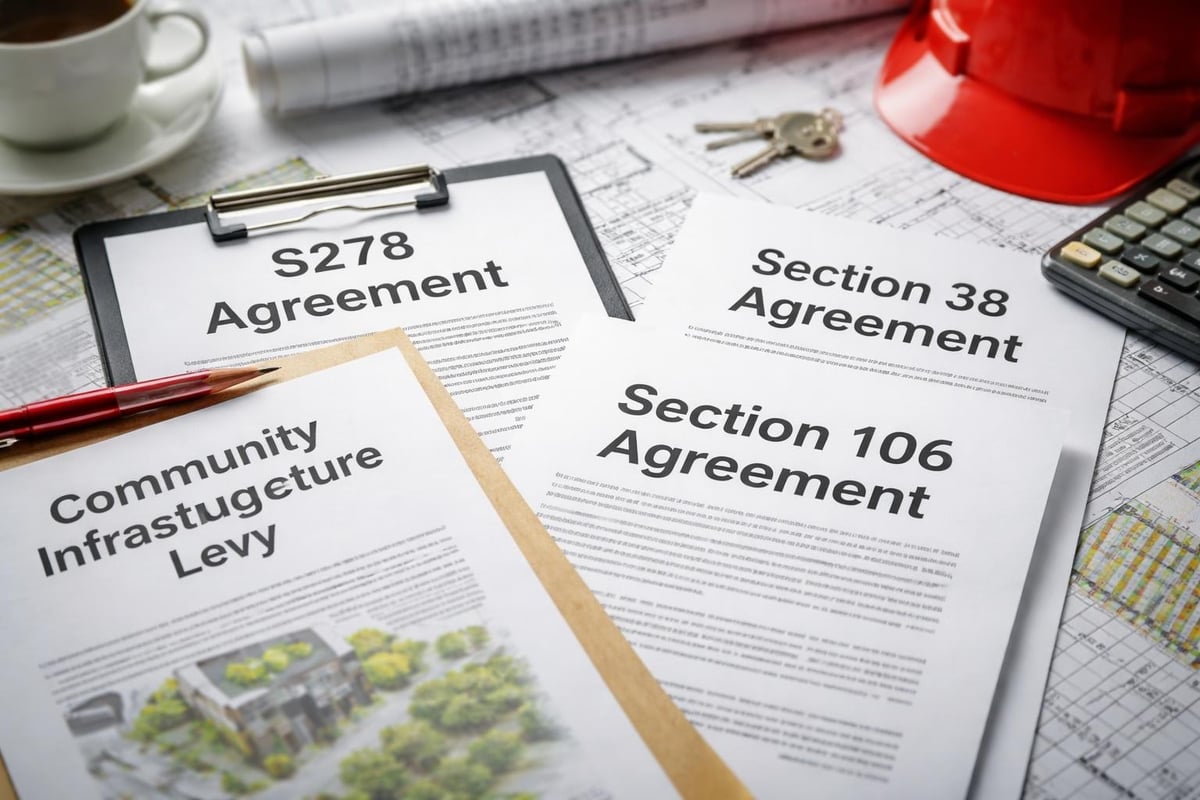
Where developments include new estate roads destined for adoption, Section 38 agreements under the Highways Act 1980 run alongside S278 works. The London Borough of Havering’s planning guidance explains how these different agreement types interact within the planning process.
Coordinating Section 38 and S278 requirements with a single highway authority contact streamlines approvals and ensures consistent technical standards across both agreement types. Design standards for new roads must align with modifications to existing highways at their interface points.
Contractor Selection and Procurement
Appointing contractors capable of delivering highway works to the required standards is critical. Highway authorities typically require contractors to demonstrate relevant experience, appropriate insurance, and quality management systems before approval.
Many developers working on projects requiring highway modifications partner with specialist civil engineering contractors who understand the technical requirements and approval processes. This expertise proves invaluable in delivering compliant works efficiently.
Financial Considerations Beyond Construction Costs
The s278 planning condition creates financial obligations extending beyond the direct cost of constructing highway works. Comprehensive budget planning accounts for these additional expenses to avoid financial surprises during delivery.
Commuted Sum Payments
Highway authorities require commuted sum payments to cover the future maintenance costs of adopted highway works. These one-off payments compensate the authority for maintaining infrastructure beyond standard highway maintenance requirements.
Commuted sums vary significantly depending on the elements installed. Complex features like traffic signals, unusual surfacing materials, or extensive landscaping attract higher commuted sums than standard road construction. Authorities calculate these payments using prescribed formulae, typically based on estimated maintenance costs over 15-25 years.
Typical commuted sum calculations:
| Element | Annual Maintenance | Commuted Period | Typical Sum |
|---|---|---|---|
| Traffic Signals | £3,000-£5,000 | 25 years | £40,000-£60,000 |
| Specialist Surfacing | £15-£25/m² | 20 years | £300-£500/m² |
| Street Lighting | £150-£250/column | 25 years | £2,500-£4,000/column |
| Landscaping | £5-£10/m² | 15 years | £75-£150/m² |
Engaging with the highway authority early regarding commuted sum expectations enables informed design decisions that balance functionality with long-term financial implications.
Bond and Security Arrangements
Financial bonds protecting the highway authority against developer default represent substantial cash flow considerations. These securities typically take the form of performance bonds issued by financial institutions or cash deposits held by the highway authority.
Bond costs include arrangement fees (typically 1-2% annually) and the opportunity cost of capital tied up in deposits. Factor these costs into development appraisals alongside direct construction expenditure.
Practical Tips for Developers and Property Owners
Successfully managing an s278 planning condition requires proactive planning, effective communication, and attention to procedural detail. These practical recommendations draw on industry experience across numerous projects.
Early Engagement Strategy
Contact the highway authority before submitting your planning application. Pre-application discussions identify potential highway requirements, inform site layout decisions, and establish realistic timescales for agreement delivery.
Pre-application advice services, offered by most highway authorities for a fee, provide formal feedback on proposals and clarify technical requirements. This investment typically saves time and cost during subsequent formal processes.
Design Approach and Standards
Highway authorities expect designs complying with current standards, primarily the Design Manual for Roads and Bridges (DMRB) and associated guidance documents. Familiarise your design team with these standards or appoint consultants with proven highway design experience.
Standard details and solutions generally progress through approvals faster than bespoke designs requiring detailed assessment. Where possible, adopt proven approaches that the highway authority has previously approved.
Programme Management
Develop realistic programme assumptions for each stage of the s278 planning condition process. Industry benchmarks suggest:
- Initial application to feasibility decision: 8-12 weeks
- Detailed design development: 12-16 weeks
- Technical approval of detailed designs: 8-12 weeks
- Legal agreement drafting and completion: 8-16 weeks
- Pre-construction approvals: 4-6 weeks
These timescales can extend significantly for complex projects or during peak periods. Building flexibility into your development programme accommodates realistic approval timescales without jeopardising overall delivery.
The planning obligations guidance from FACE IT provides broader context on how S278 agreements fit within developer contribution frameworks.
Documentation and Record Keeping
Maintain comprehensive records throughout the s278 planning condition process. Document all correspondence with the highway authority, retain dated copies of submitted drawings, and record verbal agreements in writing.
This documentation proves invaluable when disputes arise, when demonstrating compliance with agreement terms, or when coordinating with other project stakeholders. Organised record keeping also facilitates handover to contractors and ensures continuity if project team members change.
Case Study Applications
Examining real-world applications of s278 planning conditions provides valuable insights into how these agreements function in practice across different development types.
Commercial Development Example
The Southall High Street mixed-use development demonstrates S278 detailed design integration in urban commercial contexts. This project required extensive highway modifications to accommodate the development whilst enhancing pedestrian environments and public realm quality.
The S278 works included junction improvements, footway widening, traffic signal modifications, and public realm enhancements. Coordinating these works within a constrained urban environment, maintaining access to existing businesses, and satisfying multiple stakeholder requirements presented significant delivery challenges.
Success factors included early engagement with the highway authority, comprehensive traffic management planning, and phased construction enabling progressive handover of completed elements. The project demonstrates how s278 planning conditions can deliver highway improvements benefiting wider communities beyond the immediate development site.
Residential Development Considerations
Residential developments frequently trigger s278 planning conditions where new estate roads connect to existing highway networks. Visibility requirements at these junctions often necessitate highway land, requiring stop-up orders or land dedication alongside the S278 agreement.
The Thurston Parish Council’s discussion of Persimmon Homes development illustrates community perspectives on S278 condition discharge and the importance of transparent communication about highway works impacts.
For residential schemes, coordinating S278 junction works with Section 38 estate road construction optimises delivery efficiency. Appointing a single contractor for both elements ensures consistent standards and simplifies interface management between adopted and unadopted highway areas.
Working with Specialist Civil Engineering Contractors
The technical complexity and regulatory requirements associated with s278 planning conditions make specialist contractor selection critical to successful delivery. Contractors must demonstrate highway works competence, understanding of approval processes, and quality management capabilities.
Contractor Capabilities and Experience
When evaluating potential contractors for S278 works, assess their track record on similar projects, their relationships with local highway authorities, and their quality assurance procedures. Request references from previous projects and verify their insurance coverage meets highway authority requirements.
Experienced contractors understand the inspection regimes highway authorities employ and implement quality control measures preventing defects and ensuring first-time approval. This expertise reduces programme risk and minimises costly remedial works.
Collaborative Delivery Models
Engaging contractors during the design development phase enables buildability input and cost certainty before committing to final designs. Early contractor involvement identifies construction methodology constraints, informs temporary works requirements, and optimises designs for efficient delivery.
Some developers adopt two-stage tender processes where contractors are appointed initially on a consultancy basis during design development, then novated into construction contracts following design approval. This approach combines design optimisation with competitive cost certainty.
Understanding s278 planning conditions and navigating their requirements successfully is essential for any developer undertaking projects affecting public highways. From initial planning through design approval, agreement execution, and construction delivery, each stage demands careful attention to technical requirements, procedural compliance, and financial obligations. Whether you're developing commercial sites, residential estates, or infrastructure projects, professional guidance and experienced delivery partners prove invaluable in managing these complex agreements efficiently. At JRG Civils, we bring extensive experience in delivering highway works to the exacting standards required by S278 agreements, from detailed design through construction and adoption, ensuring your development progresses smoothly from planning approval to successful completion.