
When planning any development that requires alterations to public highways, understanding the s278 process is essential for developers, contractors, and property owners alike. This legal framework, established under Section 278 of the Highways Act 1980, governs how private developers can fund and execute works on public roads. Whether you're creating a new access point for a commercial development, improving road junctions, or installing new footpaths, navigating this process efficiently can save significant time and resources.
Understanding the Legal Framework of S278 Agreements
The s278 process provides a statutory mechanism that allows developers to carry out works on the public highway, provided they enter into a formal agreement with the local highway authority. This legislation exists to ensure that any modifications to public roads meet safety standards, align with highway design specifications, and serve the broader public interest.
Section 278 agreements differ fundamentally from Section 38 agreements, which deal with the adoption of new roads. The s278 process specifically addresses alterations to existing highway infrastructure. These modifications might include widening carriageways, creating new vehicle crossovers, installing traffic signals, or reconfiguring junctions to accommodate increased traffic from new developments.
Key Parties Involved
The s278 process typically involves three primary stakeholders:
- The Developer – responsible for funding the works and ensuring completion to specification
- The Local Highway Authority – holds legal ownership of the highway and grants permission for alterations
- The Approved Contractor – undertakes the physical construction work to required standards
Understanding each party's responsibilities is crucial for smooth project delivery. The Birmingham City Council provides detailed guidance on work on public highways under s278 agreements, including application requirements and fees.
Types of Works Covered Under S278
The scope of works permissible under the s278 process is remarkably broad, encompassing various highway improvements and alterations. Developers frequently require these agreements when their projects impact existing road networks.
Common examples include:
- Access creation – new vehicle entrances for residential or commercial developments
- Junction improvements – modifications to roundabouts, traffic light installations, or intersection reconfigurations
- Road widening – expanding carriageways to accommodate increased traffic volumes
- Pedestrian facilities – new footpaths, crossing points, or tactile paving installations
- Drainage systems – surface water management solutions affecting highway areas
- Street lighting – additional or upgraded illumination for safety purposes
- Traffic calming measures – speed humps, chicanes, or other flow management features
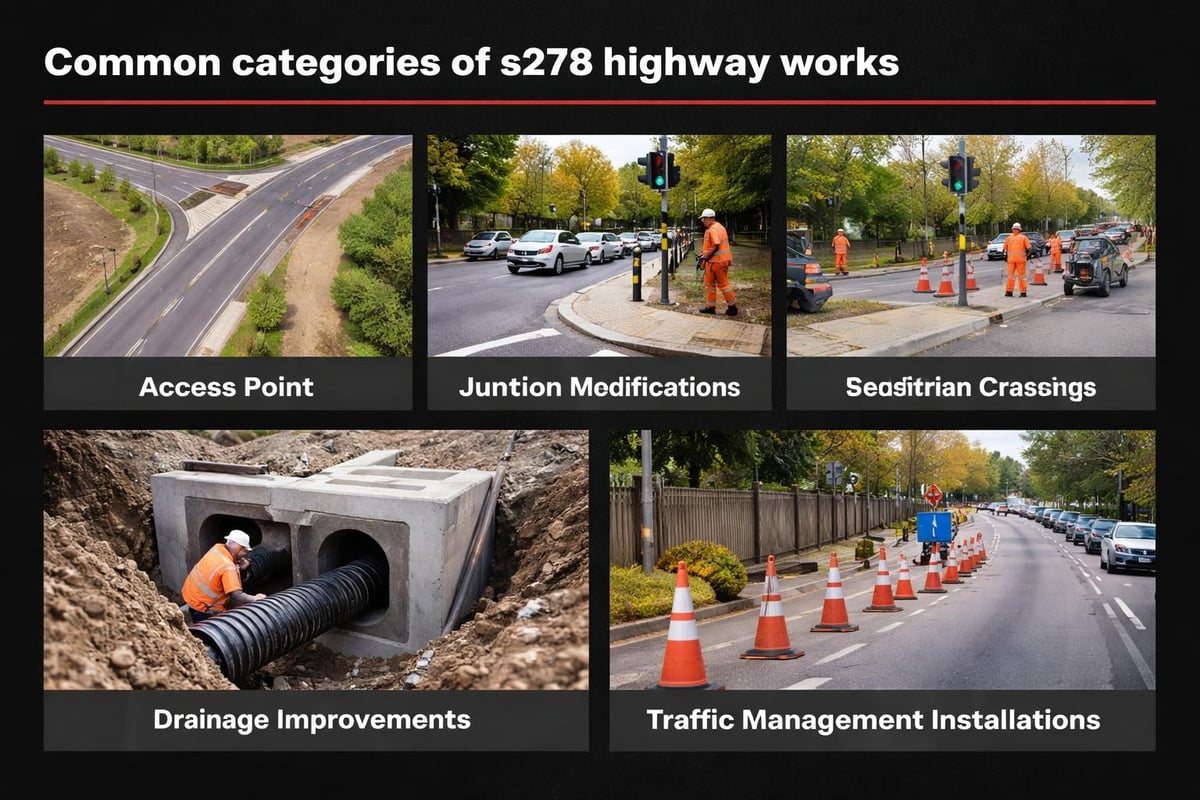
Commercial projects such as drive-through restaurants, retail parks, and industrial estates frequently trigger s278 requirements due to their traffic generation potential. Surrey County Council offers comprehensive guidance on alterations to existing roads under this legislative framework.
The Application and Approval Process
Navigating the s278 process requires careful attention to procedural requirements and timescales. The journey from initial application to completed works typically follows a structured pathway, though specific requirements vary between highway authorities.
Initial Planning Stage
Before submitting a formal s278 application, developers should engage with the highway authority during the planning permission phase. This early consultation helps identify potential issues, clarify technical requirements, and establish realistic timescales. Many authorities require a Transport Assessment or Transport Statement demonstrating how the development will impact local road networks.
The planning permission itself often includes conditions requiring s278 works, meaning you cannot occupy or operate the development until these highway improvements are completed and approved.
Technical Approval Requirements
Once planning permission is granted, the technical approval stage begins. This involves:
- Detailed highway design drawings prepared by qualified engineers
- Safety audit documentation (typically Stage 1 and Stage 2 audits)
- Materials specifications meeting highway authority standards
- Construction methodology statements
- Traffic management plans for works execution
The East Riding of Yorkshire Council provides clear information on the highway development s278 and s38 agreements process, covering all necessary approval stages.
Agreement Drafting and Execution
After technical approval, the legal agreement itself must be drafted, negotiated, and executed. This document establishes:
| Agreement Element | Purpose | Typical Provisions |
|---|---|---|
| Financial Bond | Protects authority against non-completion | Usually 125% of estimated costs |
| Commuted Sum | Covers future maintenance costs | Calculated based on anticipated lifespan |
| Timescales | Sets deadlines for works completion | Penalties for overruns may apply |
| Specifications | Defines quality and material standards | Must align with authority requirements |
| Inspection Rights | Allows authority oversight | Regular monitoring throughout construction |
The London Borough of Havering's detailed documentation on the s278 process including timescales and submission requirements offers valuable insights into agreement structuring.
Cost Implications and Financial Considerations
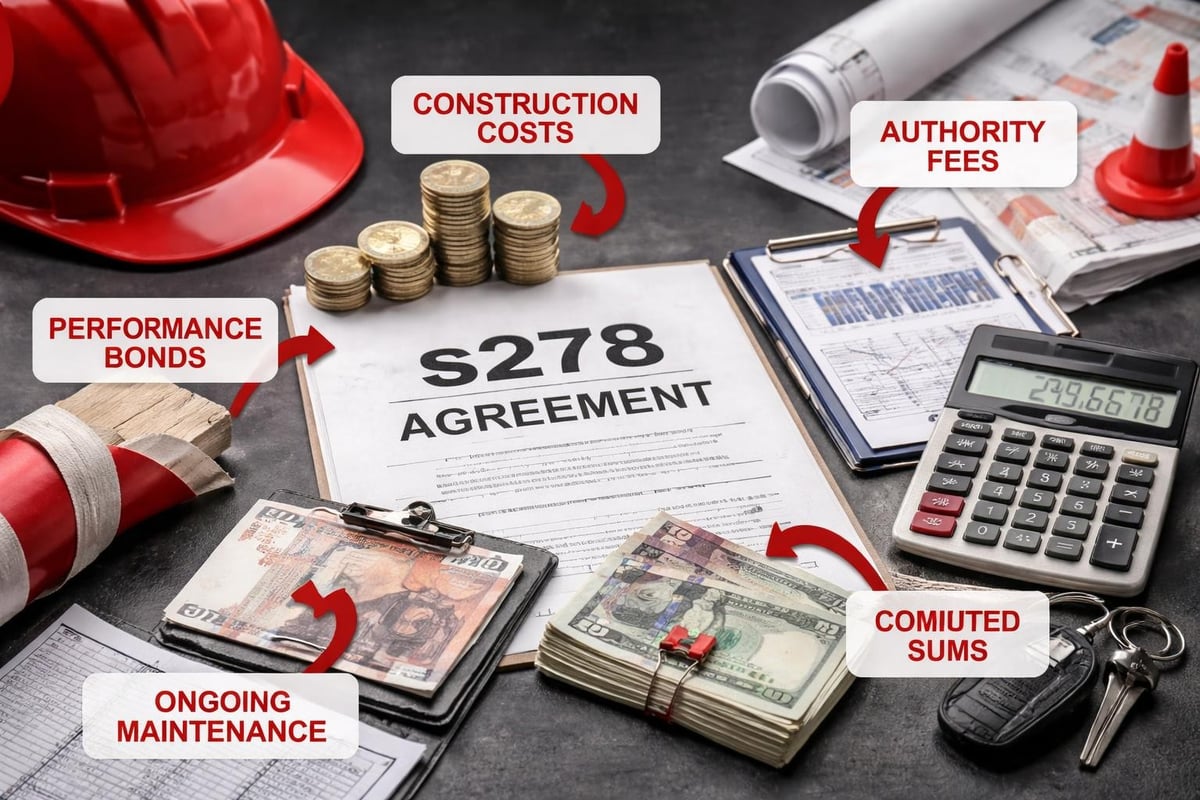
Understanding the financial aspects of the s278 process is critical for accurate project budgeting. Costs extend beyond the physical construction works themselves, encompassing various fees and financial securities.
Direct Costs
The developer bears full responsibility for all costs associated with s278 works. These typically include:
- Design and consultancy fees – for preparing technical drawings and safety audits
- Construction costs – materials, labour, and plant hire for the physical works
- Highway authority fees – processing, inspection, and administration charges
- Traffic management – temporary signals, diversions, and safety measures during construction
- Utility diversions – relocating services affected by highway alterations
Highway authority fees vary significantly between councils, with some charging fixed rates and others calculating fees based on estimated construction costs. These fees typically range from £2,000 for minor works to £15,000 or more for complex projects.
Financial Securities
Two major financial commitments form part of most s278 agreements:
Performance Bond – This security, usually set at 125% of the estimated construction cost, protects the highway authority if the developer fails to complete the works. The bond remains in place until the authority formally certifies completion and accepts the works.
Commuted Sum – Authorities require this payment to cover future maintenance of the new or altered highway infrastructure. Calculations consider the anticipated lifespan of materials, expected maintenance intervals, and current cost rates. Commuted sums for significant works can reach substantial amounts.
Timescales and Project Duration
The s278 process timeline varies considerably depending on project complexity, authority responsiveness, and technical challenges. Understanding realistic timescales helps developers plan their broader construction programmes effectively.
Typical Timeline Breakdown
A straightforward s278 project might follow this general schedule:
- Pre-application discussions – 4 to 8 weeks
- Formal application submission – 1 to 2 weeks preparation
- Technical approval – 8 to 16 weeks (authority review and potential revisions)
- Agreement drafting – 6 to 12 weeks (legal negotiations)
- Agreement execution – 2 to 4 weeks (signing and bond arrangements)
- Construction phase – variable (weeks to months depending on scope)
- Inspection and certification – 2 to 6 weeks
- Defects period – typically 12 months
More complex projects involving multiple junctions, extensive traffic management, or significant infrastructure changes can extend these timescales considerably. Some major schemes take 18 months or longer from initial application to final certification.
Factors Affecting Duration
Several elements influence how quickly the s278 process progresses:
- Authority workload – heavily subscribed teams may have longer review periods
- Design complexity – intricate schemes require more detailed scrutiny
- Safety audit outcomes – significant concerns necessitate redesign and resubmission
- Stakeholder consultation – affected parties may raise objections requiring resolution
- Seasonal restrictions – some authorities limit highway works during peak periods
- Utility conflicts – discovering unexpected services can cause delays
Planning ahead and building contingency time into development programmes helps mitigate these potential delays. For detailed procedural guidance, the legal framework documentation provides valuable insights into statutory requirements.
Working with Approved Contractors
The s278 process requires that all highway works are undertaken by contractors approved by the relevant highway authority. This approval system ensures that only competent, experienced firms work on public roads, maintaining safety and quality standards.
Contractor Approval Requirements
Highway authorities maintain lists of approved contractors who have demonstrated competence in highway construction. Approval typically requires:
- Public liability insurance – minimum £10 million cover
- Professional indemnity insurance – appropriate to project scale
- Health and safety credentials – SSIP certification or equivalent
- Technical competence – qualified supervisors and operatives
- Previous experience – demonstrated track record in highway works
- Quality management systems – ISO certifications or similar frameworks
Working with experienced contractors familiar with the s278 process significantly reduces risk and ensures smoother project delivery. IBBCO Civil Engineering provides perspective on the s278 agreement process from a contractor’s viewpoint, detailing typical procedures and requirements.
Inspection and Quality Control
Throughout construction, highway authority inspectors regularly visit sites to verify compliance with approved designs and specifications. Key inspection points include:
- Setting out – confirming accurate positioning of works
- Formation levels – checking excavation depths and gradients
- Drainage installation – inspecting pipework and connections before backfilling
- Sub-base construction – verifying material quality and compaction
- Surfacing works – monitoring layer thicknesses and finishes
- Line marking and signing – ensuring regulatory compliance
Failed inspections result in remedial work requirements, potentially delaying project completion and increasing costs. Quality-focused contractors with strong s278 experience minimise these risks through proactive quality management.
Maintenance Responsibilities and Adoption
Once s278 works are completed and certified, understanding ongoing maintenance obligations is crucial. The process doesn't simply end when construction finishes.
Defects Period
Most s278 agreements include a defects liability period, typically lasting 12 months from the completion certificate date. During this time:
- The developer remains responsible for rectifying any defects in the completed works
- The performance bond stays in place to secure this obligation
- Highway authorities monitor the works for issues requiring remediation
- Settlement, surface failures, or drainage problems must be addressed promptly
Only after successfully completing the defects period and obtaining final certification does the highway authority release the performance bond and fully adopt the works into the publicly maintainable highway.

Long-term Maintenance Funding
The commuted sum payment covers anticipated maintenance costs over a defined period, often 20 to 30 years. This financial contribution recognises that new highway infrastructure creates ongoing maintenance liabilities for local authorities with already stretched budgets.
Choosing Between Authority-Led and Developer-Led Works
Some highway authorities offer the option for them to undertake the s278 works directly on behalf of developers. This approach, highlighted by Stoke-on-Trent City Council's guidance on highways section 278 benefits, presents both advantages and considerations.
| Approach | Advantages | Considerations |
|---|---|---|
| Authority-Led | Single point of contact; integrated project management; potentially faster approvals | Less developer control; may have higher costs; authority availability constraints |
| Developer-Led | Greater control over timing; competitive contractor selection; potential cost savings | More complex coordination; developer carries more risk; requires dedicated project management |
The choice depends on project specifics, developer experience, and local authority capacity. For large-scale commercial developments, experienced developers often prefer managing works directly through their approved contractors, whilst smaller projects might benefit from authority-led delivery.
Common Challenges and How to Overcome Them
Despite careful planning, the s278 process can present challenges. Being aware of common pitfalls helps developers and contractors navigate more successfully.
Design Revisions and Rework
Safety audits frequently identify issues requiring design modifications. To minimise revisions:
- Engage experienced highway design consultants familiar with local authority standards
- Request pre-application meetings to clarify specific requirements
- Commission early-stage safety audits to identify concerns before formal submission
- Build realistic timescales into programmes accommodating potential design iterations
Utility Conflicts
Discovering unexpected services during construction causes significant delays. Mitigation strategies include:
- Comprehensive utility searches before design finalisation
- Trial holes at critical locations to confirm service positions
- Early engagement with utility companies regarding potential diversions
- Contingency planning for alternative construction methodologies
- Programme buffers to accommodate unforeseen utility work
Traffic Management Approvals
Complex traffic management requirements can extend timescales and increase costs. Planning Geek offers a useful overview of s278 agreements, including examples of typical requirements. Effective strategies include:
- Early consultation with traffic management teams
- Considering works phasing to minimise disruption
- Planning works during off-peak periods where possible
- Incorporating temporary signals or diversions into initial designs
- Budgeting adequately for extended traffic management periods
Regional Variations in S278 Procedures
Whilst the legislative framework remains consistent across England and Wales, individual highway authorities implement the s278 process differently. These variations affect timescales, costs, and procedural requirements.
County Councils vs Unitary Authorities
County councils typically handle strategic road networks and rural highways, whilst unitary authorities manage all roads within their boundaries. Each develops its own:
- Fee structures and charging methodologies
- Technical approval processes and documentation requirements
- Standard details and construction specifications
- Inspection regimes and quality control procedures
- Timescales for application review and agreement drafting
Commuted Sum Calculations
Particularly significant variation exists in how authorities calculate commuted sums. Some use standardised formulas based on asset types, whilst others undertake bespoke assessments for each project. These differences can substantially impact overall project costs, with commuted sums for identical works varying by tens of thousands of pounds between authorities.
Documentation Standards
Required submission documentation also varies. Some authorities accept digital submissions and electronic signatures, whilst others maintain traditional paper-based processes. Understanding local requirements early prevents submission delays and repeated revision requests.
Best Practices for Successful S278 Projects
Drawing from successful project delivery across various sectors, several best practices emerge for navigating the s278 process effectively:
Engage early and often – Begin discussions with highway authorities during initial development planning, not after securing planning permission. This proactive approach identifies requirements, clarifies expectations, and establishes working relationships that facilitate smoother processing.
Appoint experienced professionals – Utilise consultants and contractors with proven s278 track records. Their familiarity with procedures, technical standards, and authority expectations significantly reduces risks and delays.
Build realistic programmes – Allow adequate time for each process stage, incorporating contingency for revisions, inspections, and unforeseen challenges. Rushing the s278 process invariably proves counterproductive.
Maintain detailed records – Document all communications, design decisions, and approval stages. This paper trail proves invaluable if disputes arise or clarification becomes necessary.
Budget comprehensively – Account for all cost elements including fees, bonds, commuted sums, and potential variations. Underestimating s278 costs creates financial pressures that can jeopardise broader development viability.
At JRG Civils, our experience delivering commercial projects including drive-through facilities demonstrates the importance of meticulous s278 planning and execution. Our comprehensive approach to highway works ensures developments proceed smoothly from planning through to completion.
Technical Standards and Specifications
Highway works undertaken through the s278 process must comply with rigorous technical standards ensuring safety, durability, and consistency across the road network.
Design Standards
Most highway authorities require compliance with:
- Design Manual for Roads and Bridges (DMRB) – comprehensive standards for highway infrastructure
- Manual for Streets – guidance for residential and mixed-use developments
- Traffic Signs Regulations and General Directions (TSRGD) – regulatory framework for signing and marking
- Local authority supplementary guidance – specific requirements varying by location
These standards cover geometric design, structural requirements, drainage specifications, and accessibility provisions. Deviations from standard parameters require formal departure applications with robust justification.
Materials and Construction Quality
Quality materials and workmanship form the foundation of successful highway works. Typical specification requirements include:
- Sub-base materials – Type 1 granular material to specified grading and compaction standards
- Binder course – dense bitumen macadam meeting appropriate BS standards
- Surface course – specified aggregate gradation and binder content for durability
- Kerbing – hydraulically pressed concrete units to prescribed dimensions
- Drainage components – inspection chambers, gullies, and pipework meeting adoptable standards
- Signing and lining – retroreflective materials with specified performance characteristics
Construction testing requirements typically include compaction verification, material sampling, and visual inspections at defined hold points. Maintaining comprehensive test records facilitates smooth certification and adoption processes.
Navigating the s278 process successfully requires careful planning, technical expertise, and procedural understanding. By engaging early with highway authorities, appointing experienced professionals, and allowing realistic timescales, developers can deliver highway works efficiently whilst maintaining quality standards. Whether you're planning commercial development access, junction improvements, or highway alterations, understanding these requirements ensures smooth project delivery. At JRG Civils, our civil engineering expertise and commitment to excellence means we deliver highway works to the highest standards, supporting developments across the North East and throughout the UK.