
Navigating highway improvement works requires a thorough understanding of the legal frameworks governing alterations to public highways. When development projects necessitate modifications to existing road infrastructure, developers must secure proper authorisation from the local highway authority. This legal mechanism ensures that all works meet required standards, protect public safety, and integrate seamlessly with existing highway networks. For civil engineering contractors and developers undertaking commercial or residential projects, understanding this process proves essential for project planning, budgeting, and successful delivery.
Understanding the Legal Framework
A Section 278 agreement represents a legally binding contract between a developer and the local highway authority, established under the Highways Act 1980. This mechanism allows developers to carry out alterations or improvements to public highways that directly relate to their development projects.
Birmingham City Council provides comprehensive information about how these agreements function within the planning system. The agreement ensures that highway works meet technical standards, remain maintainable by the authority, and integrate properly with existing infrastructure.
Key Principles and Applications
S278 agreement guidance typically covers several fundamental aspects that developers must comprehend:
- Scope of works: Modifications to junction layouts, creation of new access points, installation of traffic signals, or improvements to pedestrian crossings
- Legal obligations: Binding commitments regarding design standards, construction quality, timing of works, and post-completion maintenance periods
- Financial arrangements: Cost estimates, bond requirements, commuted sums for future maintenance, and inspection fees
- Technical specifications: Design approval processes, material specifications, construction methodologies, and safety requirements
The agreement protects both parties by establishing clear responsibilities and ensuring that works align with highway authority standards and policies.

When S278 Agreements Become Necessary
Commercial developments frequently trigger the need for highway modifications. Drive-through restaurants, retail parks, residential estates, and industrial facilities often require alterations to existing road networks to accommodate increased traffic volumes and provide safe access.
For contractors specialising in civil engineering works, recognising early when a project requires this legal framework proves crucial. Planning applications typically identify highway impact, but detailed assessments occur during the technical approval stage.
Common Scenarios Requiring Agreements
| Development Type | Typical Highway Works | Agreement Complexity |
|---|---|---|
| Drive-through restaurants | New junction, traffic islands, pedestrian crossings | Medium to High |
| Residential estates | Visibility splays, junction improvements, footway extensions | High |
| Retail developments | Signalised junctions, road widening, bus stops | High |
| Industrial units | Access roads, turning areas, signage | Medium |
| Small commercial | Dropped kerbs, minor junction alterations | Low to Medium |
St Helens Borough Council outlines how the agreement terms vary depending on the scale and complexity of proposed works.
The Application and Approval Process
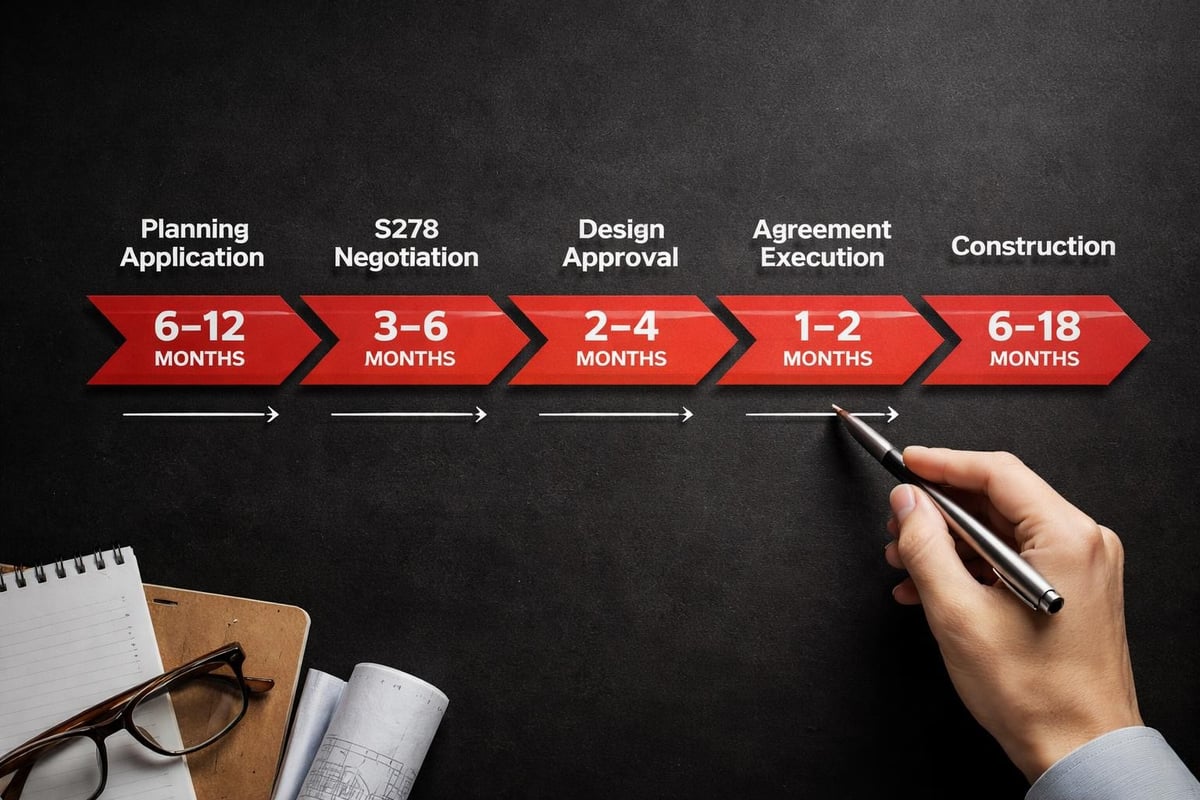
Securing s278 agreement guidance early in project development prevents delays and cost overruns. The process typically commences during planning application stages, though formal agreements are finalised before construction begins.
Initial Steps and Requirements
- Pre-application consultation: Engage with highway authority engineers to discuss proposed works and identify potential issues
- Technical submission: Provide detailed drawings, traffic impact assessments, and design calculations
- Design approval: Obtain highway authority acceptance of technical designs and specifications
- Legal drafting: Solicitors prepare agreement documents detailing obligations, costs, and timescales
- Financial securities: Arrange bonds or deposits to guarantee work completion and quality
- Agreement execution: Both parties sign the legal document, enabling works to commence
Sheffield City Council’s application procedures demonstrate how different authorities structure their approval processes. Understanding local variations in requirements helps contractors plan effectively.
The technical approval stage demands particular attention. Highway authorities scrutinise designs against current standards, including visibility requirements, drainage provisions, road geometry, and safety features.
Cost Considerations and Financial Planning
Financial planning for highway works under s278 agreements requires careful consideration of multiple cost elements. Unlike standard construction contracts, these agreements involve specific charges and financial securities that impact overall project budgets.
Direct construction costs represent the physical works expense, including materials, labour, plant hire, and traffic management. These costs vary significantly based on work complexity, site constraints, and material specifications.
Authority fees and charges cover the highway authority's administrative costs, including:
- Design review and technical approval
- Legal agreement preparation
- Construction supervision and inspection
- Adoption processes and documentation
Financial Security Requirements
Highway authorities typically require financial guarantees to protect against contractor default or substandard work. Stoke-on-Trent City Council highlights how having the authority undertake works can provide cost certainty, though many developers prefer using specialist contractors.
| Security Type | Typical Amount | Purpose |
|---|---|---|
| Performance bond | 120-150% of work value | Ensures completion if contractor defaults |
| Commuted sum | Calculated per asset type | Covers future maintenance costs |
| Inspection fees | 10-15% of work value | Authority supervision and sign-off |
| Legal fees | Fixed or hourly rate | Agreement preparation and processing |

Technical Standards and Design Requirements
Highway works must comply with rigorous technical standards that ensure safety, longevity, and compatibility with existing infrastructure. S278 agreement guidance emphasises adherence to national design standards and local authority specifications.
The Welsh Government’s official guidance provides comprehensive technical requirements that influence design development across the UK.
Design Manual for Roads and Bridges (DMRB) Compliance
Most highway authorities require designs to conform with DMRB standards, which cover:
- Geometric design parameters
- Drainage and surface water management
- Pavement construction and materials
- Road markings and signage
- Lighting specifications
- Safety barrier installation
For contractors experienced in commercial projects like drive-through developments, understanding these standards ensures designs gain approval efficiently. Drive-through facilities demand particular attention to traffic flow, queuing arrangements, and pedestrian safety.
Construction Phase Management
Once agreements are executed and approvals obtained, construction phase management becomes critical. Highway works often occur in live traffic environments, requiring sophisticated traffic management and coordination with highway authorities.
Site Supervision and Inspection Protocols
Highway authorities typically conduct regular inspections throughout construction to verify compliance with approved designs and specifications. Contractors must maintain detailed records, including:
- Material test certificates and compliance documentation
- Photographic records of construction stages
- As-built drawings showing actual construction details
- Quality assurance documentation
Sheffield’s detailed guidance for developers explains inspection requirements and quality standards expected during construction.
Traffic management requires careful planning and often represents a significant cost element. Temporary traffic signals, road closures, diversion routes, and pedestrian management all need highway authority approval before implementation.
Common Challenges and Solutions
Developers and contractors frequently encounter specific challenges when navigating s278 agreement processes. Understanding these obstacles and their solutions streamlines project delivery.
Design approval delays often result from incomplete submissions or non-compliance with standards. Engaging experienced highway design consultants early prevents iterative revisions and accelerates approval timelines.
Cost escalation can occur when scope changes emerge during design development. Thorough initial assessments and contingency planning mitigate financial risks.
Coordination with Other Approvals
Highway works rarely exist in isolation. S278 agreement guidance must align with:
- Planning conditions and obligations
- Utility diversions and apparatus protection
- Environmental permits and ecological considerations
- Statutory undertakers' requirements
- Building control approvals
Lincolnshire County Council discusses how different legal agreements apply to various scenarios, helping developers select appropriate mechanisms.
Working with Specialist Contractors
Selecting contractors with proven experience in highway works significantly impacts project success. Specialist civil engineering firms bring technical knowledge, established relationships with highway authorities, and understanding of approval processes.
For commercial developments requiring highway modifications, contractors who have delivered similar projects understand the nuances of s278 agreement guidance. Experience with drive-through facilities, retail parks, or residential developments demonstrates capability to navigate technical and administrative requirements.
Contractor Selection Criteria
| Capability | Importance | Evaluation Method |
|---|---|---|
| Previous s278 project delivery | Critical | Request case studies and references |
| Technical design capability | High | Review qualifications and resources |
| Highway authority relationships | High | Discuss previous projects in jurisdiction |
| Traffic management experience | Critical | Examine NRSWA accreditations |
| Quality assurance systems | High | Review certification and processes |
Contractors based in regions where projects occur often possess valuable local knowledge of authority requirements and preferences. However, firms capable of nationwide project delivery offer flexibility for developers with multiple sites.
Regional Variations and Local Requirements
While s278 agreements follow statutory frameworks, individual highway authorities implement varying procedures, fees, and technical requirements. S278 agreement guidance differs between councils, necessitating careful research for each project location.
Doncaster Council’s detailed guidance notes illustrate how authorities publish specific requirements, including procedural steps, insurance requirements, and technical approval processes.
Authority-Specific Considerations
Northern councils may emphasise different design elements compared to southern authorities, reflecting local traffic patterns, climate considerations, and infrastructure priorities. Developers working across multiple regions benefit from contractors familiar with these variations.
Some authorities maintain preferred contractor lists or frameworks for highway works. Understanding procurement routes and contractual preferences helps position contractors advantageably.
Post-Construction and Adoption
Completion of physical works represents only one phase of the s278 agreement process. Post-construction activities ensure works meet required standards and transfer to highway authority maintenance.
Defects Liability and Maintenance Periods
Agreements typically include maintenance periods during which contractors remain responsible for defect rectification. Standard periods range from twelve to twenty-four months, depending on work complexity and authority requirements.
During this period:
- Contractors maintain surfacing, drainage, and structural elements
- Authorities conduct final inspections before adoption
- Snagging items receive attention and resolution
- As-built documentation undergoes final verification
Highway authorities formally adopt completed works once satisfied that construction meets approved standards and all documentation is complete. Adoption transfers maintenance responsibility to the authority, releasing financial securities held against contractor performance.
Insurance and Liability Considerations
Highway works carry significant liability exposure, requiring comprehensive insurance arrangements. S278 agreement guidance typically specifies minimum insurance requirements covering public liability, employer's liability, and professional indemnity.
Public liability insurance protects against third-party injury or property damage claims arising from highway works. Authorities commonly require coverage of £10-20 million for standard projects, with higher limits for complex schemes.
Professional indemnity insurance covers design liability, protecting developers and authorities against claims resulting from design errors or omissions. This becomes particularly important when developers employ consultants for highway design work.
Contractors must provide evidence of adequate insurance before agreement execution and throughout construction phases. Certificate renewals require prompt submission to maintain compliance with agreement terms.
Documentation and Record Keeping
Meticulous documentation throughout the s278 agreement process protects all parties and facilitates smooth project delivery. Essential records include design submissions, approval correspondence, inspection reports, and completion certificates.
For contractors managing multiple projects simultaneously, systematic record management prevents administrative delays and ensures compliance with agreement obligations. Digital document management systems streamline information sharing with highway authorities and clients.
As-built drawings constitute critical deliverables that must accurately reflect constructed works. These drawings inform future maintenance activities and provide definitive records of highway infrastructure modifications.
Successfully navigating s278 agreement processes requires technical expertise, procedural knowledge, and effective coordination with highway authorities. Understanding the legal framework, cost implications, and technical requirements enables developers and contractors to deliver compliant highway works efficiently. Whether you're planning a commercial development, residential estate, or infrastructure project requiring highway modifications, working with experienced civil engineering specialists ensures smooth project delivery from initial design through to adoption. JRG Civils brings proven expertise in highway works and s278 agreement delivery across commercial and residential projects throughout the UK, combining technical excellence with comprehensive project management capabilities.