
When developing commercial or residential property that requires modifications to public highways, understanding the legal framework governing such changes is essential. Section 278 of the Highways Act 1980 provides the statutory mechanism through which developers can legally undertake works on public highways, ensuring that all modifications meet the required standards and integrate seamlessly with existing infrastructure. For civil engineering contractors and developers alike, navigating s 278 works efficiently can significantly impact project timelines, budgets, and ultimate success.
Understanding Section 278 Agreements
Section 278 of the Highways Act 1980 establishes the legal basis for developers to execute, or fund, works on public highways that lie outside their development boundaries. These agreements represent a formal contract between the developer and the local Highway Authority, outlining the scope, standards, and responsibilities for highway modifications necessitated by new developments.
The fundamental purpose of s 278 works includes:
- Creating new access points to development sites
- Modifying existing junctions to accommodate increased traffic flows
- Installing or relocating traffic signals and pedestrian crossings
- Improving road alignments and visibility splays
- Adding or enhancing bus stops and public transport infrastructure
These agreements ensure that any alterations to the public highway network maintain safety standards whilst supporting economic development. The Highway Authority retains ultimate control over design specifications and construction quality, protecting the long-term integrity of the public road network.
The Legal Framework and Requirements
S 278 works cannot commence without formal approval from the relevant Highway Authority. St Helens Borough Council explains that developers must enter into a legal agreement before undertaking any highway works, with the local authority maintaining oversight throughout the process.
The agreement typically includes several critical components that protect both parties' interests whilst ensuring public safety:
| Agreement Component | Purpose | Developer Responsibility |
|---|---|---|
| Design Approval | Ensures works meet technical standards | Submit detailed designs for approval |
| Financial Bond | Guarantees completion and maintenance | Provide security deposit or bond |
| Construction Standards | Maintains quality across highway network | Employ accredited contractors |
| Defects Period | Protects against poor workmanship | Rectify issues during liability period |
| Commuted Sum | Covers future maintenance costs | Pay calculated maintenance contribution |
The financial aspects of s 278 works require careful consideration. Developers must typically provide bonds covering 150% of the estimated construction costs, protecting the Highway Authority should the developer fail to complete works to the required standard.
The S 278 Works Process
Navigating the s 278 works process requires methodical planning and clear communication with the Highway Authority. The timeline from initial application to final adoption can extend from several months to over a year, depending on the complexity and scale of proposed works.
Initial Stages and Design Approval
The process begins during the planning application phase, where the need for highway works is identified through transport assessments and planning conditions. Once planning permission is granted, developers must prepare detailed technical designs that comply with the Highway Authority's standards and specifications.
Key design considerations include:
- Compliance with current design standards and guidance
- Road safety audits at appropriate stages
- Accessibility requirements for all road users
- Sustainable drainage considerations
- Integration with existing highway infrastructure
Wakefield Council provides detailed guidance on the procedures and fees associated with these agreements, highlighting the importance of early engagement with highway officers to discuss proposals before formal submission.
The design approval process involves multiple stages of review, with Highway Authority engineers scrutinising every aspect to ensure compliance with technical standards. This rigorous approach prevents future maintenance issues and ensures that modifications enhance rather than compromise the highway network.
Construction Phase Requirements
Once designs receive approval and the legal agreement is executed, construction can commence. However, s 278 works demand strict adherence to approved plans and specifications, with Highway Authority inspectors monitoring progress throughout.
Contractors undertaking these works must hold appropriate accreditation, typically requiring inclusion on the Highway Authority's approved contractor list. Barnsley Council’s supplementary planning document emphasises the importance of proper accreditation and the responsibilities developers bear throughout the construction process.

Quality assurance throughout construction remains paramount. Materials must meet specified standards, construction techniques must follow approved methodologies, and testing regimes must verify compliance. Any deviations from approved designs require formal approval through the Highway Authority before implementation.
Types of Works Covered Under Section 278
The scope of s 278 works encompasses a broad spectrum of highway modifications, from minor access improvements to major junction reconfigurations. Understanding which works fall under this legislation helps developers budget appropriately and plan realistic timelines.
Common S 278 Applications
Commercial developments frequently require significant highway modifications to manage increased traffic volumes and provide safe access. Drive-through restaurants, retail parks, and business estates typically necessitate new traffic signals, modified junctions, or additional lanes.
According to Planning Geek’s comprehensive explanation, typical works include creating new site accesses, modifying existing junctions, relocating bus stops, installing pedestrian crossings, and improving street lighting. Each category demands specific technical expertise and compliance with distinct design standards.
Typical s 278 works by development type:
- Retail and Commercial: Roundabout modifications, traffic signal installations, dedicated turning lanes
- Residential Estates: New junction construction, visibility splay improvements, footway extensions
- Industrial Units: Heavy goods vehicle access points, road widening, junction capacity improvements
- Mixed-Use Developments: Public realm enhancements, pedestrian priority measures, cycle infrastructure
Technical Specifications and Standards
Highway works must comply with rigorous technical standards that vary depending on the road classification and local authority requirements. Northumberland County Council’s detailed guidance outlines the design checks and technical approvals required, emphasising the Highway Authority's role in maintaining network consistency.
The Design Manual for Roads and Bridges (DMRB) provides the overarching framework for major highway works, whilst local authorities often maintain supplementary guidance for minor modifications. Materials specifications, construction tolerances, and testing requirements all contribute to ensuring long-term durability.
| Work Type | Primary Standard | Key Requirements |
|---|---|---|
| New Junctions | DMRB CD 116 | Geometric design, visibility, capacity analysis |
| Footways | Local Highway Standards | Width, gradients, tactile paving specifications |
| Drainage | DMRB CD 532 | Sustainable drainage, flood risk assessment |
| Road Markings | Traffic Signs Manual Chapter 5 | Materials, dimensions, retroreflectivity |
Financial Considerations and Timescales
The financial implications of s 278 works extend beyond the immediate construction costs, encompassing design fees, legal expenses, bonds, inspection charges, and commuted sums for future maintenance. Developers must budget comprehensively to avoid unexpected financial pressures during project delivery.
Cost Components and Budgeting
Construction costs form the most visible element of s 278 works expenditure, but several additional charges significantly impact overall budgets. Highway Authority fees cover design checking, legal agreement preparation, and construction inspection, typically calculated as a percentage of estimated works value.
Commuted sums represent a particularly significant cost element, calculated to cover the Highway Authority's maintenance obligations for a specified period, usually 25 years. These calculations consider the type of construction, anticipated maintenance requirements, and local authority maintenance standards.
Comprehensive s 278 works budget should include:
- Detailed design and technical drawing preparation
- Road safety audits at multiple stages
- Highway Authority fees and inspection charges
- Construction costs including materials and labour
- Bond or security deposit (typically 150% of works value)
- Commuted sum for future maintenance
- Contingency for unforeseen complications
Early cost estimation proves challenging due to the bespoke nature of each project. Engaging experienced civil engineering contractors early in the planning process helps develop realistic budgets and identifies potential cost-saving opportunities without compromising safety or quality standards.
Timeline Planning and Critical Path
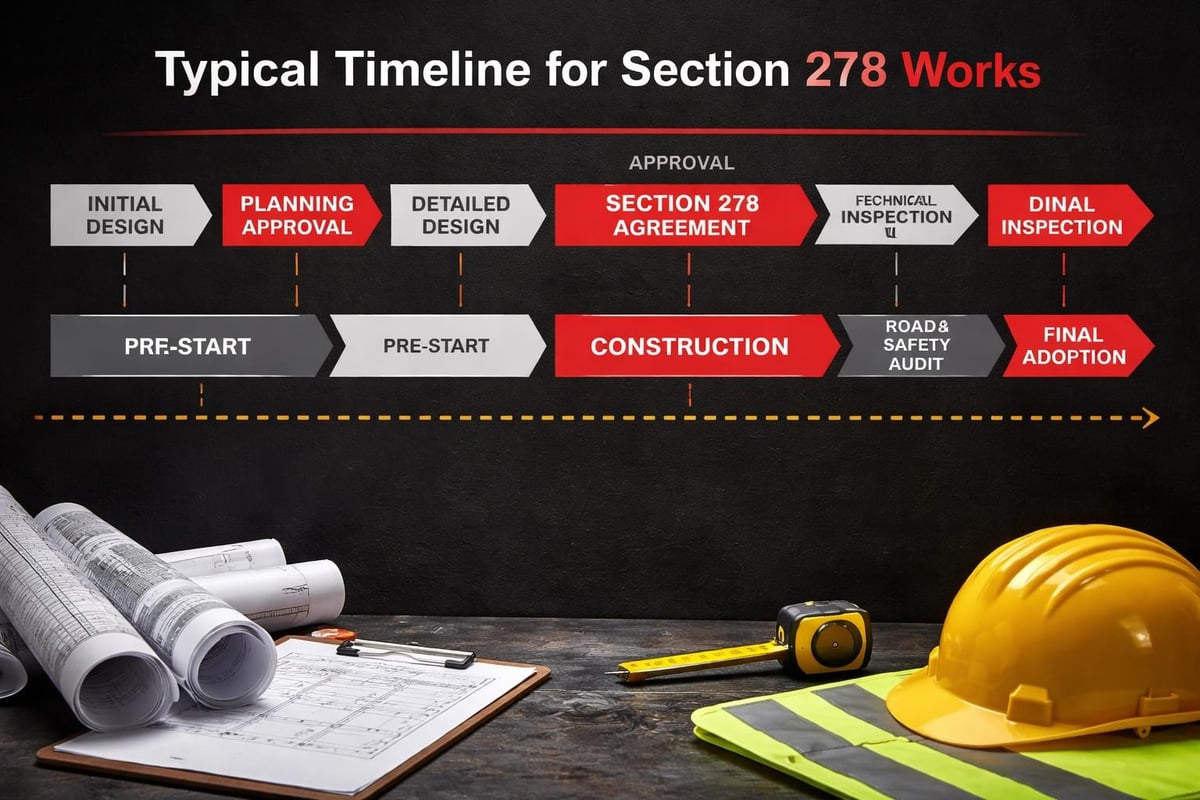
Project timelines for s 278 works vary considerably based on complexity, Highway Authority resources, and construction scale. Simple access modifications might achieve completion within six months, whilst major junction reconfigurations can extend beyond eighteen months from initial submission to final adoption.
The critical path typically includes design development, Road Safety Audit Stage 1, design approval, legal agreement execution, construction, defects rectification, and final adoption. Bristol City Council’s process guide emphasises the legal requirements and procedural steps that must be followed sequentially, highlighting where delays commonly occur.
Understanding these timescales proves essential for coordinating s 278 works with broader development programmes. Highway works often sit on the critical path for development completion, making efficient management crucial for achieving programme milestones and avoiding costly delays.
Working with Experienced Civil Engineering Contractors
The complexity of s 278 works demands contractors with specific expertise in highway construction, thorough understanding of technical standards, and established relationships with Highway Authorities. Selecting the right contractor significantly influences project success, cost certainty, and timeline adherence.
Contractor Selection Criteria
Not all civil engineering contractors possess the qualifications and experience necessary for s 278 works. Highway Authorities maintain approved contractor lists, and developers must typically select from these pre-qualified organisations. The approval process assesses technical competence, health and safety records, quality management systems, and financial stability.
Experienced contractors bring valuable insights that extend beyond basic construction capabilities. Their familiarity with local Highway Authority procedures, understanding of common approval challenges, and relationships with inspectors can streamline processes and resolve issues efficiently. SB Civils highlights how s 278 works keep developments connected and compliant, emphasising the contractor's role in achieving these outcomes.
Essential contractor capabilities for s 278 works:
- Current accreditation with relevant Highway Authorities
- Proven track record in highway construction projects
- Robust quality assurance and testing procedures
- Comprehensive health and safety management systems
- Experience with traffic management and public liaison
- Understanding of Road Safety Audit requirements
Quality Assurance and Compliance
Throughout construction, rigorous quality assurance procedures verify that works meet approved specifications. Testing regimes cover materials, construction techniques, and finished works, with results documented comprehensively for Highway Authority review. Non-compliance can result in rejection of works, requiring costly remediation.
Civil engineering contractors must maintain detailed records demonstrating compliance at every stage. Material certificates, test results, photographic evidence, and as-built drawings all contribute to the adoption package submitted upon completion. The thoroughness of this documentation directly impacts the speed of final adoption and release of bonds.
Commercial Applications and Case Studies
S 278 works feature prominently in commercial development across multiple sectors. Retail franchises, particularly drive-through establishments, frequently require substantial highway modifications to accommodate vehicular movements and ensure customer safety whilst maintaining traffic flow on the public highway.
Drive-through coffee shops and fast-food restaurants present unique challenges, requiring careful design of access and egress arrangements that prevent queuing traffic from obstructing the public highway. Traffic modelling, queue length analysis, and junction capacity assessments inform design solutions that balance commercial viability with highway safety.
Industrial and logistics developments often necessitate major junction improvements to accommodate heavy goods vehicles. Swept path analysis ensures that the largest vehicles can manoeuvre safely, whilst visibility assessments confirm that sightlines meet standards for the road classification and speed limit.
The integration of s 278 works with broader infrastructure improvements increasingly features in modern development schemes. Developers may incorporate public realm enhancements, pedestrian priority measures, or cycling infrastructure that exceed minimum requirements, creating legacy benefits for the wider community whilst facilitating development approval.
Post-Construction Responsibilities
The completion of physical construction does not conclude s 278 works obligations. A defects period, typically twelve months, follows practical completion, during which the developer remains responsible for rectifying any issues arising from construction defects or design inadequacies.
Defects Period and Maintenance
During the defects period, Highway Authority inspectors monitor the works, documenting any deterioration, failures, or non-compliance issues. Common defects include surface course failures, drainage problems, sign or marking deterioration, and structural issues. The developer must rectify all identified defects promptly and to the satisfaction of the Highway Authority.
Upon satisfactory completion of the defects period, the Highway Authority formally adopts the works, integrating them into the public highway network. Bond release follows adoption, returning the developer's security deposit minus any retention for outstanding minor works. The commuted sum then provides funding for future maintenance over the agreed period.
Post-construction timeline:
- Practical Completion: Physical works finished, initial inspection passed
- Defects Period Commencement: Usually 12 months from practical completion
- Regular Inspections: Highway Authority monitors condition throughout period
- Defects Rectification: Developer addresses all identified issues
- Final Inspection: Comprehensive assessment before adoption
- Formal Adoption: Highway Authority assumes maintenance responsibility
- Bond Release: Security deposit returned (minus any retention)
The quality of initial construction directly impacts the defects period experience. Well-executed works typically progress smoothly through this phase, whilst poor workmanship results in extensive remediation requirements, delays to adoption, and additional costs. This reality emphasises the importance of selecting experienced contractors and maintaining rigorous quality control throughout construction.
Successfully navigating s 278 works requires technical expertise, procedural knowledge, and collaborative working with Highway Authorities to deliver compliant highway modifications that support development whilst enhancing public infrastructure. Whether you're planning a commercial development requiring new access arrangements or residential schemes needing junction improvements, partnering with experienced civil engineering specialists ensures your highway works proceed efficiently and cost-effectively. For expert guidance on s 278 works and comprehensive civil engineering solutions across the North East and throughout the UK, contact JRG Civils to discuss your project requirements.