
Road kerbing serves as one of the most critical yet often overlooked components in highway construction and driveway installation. These carefully positioned concrete or stone edges define boundaries between different road users, channel surface water, and provide essential structural support to road surfaces. Whether you're planning a commercial development, residential driveway, or major highways project, understanding the fundamentals of kerbing installation can significantly impact the longevity and functionality of your surfacing work.
Understanding the Fundamental Purpose of Road Kerbing
Road kerbing performs multiple essential functions that extend far beyond simple aesthetic boundaries. The primary role involves containing the road pavement structure, preventing lateral movement of the surfacing materials under traffic loads. Without proper kerbing, road edges deteriorate rapidly, leading to premature failure and costly repairs.
Structural and Drainage Functions
The structural benefits of correctly installed kerbing cannot be overstated. Kerbs provide edge restraint to flexible pavements, preventing the horizontal spread of asphalt or block paving materials. This containment ensures that the road surface maintains its designed profile and load-bearing capacity throughout its intended lifespan.
Key structural benefits include:
- Edge confinement preventing material spread
- Support for the pavement edge during trafficking
- Reduced maintenance requirements over time
- Enhanced durability of the overall road structure
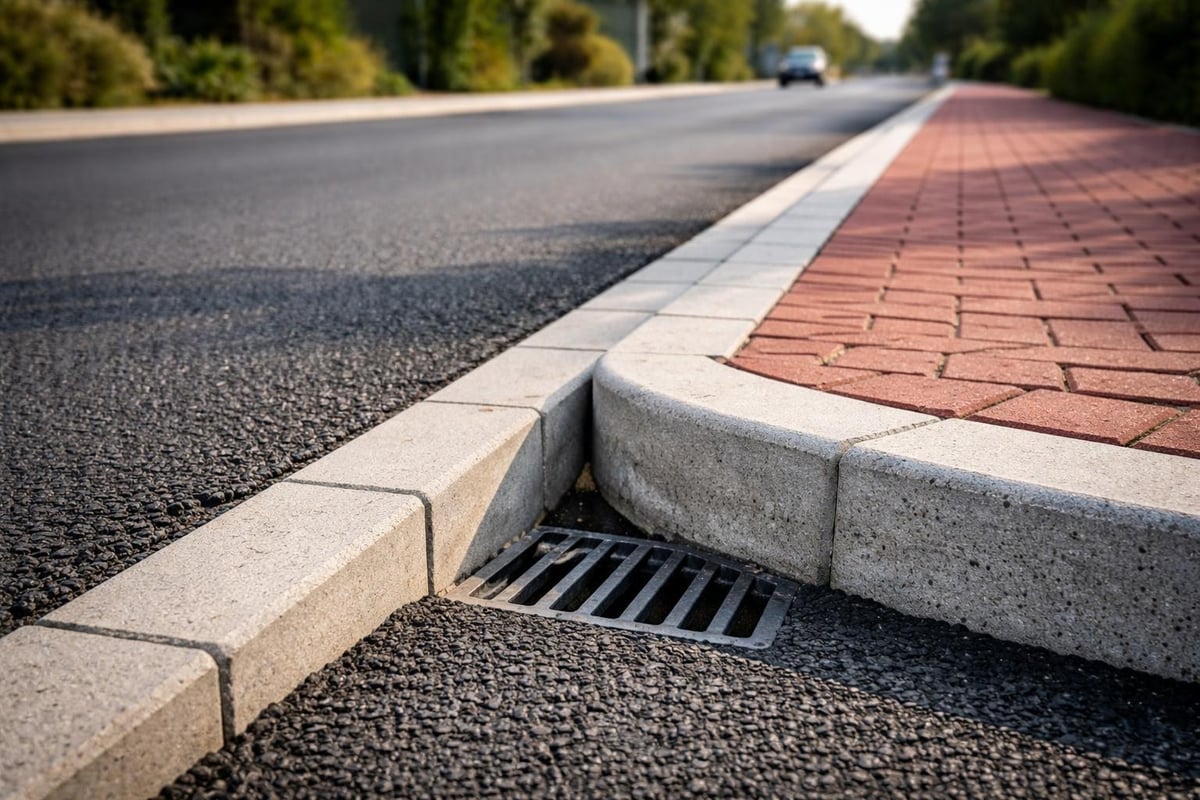
Drainage represents another critical function. Road kerbing works in conjunction with gullies and drainage channels to direct surface water away from the carriageway. The detailed design guidelines for kerbing emphasise the importance of proper fall and alignment to achieve effective water management.
Types and Specifications of Kerbing Systems
The selection of appropriate kerbing depends on the specific application, traffic volumes, and aesthetic requirements. Different kerb profiles serve distinct purposes within the highway environment.
Standard Kerb Profiles
| Kerb Type | Height | Typical Application | Key Characteristics |
|---|---|---|---|
| Half-battered | 125mm | Residential roads | Gentle face angle, pedestrian-friendly |
| Full-battered | 150mm | Main carriageways | Steeper face, vehicle containment |
| Bullnosed | 125mm | Driveways, car parks | Rounded profile, easy vehicle crossing |
| Dropper/Transition | Variable | Crossings, access points | Gradual height reduction |
Full-battered kerbs feature a steep face designed to discourage vehicle overrun, making them ideal for busy highways where traffic segregation is paramount. Half-battered kerbs offer a more gradual profile, commonly specified in residential developments where a softer appearance suits the environment.
Material Considerations
Precast concrete kerbs dominate the UK market due to their cost-effectiveness, durability, and standardised dimensions. Natural stone kerbing, whilst more expensive, offers superior aesthetics for heritage areas or premium developments. Projects undertaken by JRG Civils frequently incorporate both materials depending on client requirements and project specifications.
Innovative alternatives such as rubber kerbing have emerged in recent years, offering benefits including rapid installation, reduced excavation requirements, and improved safety characteristics. However, traditional concrete remains the standard choice for permanent highway installations.
Design Standards and Safety Requirements
Proper road kerbing design must comply with numerous regulations and standards to ensure public safety and longevity. The guidelines for safe kerb design highlight critical considerations around visibility, barrier protection, and pedestrian interaction.
Height and Exposure Standards
Kerb height above the adjacent surface significantly affects both functionality and safety. Standard upstand heights typically range from 100mm to 125mm, providing sufficient definition without creating hazardous trip points. Where kerbs form part of containment systems near high-speed roads, heights may increase substantially.
Critical design parameters:
- Upstand height appropriate to traffic speed
- Face angle matching the kerb profile specification
- Back edge support preventing rotation under load
- Adequate foundation depth for anticipated loading
The roadway kerbing standards detail how kerb specifications vary according to road hierarchy, with primary distributor roads requiring more robust installations than quiet residential streets.
Visibility and Accessibility
Modern kerb design must accommodate all road users, including those with mobility impairments. Dropped kerbs at crossing points require careful design to provide safe, accessible routes whilst maintaining effective drainage. Tactile paving installations work in conjunction with kerbing to alert visually impaired pedestrians to carriageway edges.

Installation Methods and Best Practices
Successful road kerbing installation demands meticulous attention to detail throughout the construction process. Poor installation undermines even the highest quality materials, leading to premature failure and safety hazards.
Foundation Preparation
The foundation beneath kerbing must provide stable, uniform support. A concrete bed, typically 150mm thick and 300mm wide, forms the standard foundation for most applications. This concrete haunching extends up the back face of the kerb, typically to two-thirds of the kerb height, providing crucial support against lateral forces.
| Foundation Element | Specification | Purpose |
|---|---|---|
| Sub-base | Min 150mm MOT Type 1 | Load distribution, drainage |
| Concrete bed | 150mm ST2 concrete | Primary support platform |
| Back haunching | To 2/3 kerb height | Lateral stability |
| Front haunching | Optional, 25mm upstand | Additional support, aesthetics |
The importance of proper kerb installation cannot be overstated, as inadequate foundation work represents the primary cause of kerb failure in highway environments.
Line and Level Accuracy
Achieving precise line and level throughout the kerb run ensures both functionality and appearance. String lines set to the correct gradient guide installation, with regular checks confirming alignment. Inconsistent levels create drainage problems and present poor visual appearance.
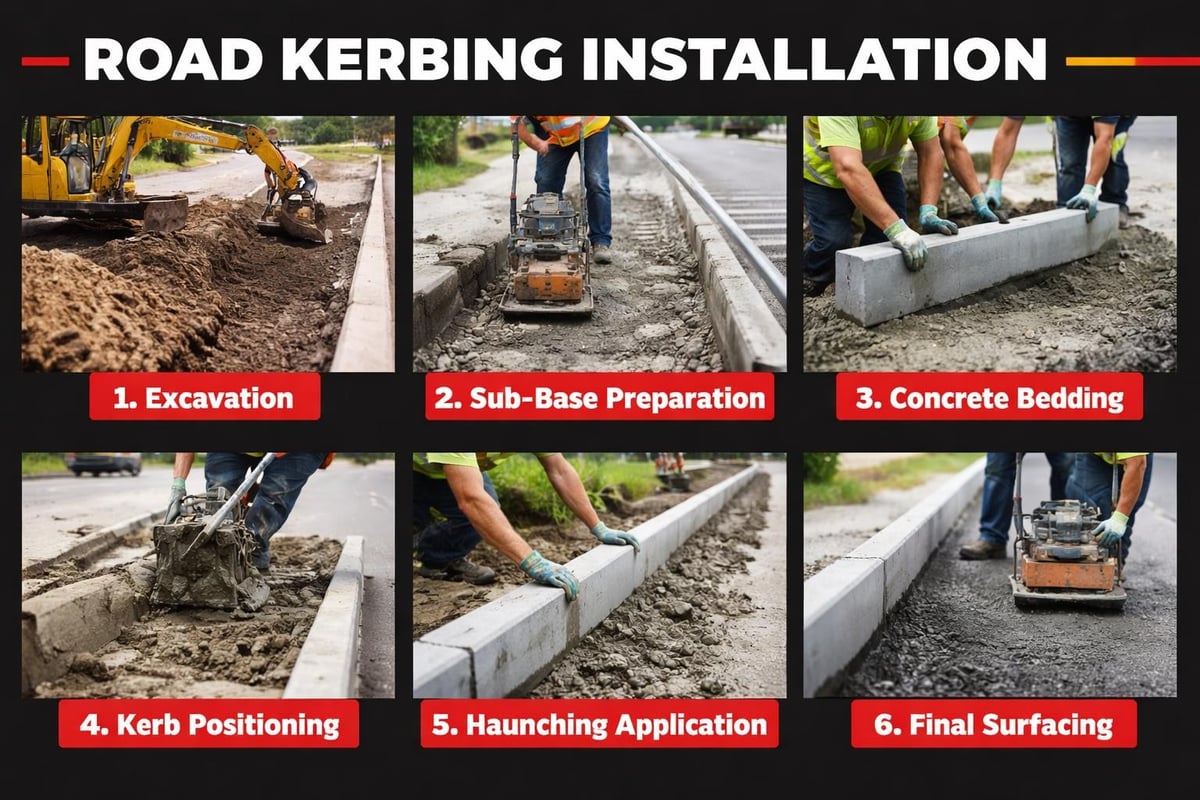
Essential installation steps:
- Excavate to correct depth allowing for foundation layers
- Compact and level sub-base material thoroughly
- Install concrete bed to appropriate thickness and width
- Position kerbs to line and level before concrete sets
- Apply haunching to both faces as specified
- Allow adequate curing time before trafficking
Maintenance and Long-Term Performance
Well-installed road kerbing requires minimal maintenance, but regular inspection identifies potential issues before they escalate. Settlement, rotation, and cracking represent the most common defects observed in kerb lines.
Common Defects and Remediation
Settlement typically results from inadequate foundation preparation or subgrade failure. Individual settled units can be lifted and re-bedded, though extensive settlement may indicate deeper structural problems requiring comprehensive reconstruction. The maintenance policies for road infrastructure outline criteria for determining when repair or replacement becomes necessary.
Rotation occurs when haunching fails or proves insufficient. Kerbs rotating backward into the verge lose their restraining function, allowing pavement edge deterioration. Forward rotation creates trip hazards and damages vehicle tyres.
Typical maintenance interventions include:
- Individual unit replacement for damaged sections
- Re-bedding settled or rotated units
- Joint repointing preventing water ingress
- Drainage clearance maintaining surface water flow
Lifecycle Considerations
Quality road kerbing installations routinely exceed 40 years service life when properly maintained. The initial investment in correct materials and installation methodology delivers substantial long-term value compared to substandard work requiring frequent intervention.
Commercial and Residential Applications
Road kerbing requirements vary significantly between commercial developments and residential projects, though fundamental principles remain consistent. Large commercial works, such as drive-through restaurants and retail parks, demand robust installations capable of handling heavy goods vehicles and intensive use.
Commercial Development Specifications
Commercial projects typically specify full-battered or barrier kerbs throughout vehicular areas. Loading bays, service yards, and delivery zones experience particularly severe loading conditions, requiring enhanced foundation specifications and potentially steel reinforcement within the concrete bed.
Projects completed by civil engineering specialists demonstrate the importance of matching kerb specifications to anticipated usage patterns. The three Costa Coffee and two Greggs drive-through developments showcase how commercial kerbing must accommodate regular HGV deliveries whilst maintaining aesthetic appeal for customers.
Residential Driveway Applications
Residential driveways benefit from more flexible kerbing options. Bullnosed profiles facilitate easier vehicle access, whilst decorative facing options complement property aesthetics. Block-edged driveways use smaller profile kerbs or specially designed edging blocks, though concrete haunching remains essential for long-term stability.
Residential kerbing considerations:
- Profile selection matching property character
- Colour coordination with paving materials
- Adequate strength for domestic vehicle loads
- Integration with existing drainage systems
- Cost-effective solutions meeting performance requirements
The attention to detail in residential kerbing contributes significantly to overall property appearance and value. Professional installations by experienced contractors ensure both functionality and visual appeal.
Integration with Modern Surfacing Techniques
Contemporary road construction increasingly employs sophisticated surfacing materials and techniques. Road kerbing must integrate seamlessly with these systems to deliver optimal performance.
Asphalt and Block Paving Interfaces
The junction between kerbing and surfacing materials requires careful detailing. Asphalt should finish tight against the kerb face, preventing water ingress that could undermine the pavement structure. Block paving installations use kerbs as edge restraint, with the paving course bearing against the kerb face.
Proper abutment prevents the formation of gaps where debris accumulates and vegetation establishes. These gaps also permit water penetration, accelerating deterioration of foundation materials. Quality workmanship at the kerb interface directly impacts the longevity of the entire surfaced area.
Sustainable Drainage Integration
Modern developments increasingly incorporate sustainable drainage systems (SuDS) where road kerbing plays an integral role. Conservation kerbs featuring drainage slots allow surface water to pass through into permeable sub-bases or storage structures, reducing strain on conventional drainage infrastructure.
| SuDS Feature | Kerb Adaptation | Environmental Benefit |
|---|---|---|
| Permeable paving | Conservation kerbs | Reduced runoff volumes |
| Filter strips | Intermittent kerbing | Improved water quality |
| Swales | Dropped sections | Natural attenuation |
| Rain gardens | Strategic gaps | Biodiversity enhancement |
These integrated approaches require careful design ensuring that water management objectives align with traditional kerb functions. Specialist knowledge proves essential when specifying and installing kerbing within SuDS schemes.
Quality Assurance and Compliance
Ensuring road kerbing meets required standards demands rigorous quality control throughout the procurement and installation process. Material testing, dimensional checks, and installation inspections all contribute to successful project delivery.
Material Compliance Testing
Precast concrete kerbs manufactured to British Standards undergo testing confirming compressive strength, freeze-thaw resistance, and dimensional accuracy. Reputable suppliers provide test certificates documenting compliance with specifications. Natural stone kerbs require similar verification of material properties and dimensional tolerances.
Quality checkpoints include:
- Material certificates confirming specification compliance
- Dimensional inspection of delivered units
- Foundation material testing and compaction verification
- Installation tolerance checks throughout construction
- Final inspection confirming line, level, and finish quality
Projects spanning multiple sites or extended timescales benefit from consistent quality procedures ensuring uniformity across all works. The professional approach adopted by established civil engineering contractors delivers confidence in project outcomes.
Specification References and Standards
UK highway construction references numerous standards governing kerbing installation. Adherence to these documents ensures work meets legal requirements and industry expectations. The Specification for Highway Works (SHW) provides comprehensive guidance on materials and workmanship standards for publicly maintainable highways.
Private developments may adopt modified specifications suited to specific requirements, though fundamental quality principles remain unchanged. Experienced contractors understand how to adapt standard specifications appropriately whilst maintaining essential performance characteristics.
Cost Factors and Value Engineering
Road kerbing costs vary according to numerous factors including materials, site conditions, and project scale. Understanding these variables enables informed decision-making balancing initial expenditure against long-term value.
Material and Installation Costs
Standard precast concrete kerbs represent the most economical option for most applications. Natural stone substantially increases material costs but may prove worthwhile for prestigious developments. Installation costs depend heavily on site access, ground conditions, and the complexity of the kerb line.
Cost influencing factors:
- Material selection and specification
- Linear metreage and economies of scale
- Site accessibility for plant and materials
- Ground conditions affecting excavation and foundation work
- Complexity of line including radii and transitions
- Integration with drainage and surfacing works
Competitive tendering amongst experienced contractors ensures fair pricing whilst maintaining quality standards. The lowest price rarely delivers the best value when considering lifecycle costs and performance.
Long-Term Value Considerations
Investing in quality road kerbing installation delivers substantial long-term savings compared to remedying defective work. Properly installed kerbs require minimal maintenance, protect adjacent surfacing from premature failure, and maintain their appearance throughout their service life.
False economies in foundation preparation or material selection inevitably result in accelerated deterioration, costly repairs, and potential safety liabilities. Professional contractors understand that reputation depends on delivering installations performing reliably for decades, not merely passing initial inspection.
Road kerbing represents a critical element in any highways, commercial, or residential surfacing project, combining functional necessity with aesthetic contribution. Understanding the principles of proper design, material selection, and installation methodology ensures projects deliver lasting value and performance. Whether you're planning a major commercial development or residential driveway enhancement, partnering with experienced specialists makes all the difference. JRG Civils brings proven expertise across commercial and private projects throughout the UK, delivering the excellence and attention to detail that ensures your kerbing installation performs flawlessly for decades to come.