
Newcastle earthworks represent a fundamental component of civil engineering projects throughout the region, encompassing everything from major commercial developments to residential driveways and patios. Whether you're planning a commercial venture, a drive-through facility, or enhancing your property with a new driveway, understanding the complexities of earthworks ensures project success, regulatory compliance, and long-term structural integrity. The North East's unique geological characteristics, combined with evolving environmental regulations, make professional earthworks expertise more valuable than ever in 2026.
Understanding Newcastle Earthworks Fundamentals
Newcastle earthworks involve the strategic manipulation of earth materials to create stable foundations, drainage systems, and level surfaces for construction projects. These operations require precise planning, specialized equipment, and thorough knowledge of soil composition, drainage patterns, and load-bearing requirements.
The scope of earthworks projects varies considerably across Newcastle. Commercial developments such as drive-through restaurants demand extensive site preparation, including bulk excavation, ground stabilization, and sophisticated drainage infrastructure. Residential projects, whilst smaller in scale, require equal attention to detail to prevent settlement issues, water pooling, and structural complications.
Site Assessment and Ground Investigation
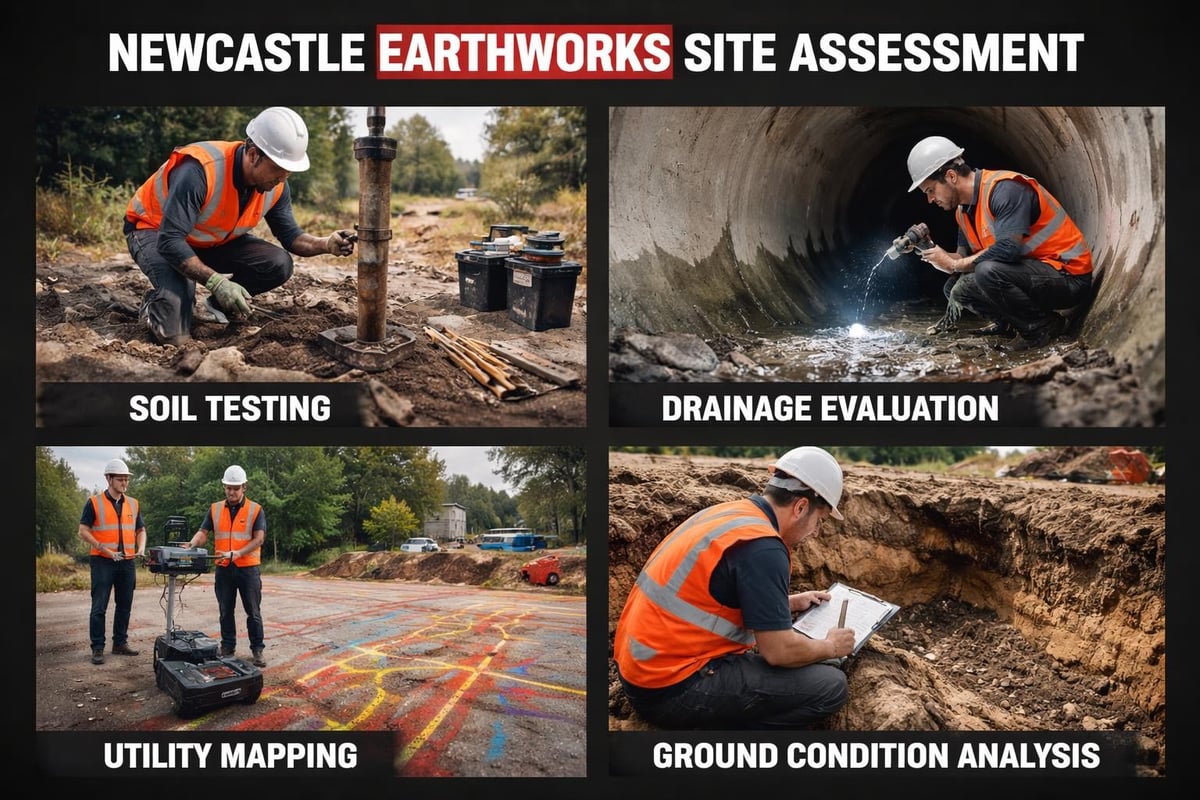
Professional newcastle earthworks begin with comprehensive site assessment. Ground investigation determines soil type, compaction levels, water table depth, and potential contamination. This information directly influences excavation methods, material selection, and foundation design.
Key assessment factors include:
- Soil classification and bearing capacity
- Existing drainage patterns and watercourse proximity
- Underground utilities and services
- Environmental constraints and protected areas
- Access limitations and neighbor considerations
Geotechnical surveys provide data that prevents costly mid-project surprises. Clay-heavy soils common in parts of Newcastle require different approaches compared to sandy or gravelly substrates. Understanding these variations before commencing earthworks saves time, reduces expenses, and ensures regulatory compliance.
Regulatory Framework and Compliance Requirements
Newcastle earthworks projects must navigate various regulatory requirements established by local authorities. Understanding these obligations prevents project delays, financial penalties, and potential legal complications. Illegal earthworks regulations outline the serious consequences of non-compliance, including flooding risks and environmental damage.
Planning permission requirements depend on project scale and location. Minor residential works may proceed under permitted development rights, whilst substantial earthworks typically require formal planning approval. Environmental impact assessments become mandatory when projects affect protected habitats, watercourses, or archaeological sites.
| Project Type | Typical Approval Required | Timeline | Key Considerations |
|---|---|---|---|
| Residential Driveway | Building Notice/Approval | 2-4 weeks | Drainage, highway access |
| Commercial Car Park | Full Planning Permission | 8-16 weeks | Environmental impact, traffic |
| Road Construction | Highways Authority Consent | 12-24 weeks | Public consultation, safety |
| Industrial Site | Multiple Approvals | 16-32 weeks | Contamination, utilities |
Building Control approval ensures earthworks meet structural standards. Drainage systems must comply with SuDS (Sustainable Drainage Systems) regulations, managing surface water without increasing flood risk to neighboring properties. These requirements reflect growing environmental awareness and climate change adaptation strategies in 2026.
Historical Context of Newcastle Earthworks
Understanding Newcastle's earthworks heritage provides valuable context for modern projects. The region's industrial past involved extensive ground manipulation for coal mining, steel production, and shipbuilding. Newcastle’s medieval town walls represent early defensive earthworks constructed in the 13th and 14th centuries, demonstrating centuries-old expertise in ground engineering.
The Castle itself required sophisticated earthworks for its construction and defensive positioning. These historical projects established Newcastle's reputation for ambitious civil engineering, a tradition continuing through modern infrastructure developments.
The transformation from industrial to post-industrial landscape involved massive remediation earthworks. Former industrial sites required decontamination, re-grading, and stabilization before redevelopment. This legacy influences contemporary projects, particularly when working on brownfield sites that may contain historical contamination or unstable filled ground.
Modern Earthworks Techniques and Equipment
Contemporary newcastle earthworks leverage advanced machinery and methodologies that dramatically improve efficiency, precision, and environmental performance. GPS-guided excavators achieve millimeter accuracy, reducing material waste and ensuring precise levels critical for drainage function.
Excavation and Ground Preparation
Bulk excavation removes unsuitable material and creates space for foundations, services, and drainage infrastructure. Modern excavators range from compact machines suitable for restricted residential access to large-scale equipment capable of moving hundreds of tonnes per hour on commercial sites.
Common excavation methods include:
- Strip and stockpile: Removing topsoil for later reinstatement
- Bulk dig: Excavating to formation level
- Reduced level dig: Creating precise platforms and gradients
- Trench excavation: Installing drainage and service ducting
- Cut and fill: Balancing earthworks to minimize material import/export
Ground stabilization techniques address weak or variable substrates. Lime stabilization improves clay soils, whilst geotextile reinforcement distributes loads across soft ground. These interventions prevent differential settlement that causes structural cracking and surface failures.

Drainage Infrastructure in Earthworks Projects
Effective drainage represents the cornerstone of successful newcastle earthworks. Poor drainage causes surface water accumulation, ground softening, and accelerated pavement deterioration. Professional drainage design considers rainfall intensity, ground permeability, and outfall availability.
Surface water management has evolved significantly with SuDS requirements. Rather than simply channeling water to combined sewers, modern approaches incorporate permeable paving, infiltration basins, and attenuation tanks. These systems reduce peak flow rates, filter pollutants, and enhance biodiversity.
Drainage System Components
| Component | Function | Typical Application |
|---|---|---|
| French Drains | Subsurface water removal | Garden areas, boundaries |
| Channel Drains | Surface water collection | Driveways, hardstanding |
| Soakaways | Rainwater infiltration | Residential developments |
| Attenuation Tanks | Flow rate control | Commercial car parks |
| Permeable Paving | Water infiltration | Driveways, pedestrian areas |
Installation quality determines drainage longevity. Correct falls ensure positive drainage without water ponding. Pipe bedding and surround materials must meet specifications to prevent settlement and joint failure. These details separate professional installations from amateur attempts that fail within months.
Connecting to existing drainage infrastructure requires careful investigation and, often, water authority approval. Overloading existing systems causes flooding and service failures. Professional earthworks contractors coordinate with utility providers to ensure compliant, sustainable drainage solutions.
Commercial Earthworks Applications
Commercial newcastle earthworks projects demand coordination across multiple disciplines. Drive-through restaurants, retail developments, and industrial facilities require robust foundations, comprehensive drainage, and durable surfacing capable of withstanding heavy traffic loads.
Site layout optimization maximizes usable space whilst accommodating vehicle movements, parking, servicing, and landscaping. Earthworks create the level platforms necessary for building construction and establish gradients directing surface water to collection points. These foundational decisions influence operational efficiency throughout the facility's lifetime.
Commercial project considerations:
- Heavy vehicle access and maneuvering
- Service vehicle requirements and loading bays
- Customer parking capacity and circulation
- Emergency vehicle access compliance
- Future expansion capability
The projects undertaken by experienced contractors demonstrate the diversity of commercial earthworks, from franchise developments to bespoke industrial facilities. Each project presents unique challenges requiring adaptable solutions and meticulous execution.
Ground-bearing capacity becomes critical for commercial developments. Buildings, car parks, and service yards generate substantial loads requiring engineered fills and compaction standards verified through testing. Professional earthworks contractors maintain detailed records demonstrating compliance with structural specifications.
Residential Earthworks Excellence
Residential newcastle earthworks encompass driveways, patios, garden terracing, and foundation preparations. Whilst smaller in scale than commercial projects, residential works demand equal professionalism to deliver lasting results that enhance property value and functionality.
Driveway construction involves careful consideration of gradient, drainage, and surface materials. Excessive gradients create traction issues during winter weather, whilst inadequate falls cause water ponding and ice formation. Professional earthworks establish optimal profiles balancing accessibility with drainage performance.
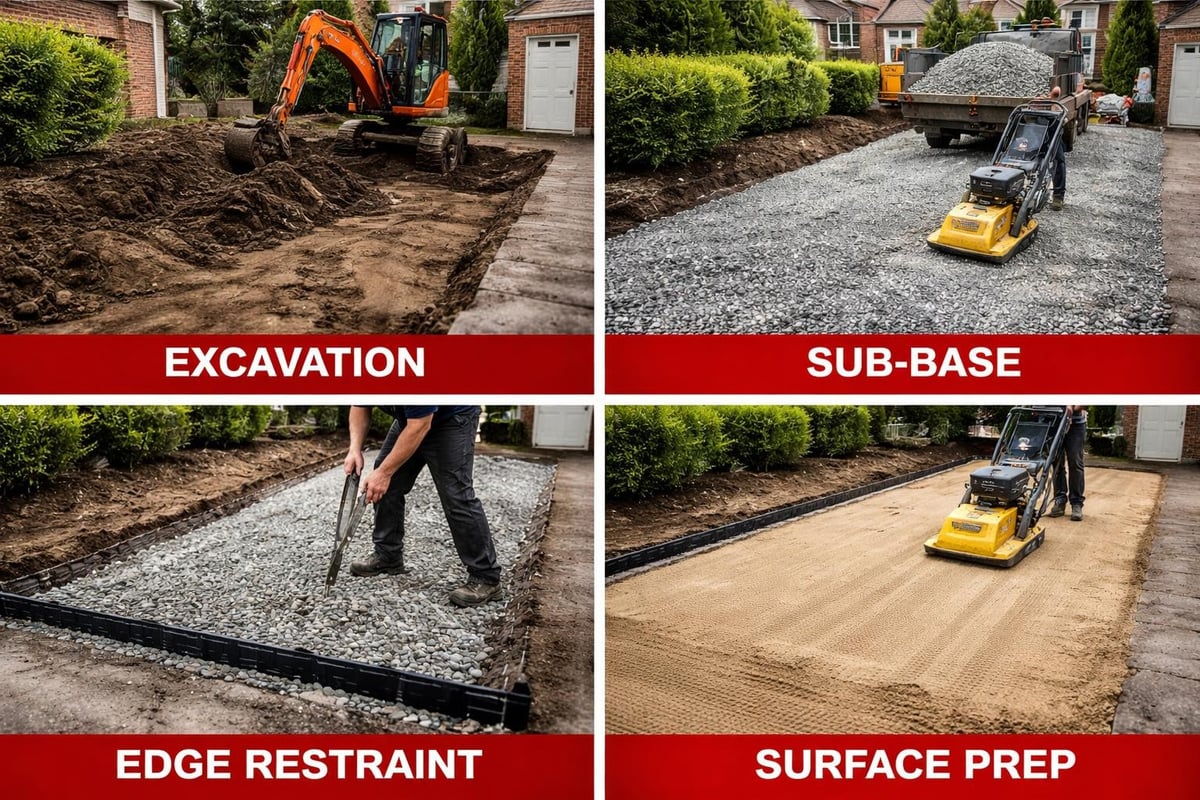
Driveway Construction Process
- Site clearance: Removing vegetation and unsuitable topsoil
- Excavation: Digging to appropriate depth for sub-base installation
- Sub-base placement: Installing and compacting Type 1 granular material
- Edge restraints: Securing boundaries with kerbs or edging
- Surface layer: Installing chosen finish (block paving, tarmac, resin-bound)
- Drainage integration: Connecting to soakaways or surface water systems
Patio construction requires similar precision. Level surfaces prevent water pooling on outdoor living spaces, whilst proper edge detailing maintains long-term stability. The interface between existing buildings and new earthworks demands particular attention to prevent water ingress or settlement affecting structures.
Garden terracing creates usable level areas on sloping sites. Retaining structures must resist earth pressure whilst providing adequate drainage to prevent hydrostatic buildup. Professional design considers visual aesthetics alongside structural requirements, integrating earthworks harmoniously within landscape settings.
Material Selection and Sustainability
Material choices significantly impact newcastle earthworks performance and environmental footprint. Aggregates, fill materials, and surfacing products must meet specifications whilst minimizing carbon emissions and resource depletion. Sustainable procurement has become central to responsible construction in 2026.
Recycled aggregates derived from construction waste offer environmental benefits compared to virgin quarried materials. Modern processing produces recycled Type 1 sub-base meeting highway specifications at reduced carbon cost. Many projects successfully incorporate recycled content without compromising performance or longevity.
Sustainable material strategies include:
- Sourcing aggregates from local suppliers reducing transport emissions
- Reusing excavated material where suitable for fill or landscaping
- Specifying recycled content in sub-base and capping layers
- Selecting permeable surfaces reducing surface water runoff
- Implementing waste segregation for responsible disposal
Soil management represents another sustainability consideration. Topsoil stripped during earthworks contains valuable organic matter supporting plant growth. Professional contractors stockpile topsoil separately from subsoil, reinstating it for landscaping and preventing needless disposal of this finite resource.
The carbon footprint of earthworks extends beyond materials to equipment operation and transport logistics. Efficient project planning minimizes plant idling time, consolidates deliveries, and sequences operations reducing unnecessary movements. These operational efficiencies deliver environmental and economic benefits simultaneously.
Quality Assurance and Testing Protocols
Professional newcastle earthworks incorporate rigorous quality assurance ensuring compliance with design specifications. Testing protocols verify compaction levels, material gradings, and drainage functionality before subsequent construction proceeds. This systematic approach prevents defects that compromise structural performance.
Compaction testing uses various methods depending on project scale and specifications. Nuclear density gauges provide rapid on-site results, whilst laboratory testing offers definitive analysis. Target compaction levels typically reach 95-98% of maximum dry density, ensuring adequate load-bearing capacity and settlement resistance.
| Test Type | Purpose | Frequency | Acceptance Criteria |
|---|---|---|---|
| Compaction | Verify density | Every 100-500m² | 95%+ MDD |
| CBR | Bearing capacity | Per material source | Design specification |
| Grading | Material specification | Per delivery/source | BS/Highway spec |
| Percolation | Drainage function | Per soakaway | Design infiltration rate |
Material grading tests confirm aggregates meet specifications for size distribution and quality. Sub-standard materials cause premature failure through inadequate interlock, excessive compaction, or poor drainage characteristics. Reputable suppliers provide certification, but site testing verifies compliance.
Drainage functionality testing ensures systems operate as designed. Percolation tests confirm soakaway infiltration rates before backfilling. CCTV surveys verify pipe installation quality and identify defects requiring rectification. These investments in quality assurance prevent expensive post-completion failures.
Weather Considerations and Seasonal Planning
Newcastle's climate significantly influences earthworks scheduling and methodology. Heavy rainfall saturates ground, preventing effective compaction and creating hazardous working conditions. Professional contractors plan operations considering seasonal weather patterns and maintain contingency provisions for adverse conditions.
Winter working presents particular challenges. Frozen ground resists excavation, frost-susceptible materials require protection, and reduced daylight limits productive hours. Projects scheduled during winter months require realistic programming accounting for weather delays and reduced productivity.
Seasonal earthworks considerations:
- Spring: Optimal conditions but high demand for contractors
- Summer: Extended daylight and generally dry conditions
- Autumn: Increasing rainfall requiring drainage management
- Winter: Limited daylight, frost risk, and ground saturation
Ground protection systems preserve access routes and working areas during wet conditions. Geotextile membranes combined with stone trackway distribute loads, preventing ground disturbance and maintaining safe vehicle operation. These temporary works represent worthwhile investments protecting project programs and site conditions.
Weather monitoring informs daily operational decisions. Ceasing work during heavy rain prevents damage to partially completed earthworks and maintains safety standards. Professional contractors balance program pressures against quality requirements, refusing to compromise standards for schedule convenience.
Integration with Broader Construction Sequences
Newcastle earthworks rarely exist in isolation. Most projects involve coordinated sequences integrating earthworks with building construction, highway improvements, and service installations. Effective coordination prevents conflicts, optimizes resources, and maintains overall project momentum.
Early contractor involvement benefits earthworks planning. Understanding subsequent construction requirements informs formation levels, access arrangements, and temporary works provisions. This collaborative approach identified potential issues during design stages when solutions remain cost-effective and straightforward.
Service installations coordinate closely with earthworks operations. Ducting for power, water, telecommunications, and drainage installs during earthworks phases, avoiding disruptive later excavations. Professional contractors maintain comprehensive records of service locations, facilitating future maintenance and modification works.
Civil engineering specialists coordinate multiple trade disciplines, ensuring seamless project delivery from initial earthworks through final surfacing and landscaping. This integrated approach delivers superior outcomes compared to fragmented procurement involving multiple uncoordinated contractors.
Technology and Innovation in Modern Earthworks
Technology continues transforming newcastle earthworks through improved accuracy, efficiency, and documentation. GPS machine control systems guide excavators and graders, achieving design profiles without traditional surveying stakes. This automation accelerates construction whilst improving precision and reducing setting-out costs.
Digital project management platforms facilitate real-time communication between site teams, designers, and clients. Photograph documentation, progress reports, and quality records upload instantly, maintaining transparent audit trails and enabling rapid problem resolution. Cloud-based systems ensure information accessibility regardless of location.
Emerging earthworks technologies:
- 3D machine control and automated grading
- Drone surveying for volume calculations and progress monitoring
- BIM integration linking design models with construction data
- Telematics monitoring equipment efficiency and carbon emissions
- Digital twins enabling virtual project visualization
Drone technology provides cost-effective surveying and monitoring capabilities. Regular aerial photography documents progress, calculates earthworks volumes, and identifies potential issues before they escalate. This bird's-eye perspective complements ground-level observations, ensuring comprehensive project oversight.
Environmental monitoring technology tracks noise, vibration, and dust emissions ensuring compliance with planning conditions. Real-time data allows contractors to modify operations minimizing community impact whilst maintaining productivity. This technology-enabled approach demonstrates responsible construction citizenship.
Future Trends and Industry Evolution
The earthworks sector continues evolving responding to environmental imperatives, technological advances, and changing client expectations. Carbon reduction drives equipment electrification, with battery-powered excavators and compactors entering mainstream deployment. These machines deliver equivalent performance with dramatically reduced emissions and noise.
Climate change adaptation influences earthworks design and execution. More intense rainfall events require enhanced drainage capacity and flood resilience. SuDS implementation becomes standard rather than exceptional, with every project contributing to catchment-wide water management rather than simply exporting problems downstream.
Circular economy principles reshape material sourcing and waste management. Maximizing on-site material reuse, specifying recycled content, and eliminating waste to landfill represent core sustainability objectives. Forward-thinking contractors invest in material processing capabilities enabling greater self-sufficiency and environmental performance.
Skills development ensures the industry meets future demands. Modern earthworks require technology literacy alongside traditional civil engineering knowledge. Training programs combining practical experience with digital competencies prepare the next generation of professionals maintaining Newcastle's earthworks excellence.
Professional newcastle earthworks form the essential foundation for construction projects across commercial and residential sectors, requiring expertise in ground engineering, drainage design, and regulatory compliance. Whether you're planning a drive-through development, commercial car park, or residential driveway enhancement, partnering with experienced civil engineering specialists ensures quality outcomes that stand the test of time. JRG Civils brings professional earthworks expertise to projects throughout Newcastle and across the UK, delivering excellence from initial site assessment through final completion.