The construction and civil engineering industries have witnessed a transformative shift towards more efficient, sustainable, and versatile approaches to traditional groundwork. Mini earth works represent this evolution, combining compact machinery with proven techniques to deliver exceptional results in spaces where conventional equipment simply cannot operate. From residential driveways to complex commercial developments, this approach has revolutionised how contractors tackle excavation, surfacing, and groundwork challenges whilst minimising environmental impact and reducing operational costs.
Understanding Mini Earth Works in Modern Construction
Mini earth works encompass a comprehensive range of groundwork activities performed using compact, manoeuvrable equipment designed for confined spaces and sensitive environments. These operations include excavation, grading, trenching, drainage installation, and surface preparation, all executed with machinery that maintains professional standards whilst offering unprecedented access and flexibility.
The fundamental advantage lies in the equipment's reduced footprint. Compact excavators, mini skid-steers, and small-scale dumpers can navigate through narrow access points, residential gardens, and congested commercial sites where traditional plant machinery would prove impractical. This capability has opened new possibilities for projects that were previously considered logistically challenging or economically unviable.
Key Applications in Commercial Projects
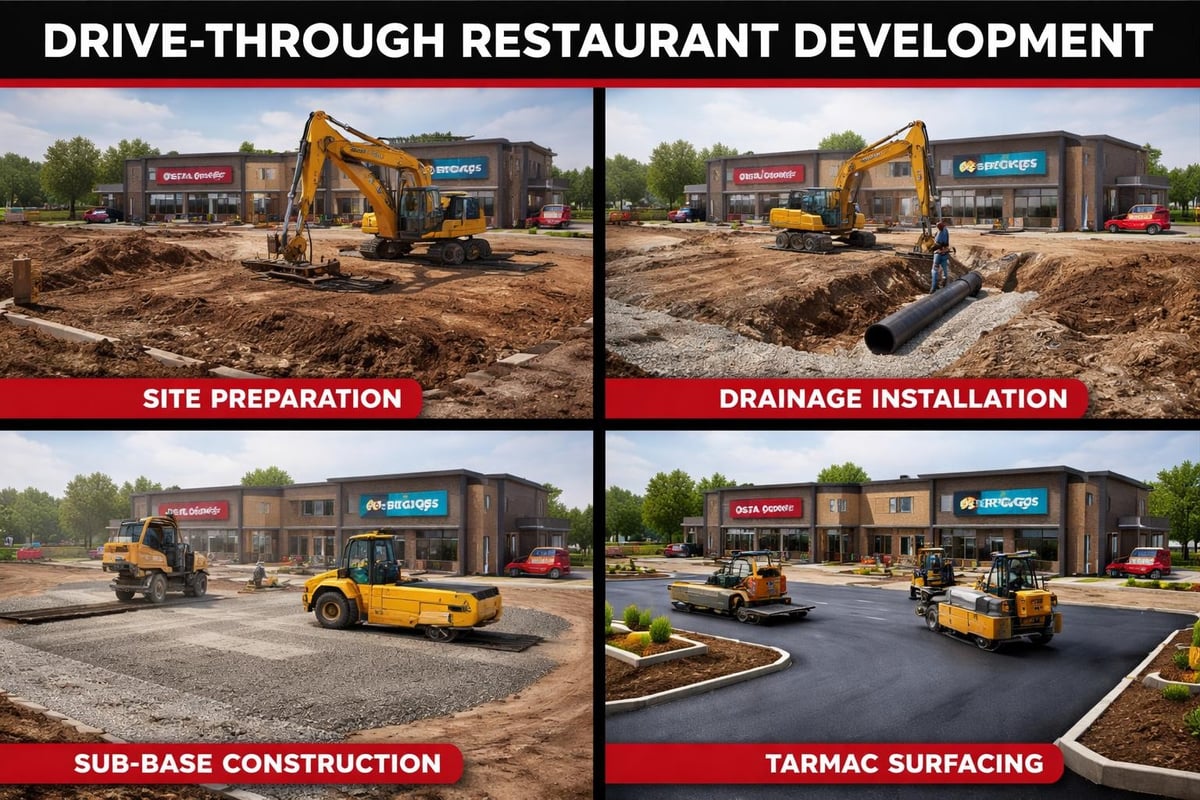
Commercial developments benefit significantly from mini earth works methodologies. Drive-through establishments, retail developments, and franchise projects require precise groundwork within tight timelines and often restrictive site conditions. The ability to complete earthworks efficiently without disrupting surrounding operations proves invaluable for businesses maintaining trading hours during construction.
Surface preparation for car parks, access roads, and loading areas demands exacting standards. Mini earth works equipment delivers the accuracy needed for proper drainage gradients, sub-base compaction, and surface levels whilst working around existing structures and utilities. The reduced ground pressure of compact machinery also minimises subsurface disturbance, preserving existing foundations and underground services.
Equipment Selection for Different Mini Earth Works Projects
Choosing appropriate machinery determines project efficiency and outcome quality. The selection process considers site access, soil conditions, excavation depth requirements, and material handling needs.
| Equipment Type | Typical Weight | Operating Width | Best Applications |
|---|---|---|---|
| Mini Excavator (1-1.5 ton) | 1,000-1,500 kg | 700-900 mm | Drainage trenches, foundation prep |
| Mini Excavator (3-3.5 ton) | 3,000-3,500 kg | 1,500-1,700 mm | Driveway excavation, bulk earthworks |
| Mini Skid-Steer | 1,200-2,500 kg | 900-1,400 mm | Material handling, grading, levelling |
| Compact Dumper | 800-1,500 kg | 800-1,200 mm | Spoil removal, aggregate transport |
Modern mini excavators offer remarkable versatility in confined spaces, with attachments ranging from standard buckets to hydraulic breakers, augers, and grading beams. This adaptability allows contractors to switch between tasks without mobilising multiple machines, reducing costs and improving programme efficiency.
Residential Driveway Construction
Driveway projects represent one of the most common applications for mini earth works. The process involves multiple stages requiring precision and appropriate equipment selection:
- Initial excavation removes existing surfaces and vegetation to design depth
- Sub-grade preparation ensures stable foundation through proper compaction
- Sub-base installation typically uses MOT Type 1 aggregate in 100-150mm layers
- Edge restraint installation provides structural support and prevents lateral movement
- Surface course application completes the driveway with chosen material
Each stage benefits from compact equipment's manoeuvrability. Access through standard residential gates, operation within gardens without extensive damage, and the ability to work close to property boundaries make mini earth works essential for homeowner projects. The reduced noise levels compared to larger plant also minimise neighbour disruption, an increasingly important consideration in residential areas.
Environmental Benefits and Sustainable Practices
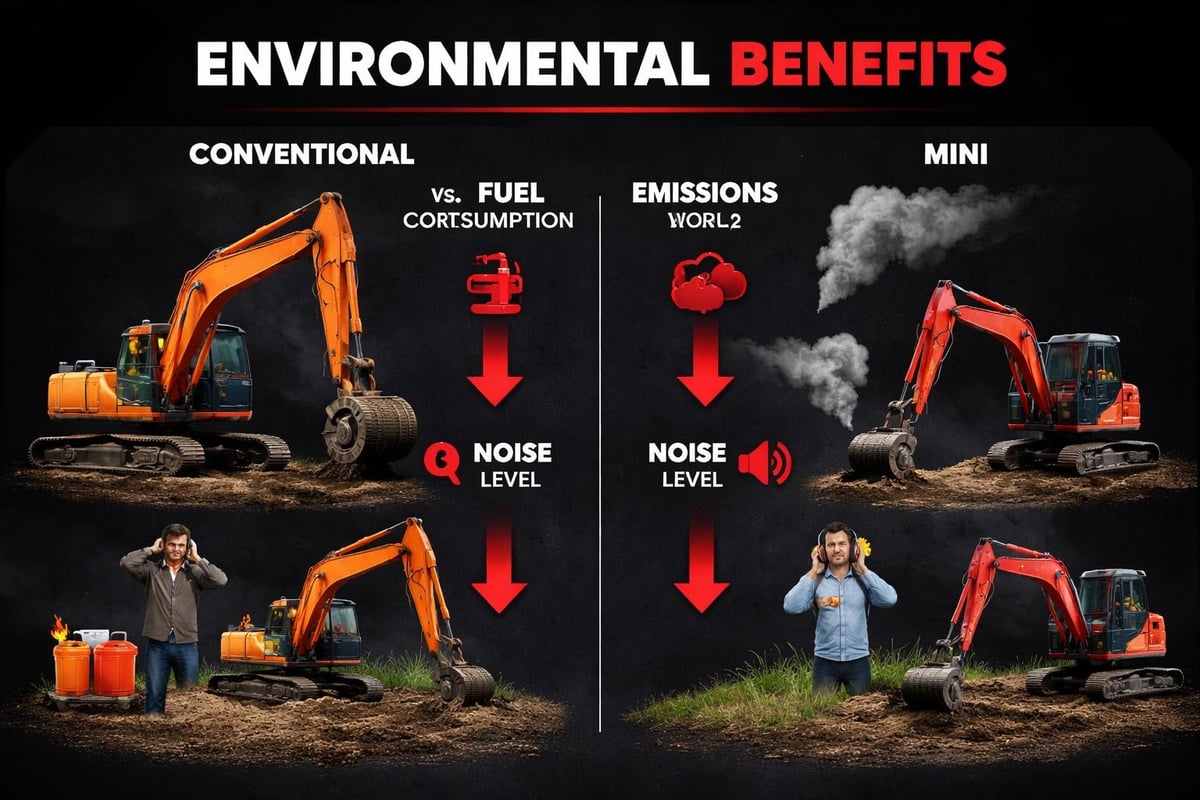
Sustainability has become paramount in construction planning and execution. Mini earth works contribute substantially to reducing project environmental footprints through several mechanisms. Mini excavators contribute to sustainable construction by consuming significantly less fuel than conventional machinery whilst maintaining productivity levels appropriate for project scale.
The reduced weight of compact equipment minimises ground compaction and vegetation damage beyond the immediate work area. This consideration proves particularly valuable for projects near established landscaping, mature trees, or environmentally sensitive areas. Root systems remain undisturbed, and soil structure preservation supports quicker site recovery post-construction.
Electric and hybrid mini excavators have emerged as viable alternatives for projects prioritising emissions reduction. These machines eliminate direct exhaust emissions whilst operating, improving air quality for workers and surrounding areas. The reduced noise pollution proves beneficial for residential neighbourhoods and projects near schools, hospitals, or occupied commercial premises.
Carbon Footprint Reduction Strategies
Implementing mini earth works as part of broader sustainability strategies requires consideration beyond equipment selection:
- Optimised material handling reduces double-handling and unnecessary movement
- Precise excavation volumes minimise spoil generation and disposal requirements
- Local material sourcing decreases transportation distances and associated emissions
- Equipment maintenance programmes ensure optimal fuel efficiency and reduced breakdowns
- Operator training maximises productivity whilst minimising unnecessary fuel consumption
These practices align with contemporary strategies to minimize environmental impacts across the construction industry, demonstrating how mini earth works support wider environmental objectives whilst delivering commercial advantages.
Technical Considerations for Highway Surfacing Projects
Highway surfacing and road construction demand rigorous standards and precise execution. Mini earth works play crucial roles in specific aspects of these larger projects, particularly where conventional equipment cannot operate effectively. Edge details, junction treatments, footpath connections, and verge works all benefit from compact machinery's precision.
The methodology for highway-standard works using mini earth works equipment follows established principles whilst adapting to equipment capabilities. Compaction requirements remain unchanged; however, achieving specified densities with smaller rollers requires adjusted pass patterns and careful monitoring. Modern compact rollers incorporate vibration systems matching larger counterparts' effectiveness whilst operating in restricted widths.
Quality Control and Specification Compliance
Meeting highway authority specifications whilst using compact equipment requires systematic quality assurance:
- Layer thickness control ensures proper compaction throughout material depth
- Density testing confirms achievement of specified compaction levels
- Level tolerance monitoring maintains surface regularity within acceptable limits
- Edge line accuracy preserves design geometry and drainage functionality
- Material certification documents aggregate and binder compliance with specifications
Professional contractors maintain comprehensive records demonstrating specification compliance throughout construction phases. This documentation proves essential for project acceptance and warranty validation, regardless of equipment scale used during construction.
Cost Efficiency and Project Economics
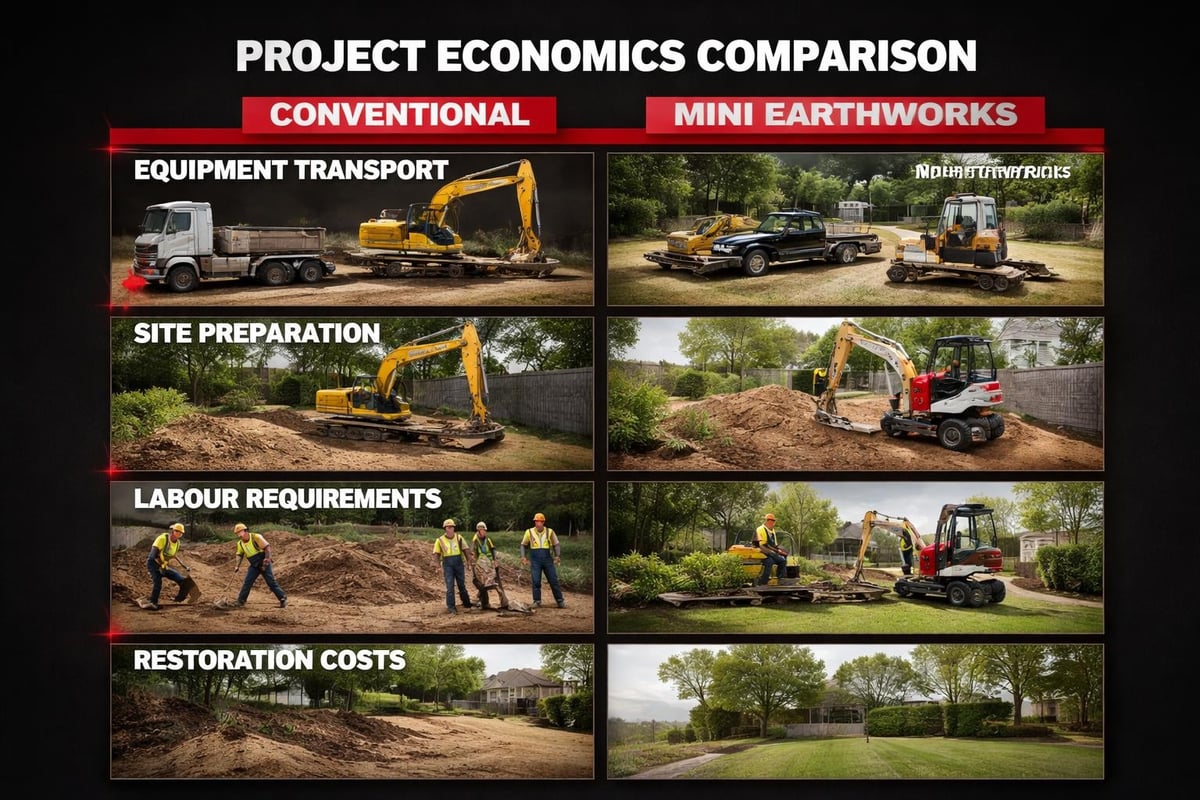
The financial advantages of mini earth works extend beyond equipment hire rates. Comprehensive cost analysis reveals savings across multiple project aspects that contribute to improved margins and competitive pricing.
| Cost Factor | Conventional Approach | Mini Earth Works Approach | Typical Saving |
|---|---|---|---|
| Equipment Transport | £400-800 per mobilisation | £150-300 per mobilisation | 50-65% |
| Site Preparation | Extensive access creation | Minimal preparation needed | 40-70% |
| Restoration Costs | Significant reinstatement | Limited damage repair | 60-80% |
| Labour Requirements | 3-4 operatives typical | 2-3 operatives sufficient | 25-35% |
Access creation alone generates substantial savings. Traditional excavators requiring low-loader delivery and potentially temporary road closures contrast sharply with mini equipment transported on small trailers behind standard vehicles. Projects avoiding these mobilisation costs improve profitability whilst maintaining quality standards.
The reduced crew requirements for mini earth works projects enhance cost efficiency without compromising safety or productivity. One skilled operator with appropriate compact equipment often accomplishes work requiring multiple personnel with manual methods, improving programme delivery whilst reducing labour costs.
Equipment Versatility and Utilisation Rates
Fleet management benefits from mini earth works equipment's versatility across project types. The same compact excavator serves residential driveway construction one week and commercial groundwork the next, maximising utilisation rates and return on capital investment. Small but mighty construction equipment delivers exceptional value through this multi-project capability.
Attachment systems further enhance versatility. Quick-hitch mechanisms allow rapid changes between buckets, breakers, augers, and grading beams, transforming single machines into comprehensive toolsets. This flexibility reduces the total equipment inventory required whilst ensuring appropriate tools remain available for diverse project requirements.
Safety Considerations and Operational Best Practices
Mini earth works projects demand identical safety standards to larger operations, with specific considerations reflecting compact equipment characteristics. The reduced machine size does not diminish hazard potential; proper risk assessment and control measures remain essential for safe project delivery.
Visibility represents a particular consideration with compact machinery. Operators working in confined spaces must maintain constant awareness of surroundings, particularly regarding pedestrians, other site personnel, and overhead services. Modern equipment incorporates cameras and proximity sensors, but these supplement rather than replace proper site management and banksman deployment where appropriate.
Site-Specific Risk Management
Effective mini earth works safety programmes address project-specific hazards:
- Underground services identification through utility plans and detection equipment
- Overhead hazard assessment including power lines, tree branches, and structures
- Ground stability evaluation particularly for excavations near existing foundations
- Public interface management when working in occupied or accessible areas
- Weather condition monitoring affecting ground conditions and visibility
Comprehensive method statements detail how these risks will be controlled throughout project execution. The documentation demonstrates professional approach and provides clear guidance for site teams implementing works safely and efficiently.
Foundation Works and Structural Applications
Beyond surface works, mini earth works extend to foundation construction and structural groundwork. Eco-friendly foundations through mini piling techniques demonstrate how compact approaches deliver structural solutions with reduced environmental impact.
Foundation trenches for extensions, garden structures, and boundary walls benefit from precise excavation using mini excavators. The accuracy achievable with skilled operators minimises over-excavation, reducing concrete volumes and associated costs whilst ensuring structural adequacy. Working close to existing structures without causing vibration damage proves particularly valuable for sensitive projects.
Drainage installations form integral components of many mini earth works projects. Compact equipment excels at trench excavation for surface water management, foul drainage connections, and land drainage systems. The ability to maintain trench stability in confined spaces whilst achieving required gradients demonstrates the precision available with appropriate equipment and operator expertise.
Integration with Broader Construction Programmes
Mini earth works rarely occur in isolation; integration with overall project programmes requires careful coordination. The compact equipment's flexibility supports phased approaches where groundwork proceeds alongside other activities, maintaining programme progress without creating conflicts between trades.
For commercial projects like drive-through facilities, mini earth works enable construction sequencing that minimises business disruption. Initial phases establish access and service connections whilst existing operations continue, with final surfacing completing during planned closures. This approach reduces economic impact for clients whilst delivering quality infrastructure.
Material Selection and Specification
Appropriate material selection ensures mini earth works projects achieve design life expectations. The reduced equipment size does not alter material performance requirements; specifications must reflect intended use, loading conditions, and environmental exposure.
Sub-base materials typically comprise well-graded aggregates providing mechanical stability through particle interlock. MOT Type 1 remains the standard specification for most applications, offering proven performance across various project types. Proper installation in controlled layers with appropriate compaction proves more critical than material type alone.
Surfacing options depend on project requirements, aesthetic preferences, and budget parameters:
- Tarmac provides durable, low-maintenance surfaces for driveways and access roads
- Block paving offers design flexibility with good load distribution characteristics
- Resin-bound surfacing delivers permeable, attractive finishes for appropriate applications
- Concrete ensures maximum durability for heavy loading and frequent traffic
Each surface type requires specific sub-base preparation and installation techniques. Professional contractors match approaches to chosen finishes, ensuring structural adequacy throughout the pavement construction.
Drainage Integration and Water Management
Effective drainage design forms an essential component of successful mini earth works projects. Surface water management prevents pavement deterioration, protects adjacent properties, and ensures compliance with planning requirements regarding runoff rates and destinations.
Modern developments face increasingly stringent drainage regulations. Permeable surfacing solutions, attenuation features, and controlled discharge systems address these requirements whilst maintaining functionality and aesthetics. Mini earth works equipment facilitates installation of complex drainage infrastructure within tight spatial constraints.
Sustainable Drainage System Implementation
SuDS features commonly integrated within mini earth works projects include:
- Permeable paving systems allowing infiltration whilst maintaining structural capacity
- French drains managing subsurface water flow around structures and boundaries
- Soakaways providing discharge points for surface water without overloading sewers
- Attenuation tanks controlling peak flows during storm events
- Filter strips treating runoff before discharge to watercourses
These features require careful design and precise construction. The accuracy achievable with compact equipment ensures installations meet design specifications whilst adapting to site conditions encountered during construction.
Quality Assurance and Project Documentation
Professional mini earth works delivery includes comprehensive documentation demonstrating specification compliance and providing clients with construction records. This documentation supports warranty claims, future maintenance planning, and property transactions where construction quality requires verification.
Photographic records capture works progression, showing sub-base preparation, drainage installation, and surface construction stages. These images provide evidence of proper methodology and material compliance, protecting contractors and clients alike. Digital platforms now streamline this documentation process, with cloud-based systems maintaining accessible project archives.
Material certification confirms aggregate sources, testing compliance, and delivery quantities. Maintaining these records throughout projects ensures traceability and supports quality claims. Suppliers provide documentation automatically; systematic filing ensures information remains accessible when required.
Client Communication and Expectation Management
Clear communication throughout mini earth works projects maintains positive client relationships and manages expectations regarding programme, methodology, and site conditions. Regular updates inform clients of progress whilst highlighting any variations from initial assumptions requiring agreement.
Site conditions occasionally differ from anticipated parameters, necessitating methodology adjustments or additional works. Professional contractors identify these situations promptly, explaining implications and obtaining client approval before proceeding. This transparency builds trust whilst protecting commercial interests for all parties.
Mini earth works have transformed how civil engineering projects approach groundwork challenges, delivering professional results with reduced environmental impact and enhanced cost efficiency. Whether you're planning a residential driveway, commercial development, or highway infrastructure project, the combination of compact equipment, skilled operators, and proven methodologies ensures exceptional outcomes. JRG Civils brings this expertise to projects throughout the North East and across the UK, maintaining the highest standards from initial excavation through to final surfacing and all finishing touches.