
Civil engineering is entering a new era, with the pace of change accelerating in 2026. Today’s projects are more ambitious, complex, and demanding than ever, pushing professionals to innovate at every stage.
The landscape for any new project in civil engineering is shaped by cutting-edge technologies, evolving regulations, and rising expectations. Mastering this transformation offers significant advantages, from improved efficiency to enhanced sustainability.
This expert guide lays out a comprehensive roadmap for planning, executing, and delivering successful new projects. Inside, discover strategies for project planning, compliance, technology integration, sustainability, risk management, and the future trends defining the industry.
Understanding the 2026 Civil Engineering Landscape
The landscape for any new project in civil engineering is evolving rapidly in 2026. The sector faces complex challenges, but also unprecedented opportunities driven by technology, regulation, and societal demands. To succeed, professionals must understand the key trends, compliance requirements, market expectations, workforce shifts, and obstacles shaping the industry.

Key Industry Trends and Innovations
In 2026, digital transformation is at the core of every new project in civil engineering. The widespread adoption of digital twins and Building Information Modelling (BIM) is streamlining project efficiency and reducing errors. Modular and prefabricated construction methods are rising, allowing for faster build times and improved quality.
Smart infrastructure, powered by the Internet of Things (IoT), is enabling real-time monitoring and predictive maintenance. For example, the HS2 project’s use of digital modelling highlights this shift. According to an ICE survey, 78 percent of UK firms plan to increase technology investment by 2026, signalling a seismic change in how projects are delivered.
Regulatory and Compliance Updates
Regulations are tightening for every new project in civil engineering. In particular, new building regulations and sustainability mandates are reshaping project planning. The Building Safety Act and the UK's Net Zero targets require early engagement with authorities and robust compliance strategies.
Notably, changes to Sustainable Urban Drainage Systems (SUDS) requirements are impacting design and approvals. For a comprehensive overview of the Building Safety Act and its implications for 2026, see the Building Safety Act 2022 Overview. Staying ahead of these updates is crucial for risk mitigation and project success.
Market Demands and Client Expectations
Clients commissioning a new project in civil engineering are demanding greener, more resilient infrastructure solutions. There is an increased focus on transparent project delivery and clear reporting, driven by public scrutiny and investor expectations.
Major infrastructure clients are now prioritising carbon reduction as a core requirement. This shift reflects a broader trend towards sustainability and accountability, making it essential for engineering teams to adapt their processes and communication strategies.
Skills and Workforce Evolution
The workforce required for a new project in civil engineering is undergoing significant change. Multidisciplinary teams with strong digital skills are in high demand. The industry is placing greater emphasis on continuous professional development to keep pace with evolving technology.
A recent CITB report highlights a 62 percent skills gap in digital engineering roles. Addressing this gap is critical for project delivery, quality, and long-term competitiveness in the sector.
Challenges Facing New Projects
Despite these advances, a new project in civil engineering faces persistent challenges. Rising material costs and ongoing supply chain disruptions can delay progress and inflate budgets. Health, safety, and environmental performance are under greater scrutiny than ever before.
For instance, recent delays in major UK road projects have been linked to resource shortages and compliance hurdles. Proactive planning and flexible resource management are now essential to overcome these obstacles and deliver successful outcomes.
Step-by-Step Guide to Planning a New Civil Engineering Project
Embarking on a new project in civil engineering in 2026 demands a structured, expert-led approach. Each phase, from initial scoping to risk mitigation, is critical for ensuring the project's long-term success and resilience. This guide offers a detailed, actionable roadmap tailored to the complexities and opportunities of the modern civil engineering landscape.

Step 1: Defining Project Scope and Objectives
The foundation of any new project in civil engineering is a clearly defined scope and set of objectives. Start by developing a comprehensive project brief that aligns all stakeholders, including clients, engineers, and local authorities. Use techniques such as needs analysis and feasibility studies to identify key requirements and constraints.
For example, when planning an urban bypass, define the required capacity, environmental impacts, and community benefits early. Reviewing Civil engineering project examples can help illustrate best practices for scoping and objective-setting in diverse contexts.
A transparent scope reduces misunderstandings and sets measurable goals, driving project efficiency.
Step 2: Site Investigation and Surveys
A new project in civil engineering must be grounded in accurate site data. Conduct geotechnical, environmental, and topographical surveys to assess the land's suitability. Today, drones and remote sensing technologies can quickly map large areas and detect hidden risks.
According to industry data, 40 percent of project overruns are linked to inadequate site surveys. Comprehensive investigations at this stage help identify soil stability, contamination, and potential obstacles, setting a realistic baseline for design.
Investing in thorough site assessment prevents costly surprises down the line and supports informed decision-making.
Step 3: Budgeting and Funding Strategies
Robust financial planning is essential for the success of any new project in civil engineering. Begin with accurate cost estimation, factoring in contingencies for unforeseen challenges. Explore diverse funding sources, such as public grants, private investment, and public-private partnership (PPP) models.
For green infrastructure, leveraging grants or sustainability incentives can significantly offset costs. A clear understanding of available resources ensures that the project remains viable and adaptable to market fluctuations.
Effective budgeting not only secures project delivery but also builds confidence among investors and stakeholders.
Step 4: Regulatory Approvals and Permitting
Navigating the regulatory landscape is a crucial step in launching a new project in civil engineering. Secure planning permission and complete all required environmental assessments as early as possible. Engage with local communities and stakeholders to address concerns and foster support.
A case study from recent years highlights how a major road project was halted due to a late permit application, resulting in costly delays. Early, proactive communication with authorities can help avoid such pitfalls.
Staying ahead of regulatory requirements ensures compliance and streamlines project timelines.
Step 5: Project Scheduling and Resource Allocation
Effective scheduling is vital for keeping a new project in civil engineering on track. Utilise tools like the critical path method and Gantt charts to map out key activities and dependencies. Resource levelling helps balance workloads and avoid bottlenecks, while subcontractor management ensures access to specialist skills.
Recent data shows that projects using advanced scheduling tools experience 30 percent fewer delays. Transparent scheduling also aids in progress reporting and client communication.
A disciplined approach to resource management maximises productivity and minimises downtime.
Step 6: Risk Assessment and Mitigation Planning
No new project in civil engineering is free from risk. Identify technical, financial, and environmental risks through robust risk registers and regular reviews. Develop response plans that detail actions for each identified threat.
For instance, in coastal developments, flood risk mitigation strategies—such as elevated structures or improved drainage—are essential. Ongoing monitoring and adaptive planning help keep projects resilient to unexpected challenges.
Proactive risk management preserves project value and safeguards community interests.
Integrating Advanced Design and Construction Technologies
The landscape of every new project in civil engineering is being reshaped by rapid advancements in design and construction technology. From digital modelling to robotics, these innovations are streamlining workflows, reducing errors, and enabling more sustainable infrastructure. Mastering these tools is now essential for delivering successful, future-ready projects.

Building Information Modelling (BIM) and Digital Twins
Building Information Modelling (BIM) and digital twins are now central to any new project in civil engineering. These digital tools foster collaboration among architects, engineers, and contractors, significantly reducing design clashes and on-site errors.
Digital twins provide a living, data-rich replica of assets, supporting lifecycle management and predictive maintenance. For instance, Crossrail’s BIM-driven approach enabled seamless coordination across multiple teams and assets. According to Emerging Civil Engineering Trends 2025, UK projects increasingly rely on BIM and digital twins to boost efficiency and transparency.
As technology advances, integrating BIM and digital twins is becoming the industry standard for delivering complex projects.
Automation, Robotics, and AI in Construction
Automation, robotics, and AI are revolutionising how a new project in civil engineering is executed. Autonomous machinery now handles earthworks, surfacing, and repetitive tasks with greater precision and safety.
AI-driven project management tools analyse massive datasets to uncover risks and optimise schedules. The Health and Safety Executive reports a 25% reduction in on-site accidents when robotics are deployed for hazardous or repetitive tasks.
By embracing automation and AI, civil engineering teams can accelerate delivery, minimise manual errors, and improve site safety.
Sustainable Materials and Green Construction Methods
Selecting sustainable materials is a priority for every new project in civil engineering. The adoption of low-carbon concrete, recycled aggregates, and geopolymer mixes is rising rapidly across the UK.
Modular construction techniques not only reduce waste but also enable faster assembly and disassembly. For example, recent bridge projects have successfully used geopolymer concrete, cutting embodied carbon significantly.
These green methods support environmental targets and demonstrate a commitment to responsible construction practices.
Smart Infrastructure and IoT Integration
Smart infrastructure is redefining the way a new project in civil engineering is monitored and maintained. The integration of IoT devices allows real-time structural health tracking, predictive maintenance, and usage analytics.
Smart motorway sensor networks are already deployed to gather data on traffic flow, surface conditions, and asset performance. This approach enables early detection of issues and more efficient asset management.
By embedding intelligence into infrastructure, civil engineers can deliver safer, more resilient projects.
Offsite Construction and Prefabrication
Offsite construction and prefabrication offer significant benefits for any new project in civil engineering. Prefabricated components are manufactured in controlled environments, ensuring consistent quality and reducing weather-related delays.
The rapid construction of hospital facilities during 2020-2022 highlighted the speed and reliability of this approach. Logistics planning is crucial for transporting and assembling large modules on site.
Prefabrication supports cost control, accelerates delivery, and enhances overall project quality.
Sustainability and Environmental Considerations for 2026 Projects
Sustainability is now a non-negotiable factor for any new project in civil engineering. Environmental impact, social value, and long-term resilience are at the heart of project planning and delivery. As the industry faces stricter targets and growing public scrutiny, integrating robust environmental strategies is essential for all stakeholders.
Meeting Net Zero and Carbon Reduction Goals
Achieving Net Zero is now a central requirement for every new project in civil engineering. Embodied and operational carbon must be minimised from the outset. Strategies include material selection, energy-efficient design, and on-site renewable energy. Standards such as PAS 2080 guide carbon management across the project lifecycle.
Pilot schemes in the UK, such as low-carbon road surfacing, are leading the way. Early adoption of these methods not only meets regulatory demands but also enhances reputation and project value. For a practical overview of low-carbon solutions, see Sustainable practices in civil engineering.
Biodiversity and Ecological Enhancements
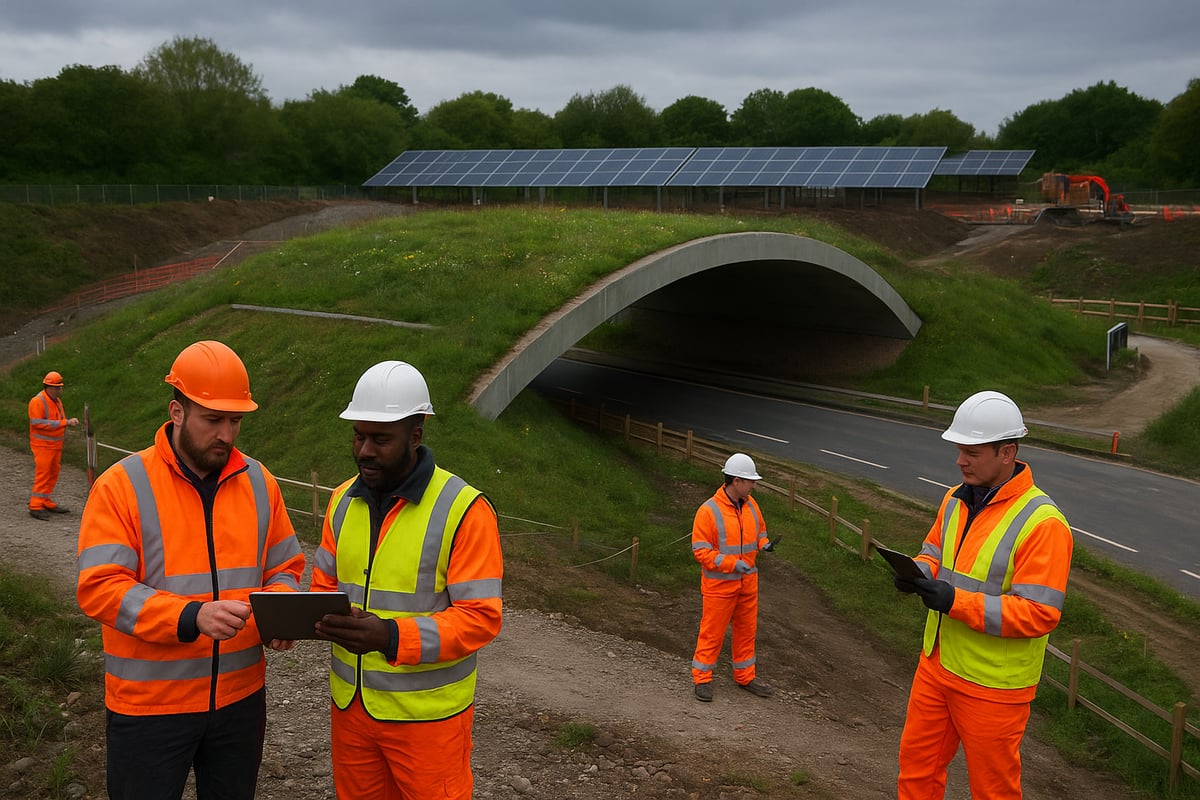
Protecting and enhancing biodiversity is a priority for any new project in civil engineering. Integrating features like green corridors, wildlife crossings, and native planting supports local ecosystems. Compliance with Biodiversity Net Gain requirements means projects must leave the environment in a measurably better state.
A notable example is river restoration within urban infrastructure, where engineered channels are replaced with naturalised banks. This approach delivers environmental benefits while also improving flood resilience and community spaces.
Water Management and Flood Resilience
Effective water management is critical for every new project in civil engineering, especially with increasing climate risks. Sustainable Urban Drainage Systems (SUDS) are now standard practice, helping to manage surface water and reduce flood risk. Flood risk assessments and climate adaptation are embedded early in the design process.
The Thames Barrier upgrades serve as a leading example of infrastructure adapting to future climate scenarios. These enhancements protect millions of properties and demonstrate the value of proactive planning in civil engineering.
Waste Management and Circular Economy Principles
Modern project delivery demands a circular approach to materials. For any new project in civil engineering, reducing, reusing, and recycling construction waste is essential. Designing for deconstruction and material recovery is becoming common practice, supporting resource efficiency.
UK data shows that 70% of construction waste is now recycled. This shift is driven by both regulation and client expectations, ensuring that projects minimise environmental impact and optimise lifecycle value.
Social Value and Community Engagement
Delivering positive social outcomes is a fundamental part of every new project in civil engineering. This includes creating local jobs, providing skills training, and designing inclusive public spaces. Community engagement ensures that developments meet real needs and foster a sense of ownership.
Community-led design in city centre redevelopment projects has shown that involving residents from the start leads to more successful, accepted outcomes. Social value is measured, reported, and used to drive continuous improvement in the sector.
Effective Project Delivery and Quality Assurance
Delivering a new project in civil engineering successfully in 2026 relies on a robust approach to project delivery and unwavering commitment to quality. Each stage, from procurement to post-completion, demands careful planning and consistent execution. Let us explore the critical pillars that ensure projects meet or surpass expectations.
Procurement and Supply Chain Optimisation
A new project in civil engineering thrives on efficient procurement strategies and resilient supply chains. Choosing the right contractors and suppliers is vital to mitigate risks and secure timely delivery of materials and services.
Framework agreements, preferred supplier lists, and transparent tender processes can help streamline procurement. Proactive management of supply chain risks, such as material shortages or logistical disruptions, is essential. For instance, highways surfacing projects increasingly rely on long-term partnerships to maintain consistency and quality.
Staying agile and fostering strong relationships across the supply chain ensures project momentum, even in the face of unexpected challenges.
Quality Control and Assurance Processes
Quality assurance is the backbone of any new project in civil engineering. Implementing recognised standards, such as ISO 9001, sets a clear benchmark for processes and outcomes.
Digital inspection tools and real-time reporting streamline quality checks and reduce rework by up to 20 percent, according to the Institution of Civil Engineers. Integrating advanced civil engineering design services further enhances quality by embedding best practices from the earliest design stages.
A structured QA strategy, combined with continuous monitoring, ensures that every deliverable meets or exceeds client expectations.
Health, Safety, and Wellbeing Best Practices
Prioritising health and safety is non-negotiable for any new project in civil engineering. Compliance with the latest HSE guidelines reduces workplace incidents and fosters a culture of care.
Initiatives such as Zero Harm and mental health support programmes contribute to safer, more productive teams. Regular safety briefings, hazard identification, and real-time monitoring tools further strengthen on-site protection.
By embedding wellbeing into daily routines, teams can deliver complex projects with confidence and resilience.
Project Handover and Post-Completion Evaluation
A seamless handover is the final hallmark of a well-executed new project in civil engineering. Comprehensive documentation, user training, and clear communication ensure clients are equipped to operate and maintain new assets.
Post-completion evaluation, including lessons learned sessions and performance reviews, drives continuous improvement. The phased opening of projects like Crossrail demonstrates the value of structured handover and feedback for future success.
Investing in thorough closeout processes sets the stage for long-term project value and stakeholder satisfaction.
Future-Proofing Civil Engineering Projects: Trends for 2026 and Beyond
Civil engineering is evolving rapidly, making future-proofing essential for every new project in civil engineering. The sector faces shifting challenges, from climate change to digital transformation. To remain resilient and competitive, professionals must anticipate change and adapt their strategies.
This section explores how to ensure long-term success and relevance for every new project in civil engineering by focusing on adaptability, technology, skills, and collaboration.
Embracing Resilience and Adaptability
Resilience is no longer a luxury for a new project in civil engineering, it is a necessity. With the growing threat of extreme weather and urban pressures, infrastructure must be designed to adapt and recover quickly.
Key strategies include:
- Flexible flood defences that adjust to rising sea levels
- Modular bridge components for swift replacement after damage
- Infrastructure that can be upgraded without major disruption
For example, adaptive flood defences in coastal towns are now standard, helping communities stay protected despite unpredictable conditions. By embedding adaptability from the outset, every new project in civil engineering can better withstand future shocks and provide long-term value.
Digital Transformation and Data-Driven Decision Making
Digital transformation is reshaping every new project in civil engineering. Innovations such as big data, AI, and predictive analytics enable smarter decisions at every stage of the project lifecycle.
Real-time monitoring and performance dashboards provide instant feedback on progress and risks. According to the UK Construction Industry Outlook 2026, 60% of UK firms report improved ROI after adopting digital tools.
Benefits include:
- Faster problem detection
- Improved resource allocation
- Reduced project delays
Integrating digital solutions ensures that a new project in civil engineering stays ahead of industry shifts and delivers measurable results.
Skills Development and Talent Attraction
Sustaining future-ready teams is vital for any new project in civil engineering. The industry faces a growing digital skills gap, making investment in workforce development critical.
Key focus areas are:
- Upskilling existing staff in BIM, automation, and sustainable methods
- Promoting diversity and attracting new talent through apprenticeship schemes
- Encouraging continuous professional development and industry certifications
For instance, apprenticeship programmes are helping to bridge the digital divide and bring fresh perspectives. Prioritising skills ensures that every new project in civil engineering benefits from a capable and adaptable workforce.
Global Collaboration and Knowledge Sharing
Global collaboration is transforming how expertise is applied to a new project in civil engineering. Cross-border partnerships and shared standards accelerate innovation and improve outcomes.
Examples include:
- Adopting international best practices from megaprojects like HS2 and Crossrail
- Participating in global forums to exchange knowledge on sustainability and technology
- Leveraging digital platforms for remote teamwork and problem-solving
Learning from international experiences allows each new project in civil engineering to avoid common pitfalls and achieve world-class results. Knowledge sharing drives continuous improvement and keeps UK projects at the forefront of the industry.