
The future of every civil engineering site is changing at a remarkable pace. Are you prepared to set the standard and lead your team to project success in 2026?
This guide offers a practical, step-by-step blueprint designed for professionals, site engineers, and project managers who want to excel in a rapidly evolving construction landscape.
Inside, you will discover up-to-date site planning strategies, the latest regulatory requirements, innovative sustainability practices, and cutting-edge technologies. You will also learn essential project management methods to ensure your sites are efficient, compliant, and ready for the challenges ahead.
As the demands and complexities of civil engineering sites grow, now is the moment to act. Follow this guide and start building the expertise and confidence you need for future-ready site success.
Laying the Groundwork: Pre-Construction Planning for 2026
Setting the stage for a successful civil engineering site in 2026 begins with robust pre-construction planning. As expectations rise and projects grow more complex, meticulous groundwork ensures efficiency, compliance, and long-term value. Here is how you can future-proof your site setup for the challenges and opportunities ahead.

The Evolving Role of Site Investigations
A thorough site investigation is the foundation of any civil engineering site. Today, advanced methods such as drone surveys, LiDAR, and 3D scanning have revolutionised terrain mapping, enabling teams to reduce investigation time by up to 40 percent. Integrating environmental impact assessments from day one is now standard practice, ensuring projects meet both regulatory and sustainability goals.
Modern site investigations also rely on digital reporting and real-time data sharing. According to the Institution of Civil Engineers, 72 percent of UK projects credit early site investigation as essential for timely delivery. For a deeper dive into the essentials, explore site engineering fundamentals to strengthen your baseline knowledge.
Navigating 2026 Regulatory Requirements
The regulatory landscape for civil engineering site projects is evolving rapidly. In 2026, new building codes and safety standards will come into effect, requiring teams to stay ahead of compliance challenges. Environmental regulations such as BREEAM and UK Net Zero targets demand sustainable design choices and transparent documentation.
With the updated Construction (Design and Management) Regulations 2025, digital documentation and regular reporting are now mandatory. Adopting structured digital workflows early helps ensure your civil engineering site meets all regulatory expectations and avoids costly delays.
Stakeholder Engagement and Communication
Effective stakeholder engagement is crucial for any modern civil engineering site. Early communication with local authorities, clients, and the community builds trust and reduces potential obstacles. Digital collaboration platforms enable transparent updates and feedback, making planning more agile and inclusive.
A notable trend is the use of community consultation portals, which have cut planning objections by 25 percent. By embracing these tools, project teams ensure everyone is aligned, paving the way for smoother approvals and a more resilient civil engineering site.
Budgeting and Risk Management for Modern Sites
Managing budgets and risks is more sophisticated than ever for a civil engineering site. Advanced cost estimation tools and integrated software platforms provide accurate forecasts and real-time tracking. Risk mapping allows teams to identify site-specific challenges early, developing mitigation strategies before construction begins.
Projects that leverage Building Information Modelling (BIM) report 20 percent fewer budget overruns, according to NBS 2023. This digital approach enhances transparency and helps keep your civil engineering site on track financially and operationally.
Timeline Development and Milestone Planning
Developing a realistic timeline is essential for every civil engineering site. Using Gantt charts and project management software such as Primavera P6 or MS Project enables precise scheduling, resource allocation, and progress tracking. Building in contingencies ensures flexibility if unexpected issues arise.
By setting clear milestones and monitoring them rigorously, project managers maintain momentum and accountability. This structured approach supports the timely delivery of your civil engineering site, even in the face of complex requirements and shifting priorities.
Sustainable Site Practices: Meeting Environmental and Social Goals
Sustainability now sits at the heart of every successful civil engineering site. As expectations rise, professionals must embed sustainable thinking into all project phases. From responsible materials to digital tracking, today’s civil engineering site is measured not just by delivery, but by its environmental and social legacy. For a comprehensive approach, see this civil engineering services overview.
Integrating Sustainability from Day One
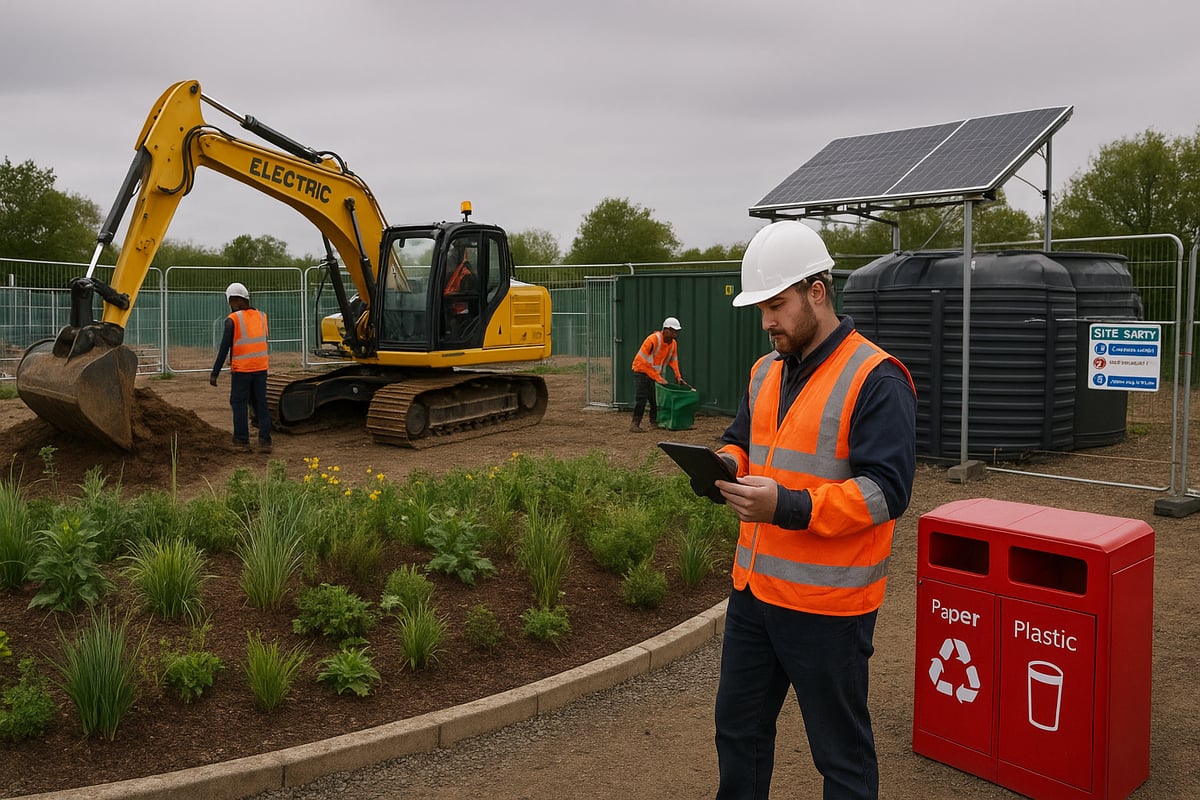
Integrating sustainability from day one is vital for any civil engineering site aiming for long-term success. Careful site layout planning can minimise transport distances, reduce emissions, and maximise resource use. Low-carbon materials, such as recycled aggregates and green concrete, are increasingly specified in tender requirements.
- Sustainable supply chain choices help reduce embodied carbon.
- Early environmental impact assessments ensure compliance.
- Example: Using recycled concrete can cut carbon emissions by up to 30% per project.
By making these decisions at the outset, your civil engineering site sets a strong foundation for compliance and future-proof performance.
Waste Management and Circular Economy Approaches
Waste management is now a core element of every civil engineering site strategy. On-site sorting, recycling, and minimisation are essential to achieving high diversion rates from landfill. In the UK, 65% of major projects now reach over 90% waste diversion (WRAP, 2023).
- Segregate materials at source for higher recycling quality.
- Reuse demolition waste through on-site crushing.
- Adopt circular economy principles to keep resources in use.
A recent case study illustrates how on-site crushing of demolition waste enabled reuse as aggregate, cutting costs and reducing transport emissions for the civil engineering site.
Water and Energy Efficiency on Site
Efficient water and energy use is rapidly becoming a standard for every civil engineering site. Implementing rainwater harvesting and greywater systems reduces the demand on mains supply and supports responsible resource use. The adoption of electric or hybrid machinery is also accelerating.
- Electric excavators can reduce emissions by 30% on pilot sites.
- Solar-powered welfare units lower energy bills and carbon footprint.
- Monitor usage to identify further savings opportunities.
These steps allow your civil engineering site to operate more efficiently, saving money and meeting client sustainability targets.
Social Value and Community Engagement
Delivering social value is now a key performance indicator for any modern civil engineering site. Local employment, apprenticeships, and training create lasting benefits for the community. Minimising disruption, especially in urban settings, improves project acceptance and neighbour relations.
- Engage communities early through digital consultation portals.
- Schedule noisy works to limit inconvenience.
- Register with the Considerate Constructors Scheme for best practice.
By prioritising social outcomes, your civil engineering site strengthens its reputation and delivers measurable value beyond the project boundary.
Monitoring and Reporting Sustainability Metrics
Tracking sustainability metrics is essential for demonstrating progress and compliance on every civil engineering site. Digital tools now enable real-time monitoring of carbon, waste, and energy performance.
- Use platforms like BRE SMARTWaste for data collection and reporting.
- Meet client and regulatory requirements seamlessly.
- Provide transparent updates to stakeholders.
Accurate reporting ensures your civil engineering site stands out for its commitment to sustainability, giving you a competitive edge in future tenders.
Technology and Innovation: Tools for the Future Civil Engineering Site
The civil engineering site of 2026 will be defined by rapid technological progress and a strong focus on efficiency, sustainability, and safety. Embracing the latest tools and innovations is essential for anyone aiming to deliver successful projects in a competitive landscape. Let us explore the technologies shaping the future of every civil engineering site.

Building Information Modelling (BIM) and Digital Twins
BIM is transforming the civil engineering site by providing a central platform for collaborative design, real-time clash detection, and efficient asset management. Teams can visualise every phase of the project, reducing errors and improving decision-making. Digital twins, virtual replicas of physical assets, are increasingly used for live site monitoring and predictive maintenance. According to recent data, 75% of UK firms plan to invest in digital twins by 2026, highlighting their growing importance in civil engineering site management.
These tools enable stakeholders to anticipate challenges and simulate solutions before implementation. The integration of BIM and digital twins streamlines workflows and supports compliance with evolving industry standards.
Automation and Robotics on Site
The use of automation is revolutionising civil engineering site operations. Autonomous machinery, such as driverless excavators and bulldozers, enhances productivity and reduces manual labour risks. Drones are now standard for progress tracking, safety inspections, and even material delivery, significantly improving site oversight.
Robotic total stations have brought new levels of accuracy to setting-out tasks, cutting down on human error. As automation spreads, the civil engineering site is becoming safer and more efficient, with teams able to focus on higher-value activities.
Smart Site Management Platforms
Smart site management platforms integrate IoT sensors across the civil engineering site to track assets, monitor environmental conditions, and ensure personnel safety. Centralised dashboards provide real-time updates, allowing managers to respond proactively to emerging issues.
Wearable technology, such as smart helmets and vests, is reducing incidents by providing instant alerts and health monitoring. These innovations make it easier to comply with health and safety regulations, contributing to a safer and more productive civil engineering site.
Prefabrication and Modular Construction
Prefabrication is gaining traction on the civil engineering site for its ability to deliver high-quality results at speed. Off-site manufacturing ensures consistent standards and reduces the impact of weather delays. Once components are ready, logistics teams coordinate their transport and assembly, making the process efficient and predictable.
Modular construction has proven particularly effective for projects like schools and hospitals, which can be completed up to 30% faster than traditional methods. This approach minimises disruption and supports the drive for sustainable construction practices on every civil engineering site.
Advanced Materials and Construction Methods
Innovations in materials and construction are reshaping what is possible on the civil engineering site. Self-healing concrete and graphene reinforcement are extending the lifespan of structures while reducing maintenance costs. 3D printing is enabling the rapid production of bespoke site components, such as offices or complex formwork, in under 48 hours.
For a deeper look at these emerging trends and their application, explore Construction engineering innovations. These advances support a future-ready civil engineering site, enhancing both performance and sustainability.
Cybersecurity and Data Protection
As civil engineering site operations become more digital, protecting sensitive information is paramount. Project data, digital plans, and client details must be secured against cyber threats. Compliance with GDPR and other data security standards is now a non-negotiable requirement.
Recent incidents have shown that breaches can cause significant delays and financial losses. Implementing robust cybersecurity measures ensures that the civil engineering site remains resilient, safeguarding both reputation and project timelines.
Project Management Excellence: Leading Teams and Delivering Results
Delivering outstanding results on a civil engineering site requires more than technical expertise. Project management excellence is the engine that drives high-performing teams, ensures safety, and guarantees project quality. By focusing on people, processes, and technology, you can lead your site to success in 2026 and beyond.

Building High-Performance Site Teams
A high-performing civil engineering site team starts with strategic recruitment and robust training. Prioritise candidates who demonstrate adaptability to digital tools and sustainable practices.
Upskilling is vital, with regular workshops on new technologies and methods ensuring your team stays ahead. Embracing diversity and inclusion fosters creative problem-solving and a stronger team culture.
Consider establishing mentorship schemes to accelerate development. A well-supported team is more resilient and better equipped to handle the complexities of modern projects.
Health, Safety, and Wellbeing in 2026
Site safety is evolving rapidly. Adherence to new HSE regulations is non-negotiable, but proactive measures set leading civil engineering site teams apart.
Introduce regular safety briefings, digital reporting tools, and real-time hazard monitoring to catch risks early. Mental health initiatives, such as access to support lines and wellbeing workshops, are increasingly essential.
Data shows a 40% reduction in accidents on sites that prioritise wellbeing programmes, making a strong case for investing in your team’s health and safety culture.
Agile Project Management Techniques
Agile methodologies are becoming indispensable for the modern civil engineering site. By breaking work into manageable sprints and holding daily stand-ups, teams stay aligned and responsive to change.
Kanban boards, both physical and digital, provide clear visual cues for progress and bottlenecks. This approach reduces rework and delays, as seen in major infrastructure projects.
Agile’s flexibility empowers site managers to adapt quickly, making your project delivery more resilient in the face of uncertainties.
Quality Assurance and Continuous Improvement
Quality assurance on a civil engineering site demands rigorous processes and the right digital tools. Use digital snagging software and defect management platforms to identify issues early and streamline resolutions.
Lean construction principles are proven to cut waste and drive down costs, with some UK highways projects reporting 15% savings. Regular lessons-learned sessions help embed a culture of improvement.
Explore civil engineering project examples to see how robust QA and continuous improvement strategies deliver real value on site.
Communication and Collaboration Tools
Effective communication is the backbone of civil engineering site management. Cloud-based document sharing ensures all stakeholders have access to the latest information, reducing errors and confusion.
Mobile apps enable instant site reporting and approvals, speeding up decision-making. Collaborative platforms support real-time updates, leading to sites reporting 25% faster resolutions on key issues.
Investing in these tools not only enhances productivity but also builds trust and transparency among your project team.
Future-Proofing Your Civil Engineering Site: Trends and Skills for 2026
Staying ahead in the civil engineering site landscape means anticipating changes and embracing new approaches. As 2026 draws closer, understanding the trends, skills, and strategies that define success is crucial for every professional aiming to future-proof their projects.
Emerging Trends Shaping Civil Engineering Sites
The civil engineering site of 2026 is transforming rapidly, driven by technology and sustainability imperatives. Smart infrastructure, such as sensor-laden roads and intelligent bridges, is becoming standard, enabling real-time monitoring and predictive maintenance.
Climate resilience is taking centre stage, with flood-resistant site layouts and adaptive design solutions gaining traction in UK urban developments. The integration of digital twins in UK civil engineering is revolutionising how sites are planned, delivered, and maintained, offering accurate simulations and better decision-making.
To remain relevant, every civil engineering site must adapt to these innovations, ensuring projects are both robust and future-ready.
Essential Skills for Tomorrow’s Site Leaders
Tomorrow’s civil engineering site leaders require a blend of digital expertise and adaptive leadership. Proficiency in BIM, data analytics, and automation is now essential, allowing teams to harness information for smarter delivery. Sustainability knowledge and regulatory awareness are equally important, as environmental standards continue to tighten.
Leadership skills—like change management and clear communication—enable site teams to navigate complexity. The impact of AI and robotics in UK construction is also reshaping job roles, demanding upskilling and a flexible mindset.
Investing in these skills ensures every civil engineering site team can lead confidently into the future.
Regulatory and Funding Landscape Outlook
The UK’s civil engineering site environment is shaped by evolving regulations and funding priorities. Government initiatives now prioritise green and digital construction, with £650 million allocated for digital infrastructure upgrades in 2024. Anticipated changes in building codes, sustainability targets, and digital documentation require site leaders to stay alert and informed.
Compliance means integrating new standards into project planning from the outset. Firms that understand the funding landscape and regulatory shifts position their civil engineering site teams for long-term success, ensuring eligibility for grants and public sector projects.
Collaboration Across the Supply Chain
Integrated project delivery models are streamlining the civil engineering site process, breaking down barriers between contractors, designers, and suppliers. Early contractor involvement and digital supply chain coordination reduce procurement delays while improving transparency.
Collaboration tools and frameworks allow teams to share data, track progress, and resolve issues quickly. As the sector becomes more interconnected, a collaborative approach ensures every civil engineering site can adapt to shifting demands and deliver outstanding results.
Embracing a Culture of Continuous Learning
Continuous learning is a defining feature of successful civil engineering site operations. Access to CPD, digital training, and apprenticeships keeps teams up to date with the latest techniques and technologies. Industry partnerships with universities and training providers support skill development.
Firms investing in workforce development consistently achieve higher project success rates, as employees bring fresh knowledge and innovative ideas to site challenges. Building a learning culture ensures the civil engineering site workforce remains agile and competitive.
Preparing for the Unknown: Building in Flexibility
Flexibility is essential for managing the unpredictable in civil engineering site environments. Scenario planning and robust risk assessments help teams anticipate supply chain disruptions, regulatory changes, or unforeseen challenges.
Modular and adaptable site setups make it possible to pivot quickly, minimising downtime. The ability to respond rapidly to global events or market shifts is a hallmark of a resilient civil engineering site, safeguarding project delivery and client satisfaction.